


It’s 8:15 AM on a Tuesday morning, and for the third time this month, your front door remains closed. You’re left wondering if your support will arrive at all, or if you’ll have to cancel your community plans again. Finding a reliable support worker shouldn’t feel like a game of chance where your independence is the prize. You deserve to feel safe and respected in your own home, knowing that the person walking through your door truly understands your unique goals.
We know how draining it is to feel like just another number in a large agency’s database. You want more than just a body to fill a shift; you want a consistent partner who shares your interests and respects your privacy. This guide shows you how to move beyond simply searching for help to building a dedicated team that supports your life, your way. We’ll explore the latest 2026 NDIS compliance standards and practical steps to ensure your peace of mind while creating a support schedule that finally offers the stability you need.
Key Takeaways
- Understand why finding a reliable support worker is about more than just filling a schedule; it is about choosing a compassionate partner who empowers your independence.
- Discover the five essential pillars of support, including how proactive communication and integrity can bridge the “reliability gap” in your NDIS plan.
- Compare the safety and accountability of registered NDIS providers against independent workers to determine which model best protects your rights and wellbeing.
- Learn how to vet potential candidates with behavioral interview questions that reveal a worker’s true character and ability to handle complex situations independently.
- Explore how a person-centred matching approach helps you build a team that respects your home and follows the philosophy of “your choice, your life, your way.”
What is a Support Worker and Why is Reliability So Critical?
Support work isn’t just about ticking off a list of daily tasks or providing basic assistance. It’s a vital partnership designed to empower your independence and help you lead the life you choose. When exploring What is a Support Worker, it’s clear the role involves a unique blend of practical aid and advocacy. These professionals help you navigate the community, manage personal care, and build the specific skills outlined in your NDIS plan. At its heart, this role is about giving you back control over your own schedule and environment.
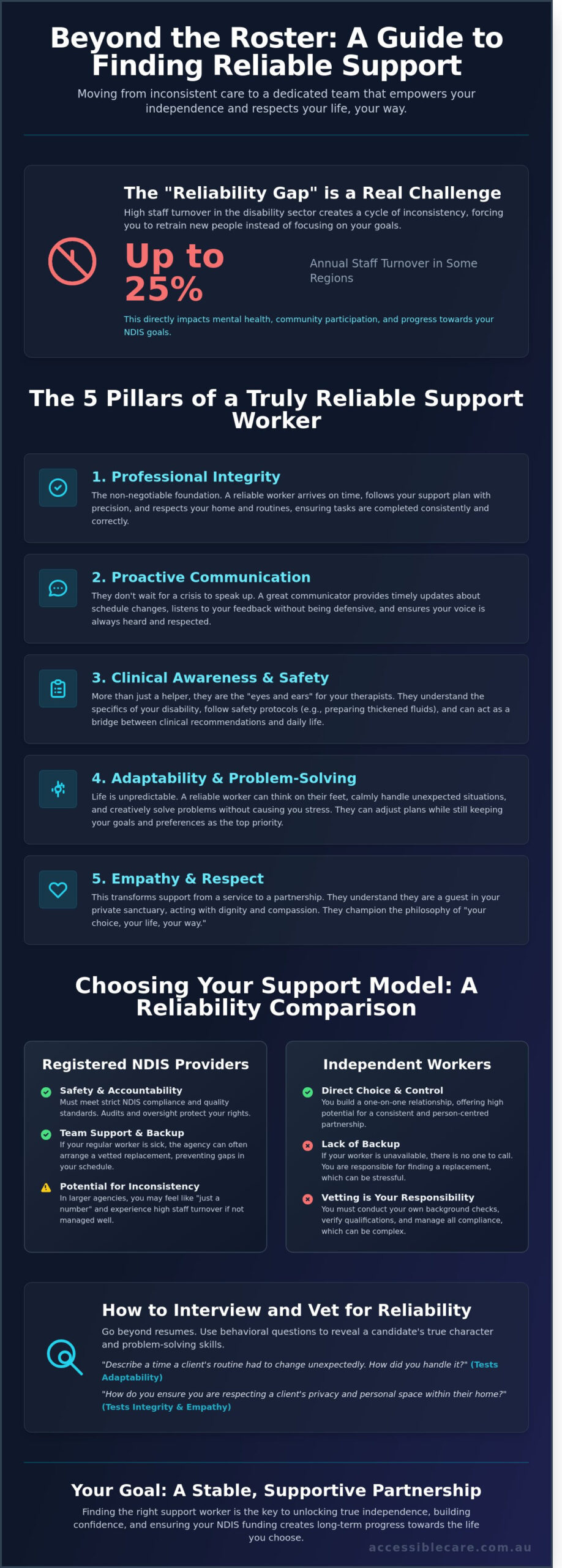
The “Reliability Gap” is a significant challenge within the Australian disability sector. Recent data from the NDIS National Workforce Plan indicates that staff turnover rates can reach up to 25% annually in some regions. This high turnover creates a cycle of inconsistency that leaves many participants feeling exhausted. Finding a reliable support worker is often the difference between a week that feels chaotic and one that feels stable. When workers frequently cancel or change, you’re forced to spend your energy retraining new staff rather than focusing on your own personal growth.
Consistency has a direct impact on your mental health and your ability to meet NDIS goals. If your goal is to increase community participation, you need to know your transport and support will arrive as scheduled. Without that certainty, anxiety levels rise; it’s difficult to feel safe when your basic support structure is unpredictable. Reliable support allows you to build a routine that fosters confidence. It ensures that the funding in your NDIS plan is being used effectively to create long term progress rather than just filling immediate gaps caused by staff shortages.
A reliable support worker is a professional who balances their duty of care with a genuine human connection that makes you feel seen and heard.
Support Work vs. Clinical Therapy
It’s helpful to understand how support workers fit into your broader team. While an Occupational Therapist or Speech Pathologist might visit once a fortnight to design strategies, your support worker is there to help you implement those ideas every day. They aren’t clinical nurses, but they are the “eyes and ears” for your therapists. For example, if a therapist suggests a new mobility exercise, the support worker monitors your progress and notes any difficulties. They provide the practical, daily living support that turns a clinical recommendation into a real world achievement.
The Emotional Side of Support
Inviting a new person into your home often triggers “stranger in the house” anxiety. This is why the “Right Fit” is just as important as a resume. A compassionate worker understands they’re entering your private sanctuary and acts with the utmost dignity and respect. When finding a reliable support worker, you’re looking for someone whose personality complements yours. This emotional bond creates a foundation of safety. When you feel comfortable with your worker, you’re more likely to take risks, try new things, and engage more deeply with your local community. It moves the relationship from a transactional service to a supportive partnership that honors your choice and your way of living.
The 5 Pillars of a Truly Reliable Support Worker
Trust is the foundation of any support relationship. When you’re finding a reliable support worker, you aren’t just looking for someone to fill a roster. You’re looking for a partner who respects your autonomy and understands your unique journey. Reliability goes beyond just being present; it’s about the quality of that presence and the consistency of the care provided.
Pillar 1: Professional Integrity. This is the most basic yet vital requirement. A reliable worker arrives five minutes early, not ten minutes late. They follow your support plan precisely, ensuring that every goal you’ve set is being actively pursued. If your plan requires specific morning routines or medication prompts, they execute these tasks with 100% consistency.
Pillar 2: Communication. Great workers are proactive. They don’t wait for a crisis to speak up. If they notice a change in your well-being or if a scheduled shift needs to move, they tell you immediately. They listen to your feedback without getting defensive, making sure your voice remains the loudest in the room.
Pillar 3: Clinical Awareness. Reliability includes safety. A worker must understand the specifics of your disability. For instance, if you live with a condition like dysphagia, a reliable worker knows exactly how to prepare thickened fluids to Australian standards. They recognize early warning signs of health risks, acting as an extra set of eyes on your physical and mental health.
Pillar 4: Cultural and Personal Alignment. Your home is your sanctuary. A reliable worker respects your values, your language, and your lifestyle. Whether it’s removing shoes at the door or understanding specific cultural traditions, they blend into your environment rather than disrupting it. This creates a space where you feel truly comfortable being yourself.
Pillar 5: Adaptability. Your needs in 2024 might look different by 2025. A reliable worker is willing to learn and grow with you. They attend new training sessions and adjust their techniques as your NDIS goals evolve. They don’t stay stuck in old ways; they find new ways to help you thrive.
Why Experience Matters in NDIS Support
Experience brings a level of calm that’s hard to replicate. Workers trained in Positive Behaviour Support (PBS) or complex care can manage challenging situations with grace and skill. These professionals understand the nuance of “doing with” rather than “doing for.” This distinction is essential for your independence. Instead of simply making your lunch, an experienced worker supports you to prepare it yourself, building your skills over time. They also handle complex NDIS reporting requirements behind the scenes, ensuring your plan data is accurate without adding stress to your daily life. You can use the official NDIS Provider Finder to locate registered providers who employ these high-calibre staff members.
Communication as a Safety Net
Reliable support is transparent. Many workers now use digital logs to record shift notes, which gives families peace of mind and provides a clear paper trail for NDIS audits. These notes can be vital during a plan review, as they provide evidence of the support you’ve received and the progress you’ve made. It’s also helpful to set clear boundaries from day one. Deciding on preferred contact methods and hours ensures your relationship stays professional and sustainable for the long term. If you’re finding a reliable support worker feels overwhelming, the team at Accessible Care can help you match with someone who fits your life perfectly.
Registered Providers vs. Independent Workers: The Reliability Debate
Choosing the right path for your care is a deeply personal decision. When you’re focused on finding a reliable support worker, you’ll likely compare independent contractors found on digital platforms against registered NDIS providers. While independent workers often offer a sense of direct control and slightly lower hourly rates, the hidden costs of time and risk can be significant. Hiring an independent worker means you take on the role of an employer. You become responsible for verifying their ABN, checking their insurance coverage, and ensuring they meet Australian tax obligations.
Registered providers take this weight off your shoulders. At Accessible Care, we manage the entire administrative lifecycle. This includes handling payroll, superannuation, and maintaining comprehensive A$20 million public liability and professional indemnity insurance. You don’t have to worry about the complex compliance details that keep a service legal and safe. While independent workers offer flexibility, registered providers offer a continuity of care guarantee if a worker is unwell. If your regular support person calls in sick at 7:00 AM, a registered provider has a pool of screened, familiar staff ready to step in so your routine remains uninterrupted.
The Safeguarding Advantage
Safety is the foundation of trust. Registered providers must adhere to the NDIS Practice Standards (2018), which involve regular, rigorous audits by the NDIS Quality and Safeguards Commission. Every staff member we employ undergoes the NDIS Worker Screening Check, a national process that replaced individual state “yellow cards” to provide a higher level of scrutiny. We also mandate ongoing training in areas like infection control and the NDIS Code of Conduct. If a conflict arises, you have a formal internal grievance process and the backing of the Commission to ensure a resolution. This level of accountability is vital for participants requiring high-intensity daily personal activities or community nursing, where a “duty of care” isn’t just a phrase, it’s a legal requirement we uphold every day.
Clinical Integration
Reliability also means your support worker understands your broader goals. When you choose a provider that offers multiple services, your care becomes a cohesive journey rather than a collection of separate appointments. Having your support worker and Speech Therapist under one roof improves outcomes because they can share insights and strategies in real time. You can learn more about The Benefit of a Multidisciplinary Team in Therapy to see how this collaboration works in practice. Accessible Care ensures our support workers are briefed on specific therapist recommendations. This means if your therapist suggests a new communication tool or a specific mobility exercise, your support worker is already trained and ready to help you practice it during your daily community outings. This integrated approach ensures that every hour of support moves you closer to your long-term goals.
Ultimately, finding a reliable support worker is about more than just filling a shift. It’s about building a support system that is resilient, professional, and focused entirely on your wellbeing. By choosing a registered provider, you’re choosing a partner that invests in your safety and long-term success, giving you the freedom to focus on living your life your way.
How to Interview and Vet for Reliability: A Step-by-Step Guide
Choosing the right person to enter your home and support your daily life is a deeply personal decision. It’s about more than just ticking boxes; it’s about building a partnership based on trust and mutual respect. When you’re finding a reliable support worker, a structured interview process helps you feel confident and in control of your choice.
Step 1: Define your ‘Must-Haves’ vs. ‘Nice-to-Haves’
Start by listing exactly what you need for your day to run smoothly. A valid Australian driver’s license is a common ‘must-have’, especially since 65% of NDIS participants require assistance with community transport. ‘Nice-to-haves’ might include shared interests, such as a love for AFL or a specific craft. Separating these ensures you don’t compromise on safety or essential care while remaining open to great personality matches.
Step 2: Ask behavioral interview questions
Move beyond simple ‘yes’ or ‘no’ questions. Ask the candidate to describe a real-life scenario, such as, “Tell me about a time you had to handle a difficult situation independently.” Their answer reveals their problem-solving skills and their ability to stay calm under pressure. You’re looking for someone who shows empathy and takes initiative without needing constant direction.
Step 3: Check references for punctuality and communication
When you call references, be specific. Ask if the worker arrived on time for at least 95% of their shifts. Inquire about how they handle schedule changes. A reliable worker doesn’t just show up; they communicate clearly and early if something unexpected happens. This professional courtesy is vital for your peace of mind.
Step 4: Conduct a ‘Meet and Greet’
Invite the candidate to a neutral space, like a local cafe, or have a trusted family member present at your home. This is a low-pressure way to see how you interact. Pay attention to how well they listen. A person-centred worker will focus on your goals and preferences rather than talking over you.
Step 5: Start with a trial period
We recommend a 2-week trial period to see how the relationship functions in your actual environment. This is the final, essential step in finding a reliable support worker who truly fits your lifestyle. It allows you to assess their skills and personality match before making a long-term commitment. Your comfort and dignity are the highest priorities during this time.
Local Considerations for Melbourne and Adelaide
Location matters for consistency. If you live in St Kilda, finding a worker based in the southern suburbs of Melbourne reduces the risk of traffic delays on the Nepean Highway. Similarly, in Adelaide, a worker local to Glenelg will likely have better knowledge of accessible community spots like the local library or foreshore. For more tailored help, explore our Disability Support Services in Melbourne to connect with locals who understand your neighborhood.
Red Flags to Watch Out For
Trust your instincts during the vetting process. If a candidate gives vague answers about their NDIS worker screening status or previous experience, it’s a sign to be cautious. Poor communication, such as taking more than 48 hours to reply to an initial interview request, often signals future reliability issues. Most importantly, avoid anyone who uses a ‘one-size-fits-all’ approach. Your support should be as unique as you are, focusing entirely on your specific person-centred goals and choices.
If you need help navigating these steps or want to find a team that prioritizes your independence, contact our compassionate team today to discuss your needs.
Why Accessible Care is Your Partner in Consistent Support
Finding a reliable support worker is often the most stressful part of managing an NDIS plan. At Accessible Care, we remove that uncertainty by grounding every decision in our core philosophy: Your choice, your life, your way. We believe that you’re the expert in your own life. Our role isn’t to take over, but to provide the steady, professional foundation you need to pursue your goals with confidence. Whether you’re located in Melbourne or Adelaide, our team focuses on building long-term relationships rather than just filling shifts.
Our recruitment process is purposefully selective. We don’t just look for certifications; we look for a rare combination of compassion and proven experience. Every support worker we hire undergoes a rigorous screening process that includes detailed background checks and competency assessments. In the last year alone, we’ve prioritised candidates who demonstrate a deep understanding of person-centred care. This ensures that the person entering your home isn’t just a worker, but a dedicated professional who respects your space and your dignity.
What truly sets us apart is our clinical backbone. Our support workers don’t operate in isolation. They’re part of a multidisciplinary team that includes experienced clinicians and support experts. This integrated approach means your support is informed by professional insights, ensuring safety and high-quality care at all times. If your needs evolve, our team is already positioned to adjust your support without the typical delays found in smaller, less structured agencies.
Our Person-Centred Matching Process
We start by looking at the big picture. Our team reviews your Functional Capacity Assessment to understand the specific physical, cognitive, and emotional support you require. This data-driven approach ensures we match you with a worker who has the exact skill set needed for your daily routine. Our Support Coordinators then step in to manage the logistics, ensuring your roster is stable and your team is consistent. We also invest in ongoing training, keeping our staff updated on the latest NDIS Quality and Safeguards Commission standards so they remain leaders in best-practice care.
Empowering Your Independence Today
Taking the next step toward consistent care is simple and pressure-free. We invite you to book a consultation where we’ll sit down and truly listen to your NDIS goals and daily preferences. We’re committed to a partnership built on transparency and mutual respect. You deserve a team that shows up on time, understands your needs, and treats you with the dignity you’ve always expected. Don’t settle for inconsistent care when professional, compassionate help is available right now.
Ready to build your ideal support team?
- Tailored matching based on your specific Functional Capacity Assessment.
- Support workers backed by a professional clinical team.
- Consistent scheduling to ensure you never miss a beat.
- A local presence in Melbourne and Adelaide you can trust.
Contact Accessible Care for reliable support workers in Melbourne and Adelaide to start your journey toward better, more consistent support today.
Take the Next Step Toward Consistent Care
Securing your independence starts with a foundation of trust. You’ve now seen that finding a reliable support worker requires a focus on the 5 pillars of reliability and a clear understanding of the safety benefits provided by registered NDIS organisations. By prioritizing transparent communication and rigorous vetting, you can ensure your daily routine remains uninterrupted and your personal goals stay within reach throughout 2026. Choosing the right partner means you don’t have to navigate these decisions alone.
Accessible Care is here to simplify this journey for you. As a Registered NDIS Provider, we’ve built an experienced multidisciplinary team that’s deeply committed to serving the Melbourne and Adelaide communities. We don’t just provide services; we build partnerships based on dignity and respect. We’re ready to listen to your needs and help you navigate your NDIS plan with peace of mind. Your choice, your life, your way is more than a slogan to us; it’s how we operate every single day.
Find a compassionate and reliable support worker with Accessible Care today
You deserve a support system that’s as dedicated to your dreams as you are. Let’s start building that future together today.
Frequently Asked Questions
How do I know if an NDIS support worker is reliable before I hire them?
You can verify reliability by checking their NDIS Worker Screening Check status and speaking with at least two recent references. A reliable worker will show up on time for the initial meet and greet; this is often the best indicator of future behavior. When finding a reliable support worker, look for someone who listens to your needs and communicates clearly about their availability.
What should I do if my support worker keeps cancelling sessions?
You should first review your signed service agreement to check the 24 hour or 48 hour cancellation policy. If cancellations happen more than twice in a month, it’s time for a formal meeting to discuss how this affects your routine. You deserve consistent care that respects your schedule. If things don’t improve, contacting your provider to request a more dependable team member is a standard step in protecting your plan.
Can I change my support worker if we don’t get along?
You absolutely have the right to change your support worker at any time if you don’t feel a strong connection. The NDIS is built on the principle of choice and control, meaning you aren’t locked into a relationship that doesn’t work. Finding a reliable support worker who also matches your personality is essential for long term success and comfort in your own home. Most professional providers offer a smooth transition period to ensure your care isn’t interrupted.
Is it better to hire a support worker through an agency or privately?
What qualifications should a reliable disability support worker have?
A reliable worker typically holds a Certificate III in Individual Support or Disability, along with a current First Aid and CPR certificate. They must also have a valid NDIS Worker Screening Check and an Australian driver’s license if they’re transporting you. While formal education is important, 85% of participants say that empathy and active listening skills are just as vital as technical qualifications for a successful partnership.
How much does it cost to hire a support worker under the NDIS in 2026?
In 2026, the standard hourly rate for a weekday support worker is projected to be approximately A$72.40 based on annual indexation trends. This rate is set by the NDIA to ensure fair pay for workers while keeping your funding sustainable. Weekend rates are higher, often reaching A$101.30 on Saturdays and A$130.20 on Sundays. You’ll find these specific figures in the latest NDIS Pricing Arrangements and Price Limits document.
How do support workers help with NDIS goal tracking?
Support workers help by recording detailed notes after every session that link directly to the goals in your NDIS plan. If your goal is to increase community participation, they’ll document the three new social groups you visited this month. These progress reports are vital during your annual plan review. They provide the evidence the NDIA needs to see that your funding is making a real difference in your life.
What is the difference between a support worker and a carer?
A support worker is a trained professional you hire to help you achieve specific goals and build independence. In contrast, a carer usually refers to an unpaid family member or friend who provides emotional and physical support. While both roles are centered on your well-being, a support worker follows a structured service agreement. This professional boundary helps you maintain your dignity while working toward living the life you choose.

