


What if you looked at your next NDIS review not as a high-stakes test to pass, but as a chance to finally have your daily life truly understood? Many families across Victoria feel like just another number in a complex system. You might feel anxious that clinical jargon will hide your real needs or that a misunderstanding could lead to losing vital funding. It’s a heavy burden to carry when your independence, or the wellbeing of someone you love, feels like it’s resting on a single document.
We believe your story deserves to be heard with heart and clarity. This guide will show you how a compassionate ndis occupational therapy assessment melbourne can act as a bridge, turning your personal strengths into a professional narrative that secures the right supports. We’ll walk you through the 2026 FCA process, explain how the latest NDIS pricing reforms affect your plan, and help you build a partnership with a therapist who prioritizes your autonomy above all else. You can move forward with confidence, knowing exactly what to expect from your assessment and how it can unlock a more empowered life.
Key Takeaways
- Learn why a Functional Capacity Assessment is the most vital piece of evidence for your NDIS plan and how it translates your daily challenges into essential support funding.
- Discover how a professional ndis occupational therapy assessment melbourne evaluates the six core domains of your life to ensure no detail of your care or goals is overlooked.
- Understand the benefits of a multidisciplinary approach, where Occupational Therapists and Speech Pathologists collaborate to provide a holistic, compassionate view of your needs.
- Prepare for your in-home assessment with a clear walkthrough of what to expect, from the initial gentle conversation to the practical observation of your daily routines.
- Gain peace of mind by learning how a person-centric report focuses on your unique strengths and autonomy to help you achieve a more independent life.
What is a Functional Capacity Assessment (FCA)?
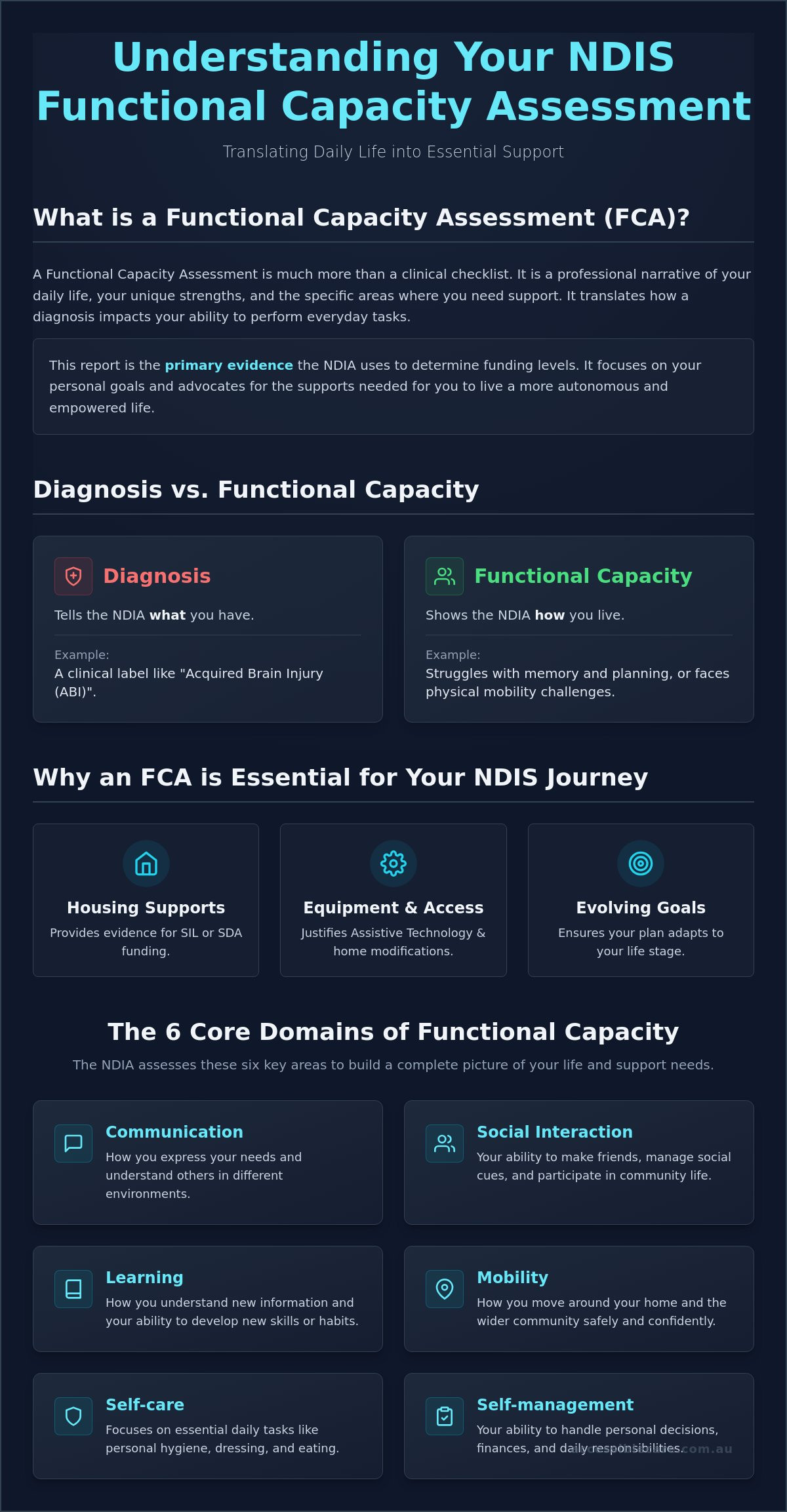
A Functional Capacity Assessment is much more than a clinical checklist. It’s a professional narrative of your daily life, your strengths, and the specific areas where you need a helping hand. Think of it as a Functional Capacity Evaluation that tells your story in a way the NDIA understands. While a medical professional might provide a diagnosis, our ndis occupational therapy assessment melbourne focuses on how that diagnosis translates into your ability to cook a meal, catch a bus, or manage your home. We treat this process as a collaborative partnership, ensuring your voice is the loudest in the room.
The resulting report is the primary evidence used by the NDIA to determine your funding levels. It doesn’t just list what you can’t do; it highlights your individual goals and advocates for the supports you need to live autonomously. By looking beyond a label, the assessment ensures that the system sees you as a person with potential rather than just a set of symptoms. This document becomes your strongest tool for self-determination within a complex system.
Why is an FCA Essential for Your NDIS Journey?
This assessment is the key that unlocks many doors within the NDIS framework. It provides the detailed, professional proof required for several critical support areas:
- Housing Supports: It’s the evidence required for Supported Independent Living (SIL) or Specialist Disability Accommodation (SDA) funding.
- Equipment and Access: It helps justify the need for Assistive Technology or complex home modifications that keep you safe and mobile.
- Evolving Goals: It ensures your NDIS plan is tailored to your current life stage and any new objectives you’ve set for yourself.
As your life changes, a regular ndis occupational therapy assessment melbourne ensures your funding remains relevant, supportive, and focused on your long-term wellbeing.
The Difference Between a Diagnosis and Functional Capacity
Two people might both have an Acquired Brain Injury (ABI), but their daily lives could look completely different. One person might struggle with memory and planning, while another might face physical challenges with mobility. A diagnosis tells the NDIA what you have, but functional capacity tells them how you live. We focus on your strengths to build a plan that empowers you, looking at what you can achieve with the right tools. Functional capacity is the bridge between a clinical diagnosis and your real-world independence.
The 6 Core Domains of Functional Capacity
To build a complete picture of your life, the NDIA looks at six specific areas called “domains.” These aren’t just clinical categories; they represent the building blocks of your independence. When we conduct an ndis occupational therapy assessment melbourne, we explore these areas with you to see where support can make the biggest difference. This structured approach ensures that no part of your daily experience is overlooked when determining your funding.
- Communication: This covers how you express your needs and how well you understand others in different environments.
- Social Interaction: We look at your ability to make friends, manage social cues, and participate in community life.
- Learning: This involves how you understand new information and your ability to develop new skills or helpful habits.
- Mobility: We assess how you move around your home and the wider community safely and confidently.
- Self-care: This focuses on essential daily tasks like personal hygiene, dressing, and eating.
- Self-management: This domain looks at your ability to handle personal decisions, finances, and daily responsibilities.
Real-World Examples of Functional Domains
It’s helpful to think about these domains in the context of your actual life. Self-management isn’t just a clinical term; it’s about whether you can safely manage your daily medication or keep track of a weekly budget without feeling overwhelmed. Social interaction might mean having the confidence to visit a local cafe in Melbourne or Adelaide to order a coffee and chat with a neighbor. Learning could involve mastering a new piece of Assistive Technology, like a specialized kitchen tool, that helps you prepare your own meals. These small moments are the true measures of your autonomy.
How Therapists Observe These Domains in Your Home
We believe the most accurate assessment happens where you feel most comfortable. Observing you in your natural home environment is the gold standard for accuracy. It’s one thing to talk about making a cup of tea in a clinic; it’s quite another to do it in your own kitchen with your own kettle. As highlighted in Occupational Therapy Australia’s Submission to Parliament, the depth of these practical assessments is what makes them so valuable for participants.
Our therapists use a mix of gentle conversational interviews and practical tasks to understand your world. We also value the perspective of those who support you every day. By gathering information from your family members or support workers, we build a 360-degree view of your strengths and challenges. This collaborative approach ensures the final report is a true reflection of your needs. If you’re looking for a team that prioritizes your unique story, our specialists are ready to provide a supportive partnership through every stage of the process.
Who Conducts an FCA and the Value of Multidisciplinary Care
Choosing the right professional to conduct your assessment is a vital step toward securing the support you deserve. When you arrange an ndis occupational therapy assessment melbourne, you’re taking a significant step toward personal agency. While most people are familiar with the role of an Occupational Therapist, a truly comprehensive assessment often benefits from a multidisciplinary team. This collaborative approach ensures that every facet of your daily life is understood and honored.
Occupational Therapists (OTs) are the most common lead assessors for general functional capacity. They are experts at looking at the big picture of your life. However, they aren’t the only ones who can help. Speech Language Pathologists (SLPs) provide specialized assessments for communication and swallowing, while Community Nurses may be involved for High Intensity supports or complex medical needs. By working together, these professionals ensure that no part of your life or autonomy is overlooked.
The Role of Occupational Therapy in Melbourne Assessments
OTs excel at evaluating your physical environment and fine motor skills. During an ndis occupational therapy assessment melbourne, our therapists focus on your essential Activities of Daily Living (ADLs). This includes everything from how you manage personal hygiene to how you move through your home safely. Our Occupational Therapy Melbourne team doesn’t just identify barriers. They recommend practical solutions, such as specific home modifications or mobility equipment that the NDIA needs to fund to ensure your long-term comfort and safety.
When a Speech Language Pathologist Should Lead the Way
For participants with an Acquired Brain Injury (ABI) or complex communication needs, a Speech Language Pathologist (SLP) plays a crucial role. If communication or swallowing challenges impact your independence, an SLP might lead the assessment or work alongside an OT. Our Speech Pathology Melbourne specialists evaluate cognitive-communication skills. These skills are essential for social independence and self-management, such as following a conversation in a busy community space or making a phone call to a medical professional.
By bringing together different experts, we create a 360-degree view of your life. This multidisciplinary approach ensures that your report isn’t just a list of clinical observations but a powerful advocacy tool. It reflects the full reality of your situation and points the way toward the specific supports that will help you thrive. We’re here to listen and guide you through this journey with expertise and genuine care.
Preparing for Your Assessment: What to Expect
It’s natural to feel a little nervous about an upcoming assessment. Many families worry that they won’t say the right thing or that their daily struggles won’t be fully understood. We want to ease that anxiety by showing you exactly what happens during an ndis occupational therapy assessment melbourne. This isn’t an interrogation or a test you can fail; it’s a gentle, supportive conversation. We start with an initial consultation where we sit down together to discuss your personal history, your current support structure, and what you hope to achieve for your future.
Next, our team moves into the observation phase. This is simply us seeing how you navigate your own home in Melbourne or Adelaide. We might watch how you move through the kitchen or manage a simple morning routine. This isn’t about judging your living space. It’s about identifying where your environment can be improved to support your autonomy. We also believe in a collaborative discussion, talking with your family or carers to capture the full picture of your life that a single visit might miss.
Preparation Checklist for Participants and Families
Taking a few small steps before we arrive can help you feel more in control. We recommend having these items ready to help us build the strongest possible case for your funding:
- Gather Documents: Collect previous medical reports, therapy summaries, and your current NDIS plan.
- Reflect on the “Worst Day”: While it’s hard to talk about, it is important to show the full range of support you need when things are at their most difficult.
- Identify Your Goals: Think about what you’d like to achieve that you currently cannot do, such as visiting a park independently or cooking a favorite meal.
Understanding the Timeline: From Visit to Final Report
A high-quality ndis occupational therapy assessment melbourne involves significant work behind the scenes. Typically, the face-to-face visit lasts between 2 and 3 hours. However, the therapist then spends a substantial amount of time, often between 4 and 7 hours, drafting a detailed, NDIS-compliant document. According to current NDIS pricing, a full assessment usually corresponds to 4 to 10 hours of total therapist time. This thoroughness is essential to ensure NDIA approval and funding success. Once the report is finished, we submit it to your Support Coordinator or the NDIA to begin the next stage of your journey. If you’re ready to start this process with a team that truly listens, you can book your assessment today and take the first step toward a more empowered life.
Navigating Your NDIS Journey with Accessible Care
We believe that every individual deserves a partner who truly listens. Our approach to an ndis occupational therapy assessment melbourne begins with your voice. We don’t just see a participant; we see a person with unique dreams and a right to self-direction. By listening first and assessing second, we honor your autonomy and ensure the resulting report is a faithful reflection of your life. This isn’t just about ticking boxes. It’s about building a supportive partnership that prioritizes your comfort and peace of mind.
Our team consists of highly experienced Occupational Therapists and Speech Language Pathologists who specialize in complex care. We have a deep understanding of Acquired Brain Injury (ABI) and the specific challenges it brings to daily living. This expertise allows us to navigate the complexities of the system while providing gentle, nurturing support. Whether you need a one-off assessment or a long-term plan for independence, we’re here to provide the competent care you expect.
Compassionate OT Support Across Melbourne and Adelaide
Our local teams possess an intimate understanding of the NDIS landscape in Victoria and South Australia. This regional knowledge is vital for navigating local resources and specific state-based regulations that might impact your plan. For those who require more specialized assistance, we provide High Intensity Supports NDIS, ensuring that even the most complex needs are met with professionalism and heart. We’re committed to your self-determination and to improving the quality of life for every client we serve through attentive listening and expert guidance.
Taking the Next Step: Booking Your Assessment
We’ve made our referral process as simple and stress-free as possible. Whether you’re an individual, a family member, or a support coordinator, getting started with an ndis occupational therapy assessment melbourne is easy. We’ll work closely with you to ensure your goals are clearly articulated and presented to the NDIA in the best possible light. You don’t have to face this journey alone. Contact our compassionate team to book your Functional Capacity Assessment today and let us help you unlock the supports you need for a more empowered life.
Empowering Your Future with Clarity and Care
As a Registered NDIS Provider and specialists in Acquired Brain Injury (ABI), our multidisciplinary team of OTs, SLPs, and nurses is here to support you. We understand that a high-quality ndis occupational therapy assessment melbourne is about more than just funding; it’s about your peace of mind and long-term wellbeing. We invite you to Book your compassionate Functional Capacity Assessment with Accessible Care. Let’s work together to unlock the supports that honor your autonomy. You have the strength to reach your goals, and we’re honored to walk beside you.
Frequently Asked Questions
Do I need a Functional Capacity Assessment to apply for the NDIS?
Yes, an FCA is a vital piece of evidence when applying for NDIS access or during your first planning meeting. It provides the NDIA with a clear, professional picture of how your disability impacts your daily life. This helps them decide if you meet the disability or early intervention requirements to receive support.
How often should I have an FCA completed by an Occupational Therapist?
Most participants have a new assessment completed every two years or whenever their life circumstances change significantly. If you’re preparing for a major plan reassessment or moving into a new home, an updated ndis occupational therapy assessment melbourne ensures your funding matches your current needs. Regular updates help capture your progress and any new goals you’ve set for yourself.
Can an FCA be done via telehealth or must it be in person?
You can choose between an in-person visit or a telehealth session based on what makes you feel most comfortable and safe. While telehealth is a convenient option, an in-person home visit allows the therapist to see exactly how you navigate your physical environment. This often leads to more specific and practical recommendations for home modifications or equipment.
What is the difference between an FCA and a Specialist Disability Accommodation (SDA) assessment?
An FCA looks at your overall ability to manage daily tasks, while an SDA assessment is specifically designed to determine your eligibility for specialized housing. The SDA report focuses on the physical design requirements of your home and the high intensity supports you need to live safely. Both reports work together to build a complete picture of your housing and care requirements.
Who pays for the Functional Capacity Assessment report?
Your NDIS plan typically covers the cost of the assessment through your Capacity Building – Improved Daily Living budget. You don’t need to pay out of pocket if you have sufficient funding allocated in this category. It’s always a good idea to check your current plan balance with your Support Coordinator or plan manager before booking your session.
What happens if the FCA report does not accurately reflect my needs?
If you feel your report doesn’t quite capture your story, you should speak with your therapist immediately to discuss your concerns. We view the assessment as a collaborative partnership and are happy to review the document to ensure it accurately reflects your challenges and strengths. Open communication is the best way to ensure the NDIA receives a true representation of your daily life.
Can a Speech Language Pathologist perform a Functional Capacity Assessment?
Yes, a Speech Language Pathologist can perform a specialized ndis occupational therapy assessment melbourne when your primary goals relate to communication or swallowing. While OTs often handle general daily living tasks, SLPs are the experts in assessing how your communication skills impact your social independence. A multidisciplinary approach often provides the most robust evidence for the NDIA.
How long is a Functional Capacity Assessment report valid for in the NDIS system?
An FCA report is generally considered current by the NDIA for 12 to 24 months. However, if you experience a significant change in your health or living situation, you may need a new one sooner to reflect those changes. Keeping your evidence up to date ensures your plan remains relevant and continues to support your autonomy as your needs evolve over time.

