

Speech isn’t the only meaningful outcome of speech therapy. Speech therapy for non-verbal children can help them express needs, make choices and connect with others through spoken language, gestures or augmentative and alternative communication (AAC), including pictures, signs and communication devices.
It’s understandable to wonder whether a child who doesn’t use spoken words will learn to speak. Every child communicates in their own way, and therapy can support communication now while working towards the child’s individual goals. AAC is one way to make it easier for a child to share what they think, feel or need.
Here, you’ll learn how speech therapy and AAC can support non-verbal children, how therapy may relate to spoken language, and why communication support can be valuable for autistic children. You’ll also learn what a speech pathologist may focus on, from recognising a child’s existing communication to building skills for everyday interactions.
Key Takeaways
- Explore how pictures, signs, gestures and communication devices can give a child more ways to express themselves.
- Learn how a speech-language pathologist tailors therapy to a child’s age, development and communication needs.
- Understand how therapy can support spoken language while building practical ways to communicate in everyday life.
- See how communication goals can support autistic children’s independence, connection and participation.
1. Augmentative and alternative communication
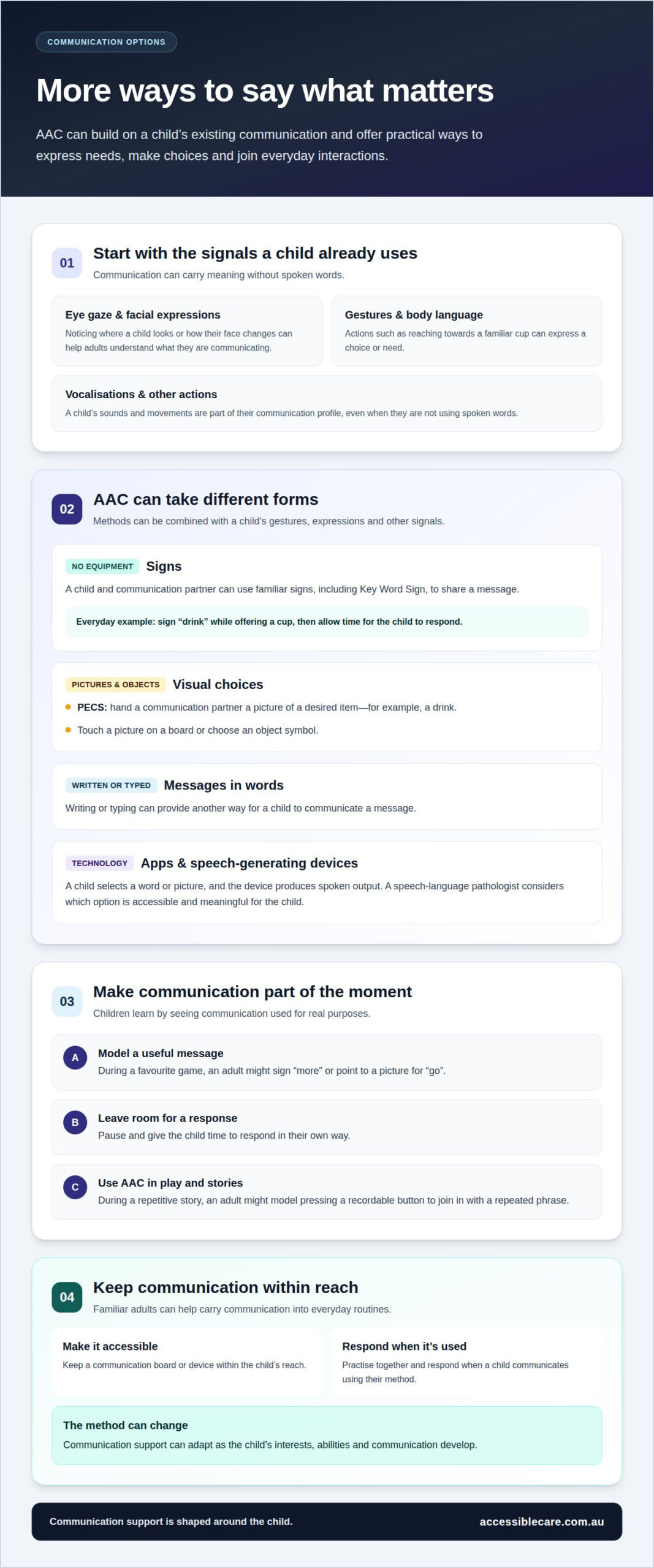
Speech therapy for non-verbal children can build on the ways a child already communicates. A child may use eye gaze, facial expressions, gestures, vocalisations or body language to make a choice or seek attention. These actions carry meaning, even without spoken words. Augmentative and alternative communication (AAC) can combine with these signals and other methods, rather than relying on speech alone.
Some AAC methods need no equipment. A child and communication partner might use signs, including Key Word Sign, to share a familiar message. Picture Exchange Communication System (PECS) involves handing a communication partner a picture of a desired item. For example, a child might give someone a picture of a drink to ask for one. Other options include touching a picture on a board, choosing an object symbol, or writing or typing a message.
When a child finds it difficult to express needs, plans or feelings, communication support can help reduce frustration. A speech-language pathologist considers which methods are accessible and meaningful for the child. They may introduce a picture board, communication app or speech-generating device, where selecting a word or picture produces spoken output. The goal is to give the child a practical way to make choices and join everyday interactions.
In speech therapy for non-verbal children, AAC can be part of play and storytime. During a favourite game, a speech-language pathologist might model a sign for “more” or point to a picture for “go”, then pause for the child to respond in their own way. While reading a repetitive story, they might model pressing a recordable button to join in with a repeated phrase. Children learn by seeing communication used for real purposes, not just by being shown a tool.
Adults can keep a communication board or device within reach and respond when a child uses it. Practising together helps communication skills carry into routines beyond therapy. The method can change as the child’s interests, abilities and communication develop.
2. Why Is Speech Therapy Important for Nonverbal Children?
A speech-language pathologist looks beyond spoken words to understand how a child communicates. They observe gestures, body language, facial expressions and actions, such as reaching towards a familiar cup. These clues help shape strategies around the child’s developmental level, interests and daily needs. Therapy can build communication skills for making choices, sharing discomfort and joining routines.
Consider support when a child has difficulty expressing needs or connecting with others, or when you have concerns about their communication. It may help to discuss the child’s communication and possible next steps with a professional. There’s no need to wait for a child to use spoken words before discussing communication support.
Private therapy, public health services and early intervention are different pathways. Consider how each option fits the child’s needs, your family’s circumstances, the setting and continuity of support. A speech-language pathologist can help clarify suitable goals and strategies, while you decide which pathway works for your family.
Look for a paediatric speech pathologist who listens to the child and family, understands the child’s communication profile and explains goals clearly. The approach should respect the child’s preferred ways of interacting and adapt as their needs change. Ask how familiar adults can be involved, so communication strategies can be used consistently at home and in other everyday settings.
Sign language can be part of everyday routines, not just a therapy activity. For example, an adult might sign “drink” while offering a cup, then give the child time to respond. Repeated, meaningful examples help connect a sign with a person, action or choice.
If language impairment is discussed alongside serotonin, keep therapy planning focused on the child’s observed communication and individual goals. A discussion of serotonin alone doesn’t show which communication strategies will suit a child. A pathologist’s assessment provides a practical starting point.
For tailored guidance, explore paediatric speech therapy support focused on your child’s communication needs.
3. Is my child ever going to speak?
Some autistic children develop language after age four, so speech can emerge beyond the early years. No single milestone predicts an individual child’s path. Speech therapy can support spoken language development while building communication skills that matter whether a child speaks, uses signs or combines different methods.
For non-verbal children, therapy may use naturalistic, developmental approaches built around the child’s interests. During play with a toy car, a speech-language pathologist might model “car goes” and pause, giving the child time to respond with a sound, gesture, sign or word. Following the child’s attention gives communication meaning in the moment.
Imitation can help children practise the building blocks of interaction. A pathologist might first copy a child’s action, such as tapping a drum, then invite the child to copy a simple action in return. Practice can start with whole-body movements, such as clapping, and move towards more specific actions, sounds or words. Each turn offers an opportunity to connect and communicate.
Conversation involves more than speaking. A pathologist can help a child practise taking turns, responding to a familiar partner and sharing attention around an activity. For example, during a ball game, the adult might pause before rolling the ball, creating space for the child to signal “again” through a look, gesture, sign or word. A suggested strategy is to wait and count to 10 after asking a question or modelling language.
Autism affects each child differently, so therapy focuses on their development and current communication. If a child uses single words, adults can model a short phrase with one additional word, such as “more bubbles” after “bubbles”. Augmentative and alternative communication, including sign language, can support these interactions alongside spoken language. The aim is meaningful communication, with speech development as one possible part of a broader plan.
4. Speech therapy benefits for autistic children
For autistic children, successful communication is the goal, whether or not they develop spoken language. Speech therapy can support ways to express preferences, share information and take part in everyday activities. For example, a child might use a picture, sign, spoken word or device to choose a game. A reliable way to make that choice can support autonomy and help others understand the child’s message.
Therapy can also build interaction skills through activities that matter to the child. During a familiar game, a speech-language pathologist might support turn-taking, shared attention or a way to request “again”. These skills can help a child participate with family members, educators and peers. The pathologist can shape practice around the child’s interests, communication style and comfort, rather than expecting every child to interact in the same way.
Visual supports can make routines and expectations easier to follow. A simple picture schedule, for instance, can show the steps from arriving home to starting dinner. Picture cues may help make directions easier for a child to follow. As the child understands a direction, cues can be adjusted to match their progress and routine.
AAC can support a child who is not speaking while leaving room for spoken language if it develops. A communication device, pictures or signs can help the child share needs and ideas in different settings. Adults can encourage communication by recognising and responding to the child’s message, and modelling useful words or symbols during shared activities. What matters is that the child can communicate meaningfully, not that they use one particular method.
Speech therapy goals can focus on participation, connection and self-expression, alongside any goals related to speaking. Explore speech therapy support to discuss communication goals suited to your child.
Accessible Care: Speech Therapy
Accessible Care provides speech therapy for children, with support that is person-centred and tailored to each participant’s goals and circumstances. Therapy can focus on expressing choices, sharing needs and participating with others, whether a child communicates through speech, gestures or augmentative communication. Family and carer involvement is part of the therapy process.
Consider speech therapy when your child has difficulty communicating or you want guidance on meaningful goals. Therapy can focus on skills that matter in daily life while respecting how your child currently communicates. Where relevant, NDIS Support Services, Occupational Therapy or Positive Behaviour Support may complement a child’s broader support needs.
Sharing examples of your child’s communication, interests and challenging routines can help inform therapy planning. This gives the speech-language pathologist useful context for working towards practical goals with your family.
Contact Accessible Care to discuss speech therapy for your child.
Take the next step at your child’s pace
Choosing speech therapy for a non-verbal child can start with a simple question: what would help them feel understood in everyday life? An initial goal might be expressing a choice, joining a familiar activity or sharing discomfort. The child’s communication priorities can guide the conversation and help shape meaningful support.
Accessible Care offers Speech Therapy, NDIS Support Services and Occupational Therapy. These services can support different aspects of a child’s needs, with communication goals kept practical and tailored to each participant’s goals and circumstances. Progress and the path towards spoken language vary for each child, so therapy focuses on meaningful ways to communicate rather than promising a particular outcome.
Starting a conversation can help you explore what support may suit your child and family. Contact Accessible Care to discuss the next step. Your child’s way of communicating matters, and their goals can guide the support ahead.
Frequently Asked Questions
Why Is Speech Therapy Important for Nonverbal Children?
Speech therapy can help children communicate important messages, including choices, discomfort and requests for help. For example, a child might have a reliable way to indicate pain during a busy family outing, even without spoken words. A speech-language pathologist can assess communication across everyday situations and set goals around what the child needs to express. This supports connection and participation, not speech alone.
How can a speech-language pathologist guide parents to support communication at home?
A speech-language pathologist can help parents notice what their child communicates and make shared strategies fit family routines. They might discuss which cues are easiest to recognise during mealtimes, getting dressed or travelling to childcare. Parents can share what works in those moments, so the pathologist can adapt goals and show familiar adults how to respond consistently to the child’s messages.
Is my child ever going to speak?
Some autistic children develop language after age four, and speech therapy can support speech development. A speech-language pathologist considers the child’s communication profile, including any sounds, words or attempts to imitate language. Therapy can work towards speaking while also supporting communication in the present. A child’s ability to share needs and ideas matters, whatever form their communication takes.
Step One: Will Speech Work?
The first step is an assessment of how the child currently communicates and whether spoken language is a useful goal. A pathologist may observe whether the child imitates a sound or word to get something they want, such as a favourite snack. This information helps guide therapy priorities. The assessment also considers communication methods that meet the child’s needs while speech skills are explored.
What does nonverbal actually mean?
“Nonverbal” generally describes someone who uses no or few consistent spoken words to communicate. It doesn’t, by itself, tell you how much language they understand. A child may follow a familiar routine or respond to a known phrase without answering aloud. Describe what you observe, such as how your child asks for help, to give their speech-language pathologist useful context.
What communication methods can speech pathologists teach, such as AAC, PECS, or sign language?
Speech pathologists can explore unaided methods, such as signs and natural gestures, and aided AAC, such as picture boards, apps or speech-generating devices. With PECS, a child gives a communication partner a picture to convey a message. A child might also select a symbol on a board or use a sign for a familiar request. The method is tailored to the child’s goals and circumstances, communication needs and abilities.

