


What if focusing on your most difficult moments was actually the kindest thing you could do for the person you love? For many families, the thought of documenting every struggle feels like a heavy weight, almost like a betrayal of the person they care for. You might feel exhausted by the invisible labor of caregiving, yet terrified that being too honest will somehow jeopardize your current funding. It’s a common fear, but your lived reality is the most important evidence the NDIS has to work with.
We’re here to help you turn that exhaustion into a clear, professional voice. This guide will teach you how to write an ndis carer statement that is both deeply honest and strategically effective. You’ll learn how to capture your daily life with compassion and align your story with the 2026 NDIS framework to secure the respite and support your family deserves. We’ll explore the “worst day” strategy and the 12 life domains, giving you a calm, methodical path toward a statement that validates your role and protects your future.
Key Takeaways
- Understand why your perspective is a vital bridge to securing funding and how it differs from a standard statement of lived experience.
- Discover how to write an ndis carer statement using five essential building blocks that clearly define the “above and beyond” care you provide daily.
- Learn to use the “Worst Day” strategy to provide an honest, safe, and realistic picture of your family’s needs without feeling guilty.
- See how to align your personal story with professional reports from therapists to create a unified and powerful request for support.
- Explore how a collaborative approach with support services can validate your role and help you secure much-needed respite or support work.
What is an NDIS Carer Statement and Why is it Vital?
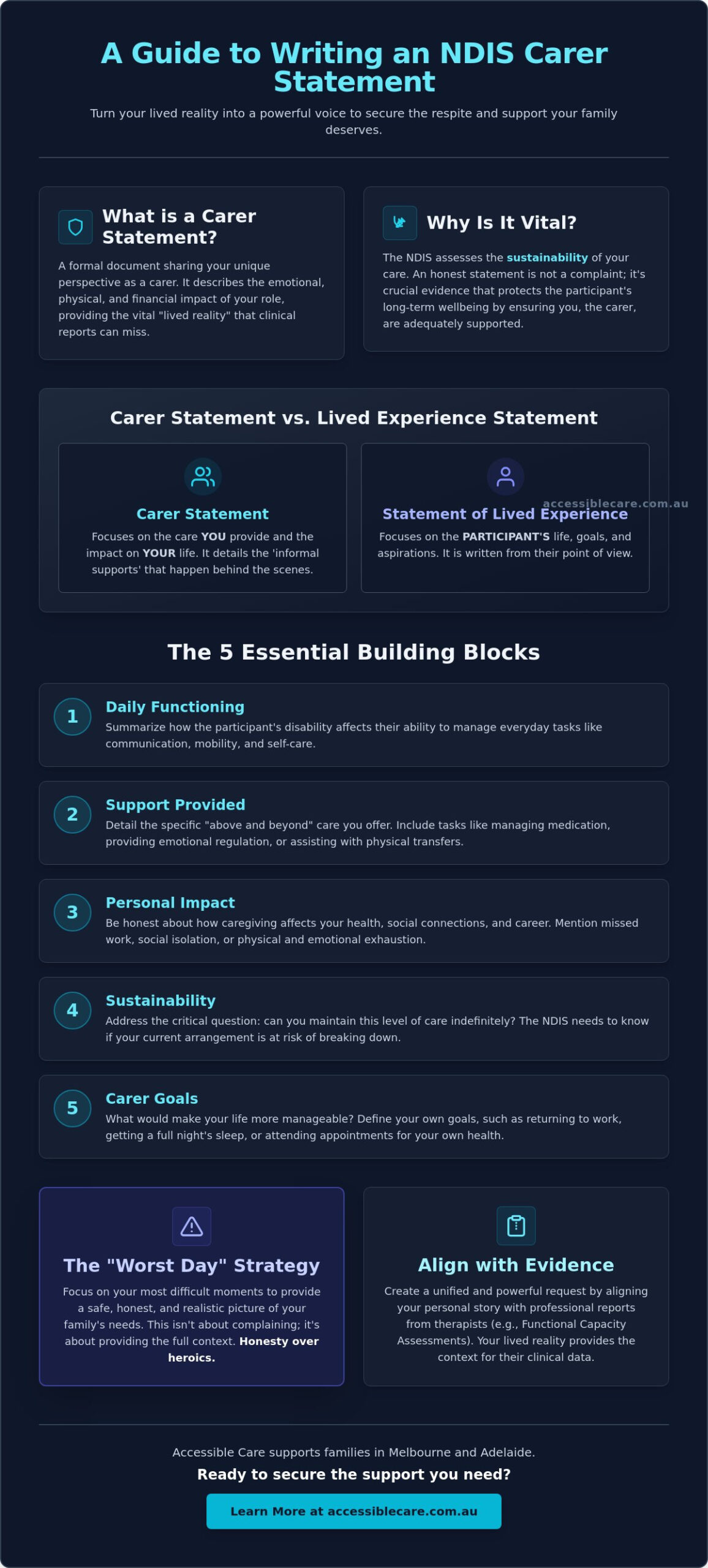
An NDIS Carer Statement is a formal document that allows you to share your unique perspective with the National Disability Insurance Agency (NDIA). While therapists provide clinical data, you provide the lived reality. It is your opportunity to describe the emotional, physical, and financial impact of your caring role. Within the National Disability Insurance Scheme, this statement serves as a vital bridge. It connects the participant’s goals with the practical support required to make those goals achievable. It is a tool for advocacy, designed to ensure the system sees the person behind the paperwork.
Many people confuse this with a Statement of Lived Experience. While they sound similar, they serve different purposes. A Statement of Lived Experience is written from the participant’s point of view, focusing on their own life and aspirations. In contrast, when you learn how to write an ndis carer statement, you are focusing on the care you provide. You are detailing the support that happens behind closed doors, often late at night or early in the morning. The NDIS refers to this as “informal supports,” and it is a cornerstone of how they calculate funding.
The NDIS makes funding decisions based on the sustainability of these informal supports. If you are exhausted or reaching a breaking point, the care you provide is not sustainable in the long term. By being honest about your own needs, you are actually protecting the participant’s long-term autonomy. You are ensuring they have a stable, healthy environment where they can thrive. This statement is about honoring your role while acknowledging its limits.
Is it Compulsory for an NDIS Plan?
Strictly speaking, a Carer Statement is not mandatory. However, it is often the most influential document in a plan review. Clinical assessments, such as a Functional Capacity Assessment, are excellent at measuring what a person can do in a controlled setting. They might miss the nuance of a sleepless night or the complexity of a difficult morning routine. Your statement provides that essential context. It allows you to advocate for respite and core support hours by showing exactly where the gaps in care exist.
Who Should Write the Statement?
The primary carer should always be the lead author. Whether you are a parent, a partner, or an adult child, your voice carries the most weight because you hold the most knowledge. Authenticity is key. You don’t need to use complex medical terms; simple, heartfelt language is far more powerful. If other family members or close friends see the impact of the caring role, they can provide supplementary impact letters. Understanding how to write an ndis carer statement starts with recognizing that your story is the most valuable evidence you have to offer.
What to Include: The 5 Essential Building Blocks
Crafting a statement that truly reflects your life requires more than just a list of tasks. It’s about painting a picture of your daily commitment. To help you structure your thoughts, we’ve identified five essential building blocks. These elements ensure the NDIA understands both the participant’s needs and your own. When you are looking at how to write an ndis carer statement, focusing on these areas helps transform your lived experience into clear, actionable evidence.
- Daily Functioning: Provide a gentle summary of how the participant’s disability affects their ability to manage everyday tasks. Focus on communication, mobility, and self-care.
- Support Provided: Detail the specific “above and beyond” care you offer around the clock. This includes things like managing medication, providing emotional regulation, or assisting with physical transfers.
- Personal Impact: Be honest about how caregiving affects your health, social connections, and career. If you’ve missed work or feel socially isolated, these facts matter.
- Sustainability: Address the hard question of whether you can maintain this level of care indefinitely. The NDIS needs to know if your current arrangement is at risk of breaking down.
- Carer Goals: What would make your life more manageable? Define your goals, such as returning to part-time work or having a full night’s sleep, and list the supports that would help.
For more detailed prompts on these sections, you might find ACD’s guide to writing a carer statement a helpful companion as you draft your notes. If the weight of these responsibilities feels overwhelming, our team can help you explore compassionate support work options to share the load.
Documenting the “Above and Beyond” (Paediatric Focus)
When writing for a child, it’s vital to compare their needs to those of a same-aged peer without a disability. While all parents provide care, NDIS criteria focus on the extra layers of support required for safety and emotional regulation. Above and beyond care is the level of support provided that exceeds what is typically expected for a person of the same age and life stage without a disability. Highlighting these differences helps the NDIA see why standard parenting isn’t enough to meet your child’s complex needs.
Sustainability and Future Planning (Adult Focus)
For those caring for adults, the focus often shifts to long-term stability and progressing conditions. It’s important to document the physical strain of manual handling or the cumulative effect of broken sleep over many years. As a carer, your own ageing process is a valid factor in sustainability. Discussing the participant’s transition toward independent living goals is not a sign of giving up; it’s a proactive step toward ensuring their autonomy and your well-being in the years to come. Understanding how to write an ndis carer statement for an adult means advocating for a future that respects everyone’s limits.
The “Worst Day” Strategy: Honesty Over Heroics
Caring for someone you love is an act of profound devotion, but the NDIS isn’t looking for heroics. They need to understand the maximum level of support required to keep everyone safe and stable. This is why many advocates suggest focusing on your “worst day.” It often feels counterintuitive to dwell on the negatives, especially when you want to celebrate the participant’s milestones. You might feel a sense of guilt or sadness as you put these struggles onto paper. These feelings are valid and very common among families. However, if the NDIA only sees your “best day,” they’ll fund for that day, leaving you without a safety net when life becomes difficult.
Understanding how to write an ndis carer statement involves a significant mindset shift. You must move away from the habit of saying “we manage” and instead say “we require support to stay safe and well.” When you tell the agency that you are managing, the system assumes no further assistance is needed. When you describe the intensity of a crisis or the exhaustion of a sleepless week, you are highlighting an unmet support need. This isn’t about complaining; it’s about providing a realistic foundation for a sustainable plan.
To help capture the invisible labor you perform, try keeping a care diary for 48 hours. Note every time you intervene to prevent a fall, soothe an emotional outburst, or assist with a transition. You’ll likely be surprised by how many tasks you do that have become second nature. Documenting these moments ensures that the “invisible” work of caregiving becomes visible to the planners who decide on funding levels.
How to Describe Challenges Without “Complaining”
Reframing is a powerful tool for maintaining your dignity and the participant’s honor. Instead of describing a child as “difficult,” you can describe “behaviours of concern that require constant 1:1 supervision to ensure physical safety.” Use objective language to describe medical episodes or challenging moments. Focus on the frequency and intensity of the support you provide. For example, instead of saying a routine is exhausting, state that “this medical procedure requires 40 minutes of preparation and the physical assistance of two people to administer safely.”
The Impact on Your Own Wellbeing
Your wellbeing is not a luxury. It is a fundamental requirement for the participant’s long-term success. Be honest about your own physical limitations, such as back strain from manual handling, or the mental health toll of constant vigilance. If your caring role prevents you from working or maintaining a social life, these facts are essential. When a carer reaches a breaking point, the entire support structure is at risk. The NDIS aims to prevent this, but they can only provide solutions for the challenges you choose to share. Your health is the foundation of their autonomy.
To explore how tailored professional services can help protect your wellbeing and prevent burnout, you can learn more about MyLife MyCare and their compassionate approach to home care.
Aligning Your Statement with Professional Evidence
A Carer Statement is a deeply personal narrative, but it shouldn’t stand alone. To be most effective, your story needs to “talk” to the clinical reports provided by your healthcare team. When the NDIA sees that your daily experience perfectly matches the findings in a Speech Pathology report or a medical assessment, it builds a powerful case for support. This alignment shows the agency that your requests are grounded in both professional evidence and lived reality. Consistency across all documents is often the deciding factor in a successful plan approval.
This multidisciplinary approach brings all voices together. If you describe the difficulty of managing meal times, a therapist’s report on swallowing safety provides the clinical “why.” When these documents work in harmony, they create a unified front. You aren’t just asking for help; you are presenting a clear, evidence-based need for intervention. Learning how to write an ndis carer statement that mirrors professional findings ensures that no part of your family’s struggle is dismissed as an exaggeration.
If you’re feeling unsure about how to bridge the gap between your home life and clinical data, our team can help. You can book a consultation with our therapists to discuss how we can provide the robust evidence your statement needs.
Connecting with Occupational Therapy
Occupational Therapists (OTs) focus on “activities of daily living” or ADLs. In your statement, try to use this language. When you describe the physical assistance you provide for dressing or bathing, you are describing ADL support. You should also highlight where assistive technology could reduce your strain. If an OT recommends a specialized hoist or a modified shower chair, explain how these tools make your caregiving more sustainable. This connection validates the OT’s recommendations while showing the NDIA how they directly improve your wellbeing.
Connecting with Speech and Behaviour Support
Communication and behaviour are often the most invisible areas of care. If you spend hours every day modelling an AAC device or using specific communication strategies, document this time. Your narrative should link these behaviour support needs to the impact on family safety and community access. When professional reports and carer statements are aligned, they create a 360-degree view of need that the NDIA cannot easily ignore. This holistic perspective is essential for securing the right level of support work or specialized therapy. Understanding how to write an ndis carer statement means ensuring your voice is the thread that ties all these professional reports together.
How Accessible Care Supports Melbourne and Adelaide Families
At Accessible Care, we understand that you are the expert on your family’s life. Our role is to act as your navigator, ensuring your voice is heard clearly by the NDIA. In Melbourne and Adelaide, we offer a holistic approach that goes beyond standard service delivery. We believe that a successful plan starts with a deep respect for the person receiving care and the family supporting them. By working together, we ensure that the daily realities you face are translated into the professional evidence needed for your next review. We provide the clinical context that complements your personal story, making the process of learning how to write an ndis carer statement feel like a shared journey rather than a solitary task.
Our therapists don’t work in isolation. They collaborate closely with you to ensure your narrative is robust and consistent. We help you identify the “invisible” tasks and ensure they are documented correctly. For families managing complex medical needs, our High Intensity Supports provide a specialized level of care that prioritizes both safety and quality of life. This level of support is designed to be sustainable, giving you the peace of mind that your loved one is in capable, compassionate hands. We believe that every family deserves a support structure that honors their unique needs and objectives.
Expert Therapy and Support Coordination
Our team includes experienced Speech Pathologists and Occupational Therapists who specialize in functional capacity and communication. They understand the nuance of NDIS criteria and how to frame support needs effectively. We also provide compassionate support work that is designed to alleviate carer strain, not just fill a roster. Our assessments are tailored to your specific goals, using industry-standard terminology that the NDIA recognizes and respects. This ensures that when you’re looking at how to write an ndis carer statement, the professional reports you submit are in perfect harmony with your own words.
Your Partner in the NDIS Journey
We prioritize listening above all else. Your autonomy and self-direction are the heart of our service philosophy. We are here to facilitate your objectives, providing the expertise you need to navigate a complex system with confidence. Whether you are in Melbourne or Adelaide, our teams are ready for a supportive chat about your needs. We want to help you feel empowered, validated, and prepared for your future. Our goal is to provide comfort, peace of mind, and an improved quality of life for the entire family unit.
Reach out to Accessible Care today for compassionate NDIS support.
Empowering Your Advocacy for a Brighter Future
Writing your story is more than just completing a form; it’s an act of advocacy that honors your commitment and protects the participant’s autonomy. You now have the tools to be honest about your most challenging days, ensuring your plan is truly sustainable for the long term. By aligning your lived experience with professional clinical evidence, you’ve created a powerful case for the support your family deserves.
Learning how to write an ndis carer statement is a vital step toward finding the balance you deserve. As a Registered NDIS Provider, our experienced multidisciplinary team in Melbourne and Adelaide specializes in high intensity and complex care. We are here to listen, support, and help you navigate this system with competence and genuine care. We believe that your well-being is the foundation of a successful support plan.
Ready to take the next step? Download our NDIS support guide or book a consultation with our team today. You don’t have to carry this weight alone; we are here to walk beside you toward a more supported and peaceful future.
Frequently Asked Questions
Do I need a new Carer Statement for every NDIS review?
You should ideally provide a new statement for every scheduled review or whenever there is a significant change in your circumstances. Your life and the participant’s needs naturally evolve over time, so an updated document ensures the funding remains relevant and safe. It’s a valuable chance to reflect on what worked, what didn’t, and any new challenges that have surfaced since the last plan was approved.
How long should an NDIS Carer Statement be?
Most statements are between one and three pages long. There isn’t a strict word count, but focusing on clarity and impact is better than writing a long, repetitive document. Use bullet points to make it easier for the planner to read. If your situation is complex, don’t feel pressured to keep it too brief; include whatever is necessary to explain the level of support required.
Can I include photos or videos with my statement?
You can certainly include photos or short videos to illustrate specific challenges or equipment needs. Visual evidence can sometimes convey the physical reality of caregiving more effectively than words alone. If you’re documenting a difficult transfer or a specific environmental barrier, a photo can provide immediate clarity for the NDIA planner. Ensure you have the participant’s consent before sharing any personal imagery that identifies them.
What if I find it too upsetting to write about our “worst days”?
It’s completely natural to feel distressed when focusing on difficult moments. You don’t have to write the entire document in one sitting. Try taking small breaks or using a care diary to jot down notes over several days. If it’s too overwhelming, you can talk through your experiences with a trusted friend or therapist and have them help you structure those heartfelt notes into a formal statement.
Does the NDIS provide a specific template for Carer Statements?
The NDIS does not provide a mandatory template for these documents. You have the freedom to write in a way that feels most authentic to you, whether that’s a letter or a structured report. While there’s no official form, following a logical structure with clear headings helps the planner find information quickly. This flexibility allows you to focus on what matters most to your specific family situation.
How do I submit my Carer Statement to the NDIA or my LAC?
You can email your completed document to your Local Area Coordinator (LAC) or NDIS planner before your meeting. It’s also a good idea to bring a printed copy to the review itself. Submitting it early gives the planner time to read your perspective and prepare relevant questions. This ensures your voice is part of the conversation from the very beginning of the planning process.
Can my support worker or therapist write the statement for me?
A support worker or therapist cannot write the statement for you, as it must reflect your unique perspective as a carer. However, they can certainly support you in the process. They can provide data on the care they observe or help you understand how to write an ndis carer statement by reviewing your draft for consistency. Their role is to provide the clinical evidence that backs up your lived experience.
Will writing a Carer Statement affect my Carer Payment from Centrelink?
Writing a statement for the NDIS won’t negatively impact your Carer Payment or Allowance from Centrelink. The NDIS and Centrelink are separate systems with different criteria. In fact, being honest about the high level of care you provide can often reinforce your eligibility for carer supports across different government agencies. It’s about ensuring you have the resources needed to continue your vital role without burning out.

