

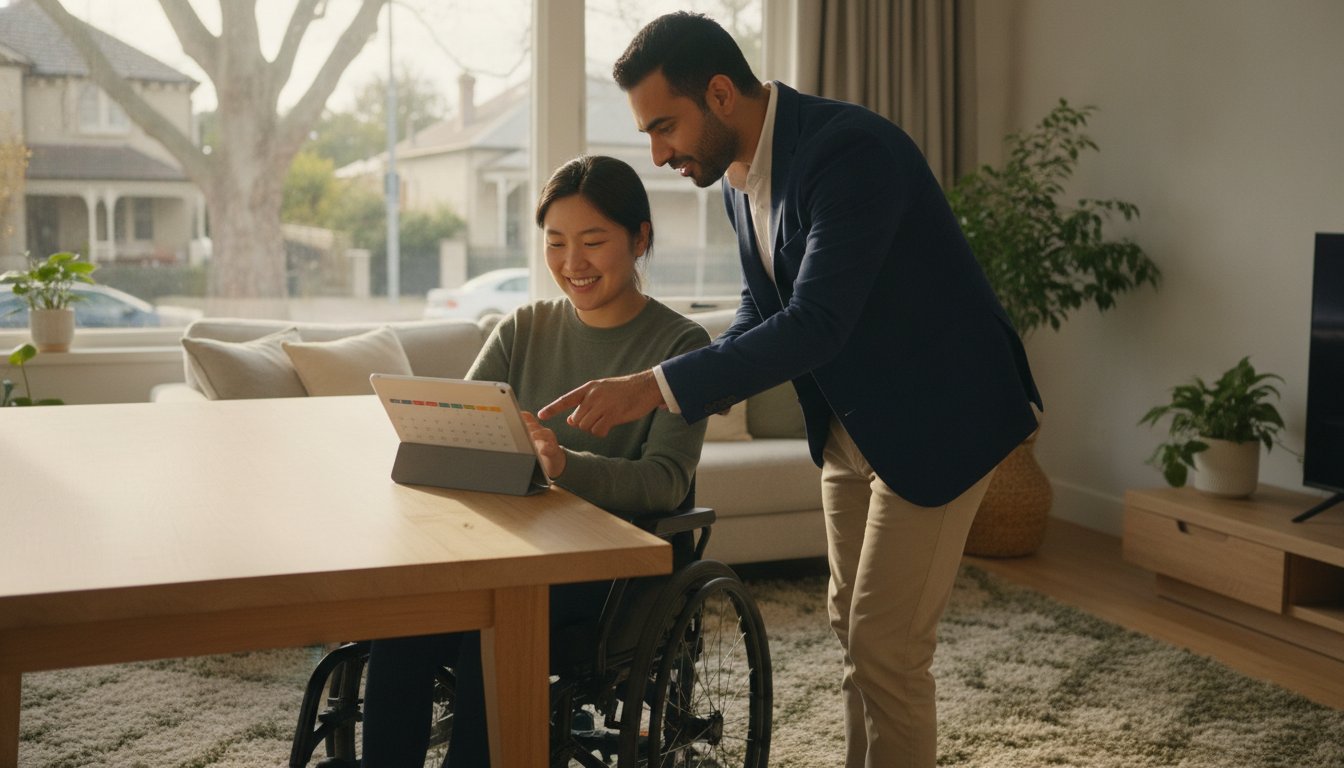
What if the support workers entering your home felt less like “staff” and more like a bridge to the life you’ve always wanted? Many NDIS participants in Melbourne and Adelaide worry that inviting help inside means giving up their autonomy or getting lost in a sea of confusing jargon. We understand that your home is your sanctuary, and you deserve in home disability support services that respect your choices while providing the clinical expertise you need to thrive.
It is natural to feel overwhelmed by the 2026 NDIS changes, especially with the rollout of the new national planning system and the I-CAN assessment tool. You might fear that a provider will take control rather than collaborate with you. We believe that true support shouldn’t be transactional; it should be a nurturing partnership that honors your self-determination. This guide explores how a seamless blend of clinical therapy and daily assistance empowers your independence. You will discover how to find reliable support that understands your clinical needs and helps you live a life of comfort and connection on your own terms.
Key Takeaways
- Learn how the shift toward home-based care prioritizes your self-determination and personal comfort over rigid institutional routines.
- Explore the full spectrum of in home disability support services, from essential daily tasks like personal care to high-intensity clinical assistance.
- Discover the benefits of an integrated approach where support workers collaborate with Speech Pathologists and OTs to help you achieve your unique capacity-building goals.
- Gain a clear, step-by-step roadmap for identifying “Core” and “Capacity Building” supports within your NDIS plan to fund your home-based independence.
- Understand how local expertise in Melbourne and Adelaide provides a reliable, nurturing partnership that respects your home as your sanctuary.
Table of Contents
Understanding In-Home Disability Support Services
In-home disability support services represent a fundamental shift in how we approach care. It is a move away from the rigid, often impersonal nature of institutional settings toward a model that celebrates the individual. In this person-centric ecosystem, your home isn’t just a place where care happens; it’s the foundation of your independence and a sanctuary where you set the rules. This model recognizes that you are the expert in your own life. Support is designed to wrap around your existing routines, rather than forcing you to adapt to a provider’s schedule.
The National Disability Insurance Scheme (NDIS) has been the driving force behind this evolution in Australia. By providing individualized funding, the scheme empowers participants to move beyond “one size fits all” solutions. This funding allows for a highly personalized approach where clinical therapy and daily assistance work in harmony. We view support work as a vital bridge to the world outside your front door. It is about more than just completing tasks; it is about building the confidence and capacity you need for active community participation, whether that means visiting a local park in Melbourne or attending a social group in Adelaide.
The Core Philosophy: Autonomy and Self-Determination
Choice and control are not just industry buzzwords; they are the essential foundations of modern support. True empowerment begins when you have the final say in who enters your home and how they assist you. We believe that a successful partnership relies on a deep sense of connection. This is why matching support workers to your unique personality and communication style is so critical. When a worker understands your preferences through attentive listening, the support feels less like a clinical intervention and more like a helpful collaboration. Self-direction is the ability to lead one’s own care journey with dignity and purpose.
Who Benefits from Home-Based Support?
A wide range of NDIS participants find that receiving care at home provides the stability and comfort necessary to reach their long-term goals. This includes:
- Individuals living with an acquired brain injury who require a familiar, low-stress environment to work on cognitive and physical rehabilitation.
- People managing neurological conditions or spinal cord injuries who benefit from clinical nursing and personal care delivered in a private setting.
- Children and adults who require specialized paediatric or adult Occupational Therapy to improve their daily living skills and sensory processing.
By bringing these specialized services into the home, we remove the exhaustion of travel and the anxiety of clinical waiting rooms. This allows energy to be focused entirely on what matters most: your progress and your quality of life.
The Spectrum of Support: From Daily Tasks to Clinical Care
Every person’s journey is unique. Because of this, in home disability support services are categorized into different levels of intensity to ensure you receive the right amount of help at the right time. Low-intensity support might involve occasional help with domestic tasks, while medium-intensity care often includes daily assistance with personal routines. For those with significant medical or physical needs, high-intensity care provides specialized clinical intervention. Understanding these levels helps you navigate the official NDIS website and your own plan with greater confidence.
The goal is always to match the support to your specific life stage and objectives. Whether you need a hand with the weekly grocery shop or require 24/7 complex care, the focus remains on your comfort and safety. This tiered approach ensures that as your needs change, your support can evolve alongside you without disrupting your home life. It is about providing exactly what you need to feel secure and empowered in your own space.
Daily Living and Social Inclusion
Specialised Clinical and Nursing Support
When medical needs become more complex, community nursing brings hospital-level expertise into your living room. This specialized care manages technical requirements such as PEG feeding, catheter care, and professional wound management. For many families, high intensity supports NDIS are the key to staying out of residential facilities. These services ensure medical stability while respecting your personal space and privacy.
In addition to physical health, we prioritize emotional and behavioral well-being. Positive Behaviour Support helps manage challenging situations with empathy and evidence-based strategies. By integrating NDIS high intensity supports, we create a safe environment where complex needs are met with professional competence and a gentle touch. If you are feeling unsure about which level of care fits your current plan, our team is here to provide reassuring guidance on your options.
The Multidisciplinary Advantage: Integrating Therapy and Support
Traditionally, therapy is something you “go to.” You might visit a clinic once a week, practice a few exercises, and then return home. However, for those receiving in home disability support services, the most meaningful progress happens in the hours between those sessions. A siloed approach to care often fails because techniques taught in a clinical setting don’t always translate to the reality of your kitchen, bathroom, or living room. When therapy is isolated from your daily life, it’s easy for valuable strategies to be forgotten or misapplied.
We believe that true empowerment comes from a team that talks to each other. When your support worker understands the specific goals set by your therapists, every daily interaction becomes an opportunity for growth. This integrated model ensures that your care is consistent and purposeful. For example, an Occupational Therapist might suggest a specific sequence of movements to help you dress more independently in the morning. Instead of you struggling to remember these tips alone, your support worker is there to gently guide you through the process every day until it becomes second nature. Having a single provider coordinate multiple disciplines removes the burden of communication from your shoulders and ensures everyone is working toward your unique vision of independence.
Speech Pathology and Communication at Home
Communication is the heart of human connection. Working with a speech pathology expert in your own home allows you to practice rebuilding language skills in the environment where you use them most. Our support workers are trained to assist with Augmentative and Alternative Communication (AAC) devices, ensuring your voice is heard throughout the day. Beyond communication, they also play a vital role in mealtime safety. They apply specialized swallowing techniques and meal textures recommended by your therapist, making every meal a safe and social experience.
Occupational Therapy for Everyday Independence
Independence is often found in the small details of our daily habits. By understanding what is occupational therapy, you can see how it transforms your living space. OTs focus on adapting your home environment for better accessibility, while paediatric specialists use play-based therapy to help children shine. This holistic approach aligns with national Disability and Carers programs that prioritize community-based care. Integrating these principles into your daily routine ensures that therapy isn’t an extra chore; it’s a natural part of living a full and autonomous life.
How to Access In-Home Support with Your NDIS Plan
Finding the right in home disability support services is a journey that begins with your own vision for the future. It is not just about filling hours; it is about finding the right people to help you reach your goals. The process should be calm, methodical, and entirely focused on your needs. By following a few simple steps, you can transform your NDIS plan from a document into a lived reality of independence and comfort.
First, look at your current plan to see where your funding is allocated. You’ll usually find support for home-based care under “Core Supports” or “Capacity Building.” Once you’ve identified your budget, take a moment to write down your specific goals. Do you want to learn to cook your own meals? Are you hoping to get out into the Melbourne or Adelaide community more often? Having these goals clear in your mind makes it much easier to find a provider who shares your vision. From there, you can research registered providers, conduct “meet and greets” to check for a personality match, and finally sign a Service Agreement that clearly outlines your care.
Understanding NDIS Funding Categories
It helps to think of your NDIS funding in two main buckets. Core Supports are there for your immediate, everyday needs. This is the category that pays for a support worker to help with showering, dressing, or domestic tasks. Capacity Building, on the other hand, is focused on the future. Specifically, the “Improved Daily Living” sub-category is what you’ll use to access professional Speech Therapy or Occupational Therapy. It’s also vital to check how your plan is managed. Whether you are self-managed, plan-managed, or NDIA-managed determines which providers you can work with and how much control you have over your budget.
Choosing a Registered NDIS Provider
Choosing a registered provider offers an extra layer of peace of mind. Registration isn’t just a badge; it means the provider meets strict government standards for safety, quality, and staff training. When you speak with a potential partner, don’t be afraid to ask about their experience with your specific needs. How do they support their staff? What is their process for matching workers to participants? If you are new to the scheme, it’s helpful to review the NDIS basics to feel more grounded in your choices.
We know that managing these systems can feel heavy at times. You don’t have to do it alone. If you’re ready to see how personalized care can change your daily life, you can reach out to us for a gentle conversation about your plan.
Accessible Care: Your Partner for Independence in Melbourne and Adelaide
At Accessible Care, we believe your home should be the place where you feel most like yourself. Choosing in home disability support services is a deeply personal decision. It requires a partner who doesn’t just provide a checklist of tasks, but who truly hears you. Our “attentive listening” philosophy is at the heart of everything we do. We take the time to understand your unique story, your personal preferences, and your long-term dreams. This ensures every therapist and support worker who enters your home is there to facilitate your goals, not to direct your life.
Our holistic approach brings together community nursing, Speech Therapy, Occupational Therapy, and Positive Behaviour Support under one roof. This coordination removes the stress of managing multiple providers. It allows us to provide a seamless experience where clinical expertise meets a warm, nurturing spirit. Whether you’re recovering from an injury or managing a lifelong condition, we’re here to walk alongside you. We provide professional competence and a genuine commitment to your peace of mind.
We see ourselves as facilitators of your autonomy. This means we focus on what you can do, and we provide the right level of assistance to help you do more. Our team is trained to be both technically expert and deeply empathetic. We understand that trust is earned through consistent, reliable care that respects your home as a sanctuary. By focusing on connection and mutual regard, we create a supportive partnership that empowers you to live with dignity and self-determination.
Tailored Support for Melbourne Communities
We’re proud to serve the diverse suburbs of Melbourne with culturally sensitive care that respects your lifestyle. Our team has deep connections to local Melbourne health networks and specialists, helping us coordinate your care more effectively. From the inner city to the outer suburbs, our experienced Speech Language Pathologists and OTs provide expert therapy in your own home. We understand the unique rhythm of life in Victoria and are committed to helping our Melbourne clients thrive.
Compassionate Care for Adelaide Families
In South Australia, we offer dedicated paediatric OT and adult support services designed for the specific needs of Adelaide families. We help you navigate the NDIS with ease, ensuring you feel grounded in your choices. We focus on honoring the autonomy of every individual, ensuring children and adults alike feel empowered to lead their own care journey. Our presence in Adelaide means we’re always close by, ready to provide the reliable, professional support you and your family deserve.
Your Journey Toward a More Independent Future
Choosing the right support means finding a team that respects your home as your sanctuary while providing the clinical expertise you need to flourish. We’ve explored how in home disability support services are most effective when therapy and daily assistance work in harmony rather than in isolation. By focusing on your specific goals and maintaining your autonomy, you can navigate the NDIS changes of 2026 with a sense of confidence and clarity.
As a registered NDIS provider with an experienced multidisciplinary team, we specialize in high intensity and complex care. We are here to listen attentively and provide the nurturing partnership you deserve in Melbourne or Adelaide. You don’t have to manage these complex systems alone; professional help is always available to ensure you live life on your own terms with dignity and peace of mind.
Are you ready to take the next step toward a more autonomous life? Contact Accessible Care for a compassionate consultation today. We look forward to hearing your story and helping you achieve the independence you envision for yourself.
Frequently Asked Questions
What are in home disability support services?
These services provide personalized assistance within your own residence to help you maintain independence and dignity. They range from help with daily personal care and household chores to specialized clinical support. By receiving care in your familiar environment, you can pursue your NDIS goals while staying connected to your local community and routines. It is a model of care that puts your choices and personal comfort at the very center of every decision.
Does the NDIS cover 24/7 in-home support?
Yes, the NDIS can fund 24/7 support if it is deemed reasonable and necessary for your specific situation. This is often provided through Supported Independent Living (SIL) or high intensity daily personal activities. The funding depends on your individual assessment and the complexity of your clinical or physical needs. This ensures you remain safe and supported around the clock while staying in the home you love.
How do I change my NDIS support provider in Melbourne?
Can I get speech therapy and support work from the same provider?
Yes, you can access both speech therapy and support work from a multidisciplinary provider. Having a single organization manage different types of in home disability support services often leads to better coordination and less stress for you. It ensures your support workers are fully aware of the communication strategies or swallowing techniques recommended by your speech pathologist. This creates a consistent and purposeful environment for your daily progress.
What is the difference between a support worker and a nurse?
A support worker focuses on daily living activities and community participation, while a nurse provides specialized clinical care. Nurses manage complex medical tasks like wound care, catheter management, or administering medication that requires professional clinical oversight. Support workers assist with tasks like meal preparation, personal hygiene, and helping you engage in social hobbies. Both roles work together to ensure your physical health and emotional well being are supported.
How much does in-home disability support cost under the NDIS?
The cost of these services is determined by the NDIS Pricing Arrangements and Price Limits, which set the maximum rates providers can charge. These rates vary depending on the time of day, the day of the week, and the intensity of the support required. Your NDIS plan will allocate specific funding amounts based on these national standards. This ensures that the assistance you receive is fairly priced and consistently funded across Australia.
Can children receive in-home disability support?
Yes, children can receive tailored in-home support to help them develop essential life skills and reach developmental milestones. This often includes paediatric Occupational Therapy or speech therapy delivered through play based sessions in their familiar home environment. It provides a stable foundation for early intervention. This helps children and their families navigate daily routines with greater ease and confidence while working toward a bright and independent future.
What happens if I don’t get along with my support worker?
You have the right to request a different worker if the personality match isn’t right for you. We prioritize your comfort and autonomy, so we encourage open communication about your preferences. A reputable provider will listen to your concerns through attentive listening and work with you to find a new team member. We want you to feel safe and respected. Finding someone who aligns with your communication style is essential for a successful partnership.

