


The key difference when comparing an independent support worker vs a registered provider is that NDIS registration applies to providers, not individual workers. Independent workers can generally support participants who self-manage or plan-manage their funding, but registration is required for supports provided to participants whose funding is NDIA-managed, Specialist Disability Accommodation, and supports involving regulated restrictive practices. A lower hourly rate may come with different insurance, screening and backup arrangements.
It’s understandable to weigh cost against confidence that support will be safe and dependable. This guide explains how registration rules affect your options, what worker screening and training can mean in practice, and why a backup plan matters if an independent worker is unavailable.
You’ll also see how the cost trade-offs relate to responsibility and oversight, helping you consider which arrangement best fits your support needs and funding management.
Key Takeaways
- Look beyond the hourly rate: insurance, oversight and possible liability can affect the overall cost of support.
- Understand which funding arrangements and support types require a registered provider before deciding between options.
- Consider how screening, training and supervision shape the safeguards around support.
- Think about continuity as well as day-to-day fit, including what happens if a worker is unavailable.
Potential risks and savings when choosing unregistered support
Unregistered support may cost less per hour, but the rate is only one part of the decision. Insurance, oversight and administrative responsibilities can affect the overall risk and value.
Comparing Worker Rates and Provider Prices
Unregistered providers may charge lower hourly rates than registered providers, potentially allowing you to arrange more support hours with the same plan funding. The NDIS Pricing Arrangements don’t mean every worker or provider charges the same rate, so compare the proposed charge and support hours with the funding available in your plan.
The NDIA approves participant plans and decides funding. The NDIA’s 2026-27 Annual Pricing Review recommended differentiated pricing for registered and unregistered NDIS providers to begin on 1 January 2027. This recommendation is relevant when considering how rates may differ, but it doesn’t give one universal price for each type of worker.
Hiring Responsibilities and Potential Savings
Insurance and superannuation arrangements can differ. Registered-provider support workers are covered by insurance and superannuation, while independent workers may not have those protections. If you hire directly, clarify how invoices, payment records, tax administration and employment arrangements will be handled. A lower hourly rate may not represent the full cost of arranging support.
Consider insurance before choosing an independent worker. If an incident isn’t covered, you may face public liability costs. For example, a lower rate may offer less value if an incident leads to costs that the worker’s insurance doesn’t cover.
Unregistered providers must still follow the NDIS Code of Conduct, which includes expectations that protect participants’ rights. However, they may not receive routine compliance audits, and workers may lack professional training or be outside required quality standards. Compare the practical safeguards alongside the rate, especially for regular community support.
Registration conditions and worker screening
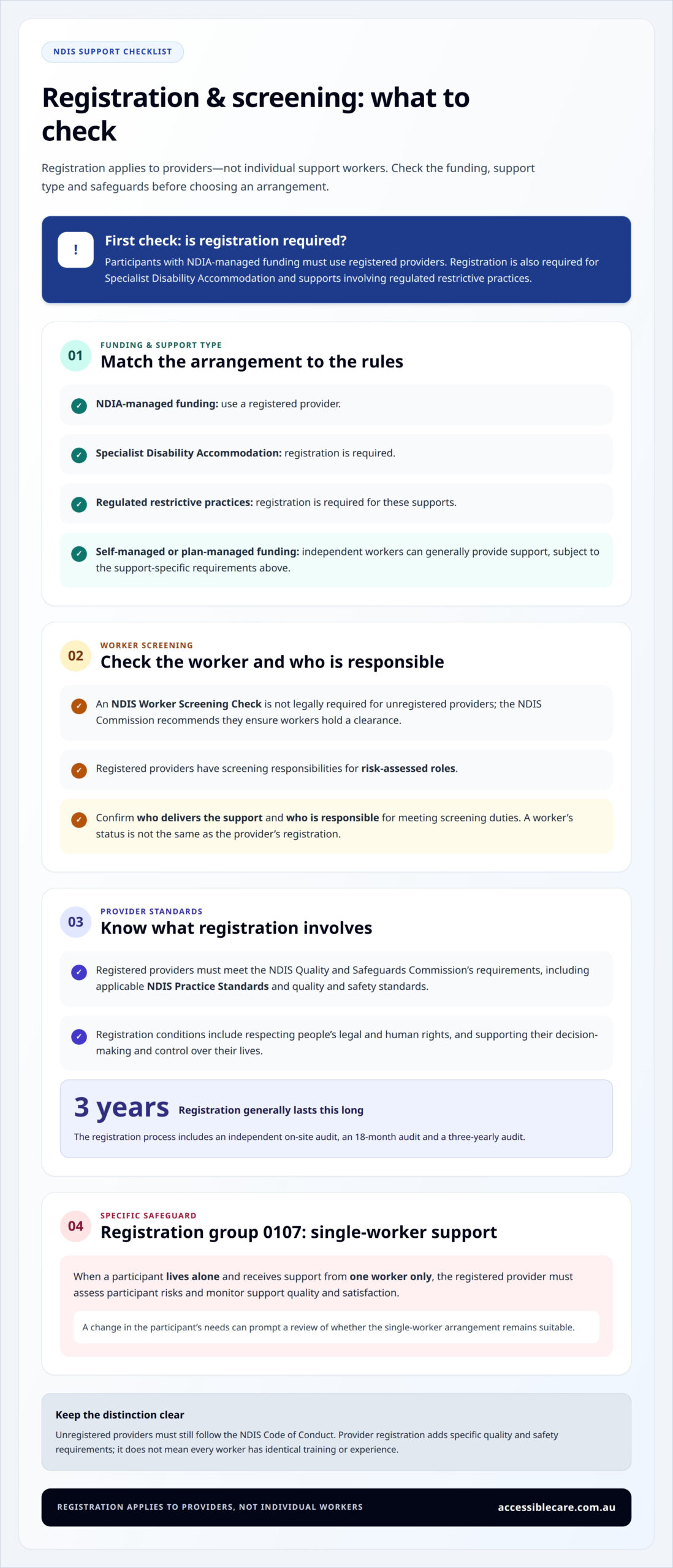
NDIS registration applies to providers, not individual support workers. Registration status matters because some supports and funding arrangements require a registered provider.
Provider Obligations and Practice Standards
Registered providers must meet the NDIS Quality and Safeguards Commission’s requirements, including applicable NDIS Practice Standards and quality and safety standards. These obligations set expectations for safe, competent support and respect for participant rights.
Under section 73F of the National Disability Insurance Scheme Act 2013, registration has conditions. Registered providers must demonstrate respect for people’s legal and human rights, and support their decision-making and control over their lives. Registration generally lasts 3 years and includes an independent on-site audit, an 18-month audit and a three-yearly audit.
Registration also brings worker-screening responsibilities for risk-assessed roles. The provider is responsible for meeting those requirements; individual workers do not hold NDIS registration. Distinguish the provider’s registration from the screening status of the person delivering your support.
Finding and Checking Support Workers and Providers
To assess a support arrangement, first identify who the provider is and whether registration is required for the support or funding involved. Participants whose funding is managed by the NDIA must use registered providers. Specialist Disability Accommodation and supports involving regulated restrictive practices also require registration.
Then distinguish provider status from worker screening. An NDIS Worker Screening Check isn’t legally required for unregistered providers, but the NDIS Commission recommends that they ensure workers hold a clearance. Registered providers have screening responsibilities for risk-assessed roles, so be clear about who delivers the support and who is responsible for meeting those duties.
For example, an independent worker may be unregistered while a participant self-manages funding. That doesn’t make the worker registered, or remove the Code of Conduct obligations applying to unregistered providers. Registration conditions are set out in section 73F, while section 73E of the Act contains information about registered NDIS providers. Those provisions help clarify what registration means, but not every individual worker is registered in their own right.
Training, supervision and backup arrangements
Training and supervision can differ between individual workers and provider teams. Unregistered providers and workers may lack professional training and aren’t required to follow NDIS quality standards. However, unregistered providers must still follow the NDIS Code of Conduct. The Code sets conduct expectations, while provider registration also involves meeting specific quality and safety standards.
A registered provider must continue meeting the NDIS Quality and Safeguards Commission’s requirements. This provides an organisational framework for safe, competent support, but doesn’t mean every worker has identical training or experience. Make sure the practical arrangements explain who coordinates support, how changes are communicated, and who is responsible if a worker cannot attend.
Registration group 0107 has a specific safeguard for some personal support arrangements. When a participant lives alone and receives support from one worker only, the registered provider must assess participant risks and monitor support quality and satisfaction. For example, a change in the participant’s needs can prompt a review of whether a single-worker arrangement remains suitable. This focuses attention on the participant’s circumstances, not simply the roster.
Backup planning matters in either arrangement. If an independent worker becomes ill, you may be left without backup support. A missed visit could interrupt a planned community activity or daily routine. A provider may be able to coordinate an alternative worker, but this depends on its arrangements. In a brokerage arrangement, the registered provider remains responsible for supports delivered under its registration, including contracted support. The arrangement should make clear who delivers your support and who holds responsibility. Clear roles help you know where to raise a concern or report a change in support.
When independent support workers must register
Registration depends on the support, funding arrangement and provider’s role, not the worker’s job title. Under the NDIS, registration applies to providers rather than individual support workers.
Subsection 33 (6) of the NDIS Act requires providers to register when they support participants whose funding is managed by the NDIA, provide Specialist Disability Accommodation, or use regulated restrictive practices. A worker operating independently may therefore need to register as a provider if their work falls into one of these categories.
Plan-managed and self-managed participants can usually use registered and unregistered providers. An independent worker may therefore be an option under those funding arrangements, unless the support itself requires registration. For example, a participant’s funding management does not remove the registration requirement for Specialist Disability Accommodation.
Other supports also have registration requirements. Specialist behaviour support providers and providers implementing restrictive practices must register. Registration is also required for plan management and NDIS digital platforms. A platform falls into that category only when its main purpose is connecting participants with supports from their plans; the platform is responsible for meeting the registration requirement.
Supported Independent Living has specific registration changes. Registration became mandatory for new SIL providers from 1 July 2026. Existing unregistered SIL providers had to apply by 1 October 2026 or stop providing SIL. These requirements concern providers, not every worker delivering support through them.
As of September 2026, most independent support workers didn’t need NDIS Commission registration unless they supported participants with NDIA-managed funding or delivered support requiring registration. Expanded mandatory registration is scheduled to begin in July 2027, with all providers in scope required to register by December 2030. The practical takeaway: establish who the provider is, how funding is managed, and whether the support type triggers registration before agreeing to an arrangement.
Accessible Care: Support work
Accessible Care can help if you’re looking for support work that respects your goals and daily choices. As a registered NDIS provider, Accessible Care offers NDIS Support Services and Support Work, helping participants and families consider support in the context of their needs.
This can be a helpful next step when you want to discuss how support could fit your NDIS plan, routines or community participation. Accessible Care also offers Speech Therapy and Occupational Therapy for people seeking related therapeutic support.
Choosing support is personal. A conversation can help you explain what matters to you and explore whether the service aligns with your priorities. Contact Accessible Care to discuss your support needs.
Choose support that fits your priorities
Choosing between an independent support worker and a registered provider is also an opportunity to define what meaningful support looks like for you. Consider which routines, relationships and personal goals you want support to make possible. Your preferences can guide a conversation about the approach that feels right for your life.
Accessible Care offers NDIS Support Services, Speech Therapy and Occupational Therapy. These options can support people whose needs extend beyond day-to-day assistance, including needs related to communication, daily activities and broader NDIS support.
If you’re ready to talk about your support needs and priorities, contact Accessible Care for support.
Your choices matter. A thoughtful next step can help you move forward with greater clarity and confidence.
Frequently Asked Questions
What is a registered NDIS provider?
A registered NDIS provider is an organisation or individual registered to deliver NDIS supports under the scheme. Registration applies to the provider, not each support worker they employ or engage. For example, a registered organisation may arrange for a worker to deliver your support, while the provider remains responsible for supports delivered under its registration.
What is the difference between an independent support worker and a registered NDIS provider in Australia?
An independent support worker generally works directly with participants, while a registered provider is the NDIS-registered entity responsible for delivering supports under its registration. An independent worker may have an Australian business number and work directly with customers. The distinction affects who arranges your support and who holds provider responsibilities, not simply who attends each visit.
Does an independent support worker need to register with the NDIS Commission?
An independent worker must register if they provide supports to participants with NDIA-managed funding, provide Specialist Disability Accommodation, or use regulated restrictive practices. Registration is also required for some support types, including specialist behaviour support. Otherwise, an independent worker may support self-managed or plan-managed participants without registering, provided the support itself doesn’t trigger a registration requirement.
Which NDIS participants must use registered providers?
Participants whose NDIS funding is managed by the NDIA must use registered providers. Registration is also required for certain support types, regardless of whether a participant’s funding is plan-managed or self-managed. For instance, Specialist Disability Accommodation requires a registered provider. Consider both how funding is managed and whether the support falls into a category with mandatory registration.
What checks and qualifications should an independent support worker have in Australia?
Consider the worker’s experience and training in relation to the actual support tasks, such as assistance with personal care or community activities. An NDIS Worker Screening Check isn’t legally required for unregistered providers, but the NDIS Commission recommends that they ensure workers hold a clearance. Discussing relevant experience and screening can help you assess whether the worker’s background suits the support arrangement.
What are the risks of hiring an independent support worker versus a registered provider?
With an independent worker, consider how support will continue if they become unavailable and whether insurance covers incidents. A missed visit could disrupt a planned community activity. Registered providers have defined quality and safety obligations, while unregistered providers may not undergo routine compliance audits. Weigh these safeguards alongside the rate, your support needs and the importance of continuity.

