


After-school care isn’t automatically covered by the NDIS. NDIS after-school support may be funded when it relates to a child’s disability needs and goals and is funded as reasonable and necessary. This could include a support worker helping a child participate in care outside school hours.
It’s understandable to want a clear picture of what support could look like for your child and how it might fit around family routines. This guide explains what after-school programs can include, how a funded worker may help before or after school, and what to consider when reviewing a child’s NDIS plan. It also covers how support can encourage participation, daily living skills and confidence, while helping families understand their options.
Key Takeaways
- Explore how after-school programs can support participation, daily routines and a child’s individual needs.
- Learn what to consider when reviewing a plan for support outside school hours.
- Understand how a funded support worker may assist before or after school, including with transport where the plan allows.
- See how eligibility and funding depend on the child’s disability-related needs, goals and funded supports.
What is NDIS After School Care?
NDIS after-school care is tailored support for children with disability outside regular school hours. It may take place in an out-of-school-hours care program or involve an additional worker helping a child participate in mainstream care. Support could include help with eating, hygiene or mobility, as well as opportunities to practise social skills through interaction and community participation.
Two NDIS budget categories may fund before- and after-school care: Assistance with Social, Economic and Community Participation and Assistance with Daily Life. The plan doesn’t always need to name before- and after-school care specifically. The support must be funded, reasonable and necessary for the child’s goals. A worker may assist a child at a mainstream service, helping them join activities and manage daily routines.
Out-of-school-hours care and school holiday programs commonly serve children aged 5 to 12 years. Activities may include arts and crafts, board games, outdoor play, music or sensory play. The Australian Government’s Inclusion Support Program can provide training, equipment and additional educators to eligible care services. NDIS-funded services don’t qualify for the Inclusion Support Program or Child Care Subsidy. For approved care, the Child Care Subsidy can reduce eligible families’ fees, including for care before and after school.
Other options include mainstream school care, school holiday programs and local community activities. Families may also explore approved care with Child Care Subsidy support. State and local offerings vary, though dedicated child-care centres such as Kool Kids Daycare highlight how structured daily programs and nurturing routines can support children’s development and social engagement.
To request NDIS funding or a plan change, explain how after-school support relates to the child’s disability needs and goals, and provide supporting information for consideration. Describe the setting, the assistance needed and how it would enable participation.
Useful evidence may include reports from professionals familiar with the child, such as a therapist, and examples of their daily support needs. Explain why existing care arrangements don’t meet those needs and how the requested support would help the child work towards their goals.
Under the Disability Discrimination Act 1992, out-of-school-hours care and school holiday providers must make reasonable adjustments for children with disability, according to the Australian Government, Federal Register of Legislation.
Benefits for families and carers
A consistent after-school plan can make the transition from school to home easier to organise. A child might need time to decompress, help with a snack or support moving from the classroom into a group activity. Agreeing on routines with the care team gives everyone clearer expectations. The child can practise familiar steps, and families can have a more predictable handover at the end of the school day.
For children, participation means more than simply being present. A support worker can help a participant join a board game, invite a peer to play or follow instructions during an activity. These everyday moments offer opportunities to practise communication, social skills and decision-making. Support should reflect the child’s preferences, giving them choices and room to build confidence without directing every interaction.
Families may also gain time to manage work, appointments, household tasks or the needs of other children. A clear plan can identify who supports the child, what assistance is useful and how important information is shared at pickup. For example, noting that a child needs prompting to eat or extra time to move between activities can help carers provide continuity. The aim is practical disability support that complements, rather than replaces, family care.
To make the arrangement useful, families can agree on simple goals with the child and support team. These might include choosing an activity, joining a group, or completing part of an after-school routine with less prompting. Review what is working and adjust the approach as needs change. If understanding funded support would help clarify the next steps, explore NDIS support options and how they may relate to your family’s routines.
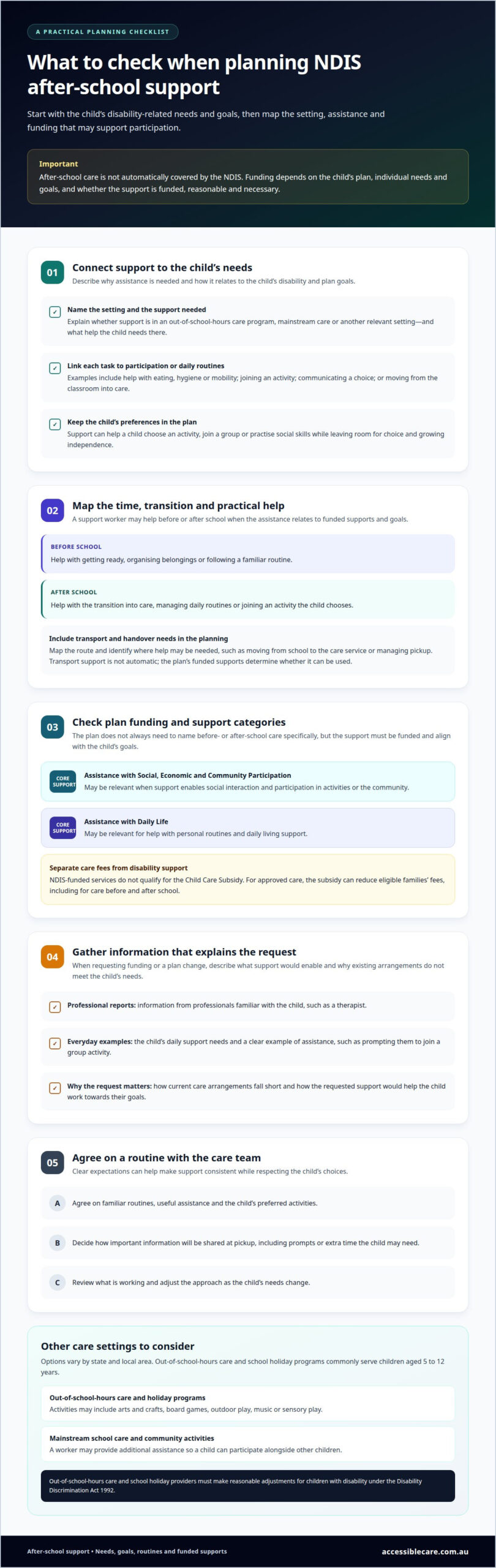
NDIS-funded support workers before and after school
A support worker may help a child use Core Supports before or after school. The assistance should relate to the child’s disability needs and funded goals. Before school, this could mean help getting ready, organising belongings or following a familiar routine. After school, a worker could support the transition from the classroom into care and help the child join an activity of their choice.
At a mainstream care service, an additional worker may help a child participate alongside other children. For instance, they could help the child understand an activity, communicate a choice or join a recreational game. Assistance with Social, Economic and Community Participation may be relevant when support enables social interaction. Assistance with Daily Life may apply to help with personal routines.
Transport needs can also be part of planning. Assistance to and from a school care service may be available through an NDIS plan, depending on its funded supports. Families can map the route and identify where help is needed, such as moving from school to the service or managing the handover. Transport support isn’t automatic; the plan’s funded supports determine whether it can be used.
To work out how a support worker could fit, describe the practical help needed before or after school. Note the setting, transition points and what the child wants to do. A clear example, such as needing a prompt to join a group activity, shows how support relates to participation. Connect each task to the child’s plan goals rather than treating the worker as general childcare.
Families can discuss how support will be delivered with the care service and worker. Agree on routines, handover communication and the child’s preferred activities. This helps keep assistance consistent while respecting the child’s choices and growing independence.
Who is eligible for NDIS after-school support?
A child’s disability doesn’t automatically mean their after-school care will be funded by the NDIS. The child needs an NDIS plan with funding that can be used for the requested support. Funding depends on the child’s individual needs and goals, and whether the support is funded and reasonable and necessary for those goals.
Start by reviewing the plan’s funded supports. Before- and after-school assistance may fit under Assistance with Social, Economic and Community Participation or Assistance with Daily Life. A child might need help with daily routines or support to join a group activity. The plan doesn’t always need to name before- and after-school care specifically, but the support type must be funded and connected to the child’s goals.
Age alone doesn’t establish NDIS funding eligibility. Australian out-of-school-hours care programs usually cater for children aged 5 to 12 years, while the Child Care Subsidy can support children with disability aged 14 to 18 years. These programs and subsidies have different purposes. The Child Care Subsidy may reduce fees for eligible families using approved care, but it doesn’t replace NDIS-funded disability support.
Evidence can help explain why support is needed in this setting. Include the child’s specific assistance needs, the activities they want to join and the barriers they face without support. For example, describe whether they need help communicating choices, managing daily routines or moving between school and care. Link each example to a plan goal rather than making a general request for childcare.
For an NDIA-managed plan, the participant must use a registered NDIS provider. The plan’s management type therefore affects which provider can deliver funded support. Reviewing the management details alongside the relevant budget can clarify the next step. Discuss your child’s support needs and how they relate to their NDIS goals.
Accessible Care: NDIS Support Services
Accessible Care can help families consider NDIS support options when a child needs assistance to work towards their goals. Its NDIS Support Services and support work may suit families exploring practical disability support around school routines.
Depending on a child’s needs, Speech Therapy, Occupational Therapy or Positive Behaviour Support may also relate to communication, daily activities or behaviour goals. These services are distinct from general childcare. A useful next step is to consider which goals the child wants to work towards and what support could help them participate with greater independence.
If you’d like to discuss your child’s support needs and possible next steps, contact Accessible Care.
Take the next step at your family’s pace
Planning NDIS after school support can start with one practical question: what would help your child feel more included in the afternoon? You might focus on an easier transition, support with communication or helping your child join activities they enjoy. A small, clear goal can make conversations about support more focused and centred on your child’s preferences.
Accessible Care offers NDIS Support Services, Speech Therapy and Occupational Therapy. These supports may be relevant when your family is considering assistance with a child’s daily participation, communication or functional goals. The next step should reflect your child’s needs and respect their choices.
If you’re ready to talk through possible support, contact Accessible Care to discuss support. Your family can take the next step with care, clarity and your child’s goals in view.
Frequently Asked Questions
Does the provider need to be registered?
For an NDIA-managed plan, yes. The participant must use a registered NDIS provider for funded support. Before arranging after-school assistance, identify how the child’s plan is managed to clarify which provider requirements apply. For example, families using an NDIA-managed plan need a registered provider to deliver support claimed through that plan.
What NDIS funding can cover after-school support for children in Australia?
NDIS funding may cover disability-related support that helps a child participate after school and meets their plan requirements. Relevant budgets can include Assistance with Daily Life and Assistance with Social, Economic and Community Participation. A support worker might assist with personal routines or joining a group activity. Transport to or from care may also be available if the plan includes suitable funded support.
Can NDIS funding pay for after-school care or OSHC fees?
NDIS funding may cover additional disability-related support at a mainstream OSHC service, rather than simply paying for attendance. For example, a child may need an extra worker to help them participate. The Child Care Subsidy can reduce fees for eligible families using approved care. NDIS-funded services don’t qualify for the Child Care Subsidy or the Inclusion Support Program.
What support worker services can be funded after school under the NDIS?
A plan may fund a support worker to assist with disability-related needs after school. This could include help with eating, hygiene or mobility, or support to join an activity the child chooses. Families can describe the tasks, setting and related goals to distinguish specific disability support from general supervision or ordinary childcare.
How do NDIS plans fund after-school support: Core Supports, budgets and line items?
Core Supports can fund a worker before or after school when the plan includes appropriate funding. Assistance with Daily Life and Assistance with Social, Economic and Community Participation are relevant budget categories. Match the requested help to its purpose, such as managing daily routines or joining a community activity. The plan’s available budget and funded supports guide how the funding can be used.
How to find and choose an NDIS after-school support provider in Australia?
Look for support work that aligns with the child’s plan goals and the tasks they need help with after school. Clarify the worker’s role, the activities the child wants to join and how school-to-care handovers will work. Accessible Care offers NDIS Support Services and support work, with personalised, NDIS-aligned services focused on independence and everyday participation.

