


The highest listed NDIS price is a limit, not a compulsory charge. NDIS support worker agency costs may be lower, depending on the support you need and when it is delivered. Evening, weekend and public holiday shifts may cost more than weekday daytime support.
It’s understandable to want a clear picture before arranging support. Your plan management type, choice of worker and whether support is shared can all affect how funding is used, so the listed limit is only part of the picture.
This article explains how these factors shape support costs in Australia, including when penalty rates apply and how shared support can affect the cost per participant. You’ll also learn what to consider when choosing support that fits your needs and goals.
Key Takeaways
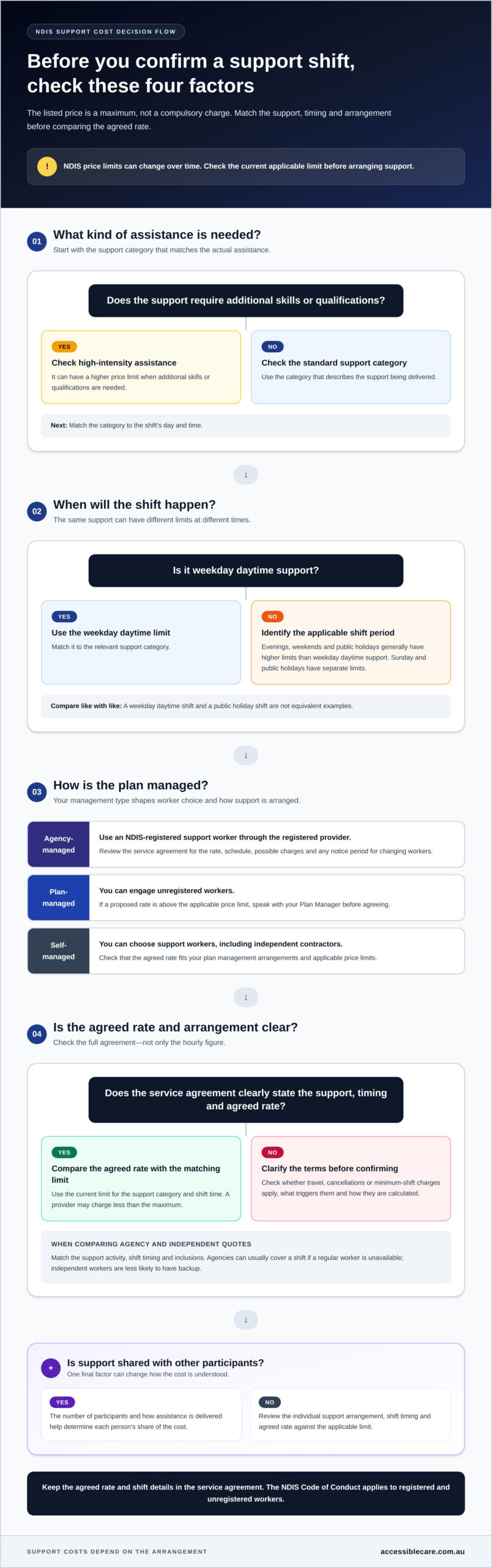
- Compare the applicable price limit with the type and timing of support, including any higher-intensity needs, to understand what shapes a shift’s cost.
- Your plan management type affects which workers you can engage and how supports are arranged.
- Agency and independent support can differ in worker choice and continuity if a regular worker can’t attend.
- With shared support, the number of participants and how assistance is delivered help determine each person’s share of the cost.
Penalty rates for evenings, weekends and public holidays
NDIS price limits set maximum charges, not compulsory rates. NDIS price limits can change over time, so check the current rates before arranging support. A provider may charge less than the applicable limit, so the maximum alone doesn’t determine what your support costs. Your support type and the time it’s delivered both matter.
Evening, weekend and public holiday support generally has higher price limits than weekday daytime assistance. For example, a Saturday personal care shift may have a different limit from the same support on a weekday. Sunday and public holiday shifts also have separate limits. Check that your service agreement clearly describes the support, timing and agreed rate.
High-intensity assistance can have a higher price limit than standard support when it requires additional skills or qualifications. The difference reflects the nature of the assistance, not simply the time of day. When planning your funding, consider both your support needs and the roster, especially if a shift falls on a public holiday.
Independent workers may agree to a different hourly rate from an agency. The rate still needs to fit your plan management arrangements and applicable price limits. If a proposed rate is above the limit, participants with plan-managed funding should speak with their Plan Manager before agreeing. Record the agreed rate and shift details in the service agreement.
Before confirming a shift, match its day and time to the relevant support category and price limit. Then compare that maximum with the rate in your service agreement. This makes it easier to understand how evening or weekend bookings may affect your funding. The NDIS Quality and Safeguards Commission requires all workers, registered or not, to follow the NDIS Code of Conduct.
Agency, plan-managed and self-managed plans
Your plan management type affects which support workers you can engage and how your funding is handled. It also shapes the practical steps involved in arranging support.
Travel, cancellation and minimum-shift charges do not have one universal rate. An agency’s service agreement can explain whether these charges apply and how they are calculated, so consider those terms alongside the hourly rate.
Service Agreements and Budget Management
A service agreement records the supports arranged and the terms agreed with a provider. The agreed rate, schedule and any applicable charges affect how quickly your NDIS plan funding is used. For example, regular evening shifts may draw on funding differently from occasional daytime support. Families and coordinators can use the agreement to understand the arrangement and plan ongoing support.
With self-managed funding, participants can choose support workers, including independent contractors. Plan-managed participants can also engage unregistered workers, while agency-managed participants must use an NDIS-registered support worker. These arrangements affect worker choice and how support is organised. Whatever the plan management type, support should match the participant’s needs and available funding.
For plan-managed support, speak with your Plan Manager before agreeing to a rate above the price limit. Agency-managed participants receive support workers through their registered provider. If you are considering a worker change, review the service agreement for any notice period. This helps participants and families plan a transition without overlooking agreed terms.
Additional Agency Charges
Travel, cancellations and minimum shifts are possible charges to clarify in the service agreement. The terms depend on the arrangement, so look for what triggers each charge and how it is calculated. For instance, a cancellation clause should explain the circumstances it covers. Clear terms help you understand the potential effect on your budget before support is scheduled or changed.
Compare the full terms of the agreement, not just the hourly rate. This gives you a clearer picture of how the support arrangement fits your funding.
Hourly cost differences between agency and independent workers
Agency and independent workers may have different hourly rates. Compare the same support activity and shift timing to see what each quote includes.
Maximum Hourly Price Limits
NDIS price limits are maximum charges for a support, not fixed prices every provider must charge. They matter because the relevant limit depends on the support category and delivery time. The NDIS Support Catalogue 2026-27 separates standard and high-intensity assistance, as well as weekday daytime, evening and weekend supports. Use the matching category when reviewing an hourly quote.
For example, assistance with self-care has different national price limits for weekday daytime and Saturday support. A quote below the applicable cap may still vary between providers. NDIS price limits change over time, so compare quotes against the catalogue that applies on the date of support, rather than relying on an older figure.
Comparing Registered and Unregistered Agencies
Compare providers by matching the support activity, shift time and service inclusions, then consider whether each provider is registered. Your plan management type affects which workers you can engage. This approach clarifies what the hourly rate covers, rather than treating a lower quote as directly equivalent to another.
With an independent worker, consider how the arrangement handles continuity if they cannot attend. Agencies can usually cover a shift when a regular worker is unavailable, while independent workers are less likely to have backup. This can matter when participants and families are planning regular activities.
To compare fairly, note the support category, time of day and any additional arrangements included in each quote. A weekday daytime shift and a public holiday shift are not like-for-like examples. Worker qualifications also matter for high-intensity assistance, which has higher price limits when additional skills or qualifications are needed. The NDIS Code of Conduct applies to registered and unregistered workers.
Support worker pricing for multiple participants
When one worker supports multiple participants, each person’s allocated cost depends on the shared arrangement. The support ratio, activities and time provided to each participant all shape how funding is used.
Sharing support does not mean every participant automatically pays an equal share. For example, two people may take part in the same community activity but need different levels of assistance. The agreed arrangement should reflect each person’s disability-related support needs and the service delivered, rather than simply splitting a shift evenly.
Timing still affects the maximum price. These limits apply to the relevant support, not automatically to every shared arrangement.
Location also matters. NDIS regional loadings can reach 50% in remote areas. A participant’s location can therefore affect the applicable maximum, alongside the support type and intensity.
NDIS support worker rates change every 1 July, and the National Disability Insurance Agency conducts an annual pricing review. The higher relevant price limit applies to the entire support when it doesn’t meet the listed time-of-day criteria. For shared weekday daytime assistance, this means the timing criteria can affect which maximum applies across the support, rather than only part of the shift.
Before agreeing to shared assistance, clarify how the arrangement allocates worker time and costs between participants. You can explore support options suited to your needs and routine.
Accessible Care: NDIS Support Services
Accessible Care provides support work through its NDIS Support Services, with arrangements shaped around your needs, goals and NDIS plan. The service sits alongside Speech Therapy and Occupational Therapy.
When discussing support, share the activities you want help with, your preferred times and whether you are considering individual or shared assistance. These details help shape support around your priorities and make the service arrangement easier to understand.
If you’re weighing up options after reviewing price limits and plan management, Accessible Care can be a next step for discussing support needs. Contact Accessible Care to talk about the support you’re looking for.
Choose support that fits your next steps
Planning support involves more than settling on an hourly rate. Understanding NDIS support worker agency costs can help you consider how an arrangement fits your priorities, routines and longer-term goals. A useful next step is to identify what you want assistance to help you do in everyday life.
Accessible Care offers NDIS Support Services, including Speech Therapy and Occupational Therapy. As you consider NDIS support worker agency costs, you can also think about which supports align with your goals. If you’re ready to discuss your options, contact Accessible Care. Keep your choices at the centre as you decide what comes next.
Frequently Asked Questions
How do agencies calculate charges for NDIS clients?
Agencies set charges based on the support category, delivery time and assistance required. The NDIS price limit is a maximum for the relevant support, while the agreed rate may be lower. For example, a quote may differ depending on whether a worker provides standard self-care assistance or higher-intensity support. The service agreement can also explain how scheduled hours, shared support and any agreed additional charges are handled.
What does this support actually cover?
NDIS support work can include assistance with self-care, personal domestic activities and participation in everyday activities, depending on a participant’s plan and support needs. This might mean help with personal routines or practical assistance to take part in the community. Different activities can have different price limits, so the support category matters. The agreed service should relate to the participant’s goals and required assistance.
What are the current NDIS price limits for support workers in Australia?
These limits took effect on 1 July 2026. Other categories, such as high-intensity support, have different caps. Match the support type and shift timing to the applicable limit rather than treating one figure as universal.
How much do NDIS support worker agencies charge per hour, including agency fees?
There is no single hourly agency charge that applies to every participant or shift. The applicable NDIS price limit is a ceiling, not a compulsory rate, and the agreed charge depends on the support category and timing. Review the quote and service agreement to see what the hourly rate covers. If travel, cancellations or minimum shifts are relevant, the agreement should explain the terms.
Do NDIS support worker prices differ for weekdays, evenings, weekends and public holidays?
Yes. Price limits can vary by shift timing, with separate limits for weekday daytime, evenings, weekends and public holidays. For example, standard self-care assistance has different maximums for weekday daytime and Saturday shifts. If a shift does not meet the listed time-of-day criteria, the higher relevant price limit applies to the entire support. This distinction can affect how a shift is priced.
How do agency-managed, plan-managed and self-managed NDIS support worker costs compare?
Plan management affects worker choice and how payments are arranged, but it does not set one fixed price for each option. Agency-managed participants use registered providers, while self-managed participants can engage independent contractors. Plan-managed participants may also use unregistered workers. Compare the same support activity, timing and service terms to assess rates fairly. For a proposed rate above the limit, plan-managed participants should speak with their Plan Manager before agreeing.

