


Transport funding is not one all-purpose travel budget. The NDIS transport funding rules provide three recurring funding levels for eligible participants, with the level based on factors such as work, study, day-program attendance and community access. This funding is separate from support worker travel costs when a worker helps deliver a support.
It can be hard to tell which travel costs belong in which part of an NDIS plan. The key distinction is whether funding supports your own disability-related transport needs or helps a worker deliver an agreed support.
This article explains who may be eligible, what recurring transport funding covers and when a support worker can drive or accompany you. It also clarifies how general transport funding differs from specialised support, helping you understand which arrangements may fit your needs.
Key Takeaways
- Learn how recurring transport funding differs from travel costs for a provider delivering face-to-face support.
- Understand which activities and support needs can affect eligibility and the funding level included in a plan.
- See when a support worker may drive or accompany you, and which travel costs may need to be agreed in advance.
- Compare general transport assistance with specialised supports, such as vehicle modifications or accessible transport arrangements.
What Is NDIS Transport Funding?
NDIS transport funding can support a participant’s disability-related travel, while provider travel relates to delivering an agreed support. Keeping these separate helps clarify what a plan may fund and how a provider should charge.
Participant Transport and Provider Travel
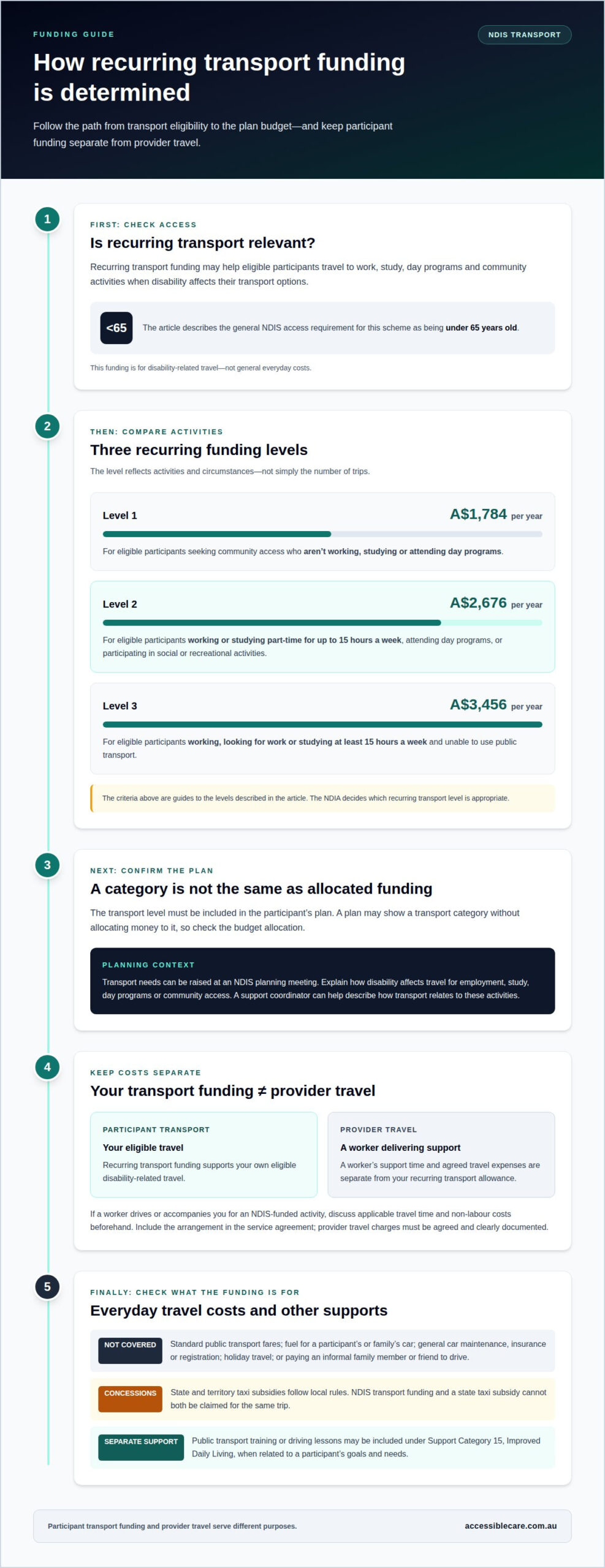
Participant transport funding supports your own eligible travel; provider travel covers a worker’s travel to deliver face-to-face support. This distinction matters because the funding and charges relate to different needs. For example, recurring participant transport funding is separate from a provider’s claim for travel time or reasonable transport costs. Provider travel charges must follow current NDIS pricing arrangements and be agreed with the participant.
This is not the participant’s recurring transport payment.
Receipts, Reimbursements and Provider Invoices
Receipts document expenses, reimbursements return eligible costs, and provider invoices itemise charges for delivered support or travel. These records help distinguish a participant’s transport spending from a provider’s claim. Provider travel must be clearly documented and invoiced, with charges agreed in advance and consistent with the service delivered.
Before a community visit, the participant and provider can agree on applicable travel time and non-labour transport costs. A clear invoice should show the travel charge rather than treating it as the participant’s recurring transport allowance. Keep receipts for personal records when they relate to a transport arrangement.
Provider and Community Transport
Provider transport involves a worker or provider helping a participant travel as part of a support. Community transport describes travel that enables access to activities and services. The distinction helps identify whether a cost relates to the participant’s transport needs or to delivering support.
For example, a worker travelling to provide face-to-face community support may claim agreed travel time and reasonable non-labour costs. A participant’s own transport funding is separate. If you cannot use public transport, the plan arrangements and purpose of each trip help determine which funding applies.
Concessions and Uncovered Transport Costs
NDIS transport supports address disability-related travel needs, while state and territory concessions subsidise eligible taxi fares under local schemes. Rules vary by jurisdiction. NDIS transport funding and a state taxi subsidy cannot both be claimed for the same trip.
The NDIS does not cover standard public transport fares, fuel for a participant’s or family’s car, general car maintenance, insurance, registration or holiday travel. Transport funding also cannot pay an informal family member or friend to drive. These limits distinguish disability-related transport support from everyday travel and household costs.
NDIS transport funding eligibility
Recurring transport funding may help eligible participants travel to work, study, day programs and community activities when disability affects their transport options. It supports disability-related travel, not general everyday costs. To meet the general NDIS access requirements described for this scheme, a person must be under 65 years old. Understanding the NDIS transport funding rules helps distinguish transport funding from other plan supports.
The National Disability Insurance Agency states that Level 2 transport funding is A$2,676 per year for eligible participants working or studying part-time for up to 15 hours a week, attending day programs, or participating in social or recreational activities. The funding level reflects activities and circumstances, rather than simply the number of trips made.
There are three standard transport funding levels, shaped by a participant’s activities and ability to travel independently. Level 1 is A$1,784 per year for eligible participants seeking community access who aren’t working, studying or attending day programs. Level 3 is A$3,456 per year for eligible participants working, looking for work or studying at least 15 hours a week and unable to use public transport. These criteria help distinguish the levels.
The NDIA decides which recurring transport level is appropriate, and the funding must appear in the participant’s plan. A plan may include a transport category without allocating money to it, so check the budget allocation. Participants can raise transport needs at an NDIS planning meeting and explain how disability affects their travel. A support coordinator can help describe how transport relates to employment, study, day programs or community access.
Recurring transport funding is separate from other disability supports. Public transport training or driving lessons may be included under Support Category 15, Improved Daily Living, when they relate to a participant’s goals and needs. This can support greater independence, while recurring funding addresses eligible transport needs. The NDIS transport funding rules also distinguish these supports by their purpose and plan category.
Funding a support worker to drive or accompany a participant
A support worker may drive or accompany you when transport assistance supports an NDIS-funded activity. The worker’s time and trip expenses are separate from your recurring transport allowance.
Transport Allowances and Support Worker Travel
Your transport allowance supports your own eligible travel, while a support worker’s time is charged as support. A worker driving you may bill time under Core Supports, usually as Assistance with Social and Community Participation. For an outing, the agreed hourly rate covers the worker’s attendance and may include travel to and from your home.
A worker may also accompany or assist you during a taxi or Uber trip, with their support time potentially funded. Tolls, parking and public transport tickets may be additional travel costs. Discuss these beforehand and include the arrangement in your service agreement. A family member or friend cannot be paid as an informal support through the transport allowance.
Combining Transport with Other Supports
Transport assistance can form part of a support that helps you attend an appointment or take part in community activities. Provider assistance with transport for face-to-face community supports is funded under Core Supports, Category 2. This lets the plan support the activity and the worker’s assistance, rather than treating every trip as a separate allowance expense.
For example, a support worker may drive you to a social activity and assist you during the outing. The support time is billed from the relevant Core Supports budget. A provider may also claim agreed travel time and non-labour costs for delivering face-to-face support. These charges must follow current NDIS pricing arrangements and be agreed in advance.
Plan Management and Transport Decisions
Plan management affects how supports are paid, while support coordination can help connect transport needs with plan goals. To request transport funding, raise it at an NDIS planning meeting and explain how your disability affects your ability to travel. Describe how transport relates to work, study, appointments or community participation.
If you want a transport decision reviewed, explain the travel barriers and the activities you need to access. Relevant details include whether you can use public transport and how a support worker’s assistance relates to the activity. Focus on disability-related needs and the support required to attend. Family or carer travel costs aren’t the purpose of participant transport funding.
General and specialised transport funding
General transport funding helps eligible participants who cannot use public transport meet disability-related travel needs. It sits under Capacity Building, Category 4, and is distinct from specialised supports for a vehicle or driving needs. The practical difference is the purpose: general funding helps with access to activities, while specialised funding addresses a disability-related transport requirement.
Specialised vehicle support may include modifications that help a participant travel in a vehicle. The NDIS may fund modifications under Assistive Technology, Category 5, when they offer value for money and are considered reasonable and necessary. It won’t pay for the vehicle itself. A modification might address a specific access need, rather than general vehicle expenses.
Neither type of funding covers ordinary motoring costs such as fuel, maintenance, insurance or registration. The transport allowance also isn’t a general budget for standard public transport fares. These boundaries help distinguish disability-related support from routine travel expenses. For example, needing a vehicle modification is different from seeking help with everyday fuel costs.
Some specialised arrangements may address a temporary access need. The NDIS may fund short-term accessible car hire when reasonable and necessary, such as while a participant’s modified vehicle is being repaired or assessed. This differs from funding a permanent vehicle purchase. The reason for the hire and its connection to the participant’s disability-related needs are relevant.
Training can also sit outside recurring transport funding. Public transport training or driving lessons may be included under Support Category 15, Improved Daily Living. Specialised driver training may be funded as a Capacity Building support when disability-related needs require practice with a modified vehicle or safe driving with a disability. The key distinction is whether support addresses a specific disability-related barrier, rather than general transport expenses.
Accessible Care: NDIS Support Services
Accessible Care can help you explore disability supports aligned with your goals and NDIS plan. If transport barriers affect your participation, broader supports may help address related needs, but they do not replace transport funding or determine eligibility.
Through NDIS Support Services, you can access support work and therapeutic options such as Occupational Therapy, Speech Therapy and Positive Behaviour Support. These supports may be relevant when your goals involve daily activities, communication or behaviour support. The focus is on understanding what matters to you and supporting greater choice and participation.
To discuss support options related to your goals, contact Accessible Care.
Make your next support decision with confidence
Transport planning can be part of a wider conversation about the life you want to lead. Consider how getting to appointments, learning opportunities or community activities connects with your personal goals. This context can help make discussions about your NDIS plan more focused and person-centred.
Understanding the NDIS transport funding rules is one part of making informed choices. Next, consider what support could help you work towards your goals, alongside any transport arrangements in your plan. Accessible Care offers NDIS Support Services, including Speech Therapy and Occupational Therapy, which may be relevant to broader support needs.
If you’re ready to talk through the supports that matter to you, contact Accessible Care to discuss your options. Your goals and preferences can guide the conversation, one step at a time.
Frequently Asked Questions
Can my family or carer be reimbursed for driving me?
NDIS transport funding usually doesn’t reimburse family members or carers for driving. An exception may apply if the person is registered as a paid support worker under your plan and the travel is reasonable and necessary. For example, a family member driving informally is different from providing an agreed paid support. The funding is intended for your transport needs, not another person’s travel expenses.
Do the three annual amounts change?
The amounts discussed in this article are the annual levels for 2026. The National Disability Insurance Agency decides whether a level is appropriate, and transport funding must be included in your plan. A previous plan’s allocation doesn’t by itself show what your current plan includes. Look at the current plan budget to see whether transport funding is allocated and which level applies.
Does a carer automatically get transport costs reimbursed?
No. A carer doesn’t automatically receive reimbursement simply for driving you or attending an outing. The arrangement may differ when that person is engaged as a paid support worker under your plan and the travel is reasonable and necessary. For instance, an agreed support worker may claim support time for an outing, while an informal lift from a friend isn’t paid through your transport allowance.
What Counts as ‘Reasonable and Necessary’ Transport Support?
Transport support should relate to needs arising from your disability and help you access an activity or support. The trip’s purpose, your ability to travel independently and its connection to your plan goals help explain the need. Ordinary expenses such as fuel, car registration and family transport aren’t disability-related transport supports. For vehicle modifications, value for money and what is considered reasonable and necessary also matter.
Will the NDIS fund accessible car hire?
The NDIS may fund short-term accessible car hire when it is reasonable and necessary for disability-related needs. For example, you may need an accessible vehicle while your modified vehicle is being repaired or assessed. This differs from purchasing a vehicle, which the NDIS won’t fund. The purpose of the hire and its connection to your transport needs distinguish this support from general travel expenses.
What transport supports can the NDIS fund?
Depending on your plan and disability-related needs, supports may include recurring transport funding, a support worker’s travel assistance, vehicle modifications or short-term accessible car hire. Public transport training or driving lessons may also be included under Improved Daily Living. These supports serve different purposes: a modification addresses access to a vehicle, while training can build skills for travelling or driving more independently.

