

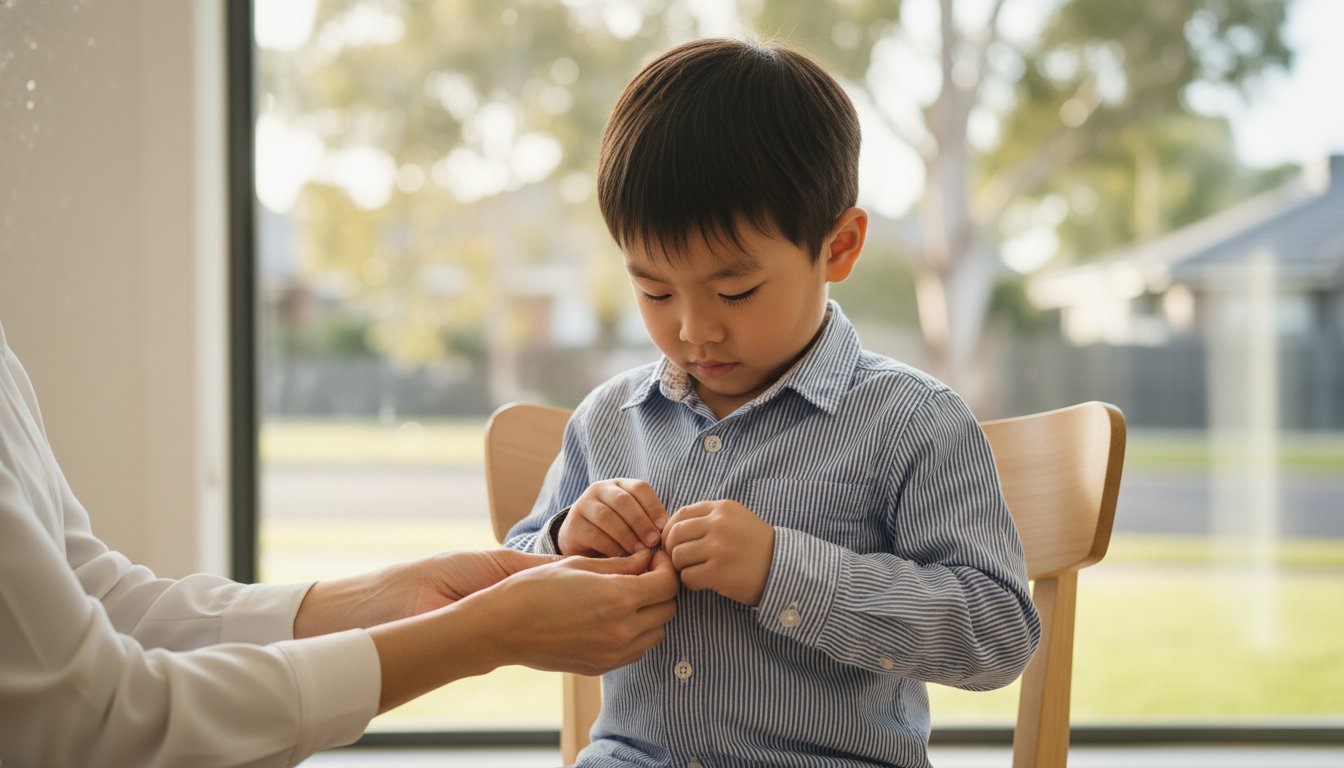
Last Tuesday, seven year old Leo sat at the kitchen table for 12 minutes, his face flushed with frustration as he struggled to loop a single button through his school shirt. It’s heartbreaking to watch a loved one struggle with tasks that should be simple, and it’s natural to feel anxious when milestones seem just out of reach. You want them to feel capable and confident, but the path through NDIS requirements often feels overwhelming and confusing.
This guide explores how occupational therapy fine motor skills development transforms these daily challenges into life changing victories. We’ll show you how a person centred approach builds the precision needed for independence, whether you’re buttoning a shirt or writing a letter. You’ll discover how the OT process works here in Australia, how to maximise your NDIS funding, and find three actionable exercises to try at home today. Together, we can turn frustration into confidence, one small movement at a time.
Key Takeaways
- Understand the vital connection between hand-eye coordination and daily independence, moving beyond simple hand strength to master functional dexterity.
- Discover how tailored occupational therapy fine motor skills support empowers participants of all ages, from toddlers reaching early milestones to seniors maintaining their autonomy.
- Learn about the “Just Right Challenge” and why engaging, play-based strategies lead to better outcomes and less frustration during your therapy journey.
- Navigate your NDIS journey with confidence by learning how mobile therapy brings professional care directly to your home or school for real-world results.
What Are Fine Motor Skills and Why Do They Matter?
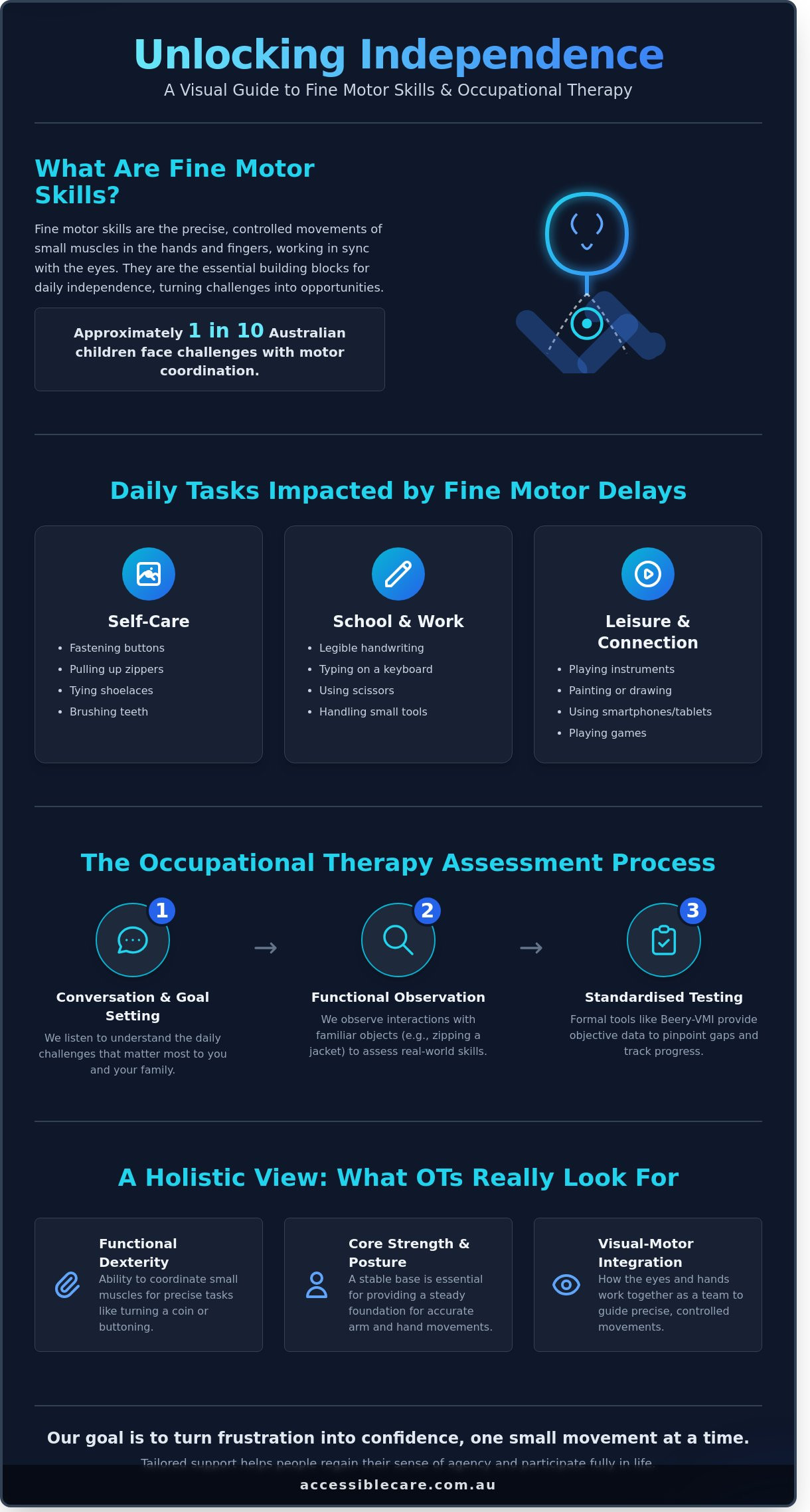
Fine motor skills involve the precise coordination of small muscles in our hands and fingers, working in harmony with our eyes. These movements might seem small, but they’re the essential building blocks for a person’s daily independence. When we talk about occupational therapy fine motor skills, we’re focusing on the ability to perform tasks that require high levels of control and accuracy. Without these skills, the world can feel like a place of constant obstacles rather than opportunities.
Hand-eye coordination plays a vital role in how we navigate our day. It allows us to reach for a cup, grasp a key, or catch a ball. For many, these actions happen without a second thought. However, for the approximately 1 in 10 Australian children who face motor coordination challenges, these tasks require immense effort. The struggle isn’t just physical; it’s deeply emotional. Difficulty with precision often impacts a person’s self-esteem. It can lead to feelings of isolation when someone can’t join in on social activities like drawing with friends or playing games. We believe that every person deserves to feel confident, and mastering these movements is a huge step toward that goal.
The Science of Small Movements
The human hand is a complex tool featuring 27 bones and a network of intricate muscles. Every time you pick up a pen, your brain’s motor cortex sends a flood of signals to these structures. This process relies on proprioception, which is your body’s awareness of its position in space. It’s what helps you know how much pressure to apply so you don’t crush a paper cup while drinking. Sensory processing serves as the hidden foundation here. If your brain doesn’t correctly interpret the feel of an object, it’s difficult to control your movements with the necessary grace.
Common Daily Tasks Impacted by Fine Motor Delays
When fine motor development is delayed, it ripples through every part of a person’s life. Our team focuses on practical goals that help participants live their lives their way. Some common areas where these delays show up include:
- Self-care: Fastening stubborn buttons, pulling up zippers, and the complex loops required for tying shoelaces.
- School and Work: Maintaining legible handwriting, typing efficiently on a laptop, and using scissors or staplers accurately.
- Leisure and Connection: Playing musical instruments, painting, or using the precise touch needed for a smartphone or tablet.
By addressing these challenges through tailored support, we help people regain their sense of agency. It’s about more than just movement; it’s about the freedom to participate fully in the community and enjoy the activities that bring joy to life. We’re here to listen and help you find the best path forward for your unique needs.
How Occupational Therapists Assess Fine Motor Challenges
Occupational therapy fine motor skills assessments are about much more than just hand strength. While a clinician might measure grip power with a dynamometer, they’re often more interested in functional dexterity. This is the ability to coordinate small muscles for precise tasks like threading a needle or typing. A person might have strong hands but still struggle with the in-hand manipulation required to turn a coin over or manage small buttons.
Our therapists take a holistic view of every participant. We know that fine motor control starts with a stable base. If a person has low core strength or poor posture, their arms and hands don’t have the steady foundation they need to move accurately. We also look at visual-motor integration; this is how the eyes and hands work together to guide movement. Identifying whether the root cause is a muscle weakness, a sensory processing issue, or a neurological challenge ensures the therapy plan is truly effective.
The Assessment Process: What to Expect
Every assessment begins with a conversation about your goals. We believe in your choice, your life, your way; so we listen to the daily challenges that matter most to you. The therapist will then use functional observations. They’ll watch how you or your child interacts with familiar objects, such as zipping a jacket or opening a lunchbox. This helps us see how skills translate to real-world independence.
Formal testing provides the objective data needed to track progress over time. We often use standardised tools like the Beery-VMI to look at visual and motor skills, or the DASH (Detailed Assessment of Speed of Handwriting) for students. These tests help us pinpoint exactly where the gaps are compared to developmental milestones.
The Link to Functional Capacity Assessments
The data gathered during these sessions is a vital part of your functional capacity assessment for NDIS reviews. When we document how fine motor delays impact your ability to dress, cook, or work, it helps the NDIS understand your reasonable and necessary support needs. This evidence is crucial for securing the right funding for your journey.
Professional reporting is essential for long-term success. It provides the evidence required to secure appropriate therapy hours and specialised equipment. If you’re feeling overwhelmed by the NDIS process, our compassionate team is here to help you navigate the paperwork with ease. Clear, professional documentation ensures your plan reflects the level of care and support you truly deserve to live an independent life.
Fine Motor Skills Across the Lifespan: From Toddlers to Seniors
It’s a common misconception that fine motor support is only for children struggling with their handwriting at school. While early intervention is vital, occupational therapy fine motor skills support is a lifelong resource that adapts to your changing needs. From the first time a baby picks up a pea to the moment a senior adapts their grip to continue painting, these skills are the foundation of personal agency. Our approach focuses on your goals at every age, ensuring you have the tools to live with dignity and purpose.
Paediatric Milestones and Early Intervention
Early detection of developmental delays can change the trajectory of a child’s life. Consider Sylvie, a toddler whose parents noticed she struggled to pick up small toys. By identifying these gaps early, we can address the pincer grasp, a milestone typically reached between 9 and 12 months. This tiny movement is the precursor to holding a pencil and feeding oneself. Research indicates that approximately 15% of children have a developmental disability, and early support is the most effective way to ensure school readiness.
Fine motor control is deeply linked to cognitive growth. When a child learns to manipulate blocks or thread beads, they aren’t just building hand strength; they’re learning problem solving and spatial awareness. Through paediatric occupational therapy, we use play as the primary tool for progress. Play makes the hard work of therapy feel like fun, which keeps children engaged and motivated to reach their milestones.
Adult Therapy: Restoring Dignity and Independence
For adults, the focus often shifts from development to restoration. Life can change in an instant due to a stroke or an acquired brain injury. Statistics show that roughly 65% of stroke survivors experience some level of hand impairment. This is where the science of neuroplasticity becomes a beacon of hope. Our OTs help the brain create new pathways to bypass damaged areas, teaching the hands how to move again through repetitive, task-specific training.
- Adaptive Strategies: We teach new ways to perform familiar tasks, such as one-handed dressing techniques or modified typing for those returning to work.
- Assistive Technology: When physical recovery reaches a plateau, we introduce tools like universal cuffs or voice-activated software to bridge the gap.
- Home Modifications: Simple changes, such as installing lever door handles instead of knobs, can restore a sense of control in your own space.
Managing degenerative conditions like Parkinson’s or Motor Neurone Disease (MND) requires a proactive strategy. We focus on maintaining dexterity for as long as possible to preserve your quality of life. Whether it’s using weighted utensils to manage tremors or ergonomic pens to reduce fatigue, the goal of occupational therapy fine motor skills intervention is always the same. We want to empower you to live your life, your way, with the respect you deserve.
Proven Occupational Therapy Strategies to Improve Precision
Occupational therapists use a method called the “Just Right Challenge” to help participants grow without feeling overwhelmed. If a task is too difficult, a person might give up. If it’s too easy, they won’t learn. By grading an activity, your therapist finds the sweet spot where roughly 75 percent of the task is manageable while 25 percent requires new effort. This balance is vital for building confidence while improving occupational therapy fine motor skills.
A common saying in the clinical world is “proximal stability for distal mobility.” This means you need a strong foundation in your shoulders and core to have precise control in your fingers. Without a stable base, tasks like writing or buttoning a shirt become significantly harder. OTs often include “heavy work” or weight-bearing exercises to strengthen these larger muscle groups first. It’s about building the body from the centre outward.
Success often depends on how we view the work. Therapeutic play is usually more effective than repetitive, clinical exercise because it keeps the brain engaged. When a child is “playing,” they’re actually building neural pathways. For adults, we focus on functional tasks that matter to you. We integrate these exercises into your daily routine, like reaching for a specific cup or using a key, to ensure long-term success in your own home.
Top Activities for Children
- Play-dough and putty: Squeezing, pulling, and hiding small beads inside putty builds the intrinsic hand muscles needed for a strong grip.
- Threading and tweezers: Using tweezers to move pom-poms or threading large beads onto a string refines the pincer grasp. This is the exact movement needed to hold a pencil or pull a zipper.
- Vertical surfaces: Drawing on a chalkboard or using stickers on a window forces the wrist into extension. This position naturally strengthens the hand more than working on a flat table.
Rehabilitation Exercises for Adults
- Object manipulation: Practising moving three A$1 coins from your palm to your fingertips one by one helps restore dexterity after an injury.
- Mirror therapy: This technique involves placing the unaffected hand in front of a mirror to trick the brain into “seeing” the affected hand move. A 2018 study published in the Journal of Stroke and Cerebrovascular Diseases showed this can significantly improve motor recovery after a stroke.
- Functional task practice: We use targeted repetition of specific movements, such as using a television remote or a house key, to help the brain relearn daily essentials.
Our compassionate team understands that every journey is unique. We listen to your goals and tailor our approach to occupational therapy fine motor skills to fit your lifestyle. Your independence is our priority, and we’re here to support you every step of the way.
Ready to build your independence with a team that truly cares? Contact Accessible Care today to learn about our personalised support options.
Accessing Support: The NDIS Journey with Accessible Care
Finding the right path to improve your child’s or your own independence doesn’t have to feel like a burden. The National Disability Insurance Scheme (NDIS) provides a clear framework to fund the specialized care needed to build lasting abilities. At Accessible Care, we walk beside you through every step of this journey. We ensure your funding translates into real-world progress that changes your daily life for the better.
We understand that every participant has a unique story. Our team focuses on creating a supportive partnership where you feel heard and valued. By bringing therapy into your natural environment, we help you or your loved one master occupational therapy fine motor skills in the places where they matter most, like the family dinner table or the school desk.
Navigating Your NDIS Plan
Most funding for fine motor support is found within the Capacity Building: Improved Daily Living budget category. This specific portion of your plan is designed to help you gain new skills that make everyday tasks easier and more manageable. Working with a registered NDIS provider ensures you’re choosing a team that meets strict Australian quality and safety standards. It also gives you peace of mind that your care is compliant and professional.
We prioritize detailed progress reports as part of our service. These documents are vital for your scheduled plan reviews. They provide the NDIS with clear evidence of growth, such as a 25 percent increase in grip strength or the ability to independently use cutlery. This data helps secure continued funding by showing exactly how your occupational therapy fine motor skills are developing over time.
Why Choose Accessible Care?
Our philosophy is simple: Your choice, your life, your way. We believe in providing care that honors your dignity and respects your personal goals. Because we offer a multidisciplinary team, you can access occupational therapists, speech pathologists, and nurses all under one roof. This holistic approach ensures every aspect of your well-being is supported by experts who communicate with each other to provide seamless care.
We currently support participants across Melbourne and Adelaide with mobile services that remove the stress of travel. Practicing skills in your own home or school isn’t just convenient; it’s more effective. It allows our therapists to suggest practical modifications to your actual environment, leading to faster results. If you’re ready to start this journey, get in touch with our compassionate team today. We’ll help you book an initial consultation to discuss your specific needs and begin building a plan for a more independent future.
Take Control of Your Daily Independence Today
Mastering small movements creates a significant impact on your quality of life. From early childhood development to maintaining dexterity in later years, precision is the key to personal freedom. Our experienced multidisciplinary team in Melbourne and Adelaide works closely with you to create tailored strategies that fit your lifestyle. We believe in a person-centred approach where your unique goals lead the way. Accessing professional occupational therapy fine motor skills support ensures that daily tasks like writing, cooking, or self-care become easier and more natural. As a Registered NDIS Provider, we handle the complexities of the system so you can focus on your progress. We’ve supported participants across Victoria and South Australia in achieving their milestones with dignity and respect. Every goal you reach is a step toward the life you choose. You don’t have to face these challenges alone when expert support is just a conversation away. Your choice, your life, your way starts with a partner who truly listens to your needs. We’re here to help you move forward with confidence.
Empower your independence, book an OT consultation with Accessible Care today
Frequently Asked Questions
What are some signs that my child might need occupational therapy for fine motor skills?
Can an adult regain fine motor skills after a brain injury or stroke?
Adults can definitely regain fine motor skills after a stroke or brain injury by using the brain’s ability to rewire itself. Our therapists use repetitive task practice and movement therapy to help you rebuild those neural pathways. Data from the Stroke Foundation Australia indicates that 65 percent of survivors face upper limb challenges, but consistent therapy significantly improves the functional use of hands and fingers.
How long does it typically take to see improvement in fine motor control?
You will typically start to see noticeable improvements in fine motor control within 8 to 12 weeks of consistent therapy. Every person’s journey is unique, so we’ll work with you to set realistic milestones based on your specific goals. While some participants see small wins in the first month, reaching complex goals like legible cursive or independent dressing often requires 6 months of dedicated practice.
Does the NDIS cover occupational therapy for fine motor delays?
The NDIS generally covers occupational therapy for fine motor skills if it’s a reasonable and necessary support for your disability. Funding usually comes from your Capacity Building budget under the Improved Daily Living category. We can help you navigate your plan to ensure you’re using the A$193.99 hourly rate, as per the current NDIS Price Guide, to achieve the best possible outcomes for your independence.
What is the difference between gross motor and fine motor skills?
Gross motor skills involve the large muscles used for walking or jumping, while fine motor skills focus on the small muscles in your hands and wrists. You use gross motor skills to climb a ladder and fine motor skills to tie your shoelaces. Both work together to help you move through the world, but occupational therapy specifically targets the precision needed for intricate daily tasks like writing or grooming.
How often should fine motor exercises be practiced at home?
We recommend practicing fine motor exercises for 10 to 15 minutes every single day to see the best results. Short, frequent bursts of activity are much more effective than one long session once a week. We’ll provide you with a tailored home program that turns these exercises into fun, meaningful activities you can easily fit into your morning or evening routine without feeling overwhelmed.
What equipment or tools do OTs use to help with fine motor development?
Our therapists use a variety of tools like Theraputty for hand strength and adaptive tweezers for pincer grasp development. We also introduce specialized equipment like weighted pens or button hooks to make daily life easier while you build your skills. These tools are selected based on your unique needs to help you gain confidence and independence in your own home and community.
Can occupational therapy help with handwriting difficulties in older children?
Occupational therapy is very effective for older children who struggle with handwriting, even if they’ve had difficulties for years. We look at the root causes, such as poor posture or weak finger muscles, rather than just practicing the letters themselves. Since roughly 25 percent of school-aged children experience handwriting issues, we focus on building the foundational strength needed for clear and comfortable writing throughout their education.

