

What if your home didn’t feel like a series of obstacles, but like the sanctuary it was always meant to be? It’s natural to feel a sense of anxiety when tasks that used to be simple now feel risky or exhausting. You want to stay in the space you love, but the fear of a fall or the confusion of NDIS funding categories can make the future feel uncertain. An occupational therapy home assessment is the first step toward reclaiming that sense of safety and confidence.
We understand these challenges, and we’re here to help you find your way through them with care. This assessment isn’t about judging your living space or pointing out faults. Instead, it’s a collaborative journey designed to unlock your potential for independence and secure the essential NDIS support you deserve. We believe that with the right guidance, your home can once again be a place of comfort and autonomy.
Discover how a professional assessment empowers your daily living by providing clear recommendations for assistive technology and a more accessible environment. We’ll walk through exactly what to expect during the process and how it creates a smooth pathway for successful funding applications, giving you and your family true peace of mind.
Key Takeaways
- Understand how an occupational therapy home assessment evaluates the connection between your physical abilities and your environment to foster greater independence.
- Learn what happens during a professional home visit, including how functional observations help identify ways to make your daily tasks safer and easier.
- Discover the differences between assistive technology and structural home modifications to determine which path best suits your long-term comfort.
- Prepare for your consultation by identifying “worst day” challenges to ensure your therapist can plan for the maximum level of support you need.
- Explore how mobile NDIS services in Melbourne and Adelaide provide a direct pathway to the funding and accessibility improvements you need to thrive.
What is an Occupational Therapy Home Assessment?
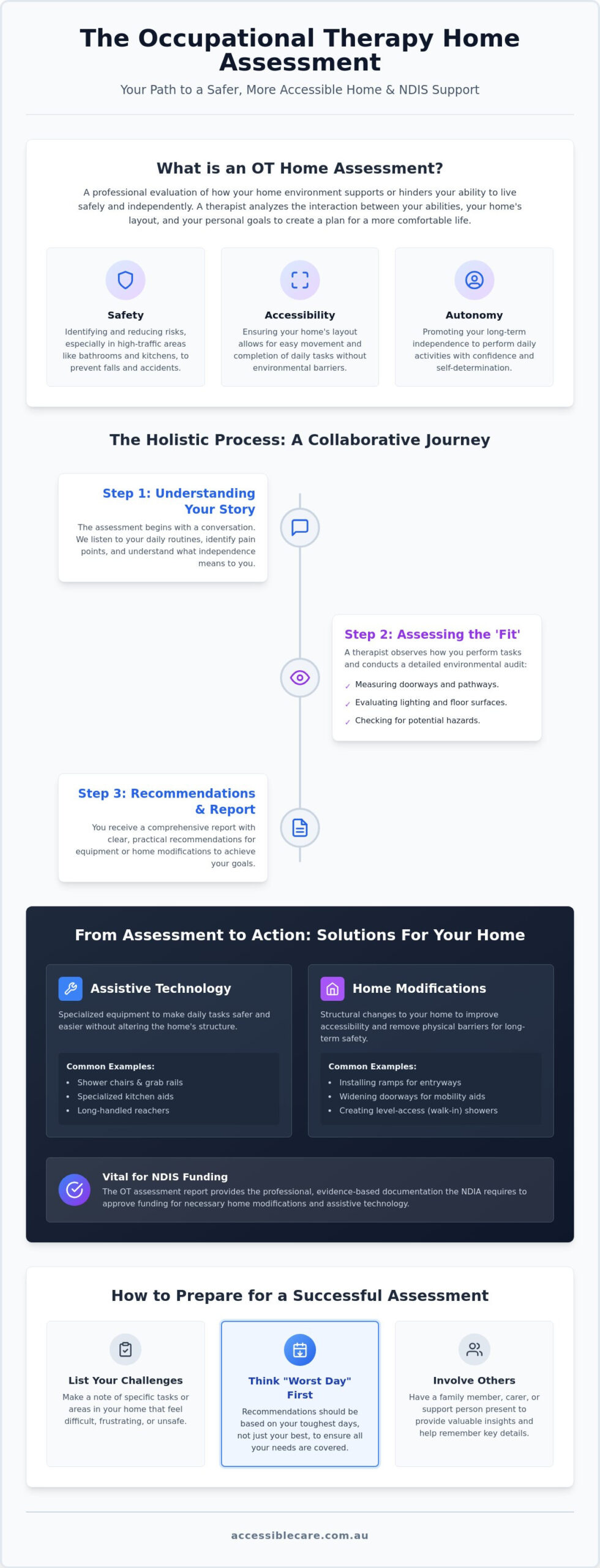
An occupational therapy home assessment is much more than a simple walk-through of your house. It’s a thoughtful, professional evaluation of how your home environment either supports or hinders your ability to live life on your terms. Instead of looking at your home as just a building, a qualified therapist looks at it as a partner in your daily routine. They study the intricate interaction between your physical abilities, the layout of your rooms, and the personal goals you want to achieve each day.
Occupational therapy is built on the belief that everyone should have the opportunity to engage in the activities that give their life meaning. During an assessment, a therapist who understands both clinical needs and NDIS requirements will visit you at home. Their goal is to identify specific barriers that might make you feel unsafe, anxious, or restricted. By finding these obstacles, they can suggest practical solutions that aren’t just clinical fixes; they’re life-changing improvements that restore your confidence and comfort.
The Core Purpose: Safety, Accessibility, and Autonomy
The primary focus of any assessment is to make your home a place where you feel truly at ease. We look closely at high-traffic areas like bathrooms and kitchens, where the risk of falls or accidents is often highest. By making these spaces more accessible, we enhance your ability to perform Activities of Daily Living (ADLs) like bathing, dressing, or cooking without needing constant assistance. This process isn’t just about preventing accidents; it’s about promoting your long-term self-determination. We want to help you stay in the home you love by tailoring the environment to your unique journey and physical needs.
Why This Assessment is Vital for NDIS Participants
If you’re navigating the NDIS, an occupational therapy home assessment serves as a vital bridge between your personal goals and your funding. It provides the professional, evidence-based documentation the NDIA requires to approve funding for home modifications or specialized equipment. Your therapist will link your functional goals directly to specific environmental changes within your NDIS plan. This careful documentation ensures that any assistive technology prescribed is actually fit for your specific space and lifestyle. It’s a collaborative process that turns your daily challenges into a clear, justified request for the support you need to thrive.
The Holistic Process: What to Expect During Your Home Visit
Approaching an occupational therapy home assessment might feel daunting, but it’s helpful to view it as a supportive partnership. We aren’t there to critique your housekeeping or judge your lifestyle. Instead, we’re there to listen, observe, and collaborate with you. The process is thorough and methodical, ensuring that every recommendation we make is grounded in your real-world experience and your personal goals for the future.
Step 1: Understanding Your Unique Story
We believe that you’re the true expert on your own life. Every assessment begins with a conversation where we focus entirely on your experiences. We want to know what independence looks like for you. Is it the ability to make your own morning cup of tea? Is it feeling confident when getting ready for bed at night? By discussing your daily routine, we can identify specific pain points where you currently feel frustrated, tired, or unsafe. This initial consultation ensures that our clinical expertise is always guided by your personal priorities and values.
Step 2: Assessing the ‘Fit’ Between Person and Place
Once we understand your goals, we move into a functional observation. This isn’t a test; it’s simply a way for us to see how you and your home work together. We might ask you to show us how you move through your space or perform specific tasks, such as getting in and out of a favorite chair or navigating the bathroom. This allows us to see the “fit” between your physical movements and the environment around you. While we observe, we also conduct a detailed environmental audit, which includes:
- Measuring doorways and pathways to ensure there’s enough room for easy movement or mobility aids.
- Evaluating lighting levels in hallways and stairwells to reduce the risk of trips.
- Checking floor surfaces for hazards that are often overlooked, such as loose rug edges or slippery tiles.
- Assessing reach ranges in the kitchen and laundry to make daily chores less straining.
After we’ve gathered this information, we don’t just walk away and write a report. We engage in collaborative brainstorming with you. We’ll discuss potential solutions together, exploring different options to see what feels right for your home and your budget. Whether it’s a simple piece of equipment or a more significant structural change, your voice is the most important part of the decision-making process. If you’re ready to start this journey toward a safer home, our team at Accessible Care is here to support you with a professional and compassionate approach.
The final step is the creation of a comprehensive report. This document translates our shared findings into the professional evidence required for NDIS funding or other healthcare needs. It’s a clear, detailed roadmap that outlines exactly what’s needed to help you live with more autonomy and peace of mind.
Home Modifications vs. Assistive Technology: Finding the Right Solution
Finding the right balance between structural changes and helpful equipment is a key goal of your occupational therapy home assessment. While these two approaches serve the same purpose—making your life easier—they involve different types of support. Assistive Technology (AT) includes any device or tool that helps you complete a task more safely. In contrast, home modifications involve physical changes to the structure of your house or apartment. Your therapist evaluates your specific needs to decide which solution, or combination of both, offers the most meaningful benefit for your daily routine.
For many, this distinction is particularly important when navigating NDIS funding categories. Most structural changes and specialized equipment fall under ‘Capital Support.’ Because these can be significant investments, the NDIA relies heavily on the results of your assessment to ensure the requested support is both reasonable and necessary. We act as your advocate, ensuring that the evidence provided clearly links these solutions to your long-term independence and safety.
Small Changes, Big Impact: Minor Modifications and AT
Sometimes, the most significant improvements come from small, thoughtful adjustments. Minor modifications and AT are often the quickest ways to restore your confidence in high-risk areas. For example, installing grab rails or a handheld showerhead can transform your morning routine from a source of anxiety into a moment of self-care. These low-cost solutions provide an immediate boost to your daily confidence. Other common recommendations include:
- Shower chairs or stools to reduce fatigue and the risk of slips.
- Lever-style taps that are easier to operate for those with limited hand strength.
- Specialized kitchen utensils designed with ergonomic grips for easier meal preparation.
- Bed rails or bed sticks to assist with safe transitions during the night.
Complex Home Modifications for Long-Term Independence
When your needs require more significant changes, we look toward complex home modifications. These are structural projects designed to ensure your home remains accessible for years to come. This might involve a full bathroom renovation to create a stepless shower or adjusting the height of kitchen benches to allow for wheelchair access. We also look at entry points, recommending ramps or platform lifts where stairs have become a barrier. Throughout this process, your therapist works closely with builders and tradespeople. We ensure that the final result doesn’t just look good, but also meets the specific clinical standards required for your ongoing autonomy.
Preparing Your Home and Mind for an OT Assessment
Inviting a professional into your private living space can feel like a significant step. Your home is your sanctuary; it’s the place where you should feel most at ease. It’s natural to feel a bit of trepidation about having your environment evaluated. However, it’s helpful to remember that an occupational therapy home assessment isn’t a test or a judgment of your housekeeping. Instead, think of your therapist as a supportive partner in your care. They’re there to help you stay in the space you love by making it work better for your needs.
To get the most out of your visit, try to think about your “worst day” scenarios. While you might feel capable and energetic during the appointment, we need to plan for the times when you’re feeling fatigued, stiff, or in pain. Identifying the specific tasks that currently cause you the most stress is a great place to start. Whether it’s reaching for items in a high cupboard or the exhaustion of getting ready in the morning, these details help your therapist plan for the maximum level of support you might require.
Gathering your existing medical reports or your current NDIS plan is also incredibly helpful. Sharing these documents allows your therapist to understand your history and goals before the walk-through begins. This context ensures that the recommendations we make are perfectly aligned with your broader healthcare journey and funding requirements.
Practical Preparation Tips
A few simple steps can make the day of your occupational therapy home assessment feel much smoother. Having your usual mobility aids ready, such as your walker, cane, or wheelchair, allows the therapist to see how you interact with your environment using your current tools. We also suggest writing down a list of questions or specific safety concerns you’ve been noticing. If you have a support worker or a family member who assists you with daily tasks, invite them to be present. They often provide valuable insights into the small challenges that you might have grown so used to that you’ve forgotten to mention them.
Overcoming the Emotional Hurdle
It’s completely normal to feel vulnerable when someone evaluates your private rooms. You’ve spent years making your home yours, and the idea of changes can feel overwhelming. Try to focus on the final outcome: a home that works for you, rather than you having to work so hard to manage your home. Our team at Accessible Care prioritises your comfort and dignity throughout the entire process. We’re here to listen first and advise second, ensuring you always feel in control of your own space. If you’re ready to make your home a safer, more empowering place to live, we’re here to guide you with compassion and expertise.
Accessible Care: Compassionate OT Support in Melbourne and Adelaide
At Accessible Care, we believe that your environment should never be a barrier to your dreams. As a registered NDIS provider, we’re proud to offer experienced adult and paediatric occupational therapy tailored to your unique life stage. We know that the most accurate and comfortable way to evaluate your needs is in the space where you actually live. That’s why our mobile services come directly to you across Melbourne and Adelaide. By conducting your occupational therapy home assessment in the comfort of your own home, we ensure that every recommendation is practical and rooted in your daily reality.
Our support doesn’t stop at the physical environment. We take a holistic, multidisciplinary approach to your wellbeing. If your journey requires more than just environmental changes, we can seamlessly integrate other essential services. This might include speech therapy to enhance communication or community nursing for specialized health needs. We work as a unified team to ensure every aspect of your autonomy is respected and supported. Our philosophy is simple: we listen, we support, and we empower.
Why Choose Accessible Care for Your Home Assessment?
Choosing the right partner for your assessment is a deeply personal decision. Our therapists are experts in functional capacity assessments and complex home modifications. We don’t just fill out forms; we take the time to truly listen. We want to understand your personal goals and your lifestyle so that our suggestions feel like a natural extension of your home. Plus, our local knowledge of Melbourne and Adelaide housing styles means we understand the specific architectural challenges common in our local communities.
Take the First Step Toward a Safer Home
Navigating the NDIS can feel like a complex puzzle, but you don’t have to solve it alone. Whether you’re a new participant or looking to review an existing plan, we’re here to help you get the modifications and equipment you deserve. Our team manages the detailed reporting process from start to finish. We focus on providing the high-quality evidence the NDIA needs, which makes it much easier for you to access the funding required for a safer, more accessible home.
Your independence is worth the investment of time and care. Let us help you unlock the potential of your living space so you can focus on what truly matters. Contact our compassionate team today to book your occupational therapy home assessment and begin your journey toward a more empowered future.
Step Into a Safer, More Empowered Future
An occupational therapy home assessment is more than a clinical requirement; it’s a profound investment in your long-term quality of life. Throughout this guide, we’ve highlighted how this collaborative process identifies physical barriers and unlocks the specific NDIS funding you need for home modifications and assistive technology. By focusing on your “worst-day” scenarios and personal goals, you ensure that every recommendation made by your therapist truly reflects your needs for safety and autonomy.
Accessible Care is a registered NDIS provider with a team of experienced paediatric and adult OTs serving the Melbourne and Adelaide communities. We take pride in our compassionate approach, ensuring that your dignity and comfort are prioritized from the moment we enter your home. We handle the detailed reporting and evidence-gathering so you can focus on what matters most: living life on your own terms.
Book Your Compassionate OT Home Assessment with Accessible Care
Taking this first step is a powerful way to reclaim your peace of mind and confidence. We look forward to partnering with you to create a home environment that supports your independence and honors your journey every single day.
Frequently Asked Questions
How long does an occupational therapy home assessment take?
A typical home visit usually lasts between 1.5 and 3 hours. This timeframe ensures your therapist has enough time to listen to your concerns, observe your daily routines, and conduct a detailed audit of your living environment without rushing the process.
Is an OT home assessment covered by the NDIS?
Yes, the NDIS covers the cost of an occupational therapy home assessment through your plan’s “Capacity Building” or “Capital Support” budgets. As a registered provider, we ensure our reporting meets all NDIS requirements to help you access the funding you need for modifications or equipment.
Do I need to clean my house before the therapist arrives?
There’s absolutely no need to clean or tidy your home before we visit. We actually prefer to see your home exactly as it’s used every day. This helps us understand your real-world challenges and ensures our recommendations are practical for your actual lifestyle.
Can I get a home assessment if I am renting my property?
You can certainly receive an assessment while renting. While structural changes will require your landlord’s permission, many assistive technology solutions are portable and don’t require permanent modifications. We can help you navigate these conversations with your property manager if needed.
What is the difference between a home assessment and a functional capacity assessment?
A home assessment focuses specifically on how your physical environment impacts your daily life. In contrast, a functional capacity assessment is a broader evaluation of your overall ability to manage tasks like self-care and social interaction. A home visit is often a key part of that larger evaluation.
How soon will I receive the report after the home visit?
You’ll typically receive your comprehensive report within two to four weeks of our visit. This time allows your therapist to carefully analyze the measurements and observations gathered to create a detailed, evidence-based document for the NDIS or your healthcare team.
Can the OT help me choose specific brands of equipment or assistive technology?
Your therapist will recommend specific types of equipment based on your clinical needs and home layout. While we focus on the functional “fit” of the technology, we can often suggest trusted suppliers and brands that have proven to be reliable for other participants in similar situations.
What happens if the NDIA rejects the recommendations in the OT report?
If a recommendation is rejected, your therapist can provide additional clinical justification or further evidence to support your request. We act as your advocate throughout the process, working closely with you to address any concerns raised by the NDIA to help you get the support you deserve.

