


What if your child’s upcoming evaluation wasn’t a test they could fail, but a way to finally see the world through their eyes? It’s completely natural to feel a sense of anxiety about clinical jargon or the pressure of meeting NDIS requirements. You want your child to thrive, yet the path to getting the right help often feels confusing and heavy with expectation.
A paediatric occupational therapy assessment is a compassionate starting point that focuses on what your child can do, rather than just where they struggle. By understanding their unique developmental profile, we can create a clear roadmap for their independence. With the 2026 NDIS standard rate fixed at $193.99 per hour, this assessment provides the essential evidence required to secure funding and support tailored to your family’s needs. This guide explains exactly what happens during the evaluation process, how it translates into practical daily improvements, and how you can use these insights to advocate for your child with confidence.
Key Takeaways
- Learn how a paediatric occupational therapy assessment looks beyond clinical labels to understand how your child interacts with their world through play and daily tasks.
- Understand the gentle, play-based steps of the evaluation process, ensuring your family’s goals and history are at the heart of every session.
- Identify the specific motor skills and sensory needs that form the foundation of your child’s daily independence and confidence.
- Discover how professional assessment results provide the essential evidence needed for NDIS planning to secure long-term support.
- See how a person-centred approach empowers you to make informed choices that respect your child’s dignity and unique developmental journey.
What is a Paediatric Occupational Therapy Assessment?
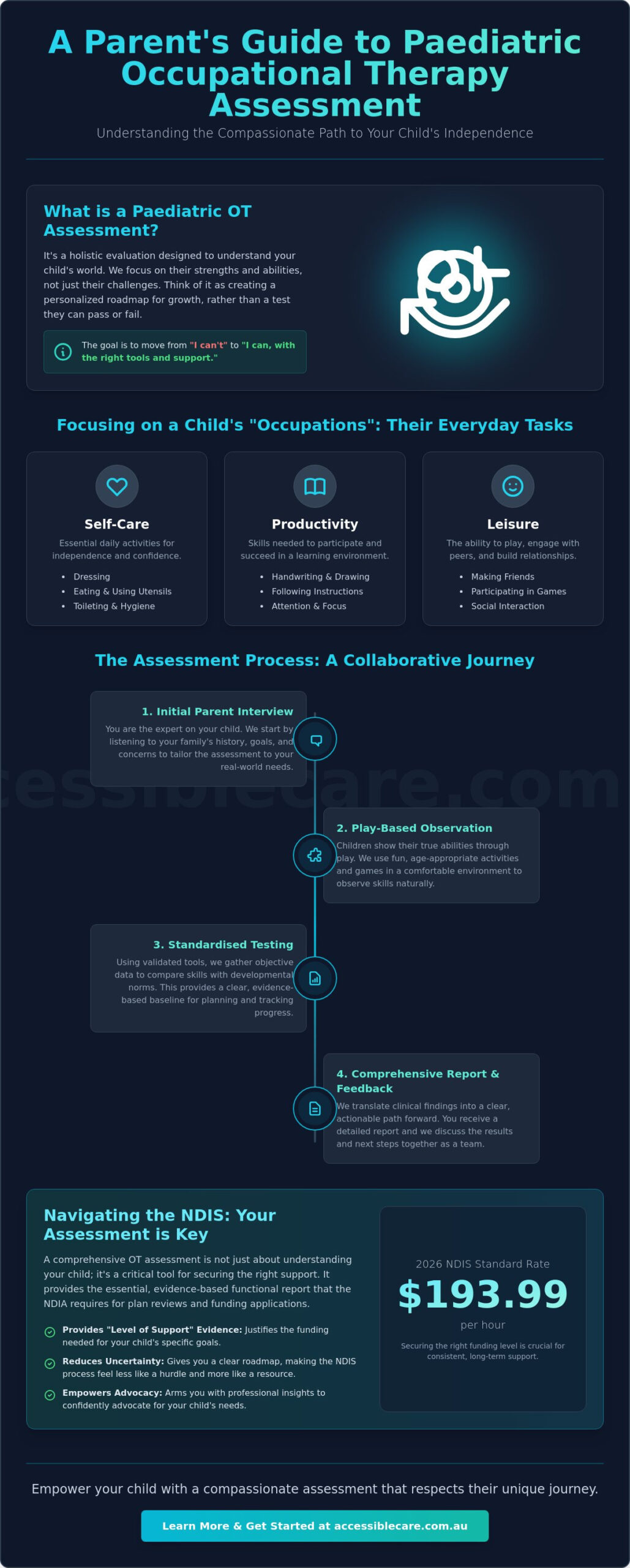
A What is a Paediatric Occupational Therapy Assessment? is far more than a simple checklist of developmental milestones. It is a holistic evaluation designed to understand how your child interacts with their world through play, self-care, and learning. Instead of viewing your child through a clinical lens of deficits, we look at the whole person. We observe how they move, how they process sensory information, and how they engage with the people around them. This compassionate approach ensures that the evaluation feels like a supportive partnership rather than a stressful test.
During a paediatric occupational therapy assessment, we focus heavily on “occupations.” For a child, these are the essential daily tasks that allow them to grow, learn, and thrive. Think of the things your child does every day. These are their “jobs.” When a child struggles with these tasks, it can impact their confidence and independence. Our goal is to identify their natural strengths and use those as a foundation for growth. This assessment is the vital first step in discovering what is occupational therapy and how it creates a pathway to a more fulfilling life.
Common occupations we evaluate include:
- Self-care: Activities like dressing, eating, and toileting.
- Productivity: Skills needed for school, such as handwriting and following instructions.
- Leisure: The ability to play, make friends, and participate in social activities.
The Goal: Moving from Challenges to Independence
We work to move your child from a place of “I can’t” to “I can with the right tools.” By gaining clinical insights into your child’s unique neurological wiring, we can provide you with a deeper understanding of why certain tasks are difficult. This isn’t about finding things to “fix.” It’s about finding ways to empower. We establish a clear baseline of current abilities, which allows us to measure progress with specific data points over time. This methodical approach ensures that every goal is tailored to your child’s specific needs and your family’s lifestyle.
Why Early Assessment Matters in 2026
Timely intervention leads to significantly better developmental outcomes. In 2026, the NDIS guidelines have placed a higher priority on evidence-based functional reports to justify funding. A comprehensive assessment provides the “Level of Support” evidence that the NDIA requires for plan reviews and initial applications. By securing a professional perspective early, you can reduce the emotional weight of uncertainty. You’ll gain a clear roadmap that outlines exactly what support is needed, making the NDIS process feel less like a hurdle and more like a resource. This clarity brings peace of mind to the whole family.
What to Expect During the Assessment Process
The journey begins with a conversation. We believe that you are the expert on your child, which is why the initial parent interview is a critical first step. During this time, we discuss your child’s developmental history, your current concerns, and the specific goals you have for their future. This isn’t just about collecting data; it’s about building a partnership rooted in trust. By understanding your family’s daily rhythm, we can ensure the paediatric occupational therapy assessment is tailored to your real-world needs.
Following our conversation, the session moves into a play-based environment. Children often learn and show their true abilities through play. We use age-appropriate, validated tools to conduct standardised testing. This provides us with objective data to compare with developmental norms. However, we also place high value on a detailed feedback session. This is where we translate clinical findings into a clear, actionable path forward. You can learn more about What to Expect During the Assessment Process to help visualize how these visits support your child’s growth.
Preparing Your Child with Compassion
A little preparation goes a long way in reducing “new place” jitters. We recommend explaining the session to your child as a time to “play games” or “try out new toys” rather than a doctor’s visit. This simple shift in language removes the pressure of performing. Ensure your child is well-rested and has had a snack before arriving. When a child feels physically comfortable, they are better able to show us their true potential. Your presence in the room serves as a reassuring anchor. You don’t need to prompt them to answer; simply being there provides the safety they need to explore. If you have questions about how to best support your child’s journey, our team is here to provide the guidance you need.
The Clinical Observation Phase
While your child plays, our therapists look for subtle cues that often go unnoticed in busy everyday settings. We watch how they move their bodies to reach for a toy or how they manipulate small objects like blocks or crayons. This phase allows us to assess social interaction and emotional regulation in real-time. Do they become frustrated when a tower falls? How do they respond to transitions between activities? These observations help us identify sensory triggers or motor planning challenges. By seeing these moments through a professional lens, we can develop strategies that respect your child’s unique wiring while building their confidence.
Common Areas Evaluated in a Paediatric OT Assessment
While we observe your child through the play-based environment discussed earlier, we’re looking for specific developmental building blocks. A paediatric occupational therapy assessment examines how different skills work together to support your child’s daily life. It’s not just about what they can do in a clinic; it’s about how they’ll use these skills at home, at school, and in the community. By breaking down these areas, we can identify exactly where your child is thriving and where they might need a little extra support to reach their goals.
Fine motor skills involve the small muscles in the hands and fingers. These are essential for tasks like handwriting, using cutlery, or manipulating small buttons and zips. Gross motor skills focus on larger movements, including balance and coordination. These skills allow a child to navigate their physical environment safely, whether they’re climbing playground equipment or walking through a crowded classroom. We also look at self-care and daily living skills. This includes the ability to follow a morning routine, groom themselves, and get dressed independently, which are foundational steps toward a life of choice and dignity.
Sensory processing is another vital area. It’s how your child responds to the world’s sounds, textures, and movements. Some children are highly sensitive to noise, while others might seek out constant movement to feel regulated. Understanding these patterns helps us create environments where your child feels safe and ready to learn. To get the most accurate picture, we use several Common Paediatric OT Assessments that are scientifically validated and respected within the NDIS framework.
Standardised Tools We May Use
We select tools based on your child’s age and the specific concerns we’re exploring. The Beery VMI helps us understand visual-motor integration, which is a key indicator of handwriting readiness. For physical coordination and motor proficiency, we might use the Movement ABC or the BOT-2. If we need to understand your child’s sensory “thresholds,” the Sensory Profile 2 provides invaluable insights. These tools give us objective data that helps secure the right level of support for your child’s unique developmental profile.
Executive Functioning and Play Skills
Executive functioning is the brain’s air traffic control system for children. We assess how your child plans, organises, and completes multi-step tasks, such as following a recipe or packing a school bag. Play skills are also vital for social-emotional growth. We evaluate symbolic play and your child’s ability to share or take turns with others. These interactions aren’t just for fun; they’re how children learn to problem-solve and build lasting relationships. Identifying strengths in these areas allows us to build a plan that empowers your child to engage fully with their peers.
Navigating the NDIS: Using Assessment Results for Funding
The NDIS process can feel like a complex puzzle, but a paediatric occupational therapy assessment is often the piece that makes everything fit together. The NDIA requires evidence that is functional rather than just medical. This means they want to know how a condition affects your child’s ability to participate in their community and perform daily tasks. The Functional Capacity Assessment (FCA) is the gold standard for this evidence. It provides a detailed look at your child’s “Level of Support” needs, which is the primary factor NDIS planners use to determine budget allocations in 2026.
For families managing more complex situations, these reports are even more vital. They provide the clinical justification for high intensity supports NDIS by detailing specific safety risks or the need for specialised care. By linking our clinical findings directly to your child’s personal NDIS goals, we build a robust case for funding. This ensures that the support you receive is truly tailored to your family’s unique circumstances, rather than a generic one size fits all plan.
Translating Clinical Data into NDIS Goals
We work closely with you to translate clinical terms into life-changing outcomes. For example, we don’t just report a “fine motor delay.” Instead, we describe how this affects “independence in dressing and schoolwork.” This specific language matches the NDIS criteria for support that is “reasonable and necessary.” It helps you advocate for the exact number of therapy hours your child needs to thrive. When the report clearly shows how therapy will improve a child’s independence, it becomes much easier for planners to approve the requested budget.
The Importance of Multidisciplinary Evidence
A child’s developmental journey rarely happens in isolation. Our OT assessments are designed to complement speech pathology reports, building a holistic picture of your child across multiple domains. If your child has challenges with both communication and physical coordination, having coordinated evidence makes your case significantly stronger. This is especially important during plan reviews or appeals, where a unified professional voice can make all the difference. We focus on coordinating this evidence so you can feel confident and supported at every stage of the process.
If you are feeling overwhelmed by the requirements of your next plan review, reach out to our team for expert NDIS assessment support today.
Compassionate OT Support in Melbourne and Adelaide
At Accessible Care, we believe every child deserves to be seen for who they truly are. Our team of experienced paediatric OTs serves families across the Melbourne and Adelaide metropolitan areas with a simple promise: to care for you with dignity and respect. A paediatric occupational therapy assessment with us is not a cold, clinical transaction. It’s the beginning of a supportive partnership. We value your voice above all else because you know your child best. This person-centred approach ensures that every recommendation we make aligns with your family’s values and your child’s daily reality.
Our services are designed to grow with your child as their needs evolve. For families managing complex situations, our OT team works seamlessly with our other specialists to provide a unified support network. This includes providing tailored support for those navigating an acquired brain injury or requiring high-intensity care. By integrating these services, we ensure your child’s support plan is cohesive and comprehensive. We live by the philosophy of “Your choice, your life, your way,” empowering you to lead the development journey on your own terms.
Our Local Presence and NDIS Expertise
We understand the specific nuances of the NDIS in both Melbourne and Adelaide. Whether you are in the coastal suburbs of Adelaide or the busy streets of Melbourne, we offer flexible options to suit your family’s routine. You can choose from mobile assessments in the comfort of your child’s home or school, or visits to our dedicated clinics. Our team stays current with the 2026 NDIS price guide changes, including the national standardisation of therapy rates at $193.99 per hour. We are a provider who listens. We take the time to understand your child’s specific journey before we even begin the formal evaluation process.
Next Steps: Starting Your Journey with Us
Taking the first step is often the hardest part of the process. To start, you can book an initial consultation with one of our compassionate therapists in Melbourne or Adelaide. During this first meeting, we’ll listen to your concerns and explain how a paediatric occupational therapy assessment provides the roadmap your family needs for NDIS success. After the assessment is complete, we don’t just hand over a report and walk away. We stay by your side. Your first therapy session will focus on turning those clinical findings into fun, engaging activities that build your child’s independence. Join our community of empowered families today and discover a provider that truly cares about your child’s future.
Empowering Your Child’s Path to Independence
Choosing to begin this journey is a significant step toward unlocking your child’s full potential. You’ve seen how a paediatric occupational therapy assessment acts as a bridge between current challenges and future independence. It’s not just a clinical report. It’s a powerful tool that provides the essential functional evidence needed for NDIS planners while giving you practical, play-based strategies for home. As a Registered NDIS Provider with experienced paediatric specialists in Melbourne and Adelaide, we prioritize your child’s dignity and your family’s unique voice. Our holistic, person-centred approach ensures that every developmental goal is meaningful and achievable.
You don’t have to manage the complexities of childhood development or the NDIS system alone. We’re here to listen, support, and guide you through every milestone. Book a compassionate paediatric OT assessment for your child today and gain the clarity your family deserves. We look forward to partnering with you to create a life of choice, confidence, and community for your child. Your journey toward empowerment starts with a single, supportive conversation.
Frequently Asked Questions
How long does a paediatric occupational therapy assessment take?
A standard face to face evaluation session typically takes between 90 and 120 minutes. However, a comprehensive paediatric occupational therapy assessment involves more than just the time spent in the clinic. When you include the initial parent interview, standardised scoring, and the detailed report writing, the total process often requires 4 to 10 hours of clinical time. This thorough approach ensures we capture a complete picture of your child’s strengths and support needs.
Can I use my NDIS funding for a paediatric OT assessment?
Yes, you can use your NDIS funding if your plan includes a budget for “Capacity Building; Improved Daily Living.” As a Registered NDIS Provider, we align our billing with the 2025-2026 NDIS Pricing Arrangements, which currently set the rate at $193.99 per hour. These assessments are essential for providing the NDIA with the functional evidence required to justify your child’s ongoing support and therapy hours during plan reviews.
What should I bring to my child’s OT assessment?
Please bring any recent reports from paediatricians, speech pathologists, or school teachers dated within the last 12 months. It’s also helpful to have examples of your child’s schoolwork or a list of their current medications. Ensure your child wears comfortable clothing that allows for easy movement during play based tasks. Having a favorite snack or toy on hand can also help them feel more at ease in a new environment.
Do I need a GP referral for a paediatric OT assessment in Australia?
You don’t need a GP referral to access our services as a private client or through your NDIS plan. However, if you wish to claim a Medicare rebate, you must have a Chronic Disease Management plan from your doctor. This plan allows for up to 5 allied health sessions per calendar year. While this can help cover part of the cost, a gap payment will still apply for the assessment process.
What happens if the assessment shows my child needs multiple types of therapy?
If the results indicate a need for varied support, we coordinate a multidisciplinary plan tailored to your child’s specific goals. Our team includes specialists in speech therapy and positive behaviour support, allowing for a seamless transition between different types of care. We focus on a person centred approach by helping you prioritize which interventions will have the most significant impact on your child’s daily independence and overall wellbeing.
How soon will I receive the written assessment report?
You will generally receive the comprehensive written report within 14 to 21 business days of the final observation session. This timeframe allows our therapists to carefully score standardised tests and integrate clinical observations into a detailed roadmap for the NDIS. If you have an upcoming plan review date, please let us know early so we can prioritize your documentation to meet NDIA deadlines and ensure your funding remains secure.
Is the assessment different for children with Autism or ADHD?
While the core process remains the same, we tailor the specific tools used during a paediatric occupational therapy assessment to suit your child’s unique profile. For children with Autism, we may place a higher focus on sensory processing and social communication. For those with ADHD, we often prioritize executive functioning and impulse control. This ensures the findings are relevant to the specific way your child’s brain is wired and provides practical strategies for home.

