


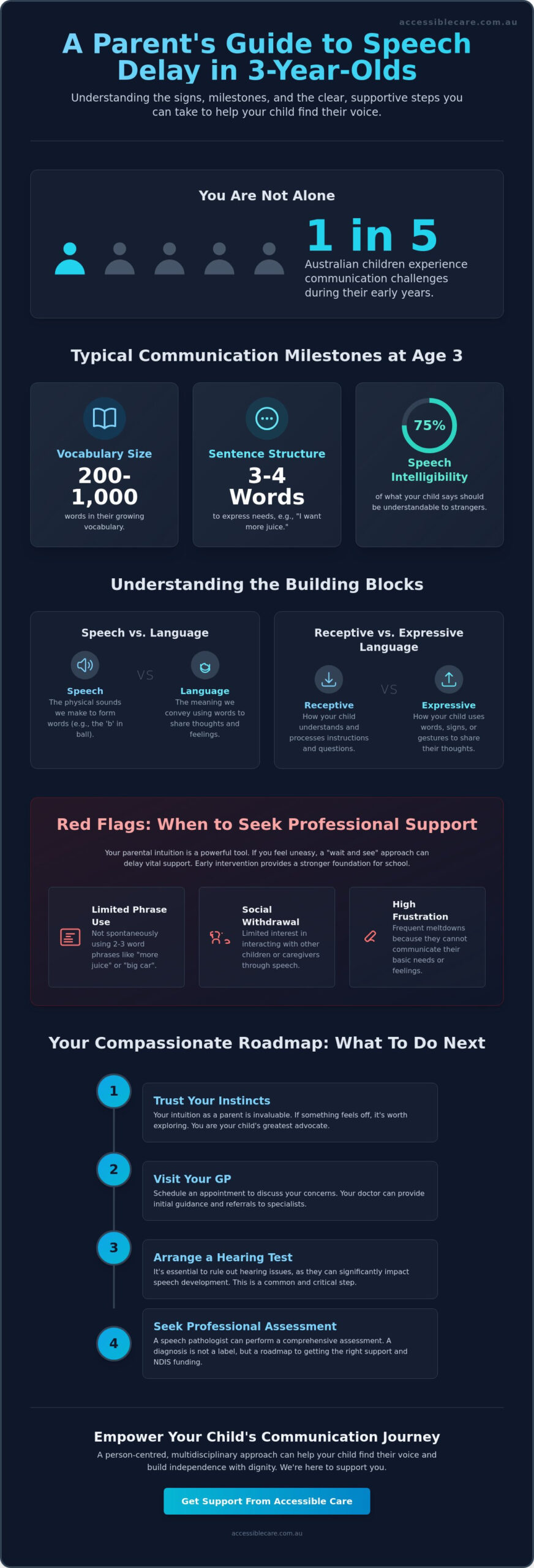
Last Monday, Sarah sat in a quiet Perth playground, watching a group of toddlers swap stories while her son simply pointed at his water bottle. It’s a heavy feeling when you realize your child isn’t communicating like their peers. Searching for speech delay in 3 year old what to do can often leave you feeling more confused than when you started. You aren’t alone. According to 2023 Australian developmental data, approximately 1 in 5 children experience communication challenges during their early years.
You’ve likely spent hours comparing your child to others at childcare or feeling lost in the complex language of NDIS terminology. It’s completely natural to feel anxious about your little one falling behind. We believe every child deserves to be heard. We’re here to support you with dignity and respect as you seek the right path forward for your family.
This guide is designed to bring you peace of mind and a clear way forward. Discover the developmental milestones for three-year-olds and the practical, supportive steps you can take to help your child find their voice. We’ll provide a clear checklist of milestones, explain the NDIS pathway, and share simple at-home tips to empower your child’s communication journey.
Key Takeaways
- Gain clarity on age-appropriate milestones and the vital distinction between the sounds your child makes and the language they understand.
- Identify specific red flags that indicate a need for professional support while learning why your parental intuition is a powerful tool.
- Understand the common physiological and neurological factors, such as hearing health or developmental conditions, that can impact communication.
- Follow a clear, compassionate roadmap for a speech delay in 3 year old what to do, from visiting your GP to arranging essential hearing tests.
- Discover how a person-centred, multidisciplinary approach can empower your child to find their voice and build independence with dignity.
Understanding Speech and Language Milestones for 3-Year-Olds
Watching your child grow is a journey filled with wonder and, occasionally, a few questions. If you’ve started to notice that your little one isn’t quite as chatty as their peers, please know that your feelings of concern are a natural part of being a dedicated parent. You want the best for them, and noticing these differences is the first step in providing the right support. A speech delay is essentially a gap between a child’s current communication skills and the milestones typically expected for their age. It isn’t a reflection of your parenting or your child’s potential; it’s simply a signpost that they might need a little extra help to find their voice.
Every child develops at their own pace, but milestones provide a helpful safety net for families. They help us identify when a child might benefit from professional guidance. When we talk about these delays, we often distinguish between speech and language. Speech focuses on the physical sounds we make, like the “b” in ball or the “s” in sun. Language is much broader; it involves the meaning we convey and how we use words to share our thoughts and feelings. If you’re researching a speech delay in 3 year old what to do, understanding these foundations helps you describe your child’s needs more clearly to professionals.
What Should a 3-Year-Old Be Able to Say?
By the time a child turns three, their world is expanding rapidly. At this stage, you can typically expect to see several key developments in their communication:
- Vocabulary size: Most 3-year-olds have a growing vocabulary of roughly 200 to 1,000 words.
- Sentence structure: They should consistently use three to four-word sentences to express their needs, such as “I want juice” or “Go to park.”
- Intelligibility: While their speech won’t be perfect, strangers should be able to understand about 75% of what your child says.
The Difference Between Receptive and Expressive Language
It’s helpful to look at language through two different lenses. Receptive language refers to how your child understands instructions and questions. Expressive language is how they use words, signs, or gestures to share their own thoughts. Many parents find that their child understands almost everything they say but struggles to respond with words. This type of Language Delay can sometimes lead to frustration or tantrums because the child has so much to say but lacks the tools to say it. Identifying whether the challenge is with understanding or speaking is a vital part of knowing about a speech delay in 3 year old what to do. We’re here to help you navigate these distinctions with dignity and respect for your child’s unique journey.
Identifying the Signs: When to Seek Professional Support
Parents often have a “sixth sense” when it comes to their child’s development. If you find yourself constantly comparing your child’s speech to their peers or feeling uneasy during playdates, your intuition is a valuable tool. It is common for well-meaning friends to suggest that children develop at their own pace. While this is true, the “wait and see” approach can sometimes delay the support your child deserves. Choosing early intervention is one of the kindest steps you can take. It provides your child with a stronger foundation before they start school.
A diagnosis is never a label that limits your child’s future. Instead, think of it as a roadmap. In Australia, a formal assessment can open doors to essential resources and funding through the NDIS. It helps you understand how your child learns best. When you know exactly what is happening, you can stop worrying about the unknown and start focusing on progress. If you are wondering about a speech delay in 3 year old what to do, the first step is always observation and seeking a professional opinion.
Communication Red Flags for Three-Year-Olds
Every child is unique, but certain milestones are key indicators of healthy development. You might notice your child struggling to keep up with the following:
- Limited Phrase Use: Your child isn’t using two or three-word phrases spontaneously, such as “more juice” or “big car.”
- Social Withdrawal: There is a limited interest in interacting with other children or caregivers through speech or shared play.
- High Frustration Levels: Frequent “meltdowns” or tantrums occur because the child cannot communicate their basic needs or feelings.
- Difficulty Following Directions: They seem to struggle with simple, two-step instructions like “pick up your shoes and put them by the door.”
Checking your child’s progress against established Speech and Language Developmental Milestones can provide clarity. If they aren’t meeting these markers, it’s a good time to chat with a professional.
Is it a Speech Delay or a Language Disorder?
It is helpful to distinguish between speech and language, as they require different types of support. A speech sound disorder usually involves the physical production of sounds. Your child might have plenty of ideas but struggles to say the words clearly. A language delay or Developmental Language Disorder (DLD) relates to how a child understands words and puts them together to share thoughts. DLD is a common condition that simply means a child’s brain processes language differently.
Specialised speech pathology services are designed to identify these specific nuances. A therapist can determine if your child is dealing with a delay that they will likely catch up on, or a disorder that requires ongoing strategies. If you feel overwhelmed, remember that you don’t have to navigate this alone. You can always reach out to a compassionate provider who can listen to your concerns and help you plan the best path forward for your family.
Common Causes of Speech Delays in Toddlers
Seeing your child struggle to express themselves is difficult, but please know you aren’t alone. It’s common for parents to feel a sense of guilt, wondering if they did something wrong. We want to be clear: clinical speech delays aren’t caused by “lazy parenting” or having the television on. These are myths that add unnecessary stress to families. Most delays have deep-rooted physiological or neurological causes that require professional support rather than lifestyle changes at home.
When specialists look at Delayed Speech or Language Development, they often find underlying biological factors. Neurological conditions like Apraxia of speech occur when the brain has trouble directing the muscles used for talking. Similarly, Autism Spectrum Disorder (ASD) can impact how a child processes social communication. These conditions are part of a child’s unique makeup. They aren’t a reflection of your love or the environment you’ve provided.
The Role of Hearing in Speech Development
Your Australian GP will usually suggest a hearing test as the very first step in your journey. This is because speech is a learned mimicry of the sounds a child hears. If those sounds are distorted, speech cannot develop clearly. A very common culprit in toddlers is “glue ear,” where thick fluid builds up behind the eardrum. This makes the world sound muffled, as if they’re listening to you from underwater.
You might notice specific signs that suggest a hearing issue rather than a cognitive delay. If your 3-year-old doesn’t turn when you call their name from another room, or if they seem to ignore verbal instructions unless you’re facing them, a hearing check is essential. Addressing fluid buildup or minor hearing loss early can often lead to rapid improvements in communication.
Developmental and Environmental Factors
Sometimes, a speech delay is one part of a global developmental delay. This means a child might be reaching milestones a bit later in several areas, including motor skills or social interaction. If you’re researching speech delay in 3 year old what to do, it’s also helpful to look at how your child interacts with their world. For example, Developmental Language Disorder is a lifelong but manageable communication style that changes how a person processes language.
It’s also important to address the “bilingual myth.” Many parents worry that speaking two languages at home confuses a child. This isn’t true. While a bilingual child might use a smaller vocabulary in each individual language initially, their total combined vocabulary is usually typical for their age. Bilingualism is a cognitive strength, not a cause of clinical delay. Whether your child’s delay is due to biology or a specific developmental style, the focus remains on empowering them to find their voice in their own way.
The Roadmap: What to Do if You Are Concerned
Taking the first step toward support can feel like a heavy weight, but you don’t have to carry it alone. If you are questioning a speech delay in 3 year old what to do, the most effective approach is to act early. Early intervention uses the brain’s natural plasticity at this age to create lasting positive changes. Start by visiting your family GP. They are your gateway to the Australian healthcare system and can provide a referral for a Speech Language Pathologist (SLP). Your GP might also discuss a Chronic Disease Management Plan, which can provide Medicare rebates for up to five allied health sessions per calendar year.
Ruling out physical barriers is a vital part of this roadmap. Book an appointment with an audiologist for a comprehensive hearing test. Many children experience “glue ear,” where fluid builds up behind the eardrum. This condition can muffle sound and make it difficult for a child to distinguish between different phonemes. Statistics from the Australian Institute of Health and Welfare suggest that middle ear infections are a leading cause of temporary hearing loss in young children. Ensuring your child can hear clearly is the foundation for all future speech progress.
Engaging a Speech Language Pathologist is the next priority. They will perform a formal assessment to see how your child uses sounds and understands language. This isn’t just about “fixing” speech; it’s about giving your child the tools to express their needs and feelings. They will work with you to set goals that matter to your family.
Navigating the NDIS Pathway for Children Under 9
In Australia, the NDIS provides specific support for young children through the Early Childhood Early Intervention (ECEI) approach. It’s designed for children under the age of 9 who have a developmental delay or disability. One of the most reassuring aspects of this pathway is that you don’t always need a formal medical diagnosis to access support. If your child’s delay is impacting their daily life, you can contact an NDIS Early Childhood partner directly. They will help you determine if your child is eligible for funded supports. To understand how this process works with more clarity, you can read our compassionate guide to the NDIS.
How to Support Your Child at Home Today
You are your child’s best teacher, and you can start supporting them immediately with simple adjustments to your daily routine. Use “parallel talk” to narrate what your child is doing. If they are playing with a car, you might say, “You’re pushing the blue car. It’s going fast!” This connects words to their actions in real time without the pressure of a “test.”
- The Power of Wait Time: After you ask a question or make a comment, wait for 5 to 10 seconds. It might feel like a long time, but 3-year-olds often need this window to process information and formulate a response.
- Visual Aids: Use gestures, pointing, or simple picture cards to help your child communicate their choices. This reduces the frustration that often leads to tantrums when they can’t find the right words.
- Face-to-Face Interaction: Get down on their level. When they can see your mouth moving, it’s easier for them to learn how to mimic sounds.
Every small effort you make at home builds a bridge toward better communication. If you feel overwhelmed by the options, remember that you are the expert on your child. Contact Accessible Care today to learn how we can support your family through this journey with dignity and respect.
How Accessible Care Supports Your Child’s Journey
Finding out your child has a communication gap can feel overwhelming for any parent. At Accessible Care, we understand the weight of wondering about a speech delay in 3 year old what to do next. Our team approaches every family with genuine warmth and dignity. We don’t just see a diagnosis; we see your child’s unique personality and potential. Our person-centred approach means we listen to your concerns first, ensuring the support we provide aligns perfectly with your family’s goals and values.
We believe that the best results come from a unified effort. That’s why we offer a multidisciplinary team that includes Speech Pathologists, Occupational Therapists, and Behaviour Support specialists. This collaborative model ensures that every angle of your child’s development is supported. When these experts work together, they can address the complex links between physical movement, sensory processing, and language. It creates a seamless experience that reduces the stress of managing multiple separate appointments.
Convenience is a core part of how we care for families in Melbourne and Adelaide. We bring our services directly to your community or into your home. For a 3-year-old, the home is where they feel safest and most confident. In-home therapy allows our clinicians to see how your child interacts with their real-world environment. This leads to more practical strategies that fit into your daily life. We are committed to the brand promise that defines us: Your choice, your life, your way.
Our Speech Pathology and Occupational Therapy Services
Our Speech Language Pathologists (SLPs) believe that joy is the most powerful teacher. They turn therapy into play-based sessions where your child learns through games, stories, and laughter. This joyful learning keeps 3-year-olds engaged and helps them build confidence in their voice. We also focus heavily on the connection between paediatric occupational therapy and communication. Often, sensory regulation or motor skills are the foundation a child needs before they can focus on speech. Our therapists empower you with simple, effective tools to continue this progress between our visits, making every interaction at home a chance for growth.
Getting Started with Us in Melbourne or Adelaide
The NDIS system often feels like a maze, but you don’t have to walk it alone. We help you navigate NDIS plan management and service agreements with total transparency and care. Our process begins with a holistic assessment. This isn’t just a checklist; it’s a deep dive into understanding your child’s strengths and what makes them thrive. If you are researching a speech delay in 3 year old what to do, the most important step is finding a partner who truly listens. We are here to provide that support and professional guidance. Your child has a bright, capable future ahead of them, and we’re ready to help them reach every milestone with confidence.
Empowering Your Child’s Voice Today
Navigating concerns about your toddler’s development can feel overwhelming, but you aren’t alone on this path. Recognizing milestones and acting early provides your child with the best foundation for future communication. Research from the Australian Institute of Family Studies indicates that early intervention significantly improves long-term educational outcomes for children facing communication challenges. If you are currently researching a speech delay in 3 year old what to do, the most effective first step is seeking a professional assessment to understand your child’s unique needs and strengths.
At Accessible Care, we’re a Registered NDIS Provider with an experienced multidisciplinary team dedicated to your family’s specific goals. We proudly serve the Melbourne and Adelaide communities, offering tailored support that prioritizes your child’s dignity and independence. Your choice matters, and we’re here to listen to your concerns. Talk to our compassionate team about speech therapy for your child today. You have the strength to guide your little one, and we’re ready to support you every step of the way.
Frequently Asked Questions
Is it too late to start speech therapy if my child is already three?
It is never too late to begin support for your child’s communication journey. While early intervention often focuses on the ages of 0 to 6, starting at age three is an ideal time to address a speech delay in 3 year old what to do. Data from the Australian Institute of Family Studies shows that proactive support at this stage leads to significantly better social and academic outcomes when they reach primary school.
How many words should a 3-year-old have if they have a delay?
A typical 3-year-old uses between 200 and 1,000 words and communicates in three-word sentences. If your child has a delay, they might use fewer than 250 words or struggle to combine them into simple phrases. Every child follows their own path, but these markers help speech pathologists identify where extra care is needed. We focus on your child’s unique goals to help them expand their vocabulary at a comfortable pace.
Can a 3-year-old catch up from a speech delay?
Most children can catch up with the right professional guidance and a nurturing environment. Statistics indicate that approximately 70% of late talkers reach the same language levels as their peers by the time they start school. Your child’s progress depends on their specific needs, but consistent therapy sessions empower them to bridge the gap. We are here to support your choice and help your little one find their voice.
How do I know if my 3-year-old needs speech therapy or just more time?
You should consider a professional assessment if your child isn’t using 2-word phrases or if their speech is difficult for strangers to understand 75% of the time. Waiting for a growth spurt can sometimes lead to missed opportunities for early support. A quick screening provides peace of mind and ensures you aren’t leaving their development to chance. It’s about giving your child the best start possible through a person-centred approach.
What happens during a toddler speech assessment?
A toddler speech assessment is a gentle, play-based session that usually lasts between 60 and 90 minutes. The speech pathologist uses toys and games to observe how your child follows directions and uses sounds. They also use standardized tools like the CELF-P3 to measure specific skills. This process is designed to be stress-free for your child while providing a clear roadmap for their tailored support plan and future goals.
Does the NDIS cover speech therapy for a 3-year-old without a diagnosis?
The NDIS provides support for children under 9 years old through the early childhood approach, even without a formal medical diagnosis. If your child has a developmental delay that impacts their daily life, they may be eligible for funding to cover speech therapy costs. This system ensures that families can access vital services early. We can help you navigate these requirements so your child receives the compassionate care they deserve.
Is my child frustrated because they can’t speak?
It’s very common for children to feel frustrated when they can’t express their needs or feelings. When a child lacks the words to say they’re hungry or tired, they may resort to physical outbursts or crying. Research shows that about 50% of children with communication challenges experience these emotional hurdles. Improving their speech often leads to a calmer, happier home life and empowers them to interact with their community more confidently.
Should I stop speaking my native language if my child has a speech delay?
You don’t need to stop speaking your native language at home. Research confirms that bilingualism doesn’t cause or worsen a speech delay in 3 year old what to do. In fact, maintaining your home language provides a strong foundation for learning English later. It also preserves your child’s connection to their culture. Speak the language you feel most comfortable using to ensure high-quality, natural communication with your child.

