


What if your NDIS plan wasn’t just a collection of line items, but a deliberate investment in the person you want to become? It’s completely normal to feel a bit lost when you first look at those complex budget categories. You aren’t alone if the terminology feels like a different language, or if you’re worried about mismanaging your funds while trying to do what’s best for your future. We understand that the pressure of choice and control can feel heavy, especially when you just want to get things right.
This guide provides your ndis capacity building budget explained with clarity and heart, helping you turn those numbers into real-world independence. We’ll show you how to unlock the true potential of your funding to build the skills you need for a more autonomous life. We’ll walk through the specific 2026 categories, how to choose providers who truly listen, and how to create a clear plan that puts your personal goals at the very centre of your support journey.
Key Takeaways
- Learn how Capacity Building funding serves as a dedicated investment in your future self-reliance, going beyond just covering your immediate daily needs.
- Get your ndis capacity building budget explained through a clear breakdown of the nine specific categories, including the frequently used Improved Daily Living section.
- Master the difference between Core and Capacity Building supports so you can manage your funding with confidence and avoid the fear of misusing your plan.
- Discover how to align your personal independence goals with the right therapy options, helping you choose between individual sessions and group programs.
- Understand why partnering with a registered provider that prioritises listening helps you maintain control and autonomy over your own support journey.
What is the NDIS Capacity Building Budget?
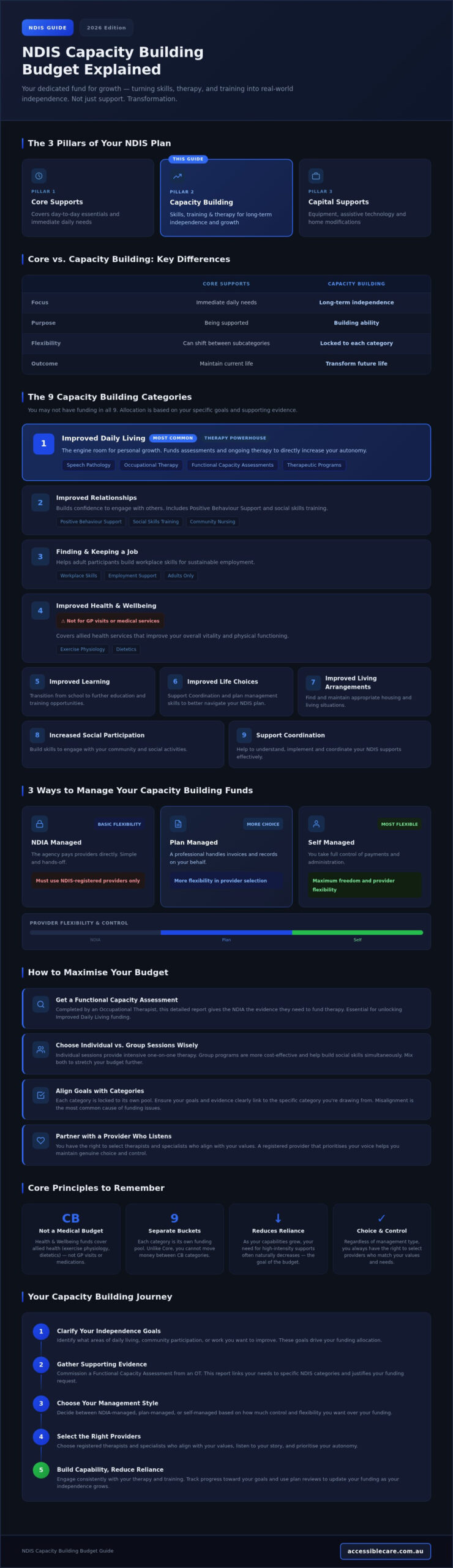
Your NDIS plan is built on three distinct pillars that work together to support your life: Core Supports, Capital Supports, and the Capacity Building Budget. While Core covers your day-to-day essentials, Capacity Building is your dedicated fund for growth. It focuses specifically on skills, training, and therapy. Having your ndis capacity building budget explained as a roadmap for your future helps shift the focus from simply “being supported” to actively “building ability.”
This budget is the key to achieving your long-term NDIS goals. It isn’t just about receiving a service; it’s about transformation. It funds the professional advice and practical training that help you bridge the gap between where you are now and where you want to go. By investing in your own abilities today, you’re taking an active and empowering role in your own future.
The Goal of Capacity Building Supports
The primary purpose of these funds is to foster true independence in daily living and community participation. This might mean learning how to manage your own household, improving your communication through speech therapy, or finding ways to participate more fully in your local Melbourne or Adelaide community. One of the heartening aspects of this funding is that it can reduce your long-term reliance on high-intensity support work. As you grow more capable, your need for constant assistance often naturally decreases because you’ve gained the tools to manage things yourself. Capacity Building is a vital investment in a participant’s autonomy that provides the tools and training necessary to lead a self-directed life.
Who Manages Your Capacity Building Funds?
You have the right to decide how your money is handled. There are three main ways to manage these funds:
- NDIA-managed: The agency pays your providers directly, though you must use NDIS-registered providers.
- Plan-managed: A dedicated professional handles your invoices and records, giving you more choice in providers.
- Self-managed: You take full control of the payments and administration, offering the most flexibility.
Regardless of the method you choose, the principle of Choice and Control remains at the heart of the system. You have the right to select therapists and specialists who align with your values and understand your unique story. If you’re still finding your feet with the basics of the system, you might find our guide on What is the NDIS? A Simple and Compassionate Guide helpful for setting the scene.
The 9 Capacity Building Categories Explained
Getting your ndis capacity building budget explained starts with looking at the nine specific categories that make up this part of your plan. Each category targets a different area of your life, from your physical health to your social connections. You might not have funding in all nine areas. The NDIA allocates money based on your specific goals and the evidence provided by your support team. Understanding these labels helps you use your funds with confidence.
Two categories often stand out for their impact on independence. Improved Daily Living is the most common, focusing on therapeutic supports. Improved Relationships is another vital area, focusing on how you interact with the world. Other categories include Finding and Keeping a Job, which helps adult participants build workplace skills, and Improved Health and Wellbeing. It’s important to know that Health and Wellbeing funds are not for medical services like GP visits; instead, they cover things like exercise physiology or dietetics to improve your overall vitality.
Improved Daily Living: The Therapy Powerhouse
This category is the engine room for your personal growth. It’s where you access vital services like Speech Pathology and Occupational Therapy. For instance, assessments and ongoing therapy from Speech Pathology are funded here to help you communicate more clearly or swallow more safely. To ensure you have enough funding in this area, Functional Capacity Assessments are essential. These detailed reports, often completed by an Occupational Therapist, provide the NDIA with the evidence they need to see how therapy will directly increase your autonomy.
Improved Relationships and Social Participation
Social connection is a fundamental human need. This category provides funding for Positive Behaviour Support and social skills training. These services help you understand your emotions and build the confidence to engage with others in your Melbourne or Adelaide community. Community nursing can also integrate with these goals by ensuring your health is stable enough for you to get out and about. If you’re feeling overwhelmed by these choices, our team is here to help you explore your support options with a friendly, listening ear. We believe that when you feel supported in your relationships, every other part of your life becomes a little easier to manage.
Capacity Building vs. Core Supports: Understanding the Difference
One of the most common points of confusion involves the boundaries between different funding types. Having your ndis capacity building budget explained in relation to Core supports is essential for managing your plan effectively. While they both exist to support your life, they serve very different purposes. Core supports are designed to solve today’s needs, providing the immediate assistance you require for daily living. In contrast, Capacity Building solves tomorrow’s needs by investing in the skills you’ll use for years to come.
Think of it this way. A support worker funded through your Core budget might help you with dressing or grocery shopping this week. An Occupational Therapist funded through Capacity Building works with you to develop the physical coordination or planning skills so you can eventually manage those tasks on your own. These two budgets work together in a holistic support plan to ensure you’re safe and cared for now, while constantly moving toward a more autonomous future.
Can I Use Capacity Building Funds for Core Needs?
The rules regarding flexibility are quite strict. You cannot move money between these two pillars. If you find yourself running low on Core funds, you can’t dip into your Capacity Building budget to cover those daily costs. If you try to overspend or use funds for the wrong category, it can lead to complications during your plan review. Balancing your budget across the entire duration of your plan requires careful thought and sometimes a bit of professional guidance. Core supports provide the foundation, while Capacity Building builds the structure of independence.
Why Capacity Building Funding is Stricter
Spending in this category is linked directly to the “Reasonable and Necessary” criteria set by the NDIA. Because this money is intended for growth, the agency requires evidence that the supports are actually helping you reach your goals. This means that therapy must be evidence-based and outcomes-focused. You’ll often need to provide reports that show the progress you’re making toward your independence. This is where a multidisciplinary team becomes so valuable. Having specialists who understand how to document your growth ensures your funds are used correctly and that your plan remains stable and supportive for the long term.
How to Maximise Your Budget for Therapy and Independence
Maximising your funds starts long before you see a therapist. It begins in your planning meeting by identifying goals that truly matter to you. When you have your ndis capacity building budget explained through the lens of your own aspirations, every dollar becomes more meaningful. You might wonder if you should choose one-on-one therapy sessions or explore group programs. While individual therapy offers focused attention, group settings can provide valuable social interaction and are often a more cost-effective way to stretch your budget further.
Assistive technology also plays a vital role here. Small tools or specialised equipment can sometimes do more for your long-term independence than hours of manual support. To keep your funding secure, you must show the NDIA that your budget is working. Regularly reviewing your progress and keeping clear records of how your skills are improving makes your next plan review much smoother. It’s about proving that the investment in your ability is yielding real-world results.
Using Improved Daily Living for OT and Speech Therapy
Whether you’re looking for paediatric Occupational Therapy in Adelaide or adult speech therapy in Melbourne, the Improved Daily Living category is your primary tool. It’s vital to allocate your funds wisely, keeping in mind that your budget needs to cover both direct therapy time and essential report writing. These reports are not just paperwork; they are the evidence that links your therapy outcomes to your primary NDIS goals. They tell the story of your progress and justify why your support should continue into the next plan period.
The Value of Multidisciplinary Care
Choosing a provider that offers a multidisciplinary team can make a significant difference to your budget and your well-being. When you have an Occupational Therapist and a Speech Pathologist working together under one roof, like we do at Accessible Care, it reduces administrative overlap. There’s no need for you to repeat your story to different organisations. Instead, your therapists can collaborate directly, leading to more cohesive clinical outcomes. This joined-up approach is especially helpful for complex situations, such as recovering from an Acquired Brain Injury (ABI), where physical and communication needs are deeply intertwined. If you’re ready to see how a personalised plan can change your life, we invite you to talk with us about your therapy goals today.
Navigating Your NDIS Journey with Accessible Care
We believe that the most important part of any NDIS plan isn’t the numbers on the page, but the person behind them. While we’ve had your ndis capacity building budget explained through categories and rules, our first step is always to listen to your story. We want to understand your dreams, your daily hurdles, and what independence looks like for you. When you have your ndis capacity building budget explained by a partner who cares, the process feels less like administration and more like progress. As a registered NDIS provider with a strong presence in Melbourne and Adelaide, we take an “Independence-First” approach. This means we don’t just provide services; we partner with you to build the skills that matter most to your specific life. Our goal is to see you thrive in your own home and community, using the supports that work for you.
Compassionate Therapy in Melbourne and Adelaide
Our multidisciplinary teams are here to support your growth at every stage of life. We have experienced Speech Language Pathologists (SLPs) who focus on communication and swallowing, alongside dedicated paediatric and adult occupational therapy teams. We specialise in helping you navigate the “Improved Daily Living” category, ensuring your therapy is targeted and effective. Whether you’re a parent seeking support for a child or an adult looking to reclaim your autonomy, our local experts are ready to walk beside you. We understand the Melbourne and Adelaide healthcare landscapes, allowing us to connect you with the right local resources and opportunities for community participation. We focus on the person, not just the process, ensuring every session brings you a step closer to your goals.
Ready to Build Your Capacity?
Taking the next step on your journey starts with a holistic assessment. We look at the big picture, considering how different therapies can work together to give you the best possible outcome. This includes specialised support for veterans and individuals with complex medical needs. We understand the unique challenges these situations present and provide the expert care you deserve. Our team is trained to handle complex clinical requirements with both technical skill and a nurturing touch, ensuring you feel safe and respected throughout your care.
If you’re ready to explore how your funding can create a brighter future, booking a consultation is a gentle way to start. We’ll help you look at your budget not as a source of stress, but as a toolkit for your own empowerment. Your path to self-determination is a personal one, but you don’t have to walk it alone. We are here to provide the professional guidance and heartfelt care you need to turn your funding into a life of greater freedom, choice, and peace of mind.
Your Journey Toward Greater Autonomy
Managing your NDIS plan doesn’t have to feel like a burden. Now that you’ve had your ndis capacity building budget explained, you have the clarity to turn those funding categories into real-world progress. Remember that these funds are a dedicated investment in your future self-reliance. They help you move from needing constant support to mastering the new skills that make life easier and more fulfilling.
Choosing a partner who truly listens is the most important step you can take. Accessible Care is a registered NDIS provider in VIC and SA, offering an expert multidisciplinary team that works together for your benefit. Our holistic, person-centric approach ensures that every therapy session and support plan is tailored to your unique life. Whether you’re in Melbourne or Adelaide, we’re here to help you navigate the system with confidence and heart. We believe that with the right tools, your potential for independence is limitless.
Let us help you build your independence. Contact Accessible Care today and take the first step toward your goals. You deserve a life of choice and control, and it’s our honor to help you build it.
Frequently Asked Questions
What are the 9 sub-categories of Capacity Building?
The nine sub-categories include Support Coordination, Improved Living Arrangements, and Increased Social and Community Participation. Others are Finding and Keeping a Job, Improved Relationships, and Improved Health and Wellbeing. Finally, you have Improved Learning, Improved Life Choices, and Improved Daily Living. Each category is designed to target a specific area of your personal development and independence. Understanding these helps you see the ndis capacity building budget explained as a toolkit for your future growth.
Can I use my Capacity Building budget to pay for a support worker?
No, you typically cannot use Capacity Building funds for standard support work. Support workers who assist with your day-to-day tasks are funded through your Core budget. Capacity Building is strictly reserved for therapeutic supports, training, and skill-building activities that increase your autonomy. While a Core support worker helps you today, Capacity Building focuses on professional specialists who help you develop the skills to do more for yourself in the future.
Is Occupational Therapy covered under Capacity Building?
Yes, Occupational Therapy is a core component of the Capacity Building budget, specifically under the Improved Daily Living category. This funding allows you to work with qualified therapists to improve your coordination, fine motor skills, or ability to manage household tasks. At Accessible Care, our experienced teams in Melbourne and Adelaide use these funds to help both children and adults build the practical skills they need for a more independent life.
What happens if I run out of Capacity Building funds mid-plan?
If your funds run low before your plan ends, you should contact your NDIS planner or Local Area Coordinator. You cannot move money from your Core or Capital budgets to cover Capacity Building costs. If your circumstances have changed significantly, you may be eligible for a plan review. It’s helpful to track your spending closely to ensure your therapeutic supports continue consistently until your next scheduled review date.
Can Capacity Building money be used for home modifications?
No, home modifications are funded through the Capital Supports budget rather than Capacity Building. While Capacity Building can pay for an Occupational Therapist to assess your home and recommend specific changes, the actual cost of the modifications or specialised equipment falls under the Capital pillar. It’s helpful to keep these two categories separate to ensure you’re following NDIS rules and making the most of your available funding.
Do I need a quote before using my Capacity Building budget?
You generally don’t need a formal quote for standard therapy sessions, but you should have a service agreement in place with your provider. This agreement outlines the costs, frequency of sessions, and how the support will help you meet your goals. For more expensive items or specialised training programs within this budget, the NDIA might occasionally request a quote to ensure the support meets their Reasonable and Necessary criteria.
How do I prove that my Capacity Building support is working?
Proving progress involves regular reports from your therapists and documenting your personal milestones. These progress reports should clearly show how the therapy is helping you achieve the specific goals listed in your NDIS plan. When your ndis capacity building budget explained is linked to measurable outcomes, like improved communication or increased physical coordination, it becomes much easier to justify continued funding during your next plan review or assessment.
Can I use Capacity Building funds for speech therapy for my child?
Yes, speech therapy for children is a common use of the Improved Daily Living category within the Capacity Building budget. These funds allow your child to work with experienced Speech Language Pathologists to develop vital communication and language skills. At Accessible Care, we provide specialised paediatric speech therapy designed to support your child’s development in a nurturing environment, helping them build a strong foundation for their future education and social life.

