


Imagine the relief of knowing that your clinical needs don’t have to mean moving into a residential facility. For many families in Melbourne and Adelaide, the line between Medicare and the NDIS feels blurry. This often leads to a deep sense of anxiety about whether home care is truly sustainable. You might wonder if your requirements qualify for ndis funding for nursing care, or how to explain these needs during a plan review. It’s a heavy burden to carry, but you deserve to feel secure and supported in your own space.
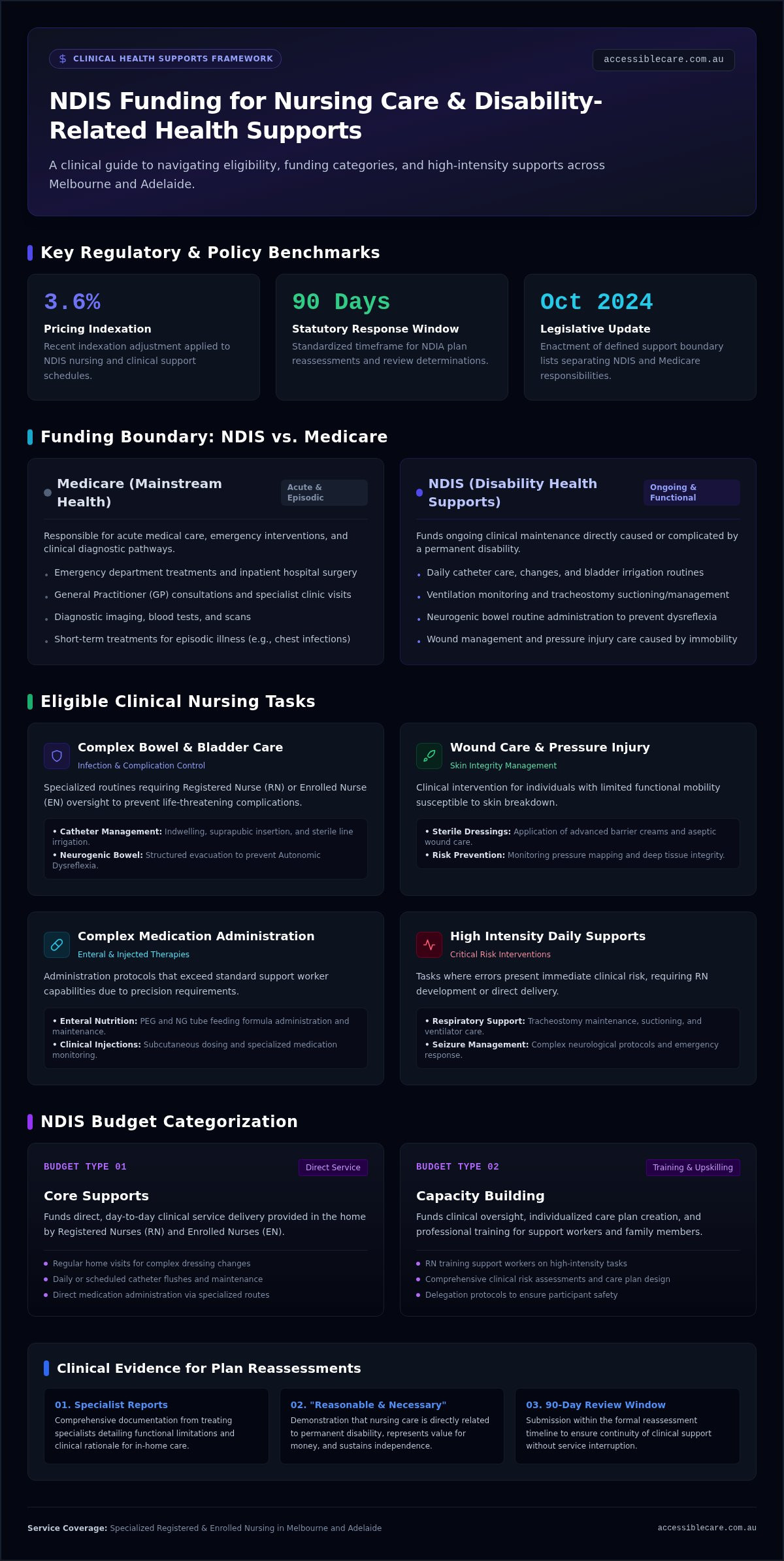
We believe that every person deserves to live with dignity and autonomy. In this 2026 guide, you’ll learn exactly how to access funding for disability-related health supports to maintain your independence at home. We’ll explore the latest pricing updates, including the recent 3.6 percent indexation and the new 90-day statutory response window for plan reassessments. We will also outline which nursing tasks are eligible and how to find a compassionate provider in your local community. By the end, you’ll have the clear information needed to advocate for your goals and find the peace of mind you’ve been searching for.
Key Takeaways
- Understand the clear boundary between Medicare and the NDIS to ensure your disability-related health supports are correctly funded for long-term stability.
- Identify the specific clinical tasks that qualify for ndis funding for nursing care, from complex wound management to enteral feeding support.
- Learn how to use both Core and Capacity Building budget categories to fund both direct clinical care and the professional training your support team needs.
- Prepare for your next plan review with a clear understanding of the essential clinical evidence and specialist reports required to secure your nursing budget.
- Discover how specialized community nursing in Melbourne and Adelaide can provide a bridge to greater independence while keeping you safe in the comfort of your own home.
Understanding NDIS Funding for Nursing Care: What You Need to Know
We understand that securing ndis funding for nursing care can feel like a daunting task when you’re already managing complex daily needs. You might feel anxious about whether your clinical requirements will be met or if you’ll be forced to rely on a revolving door of hospital visits. NDIS nursing care is a professional support that focuses on enabling your independence and participation in the community rather than simply treating a medical condition. It’s a vital resource designed to help you stay in the comfort of your own home, surrounded by the people and things you love.
When the NDIA looks at your request for support, they apply the “Reasonable and Necessary” criteria. This means the funding must be related to your disability, represent value for money, and be likely to help you achieve your goals. Accessing ndis funding for nursing care is about ensuring you have the right clinical support to live a full, self-directed life. It isn’t just about ticking boxes; it’s about honoring your right to choose where and how you receive care.
The Role of Disability-Related Health Supports
The term “disability-related health supports” refers to clinical care that you need specifically because of your disability. These aren’t temporary treatments for a short-term illness. Instead, they’re ongoing supports that manage the functional impact of your condition. For example, if you require a regular bowel routine or complex wound management due to permanent immobility, these are funded by the NDIS. These supports are essential because they prevent your health from deteriorating and help you avoid unnecessary hospital stays. By having an experienced nurse visit you in Melbourne or Adelaide, you can maintain your health in a way that respects your privacy and autonomy.
NDIS vs. Medicare: Who Pays for What?
Distinguishing between the National Disability Insurance Scheme (NDIS) and the mainstream health system is often the biggest source of confusion for families. Medicare is responsible for acute care, such as emergency treatment, surgery, and general practitioner visits. If you have a chest infection or need a diagnostic scan, these fall under the public health system.
The NDIS steps in for daily clinical maintenance that is directly caused or complicated by your disability. This includes tasks like catheter care, ventilation support, or tracheostomy management. Under the legislative changes that took effect in October 2024, the government has created clearer lists to define these boundaries. While the systems are separate, they should work together to wrap around your specific needs. We’re here to help you understand these “grey areas” so you can feel confident that your care is stable and fully funded.
What Types of Nursing Tasks Does the NDIS Fund?
Understanding exactly which clinical tasks are covered by your plan is the first step toward reclaiming your independence. While support workers provide wonderful daily assistance, certain needs require the advanced clinical expertise of a Registered Nurse (RN) or an Enrolled Nurse (EN). Under the NDIS disability-related health supports guidelines, ndis funding for nursing care is specifically allocated for tasks that carry a higher clinical risk. These services are designed to be proactive, helping you manage your health safely at home.
Common clinical tasks funded by the scheme include:
- Complex Bowel and Bladder Management: This involves catheter changes, irrigation, and managing neurogenic bowel routines to prevent complications like autonomic dysreflexia.
- Wound Care and Pressure Sore Prevention: Professional management of skin integrity is vital for those with limited mobility. Nurses provide sterile dressings and monitoring to prevent serious infections.
- Medication Administration: This covers complex needs such as managing PEG feeds or administering subcutaneous injections that require professional oversight.
High Intensity Daily Personal Activities
The NDIS uses the term “High Intensity” to describe supports where the risk to your wellbeing is greater if the task isn’t performed with clinical precision. If you require ventilation or tracheostomy care, these are strictly defined as high-intensity needs. Managing complex seizure activity also falls into this category. Our team of registered nurses in Melbourne and Adelaide works closely with you to ensure these high-stakes supports are delivered with both technical expertise and a compassionate, gentle touch.
Assessment and Care Planning
Securing ndis funding for nursing care isn’t just about the time a nurse spends in your home. It also covers the vital work of clinical assessment and care planning. A Registered Nurse must create a comprehensive Nursing Care Plan that outlines your health goals and identifies potential risks. This document is essential for your NDIS reviews and serves as a clinical roadmap for your entire support team.
Nurses also play a critical role in training your disability support workers. They ensure that your daily team can safely handle delegated tasks, such as basic enteral feeding or oral suctioning, under professional supervision. This collaborative approach ensures you remain safe while maintaining your autonomy and choice in who provides your daily care. It creates a supportive partnership that prioritizes your comfort above all else.
Navigating NDIS Funding Categories for Nursing
Many people feel overwhelmed when they first look at their NDIS plan. It often looks like a puzzle of categories and line items that don’t always make sense at first glance. Understanding how ndis funding for nursing care is distributed across your budget helps you use your funds more effectively. Usually, nursing supports appear in two primary areas: Core Supports and Capacity Building. Each serves a different purpose in your journey toward better health and autonomy.
How you manage your plan also changes how you access these services. If you’re agency-managed, you must use a registered provider who meets the NDIS Practice Standards for high-intensity supports. Self-managed participants have more flexibility but also carry the responsibility of ensuring their chosen nurse has the correct AHPRA registration and insurance. We’re here to help you navigate these choices so you can focus on your wellbeing.
Core Supports for Daily Clinical Needs
Core funding is the most common home for nursing services. It’s found under the “Assistance with Daily Personal Activities” category. This is the budget you use for direct, hands-on care. If you need a Registered Nurse to visit your home in Melbourne or Adelaide for wound care, catheter management, or medication administration, this is where the funding comes from.
The benefit of Core funding is its inherent flexibility. If your health needs fluctuate, you can often adjust the frequency of your nursing visits without needing an immediate plan review. This allows your care to be as responsive as you need it to be. To make your budget last for the full duration of your plan, it’s helpful to have a clear schedule of care that accounts for both weekday visits and any necessary weekend support.
Capacity Building for Independence
While Core funding covers the daily “doing,” Capacity Building focuses on “learning” and “planning.” This category is essential if you want to empower your wider support team. You can use these funds for a nurse to train your family members or support workers on how to handle specific health tasks safely under delegation. It also covers the time a nurse spends developing specialized health protocols or emergency plans tailored to your life.
Often, a functional capacity assessment is a vital tool for justifying this type of funding. It provides the clinical evidence the NDIA needs to see how nursing care directly supports your independence. By investing in Capacity Building, you’re not just receiving care; you’re building a sustainable support network that respects your desire to live a self-directed life at home.
How to Secure Nursing Care Funding in Your Plan
Preparing for an NDIS plan review can feel like a high-stakes moment for your family. It’s natural to feel anxious when you have to justify supports that are essential for your daily safety and comfort. “The key to nursing funding is proving that the support is directly related to your functional impact.” This means you must show the NDIA exactly how your disability creates a specific clinical need that requires professional oversight. Securing ndis funding for nursing care depends on the strength of your clinical evidence and how clearly you connect these supports to your long-term goals.
When you sit down with a planner or local area coordinator, the focus should be on how these disability-related health supports prevent your condition from worsening. You aren’t just asking for a service; you’re asking for the tools to stay out of the hospital and remain in your own home. Highlighting the “risk of harm” is a powerful way to explain this. If the lack of nursing care would lead to a serious health crisis or an emergency admission, the NDIA is much more likely to recognize the support as reasonable and necessary.
Gathering Clinical Evidence
Your GP or medical specialist is a vital partner in this journey. When they write a letter of support, it shouldn’t just list a diagnosis. It needs to describe the specific clinical tasks required, such as complex wound management or tracheostomy care, and why these cannot be safely performed by a support worker without nursing supervision. A letter that details the frequency and duration of these tasks helps the planner allocate the correct amount of funding to your plan.
We often find that a multidisciplinary approach is the most effective way to build a strong case. Combining a nursing report with a Functional Capacity Assessment creates a holistic picture of your daily life. While your nurse documents the clinical risks, an Occupational Therapist can explain how these health supports allow you to perform daily activities more safely. This combined evidence shows that your needs are permanent and directly related to your disability rather than a temporary medical issue.
Defining Your Goals for Nursing Care
The NDIS is designed to help you live a more active and engaged life. When you set your goals, try to look beyond the clinical task itself. Frame your nursing needs as a way to achieve greater autonomy or to participate in social and economic activities. For instance, having a nurse manage your specialized health needs might be the very thing that allows you to attend a community group or spend time with friends without fear.
If you’re just starting your journey, our guide on what is the NDIS offers helpful basics on how to structure your goals effectively. By showing that ndis funding for nursing care is a bridge to your independence, you make a much more persuasive case for its inclusion. If you need help gathering this evidence in Melbourne or Adelaide, our team is here to walk alongside you. You can reach out to us to discuss how we can help you prepare for your next plan review with confidence.
Compassionate Community Nursing with Accessible Care
At Accessible Care, we believe that the best care begins with a conversation. We don’t just look at a list of clinical tasks; we listen to your story, your preferences, and your aspirations. Our approach is built on the foundation of “listening first, caring always.” By placing your voice at the center of everything we do, we ensure that your ndis funding for nursing care is used in a way that truly honors your autonomy. Whether you’re in Melbourne or Adelaide, our team is dedicated to providing professional support that feels like a partnership rather than a transaction.
We understand that health needs don’t exist in a vacuum. That’s why we take a multidisciplinary approach to your wellbeing. Our Registered Nurses and Enrolled Nurses work closely with our Occupational Therapists and Speech Pathologists to provide holistic support. This collaboration ensures that every aspect of your disability-related health supports is coordinated and effective. We’re here to bridge the gap between your clinical requirements and the life you want to lead, providing a reliable safety net that lets you focus on what matters most.
Expert Care in Your Own Home
There’s a unique sense of dignity and comfort that comes from receiving care in your own familiar environment. You shouldn’t have to leave the home you love just because your needs have become more complex. Our community nursing services are designed to bring high-quality clinical support to your doorstep, allowing you to maintain your routine and stay connected to your community.
Every participant we support receives a Tailored Nursing Care Plan. This isn’t a generic document; it’s a personalized roadmap that reflects your specific health needs and personal goals. For those requiring High Intensity Supports NDIS, we provide the specialized expertise needed to manage clinical risks safely. We focus on empowering you to live with confidence, knowing that your care is in professional, caring hands.
Getting Started with Accessible Care
We know that starting with a new provider can feel overwhelming, so we’ve made our intake process as simple and gentle as possible. When you reach out to us, our friendly team will guide you through each step with patience and understanding. We’ll help you navigate your first nursing assessment, ensuring that every detail of your clinical need is captured accurately for the NDIA.
Our goal is to make accessing ndis funding for nursing care feel like a natural extension of your daily life. We’re here to answer your questions, ease your anxieties, and provide the competent care you deserve. If you’re ready to explore how we can support your independence, please contact our friendly team in Melbourne or Adelaide today. We’re ready to listen.
Empowering Your Future with Dedicated Support
Navigating the path to clinical support shouldn’t feel like a struggle against a complex system. By learning how to access ndis funding for nursing care, you’re taking a vital step toward a life defined by your own choices rather than your health requirements. We’ve explored how gathering strong clinical evidence and understanding the specific categories in your plan can help you maintain your independence. These disability-related health supports are designed to provide a safety net, allowing you to stay in the comfort of your home while staying connected to your community in Melbourne or Adelaide.
As a Registered NDIS Provider, we pride ourselves on our holistic, person-centered approach. Our experienced Registered Nurses are here to listen to your story and help you bridge the gap between clinical needs and personal aspirations. We believe that professional care should always be delivered with warmth and respect for your autonomy. If you’re ready to find a supportive partnership, please contact Accessible Care for a compassionate consultation on your nursing needs. You deserve to feel secure and empowered every day.
Frequently Asked Questions
Is nursing care covered by the NDIS?
Yes, the NDIS funds nursing care when it’s considered a disability-related health support. This means the support must be directly related to your functional impairment rather than a general medical condition. Common examples include complex wound management, catheter care, and ventilation support. These services are designed to help you maintain your independence and stay in your own home rather than moving into a residential facility.
What is the difference between NDIS nursing and hospital nursing?
NDIS nursing focuses on managing permanent or long-term health needs in the community. Hospital nursing, funded through Medicare, is for acute illnesses, surgeries, or medical emergencies. While a hospital treats a temporary condition to get you well, ndis funding for nursing care provides ongoing maintenance for your disability. This ensures you can live safely at home with professional clinical oversight that respects your autonomy and personal goals.
Do I need a Registered Nurse or a support worker?
The choice depends on the clinical risk and complexity of the task. A Registered Nurse (RN) is required for high-intensity clinical tasks like tracheostomy care or complex seizure management. A support worker can often handle daily personal care, but they must be trained and supervised by a nurse for specific health tasks. We help you determine the right level of care to ensure your safety while maximizing your budget.
Can NDIS pay for my medications?
No, the NDIS generally doesn’t pay for the medications themselves. Pharmaceutical costs remain the responsibility of the Pharmaceutical Benefits Scheme (PBS) and the individual. However, the NDIS can fund the clinical support needed to administer medications if it requires a nurse’s expertise. This includes managing PEG feeds or providing subcutaneous injections that are directly related to your disability and your functional impact on daily life.
How do I add nursing to my NDIS plan?
You can request ndis funding for nursing care during your initial planning meeting or at a scheduled plan review. You’ll need to provide clinical evidence, such as a letter from your GP or a specialist, outlining why the support is reasonable and necessary. Including a nursing assessment or a multidisciplinary report from your therapist can also help justify the need for professional clinical oversight in your home environment.
What is a Nursing Care Plan in the NDIS?
A Nursing Care Plan is a comprehensive document created by a Registered Nurse that outlines your clinical needs and health goals. It identifies potential risks and provides clear instructions for your support team to follow. This plan is essential for ensuring your care is consistent and safe. It also serves as a vital piece of evidence for the NDIA during your plan reviews to justify your ongoing funding.
Does Accessible Care provide nursing in Adelaide?
Yes, Accessible Care provides dedicated community nursing and high-intensity supports across both Adelaide and Melbourne. Our team of experienced Registered Nurses and Enrolled Nurses specializes in delivering compassionate care in your own home. We focus on holistic assessments that empower your independence. Whether you need complex wound care or help training your support team, our local professionals are here to walk alongside you and your family.
What happens if my nursing needs change mid-plan?
If your clinical needs change significantly, you can request an unscheduled plan reassessment from the NDIA. Under the August 2026 legislative amendments, the agency now has a firm 90-day statutory timeline to respond to these requests. It’s important to gather updated clinical evidence from your nurse or doctor as soon as possible. This ensures your funding remains aligned with your current health requirements and keeps you safe and supported at home.

