

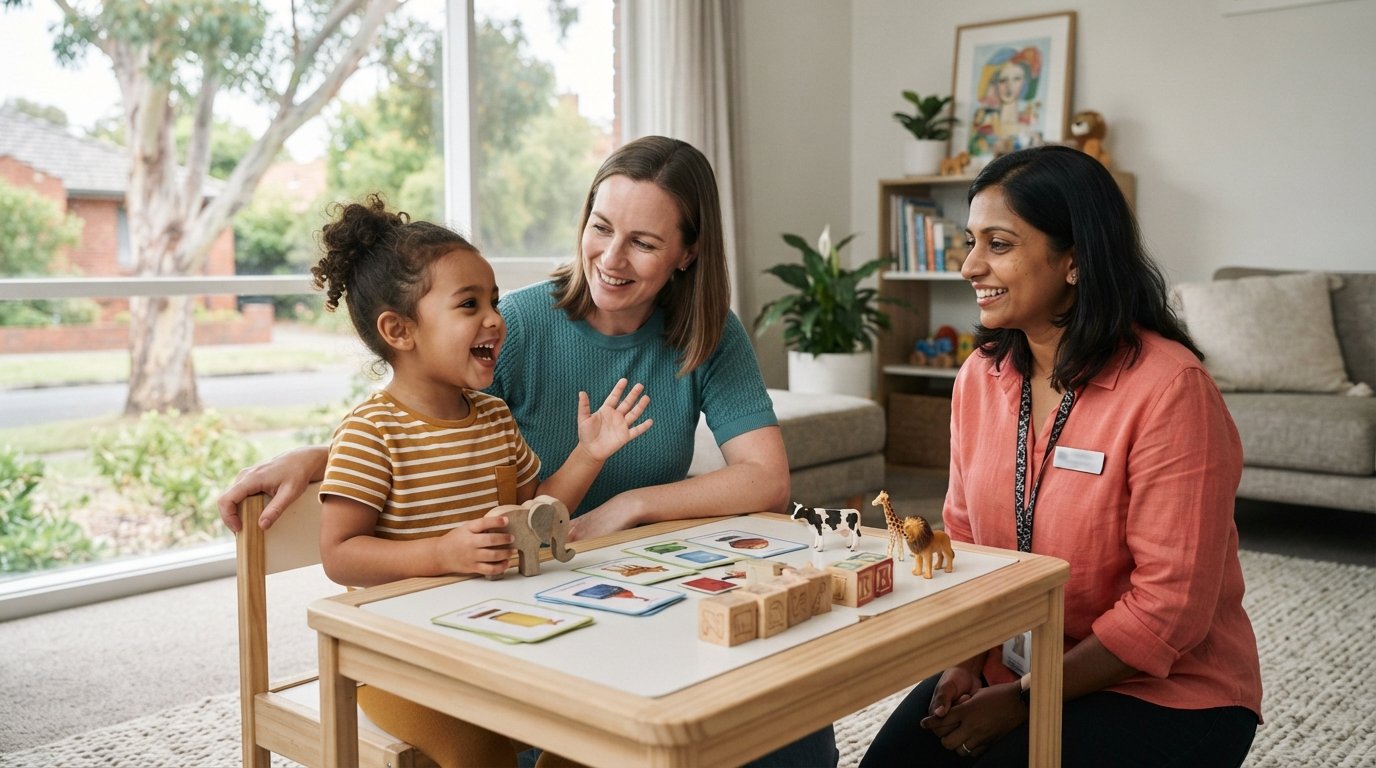
Did you know that by the age of four, an unfamiliar listener should be able to understand between 75% and 90% of what your child says? If you are finding it hard to decode your little one’s stories or noticing they aren’t quite meeting the same milestones as their preschool peers, it’s natural to feel a sense of worry. You might feel overwhelmed by clinical reports or struggle to explain exactly what support you need during an NDIS planning meeting. Setting the right speech therapy goals for 4 year old children isn’t just about ticking boxes on a development chart; it’s about giving your child the tools to share their thoughts, feelings, and needs with the world around them.
We believe that every child deserves to be heard and understood. This guide will help you move past the confusing terminology to discover how tailored speech therapy goals empower your four-year-old to communicate with confidence. You’ll gain a clear understanding of Australian paediatric milestones and learn how to collaborate effectively with your therapist. We will also explore practical ways to support your child’s speech at home and how to frame these goals to ensure you get the most out of your NDIS Early Childhood Approach funding.
Key Takeaways
- Learn the specific clinical benchmarks for four-year-olds, including the expectation that unfamiliar listeners should understand at least 75% to 90% of their speech.
- Understand how to translate complex clinical speech therapy goals for 4 year old children into functional, real-world outcomes that make sense for your family.
- Discover the process of aligning communication goals with the NDIS Early Childhood Approach to help secure appropriate Capacity Building support for your child.
- Gain confidence in your role as a collaborative partner, ensuring therapy goals reflect your child’s unique personality and daily needs at home and preschool.
- Explore the benefits of mobile speech pathology services that bring professional support into your child’s natural environment in Melbourne or Adelaide.
Understanding Communication Milestones: What is “Normal” at Age Four?
Watching your child’s personality shine through their words is a magical experience. However, it’s also a time when many parents start to notice differences between their child and others at preschool. To help ease that worry, we first look at the difference between speech and language. Speech refers to the physical act of making sounds, while language involves the meaning behind those sounds and how they follow rules to share ideas. Identifying clear speech therapy goals for 4 year old children starts with understanding these foundational benchmarks.
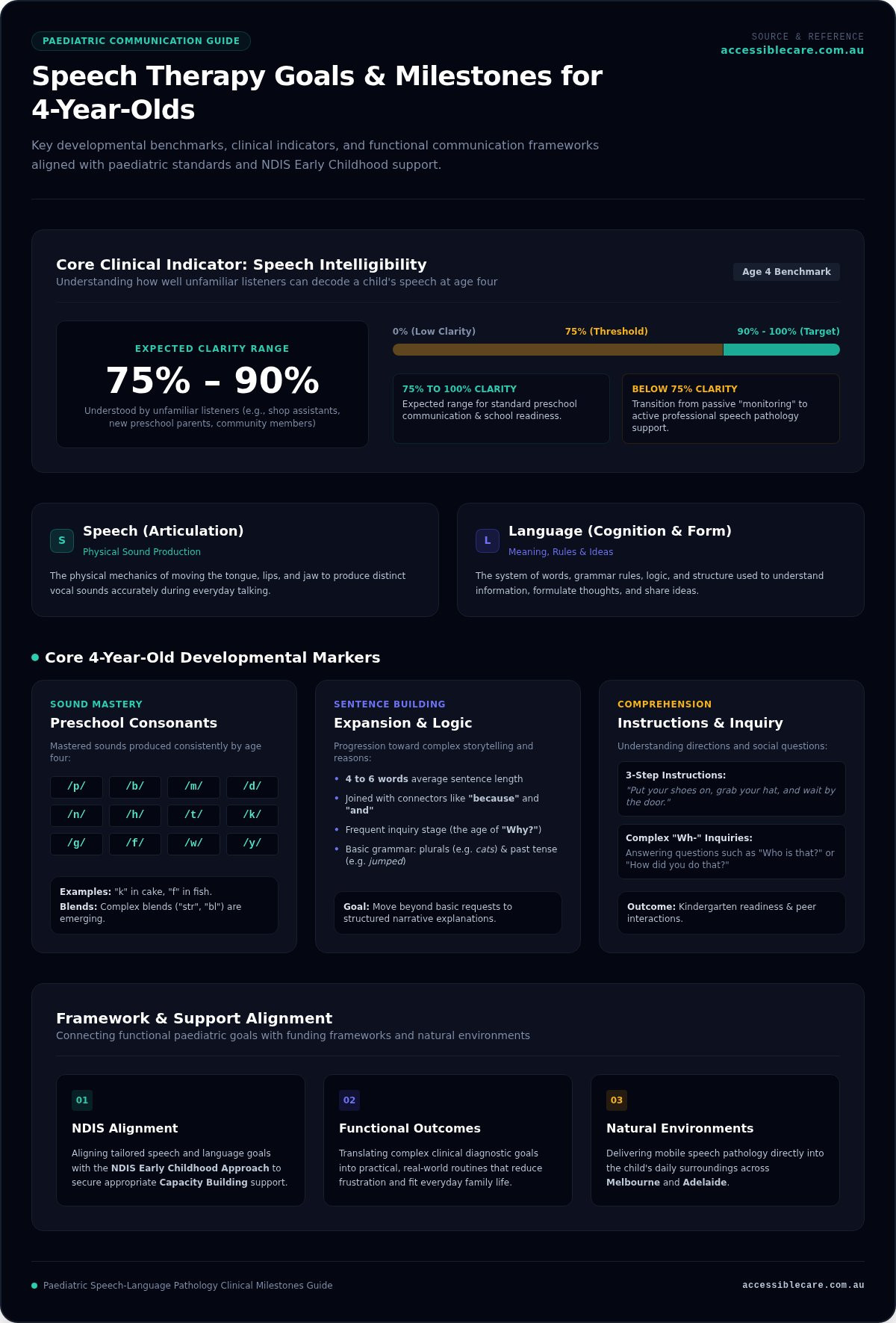
By age four, communication shifts from simply requesting a snack to complex storytelling. You’ll likely hear your little one retelling parts of their day or explaining why they chose a specific toy. A significant clinical indicator at this age is intelligibility. An unfamiliar listener, such as a shop assistant or a new friend’s parent, should understand between 75% and 100% of what your child says. If clarity is below 75%, it’s often the right time to transition from “monitoring” to active support. The field of speech-language pathology provides the tools to evaluate these areas and ensure your child is on the right path for school readiness.
Speech Sound Development (Articulation)
Articulation is the physical ability to move the tongue, lips, and jaw to produce specific sounds correctly during preschool development. By the fourth birthday, most children have mastered many early sounds. While some “cute” errors, known as phonological processes, are still normal, many should be fading as they prepare for primary school. Setting specific speech therapy goals for 4 year old children often focuses on these key sounds:
- Consonants mastered by age four typically include /p, b, m, d, n, h, t, k, g, f, w, y/.
- Your child should be able to produce the “k” in “cake” or the “f” in “fish” consistently.
- While complex blends like “str” or “bl” might still be emerging, the individual sounds within them should be becoming clearer.
Language Expansion and Sentence Structure
Language at age four is about more than just words; it’s about connection and logic. You’ll likely hear your child using sentences that are 4 to 6 words long, often joined by “because” or “and.” This is the age of “Why?” as they seek to understand their world. We focus on building these structures to help them navigate social situations and follow instructions at kindergarten. Common language milestones include:
- Using basic grammar, including plurals (cats) and past tense (jumped).
- Answering complex “Wh-” questions like “Who is that?” or “How did you do that?”
- Following three-step instructions in a home setting, such as “Put your shoes on, grab your hat, and wait by the door.”
If your child isn’t quite meeting these markers, don’t feel discouraged. These milestones are helpful guides, not rigid rules, and they help us create a compassionate roadmap tailored to your child’s unique journey.
How Speech Pathologists Create Compassionate, Meaningful Goals
Setting goals shouldn’t feel like reading a cold medical report. At Accessible Care, we believe you are the expert on your child. While our Speech Language Pathologists (SLPs) bring clinical expertise, you bring the deep understanding of your child’s personality, frustrations, and joys. This collaborative partnership is the heartbeat of effective therapy. We start by listening to your concerns, whether it’s the heartbreak of not understanding your child’s stories or the anxiety of seeing them struggle to make friends at the park.
Our approach moves therapy from the clinic into the real world. We focus on functional communication, which means we target skills that make an immediate difference in your daily life. Understanding the ASHA communication milestones for 4- to 5-year-olds helps us bridge the gap between clinical data and your child’s everyday experiences. We use holistic assessments to identify not just where your child needs help, but where they already shine. This allows us to balance immediate needs, like reducing communication-based frustration, with long-term outcomes like school readiness.
The SMART Framework for Families
When we design speech therapy goals for 4 year old children, we use the SMART framework to ensure progress is clear and encouraging. We keep goals specific, such as “initiating play with a peer,” rather than using vague clinical terms. We make them measurable so you can see the growth, but we do it through natural observation rather than making your child feel like they’re being tested. Most importantly, we ensure every goal is achievable. Small wins build big confidence, and frequent success keeps your child engaged and excited to learn.
Strengths-Based Goal Setting
We don’t just look at what’s “missing.” A strengths-based approach focuses on what your child loves to build their communication skills. If your four-year-old is obsessed with dinosaurs, we’ll use Triceratops and T-Rexes to work on speech sounds and sentence structure. This keeps therapy fun and honors your child’s autonomy. By incorporating their interests, we ensure that speech therapy goals for 4 year old learners promote self-expression and genuine connection. If you’re looking for a partner to help navigate this process, our mobile speech pathologists are ready to meet you in the comfort of your own home.
Top 3 Speech Therapy Goal Areas for 4-Year-Olds
Communication is much more than just the words we speak. It is a complex puzzle made of understanding, expression, and social connection. When we develop speech therapy goals for 4 year old children, we look at the “whole child” rather than focusing on a single isolated skill. This holistic approach ensures that your child isn’t just repeating sounds in a clinic room but is gaining the confidence to participate fully in their daily life. Many families find that the NDIS early childhood approach provides a wonderful gateway to these supports, offering a clear pathway for early intervention that respects each child’s unique developmental timeline.
Expressive Language: Building Complex Sentences
At age four, language becomes a vibrant tool for sharing ideas and stories. We move beyond simple requests to help children build longer, more descriptive sentences. A meaningful goal in this area might involve using “and” or “because” to link ideas together, allowing your child to explain their thoughts more clearly. We also focus on expanding their vocabulary to include descriptive words like “fast,” “loud,” or “heavy.” Developing narrative skills is another priority; we want to empower your little one to tell a simple story about their day at preschool, helping them connect with you and their peers.
Social Pragmatics: The Art of Conversation
Communication is a two-way street that requires a delicate balance of listening and speaking. Social pragmatics, or the “social rules” of language, is essential for making friends and navigating the classroom. Goals often focus on the rhythm of conversation, such as turn-taking during play or staying on a single topic for two or three exchanges. We also help children understand non-verbal cues, including facial expressions and body language. These skills are the building blocks of empathy and social autonomy, ensuring your child feels capable and included in group settings.
Articulation: Mastering Tricky Sounds
While language focuses on meaning, articulation ensures that those meanings are understood by others. We want to make sure your child’s voice is heard clearly, even in busy or noisy environments. Common speech therapy goals for 4 year old learners often target specific speech patterns like “fronting,” where a child might say “tup” instead of “cup.” We work gently to reduce these patterns and increase overall clarity. A key part of this process is self-correction; we help your child develop the awareness to hear and fix their own sounds, which builds a lasting sense of competence and pride in their speech.
Linking Speech Goals to Your Child’s NDIS Plan
Securing the right support for your child often feels like learning a second language. The National Disability Insurance Scheme (NDIS) uses specific terms that don’t always match how you talk about your child at home. For a four-year-old, therapy is usually funded through the Early Childhood Approach (ECA), which supports children under nine who have developmental delays or disabilities. It’s heartening to know that for children under six, a formal diagnosis isn’t always required to access early intervention; evidence of a delay is enough to start the journey.
Most speech therapy falls under the “Capacity Building” category, specifically “Improved Daily Living.” To ensure your child receives the right allocation, a functional capacity assessment is a vital piece of evidence. This document doesn’t just list what your child can’t do; it paints a picture of their life and the specific hurdles they face. It shows NDIS planners exactly how speech therapy goals for 4 year old participants will improve their independence and ability to connect with their community.
NDIS Language: Translating Goals for Planners
NDIS planners look for goals that focus on “Social and Economic Participation.” While your four-year-old isn’t looking for a job, their “economic participation” in the future depends on their ability to learn and socialise now. We frame communication goals around independence in daily living. For example, being able to tell a teacher they feel sick or asking a friend to share a toy are essential skills that reduce the long-term need for high-intensity support. By focusing on these functional outcomes, we help planners see the long-term value of early intervention.
Evidence-Based Reports that Get Results
When it comes time for a plan review, your Speech Pathologist’s report is your most important tool. Planners need to see clear, evidence-based progress against the goals funded in the previous plan. They look for specific data that shows how therapy is making a real-world difference. Working with an NDIS provider in Melbourne or Adelaide who understands these nuances makes the process much smoother. Our team at Accessible Care focuses on writing reports that speak the NDIS language while keeping your child’s unique voice at the centre. If you need help preparing for your next review, contact our team today to discuss how we can support your child’s communication journey.
How Accessible Care Supports Your Child’s Communication Journey
At Accessible Care, we understand that every child’s voice is a gift. Our approach to paediatric speech pathology is built on the belief that communication is a fundamental human right. We don’t just work in a clinical bubble; we bring our expertise directly to you. Our mobile therapy services in Melbourne and Adelaide allow your child to work on their speech therapy goals for 4 year old development in the place where they feel safest: their own home. This natural environment makes it easier for them to generalise new skills, whether they’re practicing speech sounds at the dinner table or using new words in their backyard.
Sometimes, communication challenges are part of a bigger picture. For children with complex needs, we offer multidisciplinary support where our Occupational Therapists and Speech Pathologists work together. This ensures we’re looking at your child’s sensory, motor, and communication needs as one connected whole. By collaborating, we ensure that every therapy session moves your child closer to independence. We focus on building a supportive partnership with you, ensuring you feel confident and equipped to champion your child’s progress every day.
Therapy that Fits Your Family Life
Life with a preschooler is busy. We offer flexible scheduling to fit around your family’s routine and kindergarten hours. A key part of our service is parent coaching. We don’t just treat your child; we empower you with the tools to support their progress between sessions. We also deeply respect the unique culture and dynamics of every Australian home, ensuring our support is always respectful, inclusive, and person-centric. It’s about making therapy a natural, low-stress part of your week.
Start Your Child’s Journey Today
Taking the first step can feel daunting, but we’re here to guide you. Referring your child to Accessible Care is a simple, stress-free process. Our initial holistic assessment is designed to be gentle and engaging for your little one. We spend time getting to know your child’s strengths and interests, ensuring that the speech therapy goals for 4 year old children we set are meaningful to your family. In this first session, we’ll discuss your concerns, observe your child’s natural communication, and begin crafting a roadmap that gives you peace of mind. Speak with our compassionate team about your child’s needs to learn how we can help your little one connect with the world.
Empowering Your Child’s Voice for the Future
Your journey as a parent is filled with important milestones, and seeing your child communicate with confidence is one of the most rewarding. We have explored how identifying the right speech therapy goals for 4 year old children can transform their daily interactions at home and preschool. By understanding clinical benchmarks and translating them into functional NDIS goals, you move from a place of anxiety to one of empowerment. You don’t have to navigate this complex system alone.
Accessible Care is here to walk beside you as a supportive partner. As a Registered NDIS Provider with specialised paediatric SLPs, we focus on holistic assessments that honour your child’s autonomy. Whether you are in Melbourne or Adelaide, our mobile team brings professional, warm support directly to your natural environment. We listen to your perspective and prioritise your child’s unique needs above all else. Ready to take the next step? Book a Compassionate Consultation for Your Child today. Let’s work together to help your little one share their world with clarity and joy.
Frequently Asked Questions
How do I know if my 4-year-old actually needs speech therapy?
You should consider an assessment if strangers understand less than 75% of your child’s speech or if they struggle to follow three-step instructions. At age four, children should use sentences of 4 to 6 words and answer “why” questions. If your child seems frustrated when trying to share their thoughts, a gentle evaluation by a paediatric SLP can provide clarity. Early support helps ensure they feel confident when starting school next year.
Can NDIS funding be used for speech therapy goals?
Yes, NDIS funding is a primary pathway for early intervention in Australia. Children under 9 access support through the Early Childhood Approach without always needing a formal diagnosis. Funding for speech therapy goals for 4 year old children usually falls under the “Capacity Building: Improved Daily Living” category. This funding allows you to work with registered providers like Accessible Care to build your child’s communication skills and functional independence at home and preschool.
How long does it typically take to see progress in speech therapy?
Every child’s communication journey is unique, so there is no fixed timeline for results. You might notice small wins, such as improved eye contact or new words, within the first few sessions. Achieving complex speech therapy goals for 4 year old learners, like mastering tricky sounds or narrative skills, often takes several months of consistent support. Progress is fastest when therapy is integrated into your daily family routines through regular parent coaching and home practice.
What happens if my child doesn’t meet their therapy goals?
If a goal isn’t met, we simply pause and recalibrate our approach. It’s never a failure on the child’s part; instead, it’s an opportunity for us to refine the therapy plan. We might break the goal into even smaller, more achievable steps or change the way we use your child’s interests to engage them. Our focus remains on your child’s autonomy and building their confidence through success, no matter how small the step.
Is it better to have speech therapy at home or in a clinic?
For many four-year-olds, home-based therapy is the preferred choice. Practicing in a natural environment allows your child to feel safe and relaxed, which often leads to better engagement. Mobile therapy also helps children generalise their skills because they are learning in the same place they eat, play, and interact with family. It also removes the stress of travel for you, making it easier to fit support into your busy weekly schedule.
How can I help my 4-year-old with their speech goals at home?
You are your child’s most important communication partner. You can support them by narrating your daily activities, reading stories together, and playing games that encourage turn-taking. Your Speech Pathologist will provide specific strategies that feel like play rather than a chore. By using the techniques learned during coaching sessions, you can turn mealtimes or bath time into natural opportunities for your child to practice their speech sounds and sentence structures in a comfortable setting.
What is the difference between a Speech Pathologist and a Speech Therapist?
In the Australian healthcare system, these terms are often used interchangeably by the public. However, “Speech Pathologist” is the official clinical title for university-trained professionals who are members of Speech Pathology Australia. They are experts in diagnosing and treating communication and swallowing disorders. Whether you call them a therapist or a pathologist, their role is to act as a compassionate partner in your child’s developmental journey, ensuring they have the tools to connect with others.

