


Securing the right support when your needs shift isn’t just about filing paperwork; real outcomes depend on clinical evidence of functional change. If your living arrangements or daily abilities have shifted, submitting an ndis change of circumstances form, officially titled the Change of details or change of situation form, can bring unexpected anxiety. It’s completely understandable to worry that asking for an adjustment might trigger unwanted funding cuts or trap you in administrative delays.
You deserve peace of mind and supports that honor your daily autonomy. Navigating the difference between a simple plan variation and a full reassessment shouldn’t feel like guesswork. In this guide, you’ll learn how to accurately complete and lodge your notification, choose the correct legal pathway, and substantiate your functional needs so your plan reflects your genuine life. We’ll preview the required allied health assessments, official submission channels, and key decision timelines so you can approach the NDIA with clarity and quiet confidence.
Key Takeaways
- Understand the vital difference between a targeted plan variation and a full reassessment so you request the exact adjustment your life requires.
- Learn how to accurately complete and submit the official ndis change of circumstances form to clearly communicate changes in your daily independence.
- Discover why objective clinical reports from allied health professionals, such as occupational therapists and speech pathologists, matter far more than basic medical summaries.
- Know what to expect from NDIA decision timelines and understand your review rights if an outcome doesn’t reflect your situation.
- Find out how partnering with an empathetic, registered provider can help you document functional needs while protecting your personal autonomy and choice.
Understanding the NDIS Change of Circumstances Form and Notification Rules
Life doesn’t stand still, and neither do your personal support needs. The official document known as the Change of details or change of situation form, widely called the ndis change of circumstances form, is the statutory tool that keeps your plan aligned with reality. Established under Section 51 of the National Disability Insurance Scheme Act 2013, notifying the National Disability Insurance Agency (NDIA) isn’t just an administrative chore; it’s a legal obligation designed to protect your right to reasonable and necessary funding as your life evolves. If you are exploring the foundational principles behind how funding decisions work, our guide on what is the NDIS provides helpful context for understanding these core rights under the National Disability Insurance Scheme.
What Qualifies as a Significant Change in Circumstances?
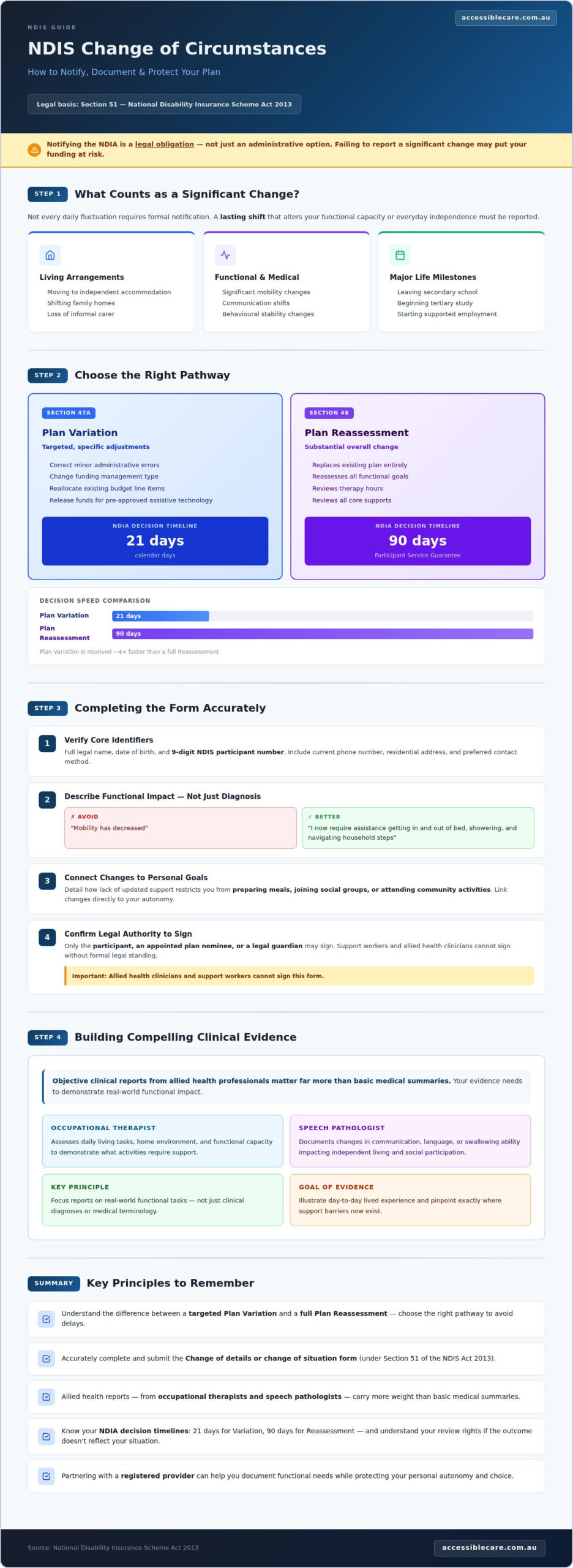
Not every daily fluctuation requires formal notification. You must lodge a notice when a lasting shift alters your functional capacity or everyday independence, including:
- Living arrangement changes: Moving into independent accommodation, shifting family homes, or the sudden loss of an informal carer who previously provided essential daily support.
- Functional or medical transitions: Significant changes in physical mobility, communication, or behavioural stability that demand revised therapy or nursing interventions.
- Major life milestones: Leaving secondary school, beginning tertiary study, or transitioning into supported employment programs.
Plan Variation vs Plan Reassessment under NDIS Rules
Knowing which administrative door to knock on saves months of confusion. Under current rules, the NDIA divides updates into two distinct legislative paths:
- Plan Variation (Section 47A): Ideal for targeted, specific adjustments that do not require replacing your whole plan. This includes correcting minor administrative errors, changing how your funding is managed, reallocating existing budget line items, or releasing funds for pre-approved assistive technology. The NDIA must decide on a variation request within 21 calendar days.
- Plan Reassessment (Section 48): Required when your overall daily situation has changed substantially. This pathway replaces your existing agreement with a completely new plan, reassessing your overall functional goals, therapy hours, and core supports. Under Participant Service Guarantee standards, the Agency has up to 90 days to determine whether an unscheduled reassessment will proceed.
Choosing the right avenue ensures your request is processed smoothly without placing your existing funding at risk.
Step-by-Step Guide: How to Complete and Submit the NDIS Form
Completing paperwork can feel overwhelming, especially when you are already adjusting to significant life changes. Taking a methodical approach ensures your voice is heard clearly by NDIA decision-makers. The goal of lodging the ndis change of circumstances form is to illustrate your day-to-day lived experience and pinpoint exactly where support barriers now exist.
Documenting Personal Details and Describing Functional Impact
Accuracy prevents unnecessary administrative delays. When filling out the notification, ensure you complete these foundational steps:
- Verify your core identifiers: Clearly print your full legal name, date of birth, and nine-digit NDIS participant number. Double-check your current phone number, residential address, and preferred contact method.
- Detail what has changed: Focus on real-world functional tasks rather than just naming a medical diagnosis. Instead of writing “mobility has decreased,” explain that you now require assistance getting in and out of bed, showering, or navigating household steps safely.
- Connect shifts to personal goals: Directly link these changes to your autonomy. Detail how a lack of updated support restricts you from preparing meals, participating in social groups, or attending community activities.
- Confirm legal authority: Ensure the document is signed by the participant, an appointed plan nominee, or a legal guardian. Under current rules, support workers and allied health clinicians cannot sign this form without formal legal standing.
Submission Pathways: Online, Email, and In-Person Options
Once your paperwork and functional descriptions are ready, you have several reliable ways to submit according to the official NDIA plan change guidelines:
- Online portal: Upload your documents directly through the my NDIS participant portal or app. This is the fastest method to ensure immediate electronic receipt.
- Email: Send your completed form and supporting reports to
[email protected]. Use a clear subject line featuring your participant number and the words “Change of Details / Situation”. - In person: Lodge your documents with a Local Area Coordinator (LAC) or an NDIA partner office in metropolitan Melbourne or Adelaide. Visiting in person allows a staff member to scan your materials on the spot.
- Postal mail: Post your documents directly to National Disability Insurance Agency, GPO Box 700, Canberra ACT 2601.
Always request a formal reference or receipt number when lodging your ndis change of circumstances form. Keeping an electronic copy and noting your submission date provides essential peace of mind. If you need compassionate guidance coordinating functional assessments to substantiate your paperwork, you can partner with Accessible Care to help articulate your daily support needs.
Building Compelling Clinical Evidence: Reports That Support Your Request
Submitting an ndis change of circumstances form with only a diagnostic label or a brief GP certificate often leads to disappointment. NDIA planners make funding decisions based on functional barriers rather than medical terminology alone. To secure an outcome that truly supports your daily routine, you need objective allied health documentation that illustrates how your condition impacts your everyday living, communication, and social connection.
The Essential Role of Functional Capacity Assessments (FCA)
A comprehensive assessment completed by an Occupational Therapist serves as the gold standard of evidence for any funding review. If you are wondering what is occupational therapy, it is a clinical practice centered on helping people participate fully in daily life. An OT uses validated scoring tools, such as the WHODAS or Vineland assessments, to evaluate your core daily domains, including personal grooming, meal preparation, mobility, and community access. Standardized metrics show planners your baseline capacity on both good and challenging days, proving precisely why support hours must be adjusted.
Allied Health Reports: Speech Therapy and Behaviour Support
Communication and behavioural changes require targeted assessments from qualified practitioners. Integrating dedicated clinical insights from speech pathology allows you to document complex swallowing safety concerns, mealtime management risks, or augmentative communication needs. In situations where emotional distress creates safety barriers, a Positive Behaviour Support practitioner provides essential incident tracking and behaviour support plans. These clinical reports translate your personal challenges into measurable needs that align directly with reasonable and necessary criteria under the law.
Distinguishing Temporary Setbacks from Permanent Functional Shifts
The NDIA funds supports for long-term or permanent functional impairment, which means planners closely evaluate whether your situation represents a temporary health episode or a lasting change. When a participant experiences increased clinical frailty or acute medical needs, documentation must clarify the ongoing trajectory. For individuals requiring complex clinical interventions, incorporating verified evidence for high intensity supports NDIS validates the necessity for skilled community nursing or specialised care workers. Ensuring your clinical documentation explicitly confirms long-term prognosis gives your ndis change of circumstances form the foundation it needs, protecting your rights if you later need to reference the Administrative Review Tribunal NDIS review process to dispute an adverse finding.
Navigating NDIA Timelines, Possible Outcomes, and Request Refusals
Waiting for a response after submitting your paperwork can feel unsettling. While the Participant Service Guarantee sets statutory targets, real-world processing times often vary depending on application backlogs. Knowing what happens behind the scenes helps you maintain peace of mind while your submission is under review.
Understanding Potential Outcomes and Review Timelines
Once you lodge your ndis change of circumstances form, the NDIA will evaluate your request against legislative criteria. Under the NDIS Act, the Agency must decide whether to vary a plan within 21 calendar days, or decide whether to conduct an unscheduled reassessment within 90 days. If the Agency fails to make a formal decision within these timeframes, the law treats this as a “deemed refusal,” granting you immediate rights to dispute the inaction.
| NDIA Decision | What It Means for You | Key Timeframes |
|---|---|---|
| Outcome A: Plan Variation Approved | The Agency agrees to specific, targeted adjustments without replacing your current plan structure. | A copy of your varied plan must be delivered within 7 calendar days of the decision. |
| Outcome B: Plan Reassessment Initiated | The Agency agrees that substantial changes have occurred, initiating a full review to build a brand new plan. | The NDIA has 28 calendar days to complete and issue the new plan once the reassessment begins. |
| Outcome C: Request Declined | The Agency determines the evidence does not justify a plan variation or an unscheduled reassessment. | Written notice is issued, opening a 90-day window to lodge a formal dispute. |
Constructive Actions to Take If Your Request Is Declined
A refusal can feel deeply frustrating, but it isn’t the end of your journey. Receiving a negative response simply means the Agency requires clearer functional proof. You can take immediate, proactive steps to protect your rights:
- Request a Statement of Reasons: Ask the NDIA decision-maker for their written explanation. This document highlights exactly which functional criteria your evidence didn’t satisfy.
- Lodge a Section 100 Internal Review: You have three months (90 days) from the date of the decision notice to request an internal review by an independent NDIA officer.
- Connect with independent advocates: Disability advocacy groups across Victoria and South Australia can offer free guidance throughout your appeal. If an internal review remains unsatisfactory, you can lodge an external appeal with the Administrative Review Tribunal (ART) within 28 days.
If you face a setback after lodging your ndis change of circumstances form, you don’t have to manage the process alone. Reach out directly to Accessible Care to discuss your plan requirements and explore how our therapists can substantiate your daily living needs.
Partnering with Accessible Care to Protect Your Independence and Plan
Your goals, your choices, your life. Adapting to new challenges shouldn’t mean facing complex systems on your own. At Accessible Care, we believe in walking alongside you and your family as a trusted partner, safeguarding your autonomy every step of the way. When your daily life evolves, gathering clear clinical reports for an ndis change of circumstances form should feel supportive and collaborative, never overwhelming.
Multidisciplinary Clinical Services Across Melbourne and Adelaide
As a registered NDIS provider supporting communities across metropolitan Melbourne and Adelaide, our clinicians work collaboratively to capture your true functional abilities. We coordinate multiple clinical disciplines into unified, person-centred documentation:
- Occupational Therapy: Our paediatric and adult occupational therapists evaluate daily living skills, home safety, and functional independence right where you live.
- Speech Therapy: Experienced speech-language pathologists provide holistic evaluations for complex communication hurdles, speech development, and safe mealtime management.
- Positive Behaviour Support: Dedicated practitioners develop compassionate, evidence-based behaviour support plans that prioritize personal choice and emotional wellbeing.
- Community Nursing and Support Work: Registered nurses deliver tailored care for complex health needs, complemented by caring support workers who assist with everyday routines.
Gentle Support and Personalized Care for Every Step
We believe every individual deserves care rooted in dignity and honor. Gathering evidence isn’t simply about filing documents; it begins with attentive listening. Our clinicians take the time to hear your authentic story, ensuring your personal goals and lived experiences directly shape every assessment.
By coordinating our therapy teams, we help remove the friction and exhaustion of scheduling multiple separate evaluations. You receive thorough, cohesive documentation that accurately substantiates your ndis change of circumstances form while keeping your personal preferences front and center. Together, we work to ensure your supports continue to champion your independence at home and in your local community.
Take Confident Next Steps Toward the Support You Deserve
Your plan should always reflect who you are and what you need to thrive each day. When life shifts, lodging an ndis change of circumstances form gives you the opportunity to realign your funding with your true daily independence. Choosing the right path between a targeted variation and a full reassessment, backed by objective allied health assessments, ensures NDIA decision-makers clearly see your functional needs.
You don’t have to navigate these administrative requirements on your own. As a registered NDIS provider serving metropolitan Melbourne and Adelaide, our multidisciplinary team brings together occupational therapy, speech pathology, and community nursing to champion your personal autonomy. Connect with our compassionate team at Accessible Care today to schedule your functional therapy assessment. Together, we’ll ensure your authentic voice is heard so you can continue living life on your own terms.
Frequently Asked Questions
How long does the NDIA take to process a change of circumstances form?
The NDIA operates under statutory Participant Service Guarantee timeframes once you submit an ndis change of circumstances form. For a targeted plan variation, the Agency must decide within 21 calendar days. For an unscheduled plan reassessment, the NDIA has up to 90 days to issue a decision. If the Agency exceeds these deadlines without responding, the request is treated as a deemed refusal, allowing you to request an immediate review.
Can my NDIS funding be decreased if I submit a change of circumstances?
Your existing supports aren’t automatically reduced simply because you request an update. However, requesting a full plan reassessment opens your entire budget for review, meaning planners evaluate all supports against current reasonable and necessary criteria. If clinical evidence shows your independence has grown in certain areas, funding may shift to reflect those new priorities. Providing robust, up-to-date functional assessments ensures any plan adjustments accurately reflect your genuine daily needs.
What is the main difference between an NDIS plan variation and a reassessment?
A plan variation under Section 47A adjusts specific details without altering the entire plan. It suits minor administrative corrections, manager changes, or allocating funds for approved assistive technology. Conversely, a plan reassessment under Section 48 replaces your entire plan with a brand new one. You need a reassessment when substantial, lasting changes in your life, living situation, or informal care network require a comprehensive reset of your funding and goals.
Do I need a new Functional Capacity Assessment before submitting my form?
While not legally mandatory to lodge the initial paperwork, submitting an up-to-date Functional Capacity Assessment greatly improves your chances of a positive outcome. Planners base decisions on functional impact rather than medical diagnoses alone. A recent assessment from a qualified occupational therapist or speech pathologist clearly documents how your abilities have shifted across daily tasks, giving the NDIA objective clinical evidence to justify the exact support hours you need.
Can my family member, carer, or support coordinator lodge the form for me?
Only you, your appointed plan nominee, child representative, or legal guardian can formally sign and submit the ndis change of circumstances form. Following recent legislative updates, support coordinators and service providers cannot legally lodge the request on your behalf without formal nominee status. However, your family, support workers, and allied health team can assist you in gathering reports, writing statements, and filling out the paperwork before you sign.
What happens if my change of circumstances request is rejected by the NDIA?
If the NDIA declines your request, you retain clear legal appeal rights. You can request a written Statement of Reasons explaining the decision, followed by a Section 100 Internal Review within 90 days. If the internal review outcome remains unsatisfactory, you have 28 days to escalate the matter to the Administrative Review Tribunal (ART). Connecting with independent disability advocates can provide calm guidance and advocacy throughout this appeals process.
How do I submit supporting therapy documents after lodging the initial form?
You can submit additional clinical reports anytime after your initial lodgement. Simply upload documents directly through the my NDIS participant portal or email them to [email protected]. When sending extra files via email, always include your full name, nine-digit participant number, and your original submission reference number in the subject line. This ensures your allied health assessments are promptly matched to your pending file before planners begin their review.

