


What if preparing for your upcoming plan review didn’t feel like an exhausting battle to protect the daily supports you rely on? With recent changes under the 2026 NDIS legislation and tighter evidentiary rules, it’s completely understandable if you feel anxious about keeping your therapy hours and support team intact. Coordinating reports across different therapists on a tight deadline is stressful. That is why having a clear ndis plan reassessment checklist 2026 makes all the difference, turning confusion into steady, confident action.
We believe your plan should honor your autonomy and truly reflect your everyday needs. In this complete guide, you’ll discover how to coordinate multidisciplinary evidence, articulate your goals effectively, and safeguard essential funding for long-term stability. Ahead, we walk you through a practical, step-by-step preparation timeline covering what to do 90 days out, 30 days out, and on meeting day so you can advocate for your supports with complete peace of mind.
Key Takeaways
- Understand the vital distinction between routine plan variations and full reassessments under current 2026 NDIA guidelines to request the right level of support.
- Use our structured 90-day ndis plan reassessment checklist 2026 to audit past budget utilisation and organise your preparation without feeling rushed.
- Identify the core allied health evidence, including functional capacity and communication reports, required to justify your one-on-one therapy and support worker hours.
- Master practical self-advocacy techniques for meeting day so you can candidly express your worst-day support needs alongside your personal strengths and goals.
- Follow a clear post-meeting audit routine to verify your funding splits across Core, Capital, and Capacity Building before putting your new plan into action.
Understanding Your NDIS Plan Reassessment in 2026
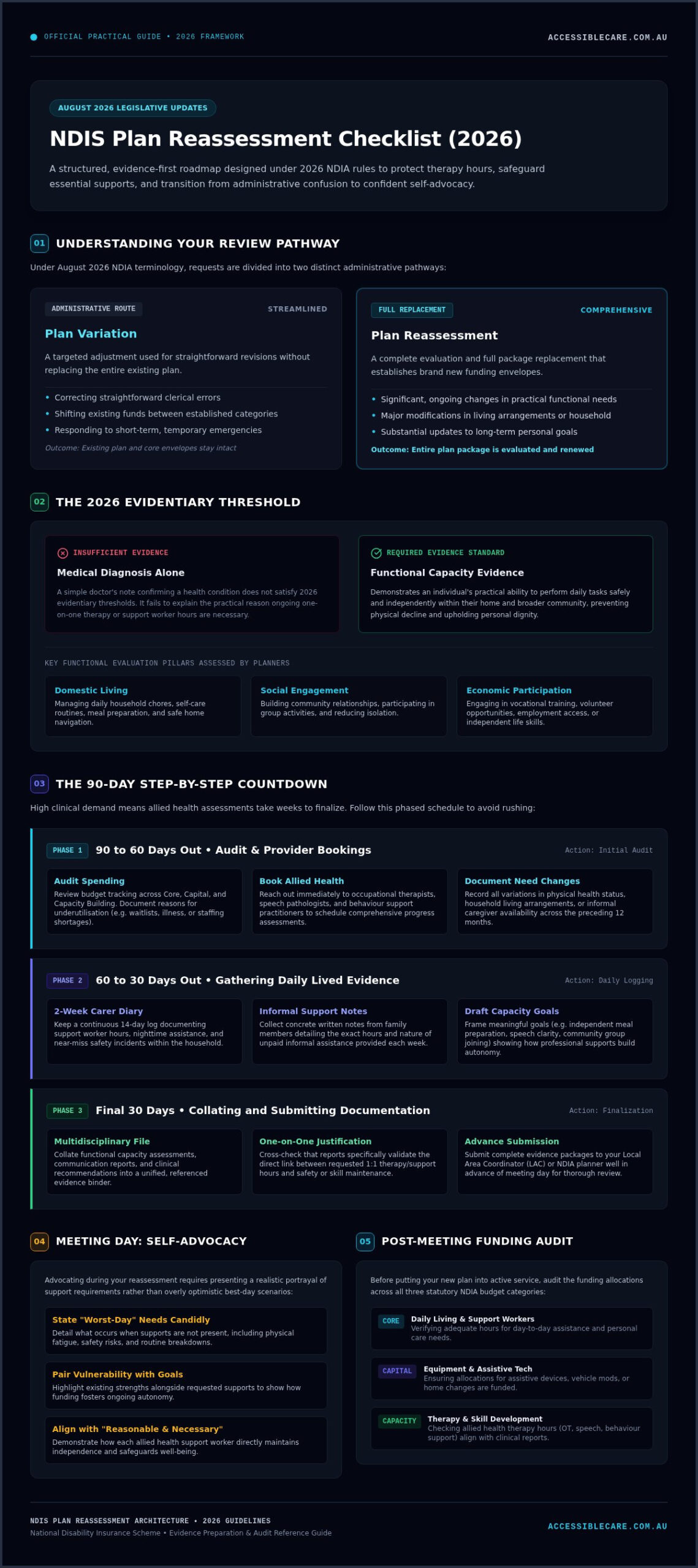
Facing a plan review can bring up genuine worry about keeping your essential daily routines steady. Following legislative updates passed in August 2026, the National Disability Insurance Agency officially uses the term “plan reassessment” instead of the older phrase “plan review.” In Australia’s National Disability Insurance Scheme, a plan reassessment represents a complete evaluation and replacement of your existing funding package. When sitting down with your Local Area Coordinator (LAC) or NDIA planner, the conversation centers on whether your supports remain reasonable and necessary to sustain your independence and safety.
Having a dependable ndis plan reassessment checklist 2026 helps you approach these discussions with confidence. Instead of feeling caught off guard by changing administrative rules, you can focus on showing how personalized care preserves your quality of life.
Plan Reassessment vs. Plan Variation: Key Differences
Knowing which process applies to your situation saves time and prevents unnecessary stress. The NDIA handles plan adjustments through two distinct pathways:
- Plan Variation: A streamlined administrative change used for minor, straightforward adjustments, such as correcting clerical errors, shifting funds between existing categories, or responding to short-term, temporary emergencies without replacing the entire plan.
- Plan Reassessment: A comprehensive review that replaces your whole plan, required when there is a significant, ongoing change in your functional needs, living arrangements, or long-term personal goals.
Multi-year plans may extend across several years with routine check-ins, but a full reassessment establishes entirely new funding envelopes.
The 2026 Focus on Functional Evidence
Securing adequate funding in 2026 relies on clear functional evidence rather than medical diagnoses alone. Planners review how your disability impacts your capacity to manage domestic chores, engage socially, and participate in economic life. Functional capacity refers to an individual’s practical ability to perform essential daily tasks safely and independently within their home and broader community.
A simple doctor’s note confirming a health condition does not explain why you need regular therapy or a support worker. The agency needs to see the real-world impact of your supports: do they maintain your personal autonomy, uphold dignity, and prevent physical decline? Integrating these vital details into your ndis plan reassessment checklist 2026 ensures your clinical evidence accurately mirrors your lived experience.
Step-by-Step Preparation Checklist: 90 Days to Reassessment
Waiting until the last month to gather reports creates needless stress. High clinical demand across Australia means therapists often need several weeks to complete in-depth evaluations. Following a structured countdown ensures you secure your evidence early, keeping your personal goals at the center of the conversation. Using this ndis plan reassessment checklist 2026 breakdown gives you the breathing room to prepare calmly and thoroughly.
Phase 1: 90 to 60 Days Out – Audit and Provider Bookings
Begin by assessing where your current plan stands and securing essential appointments:
- Audit current spending: Review your budget tracking in Core, Capital, and Capacity Building. If you underutilised funds, note whether it was due to therapist waitlists, illness, or staffing shortages so planners understand the context.
- Book allied health assessments: Reach out immediately to your occupational therapist, speech pathologist, or behaviour support practitioner to schedule formal progress assessments.
- Identify changes in need: Document any changes in your physical health, living arrangements, or informal caregiver availability over the past twelve months.
Phase 2: 60 to 30 Days Out – Gathering Daily Evidence
During this stage, capture the lived reality of your household routines. Keep a detailed two-week carer diary logging support worker hours, nighttime assistance, and near-miss safety incidents. Gather notes from family members detailing the informal assistance they provide each week.
Take time to draft meaningful, forward-looking goals. Focus on what you want to achieve, such as building independent meal-preparation skills, joining a local community group, or improving speech clarity. Frame each goal around how specific professional supports help you build long-term capacity.
Phase 3: Final 30 Days – Collating and Submitting Documentation
Organise all collected reports into a clean, easy-to-read evidence binder or digital folder:
- Ensure every clinical recommendation links directly to the specific funding category you are requesting.
- Cross-check that therapist letters clearly justify why one-on-one assistance remains reasonable and necessary.
- Submit your completed evidence packet to your planner or LAC at least two weeks before your scheduled review.
For a foundational look at how core scheme principles work together, explore What is the NDIS? A Simple and Compassionate Guide. If you need dedicated guidance organising assessments across Melbourne or Adelaide, partnering with Accessible Care can help you assemble comprehensive clinical evidence that honours your unique journey.
Allied Health Reports: Your Essential Evidence Checklist
Strong clinical evidence forms the backbone of any funding request. Progress notes alone rarely convince NDIA delegates; planners require formal assessments with validated measurement tools like the WHODAS 2.0 or Vineland-3. When speech pathologists, occupational therapists, and behaviour practitioners collaborate, their unified evidence clearly shows why one-on-one supports are necessary to foster autonomy. Ensuring your allied health team submits coordinated documentation is a cornerstone of an effective ndis plan reassessment checklist 2026.
Occupational Therapy and Functional Capacity Assessments
A comprehensive Functional Capacity Assessment (FCA) completed by an occupational therapist serves as the gold standard for justifying daily living support. These assessments evaluate fine motor skills, sensory processing, and personal care routines, providing concrete proof for support worker hours, assistive technology, and home modifications. Discover clinical details in What is Occupational Therapy? A Compassionate Guide to Regaining Independence.
Speech Pathology and Communication Evidence
Speech pathology reports address communication barriers, social interactions, cognitive processing, and safe swallowing. For individuals with mealtime risks, a formal Dysphagia and Mealtime Management Plan is critical to validate trained support worker supervision during meals. Augmentative and Alternative Communication (AAC) assessments outline the specialized devices and ongoing training needed to maintain personal agency. Explore how targeted therapy helps participants communicate through Speech Pathology: A Compassionate Guide to Communication and Swallowing Support.
Positive Behaviour Support and Nursing Reports
When complex emotional or medical needs arise, tailored specialist documentation protects participant rights and physical well-being:
- Positive Behaviour Support Plans (PBSP): A registered practitioner must formulate proactive strategies and provide clinical justification if restrictive practices are used, ensuring human rights and dignity remain protected.
- High-Intensity Nursing Summaries: Clinical assessments by registered nurses detail required care plans for complex bowel care, enteral feeding, tracheostomy care, or subcutaneous injections.
These reports prove that skilled assistance is essential to prevent hospitalization and preserve health stability. Connect complex medical care requirements to High Intensity Supports NDIS: A Compassionate Guide to Complex Care in 2026. By gathering these clinical documents within your ndis plan reassessment checklist 2026, you present an undeniable case for ongoing funding.
Day-of-Meeting Checklist: Self-Advocacy and Discussion Guide
Walking into your meeting can feel intimidating, but remember that you are the leading expert on your own life. This conversation is your opportunity to ensure the funding allocated matches what you truly need to live safely and independently. Having a focused day-of-meeting guide as part of your ndis plan reassessment checklist 2026 keeps you grounded, ensuring your voice remains front and center throughout the discussion.
Communicating Functional Needs Without Losing Dignity
It’s natural to want to highlight your accomplishments, yet plan reassessments require sharing what happens on your hardest days. If you only describe your best moments, planners might assume you require less help than you actually do.
Frame your capacity around the support that makes your independence possible. You can use direct, clear phrasing such as:
- “On high-fatigue days, I cannot safely prepare a meal without physical assistance.”
- “My current support worker hours prevent severe sensory overwhelm and keep me safe in the community.”
- “I am building daily living skills, but withdrawing these therapy hours now would cause my physical function to regress.”
Who to Have by Your Side During the Meeting
You never have to attend this meeting alone. Having a trusted family member, support coordinator, or independent advocate by your side provides reassurance and practical backup. Participants in Melbourne and Adelaide have the clear right to include professional advocates or key support workers in their reassessment discussions. If you feel overwhelmed, anxious, or tired, ask for a short break. Taking ten minutes to pause and reset protects your well-being.
Crucial Questions to Ask Your NDIA Planner
Before the meeting wraps up, clarify exactly how decisions are being formed. Ask your planner these critical questions:
- Will the approved funds be stated or flexible within my Core and Capacity Building categories?
- How do your draft funding recommendations align with the clinical hours suggested in my allied health reports?
- What is the expected timeframe and communication method for receiving the final approved plan?
If the planner indicates potential funding reductions, ask them to note your disagreement in the official file immediately. For dedicated help preparing your clinical evidence and self-advocacy strategy, contact Accessible Care today to partner with our experienced team.
Post-Reassessment Checklist: Reviewing Plans and Next Steps
Receiving your new plan brings a welcome sense of relief, but your journey isn’t quite finished when the paperwork arrives. Taking time to complete the final phase of your ndis plan reassessment checklist 2026 ensures the funding allocated matches your daily living requirements and clinical recommendations. Auditing your plan right away gives you peace of mind and sets you up for a smooth transition.
Auditing Your New Plan Within 30 Days
Carefully review your funding allocations as soon as your plan becomes active in the participant portal. Check off these key items during your audit:
- Compare budget lines: Check your Core, Capital, and Capacity Building budgets against the specific hours recommended in your therapist summaries.
- Identify stated supports: Look for any items marked as “stated supports,” which must be spent exactly as written rather than used flexibly.
- Confirm plan dates: Verify the start and end dates along with any scheduled milestone reviews to prevent support gaps.
Resolving Discrepancies: Internal Reviews and Appeals
If your approved funding falls short of what you need to stay safe and well, don’t lose heart. You have a clear legal right under Section 100 of the NDIS Act to request an internal review of the decision. This request must be submitted within 90 days of receiving your plan approval letter.
Requesting an internal review is a routine, protected step. Work closely with your therapists to provide supplementary functional evidence that directly answers the NDIA’s reasons for reduction. Clearly showing how missing supports threaten your safety or cause functional decline helps planners reconsider their decision.
Implementing Supports with Compassionate Allied Health Partners
Once your funding is confirmed, update your service agreements with your therapy and support teams. Establishing flexible, transparent agreements ensures your support workers, occupational therapists, and speech pathologists work together toward your personal goals. Book regular six-month clinical check-ins to monitor functional progress, creating an ongoing paper trail long before your next reassessment.
If you live in Melbourne or Adelaide, choosing the right partner makes all the difference. Explore Accessible Care Support Services to connect with a compassionate multidisciplinary team that listens to your voice, respects your choices, and supports your ongoing independence.
Take Control of Your NDIS Journey with Confidence
Protecting your essential supports shouldn’t feel like an uphill struggle. By gathering functional evidence early, tracking your everyday routines, and speaking honestly about your worst-day support needs, you give yourself the strongest foundation for success. Working through a dedicated ndis plan reassessment checklist 2026 transforms a stressful administrative review into a clear, empowering pathway toward lasting stability.
You don’t have to carry this preparation on your own. As a registered provider supporting participants across Melbourne and Adelaide, Accessible Care provides holistic allied health and in-home assistance. Our multidisciplinary team covers Occupational Therapy, Speech Pathology, Positive Behaviour Support, Community Nursing, and dedicated support work. We deliver detailed clinical reporting tailored to meet strict NDIA functional standards while honoring your self-determination. When you’re ready to safeguard your plan, connect with Accessible Care for compassionate NDIS therapy and evidence support. Together, we can ensure your voice is heard and your everyday independence is protected.
Frequently Asked Questions
How long before my NDIS plan ends should I start preparing for reassessment?
You should begin preparing at least three months (90 days) before your plan’s end date. Allied health clinicians often have waitlists for formal assessments, and gathering evidence takes time. Starting 90 days out allows you to book your occupational therapy and speech pathology appointments early, collect carer logs, and review budget spending calmly. Following a structured ndis plan reassessment checklist 2026 gives you the space to compile thorough evidence without feeling rushed.
Can my NDIS funding be cut during a 2026 plan reassessment?
Yes, the NDIA can reduce funding if your evidence does not clearly prove your current supports remain reasonable and necessary. Funding cuts usually happen when reports fail to demonstrate functional need, or when past budgets were significantly underused without explanation. You can protect your funding by submitting detailed, up-to-date functional capacity assessments and allied health summaries. Clear evidence shows planners that ongoing support worker hours and therapies directly maintain your daily safety and personal independence.
What is the difference between an NDIS plan reassessment and an internal review?
A plan reassessment is the standard process of replacing an expiring plan, while an internal review is a formal legal appeal against an unsatisfactory planning decision. You enter a plan reassessment routinely or when your life circumstances change significantly. In contrast, an internal review (under Section 100) specifically asks senior NDIA staff to reconsider a decision you disagree with, such as reduced therapy funding. You must lodge an internal review within 90 days of receiving your plan approval letter.
Do I need a new Functional Capacity Assessment for every plan reassessment?
While not legally mandatory for every minor reassessment, having a recent Functional Capacity Assessment (FCA) is the most reliable way to protect your funding. The NDIA prefers clinical evidence completed within the past six to twelve months. If your daily challenges, mobility, or living arrangements have changed, an updated FCA from an occupational therapist gives planners the objective data required to justify ongoing one-on-one supports.
What happens if my circumstances change suddenly before my scheduled reassessment date?
You do not have to wait for your plan end date; you can request a plan reassessment at any time if your circumstances change significantly. If you experience an unexpected shift, such as a loss of informal family care, medical decline, or moving home, submit an official request form immediately. The NDIA will evaluate your evidence and determine if a full reassessment is required to keep you safe.
Can I bring my therapist or support coordinator to the reassessment meeting?
Yes, you have the full right to bring trusted professionals, family members, or independent advocates to your reassessment meeting. Having your support coordinator, occupational therapist, or behaviour support practitioner attend can provide immense peace of mind. They can help articulate complex clinical terminology, clarify functional recommendations, and support you if you feel stressed. Just remember to notify your planner ahead of time so they can accommodate everyone in the room or on the call.
What should I do if my approved NDIS plan does not include enough funding for therapy?
First, contact your planner or Local Area Coordinator to request an explanation of the decision in writing. If the funding cannot support your essential allied health needs, lodge a Section 100 internal review within 90 days. Working through your ndis plan reassessment checklist 2026 earlier in the process helps, but if shortfalls occur, collaborate with your therapists to provide supplementary letters outlining the direct risks and functional regression you face without adequate therapy hours.

