


What if choosing in-home support started with what matters to the person receiving it? Finding in home disability support melbourne can feel difficult when you’re unsure which services can be provided at home, how NDIS funding may apply, or whether a provider will listen. These questions deserve clear answers, with the person’s goals and preferences leading the conversation.
The right support looks different for everyone. It may involve practical support work or community nursing at home. Occupational therapy, speech therapy or positive behaviour support may also be relevant, depending on individual needs and how services can be delivered. These options have different purposes, and no single combination suits everyone.
This guide explains common support options in Melbourne, offers practical questions for comparing providers, and outlines how to prepare to discuss goals, funding and next steps. It also highlights what to clarify about service fit and availability before making a decision. Accessible Care is a registered NDIS provider serving Melbourne, with several relevant supports to discuss. The aim is to help you take the next step with greater confidence while keeping the person’s voice, choices and aspirations at the centre.
Key Takeaways
- Compare the purposes of support work, community nursing, therapy and high-intensity support, then consider which options may fit the person’s needs.
- When comparing in home disability support melbourne providers, ask how they’ll respect preferences, communicate changes and respond to feedback.
- Prepare for provider conversations by noting the person’s goals and support needs, then checking relevant NDIS plan information.
- Accessible Care offers several support types in Melbourne. Ask whether the available services align with the person’s circumstances and plan.
Benefits of In-Home Disability Support in Melbourne
Deciding whether support at home is right for you can raise practical questions as well as strong feelings. You may want help that fits familiar routines while protecting privacy and choice. This guide compares support types so you can consider what may suit the person’s goals, without assuming that one arrangement works for everyone.
In-home disability support is assistance provided in a person’s home to help them work towards their individual goals. Different professionals may deliver support, depending on what is needed. The type and frequency depend on the person’s circumstances, service arrangements and, where relevant, their NDIS plan. Funding isn’t automatic: check current official guidance and the person’s plan before making decisions. For general background, see this overview of the National Disability Insurance Scheme (NDIS), or read this guide to understanding the NDIS.
Good support makes room for the person’s preferences rather than taking over. Discuss how assistance could fit into daily routines, how privacy will be respected, and how the person will be involved in decisions. An arrangement may help someone work towards personal goals at home, but it cannot guarantee independence or a particular outcome. When exploring in home disability support melbourne, start with the person’s needs rather than a standard schedule or assumptions about what they can do.
What can a support worker help with at home?
Support work focuses on agreed everyday assistance shaped around the person’s goals. Depending on individual needs and the service agreement, this might include help with parts of a daily routine or practical activities at home. Before agreeing, clarify which tasks are included, what falls outside the arrangement, and how timing will be discussed. Providers don’t all deliver the same support, so examples shouldn’t be taken as a promise that a particular task or schedule will be available.
How is in-home support different from therapy or nursing?
Support workers provide agreed day-to-day assistance. Occupational therapists and speech therapists offer therapy within their respective professional areas, while community nurses provide nursing support. These services have different purposes, and an assessment may be needed to determine suitability. A person might use one service or consider several, depending on their circumstances and plan. Ask what each service involves, what it is intended to address, and how it relates to the person’s goals.
Compare In-Home Disability Support in Melbourne
Service names can sound similar even when the purpose and provider role differ. Use this comparison to prepare questions when exploring in home disability support melbourne. It’s a starting point, not a recommendation. The right fit depends on the person’s goals, circumstances and relevant plan information.
| Support type | Purpose and typical provider role | Questions to ask |
|---|---|---|
| Support work | Agreed everyday assistance shaped around personal goals and needs at home. | What tasks can be included in the service agreement? How will the person’s routines and preferences guide the support? |
| Community nursing | Nursing support delivered in the community. It is distinct from general medical practice. | What nursing support is within the provider’s scope? What information or assessment is needed to check suitability? |
| Occupational or speech therapy | Therapeutic support directed towards goals in each discipline’s area of practice. | What goals could the therapy address? How is suitability assessed, and how will the person take part? |
| High-intensity support | Support that may be relevant for people with complex medical and disability needs. | What experience and arrangements are relevant to the person’s specific requirements? How will the provider confirm the service is suitable? |
These options aren’t interchangeable. Everyday assistance differs from nursing, therapy and support involving complex needs. More than one service may be considered, but whether a combination is appropriate depends on the individual and their circumstances. Ask providers to explain their service scope clearly, and check service fit and funding details against current official NDIS guidance.
When might support work or community nursing be relevant?
Support work may suit someone seeking agreed help with everyday needs in line with their goals. Community nursing may be worth discussing when nursing support at home is being considered. Neither service name tells you exactly what a provider can deliver. Explain the person’s requirements and ask how the provider will confirm its scope and suitability before agreeing on support.
When should you ask about therapy or high-intensity support?
Occupational therapy and speech therapy address distinct goals, so ask what each service could involve in the person’s situation. High-intensity support may be relevant where needs are complex, but suitability must be considered individually. Read this guide to high-intensity NDIS support for more context.
Service fit depends on the person’s goals and circumstances, not on a generic service label. The person’s choice matters throughout the process. For Victorian advocacy and support resources, see the Victorian Advocacy League for Individuals with Disability (VALID). You can also review Accessible Care’s support options and ask whether they align with the person’s needs and plan.
How to compare Melbourne providers without giving up choice or control
Support should be planned with the person, not simply arranged around them. When comparing providers for in home disability support melbourne, look for a process that considers the person’s goals, communication style, routines and preferences. A provider’s willingness to listen and explain options can help you understand how decisions may be made together.
Compare more than the services listed. Ask how the provider considers staff suitability, whether continuity can be discussed, and how cultural or other personal preferences can be shared. Don’t assume a particular worker, schedule or arrangement is guaranteed. Find out what the provider can consider and how it will communicate if circumstances change.
What should you ask a potential support provider?
Invite the person receiving support to share what matters to them in a way that works for them. These questions can make the conversation more practical:
- How will you learn about the person’s goals, communication preferences and daily routines?
- How do you consider support worker suitability, and can the person share preferences about who supports them?
- How are arrangements reviewed if needs, routines or preferences change?
- Who should the person contact with questions, feedback or concerns, and what happens next?
Clear answers help you understand the provider’s approach. If something is vague, ask for an explanation in everyday language before deciding whether the arrangement feels suitable.
How can you check whether support feels respectful?
Whenever possible, include the person in conversations and decisions. Before support begins, discuss privacy, consent, personal boundaries and preferred ways to communicate. Ask how the provider will check in if the person’s needs or preferences change. Make space for the person to express what feels comfortable, including cultural preferences and routines that matter to them.
Notice how the provider responds. Do they listen without rushing, take the person’s views seriously and explain choices plainly? Can the person ask for a routine to change or raise a concern without feeling dismissed? These conversations can show whether the working relationship is collaborative. A good fit depends not only on the service, but also on whether the person feels heard and involved.
Before agreeing to an arrangement, check that the person understands what has been discussed and knows how to revisit the conversation. Keep their preferences part of the planning as support begins and goals are reviewed.
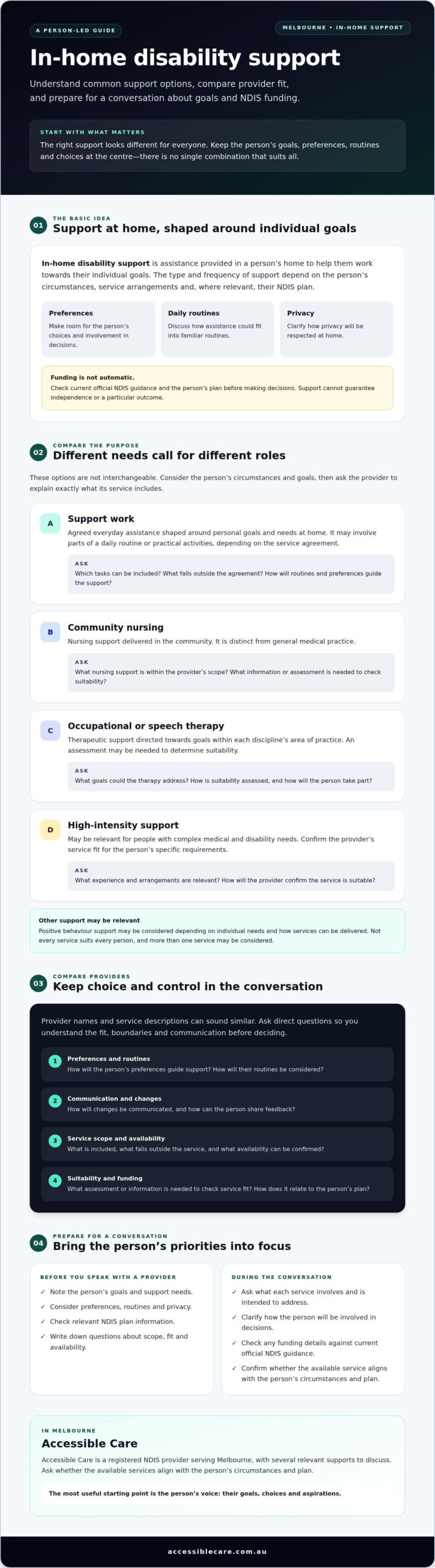
Prepare for in-home disability support: goals, NDIS funding, and practical questions
A little preparation can make a first conversation with a provider easier to manage. You don’t need to have every detail decided. Start with what the person wants support to help with, then use any plan information and questions to explore what may be suitable. For people considering in home disability support melbourne, the person’s priorities should guide the discussion.
First, note the person’s goals and support needs; next, review any plan information they choose to share; then, discuss service fit and questions with providers. This is a useful starting checklist, not a mandatory NDIS process. Keep the person involved at each step, and ask whether they would like a trusted supporter to join the conversation.
Which information is useful before contacting a provider?
Brief notes can keep the conversation focused. Consider writing down:
- The person’s goals and the everyday support priorities that matter most to them.
- Preferred routines, communication needs and any preferences that could help support feel comfortable.
- Questions about the provider’s service scope, possible scheduling arrangements, communication and how support is reviewed.
If the person wants to discuss NDIS funding, have relevant plan information available. Share only what they’re comfortable discussing. If the person agrees, a trusted supporter can help take notes or ask questions while keeping the person central to decisions about their support.
What should you clarify about NDIS funding?
Funding and service suitability depend on individual circumstances and the person’s plan. Ask the provider whether the proposed service appears relevant to the person’s goals and the plan information available. Treat this as a discussion about fit, not confirmation that funding will be available or that someone meets NDIS eligibility requirements.
Before deciding, check current official NDIS guidance or confirm plan-specific questions through the appropriate NDIS contact. Rules and guidance may change, so a general explanation should not be treated as a decision about a particular plan. If anything is unclear, ask what needs checking and who can confirm it.
It can also help to clarify practical arrangements before support starts: what the service includes, how scheduling is discussed, who to contact with questions, and how changes or reviews are handled. Note the answers and consider whether they reflect the person’s preferences and goals.
If you’re weighing up support options, discuss your support needs with Accessible Care and ask whether its available services align with the person’s circumstances and NDIS plan.
In-Home Support with Accessible Care in Melbourne
Choosing support is personal. It helps to speak with a provider that explains its services clearly and makes room for the person’s priorities. Accessible Care is a registered NDIS provider serving Melbourne. Relevant options include support work, community nursing, high-intensity support, occupational therapy and speech therapy. Support work and community nursing are offered in clients’ homes. Ask whether other services can be delivered in a way that suits the person’s needs.
These options have different purposes, and not every service will suit every person or funding plan. An initial conversation can help you explain what matters at home, explore which supports may be relevant, and ask how the provider assesses service fit. It’s a chance to gather information, not a commitment to proceed.
Talk with Accessible Care about your support needs and ask which Melbourne support options may align with the person’s goals and circumstances.
What to discuss in an initial conversation
Start with what the person wants daily life at home to look or feel like. Their priorities might relate to routines, communication or a particular support need. The person can lead the conversation, explain preferences in their own way, and choose whether a trusted supporter joins them.
Useful questions include:
- Which of your support types may be relevant to these goals, and how do you confirm service fit?
- What support can be provided in the person’s home, and what would need to be discussed further?
- How can the person share communication preferences and let you know if their needs or routines change?
- What plan information would be useful to discuss, and where should funding questions be confirmed?
Ask the provider to explain unfamiliar terms in plain language. Suitability, service availability and NDIS funding depend on individual circumstances, so confirm details directly rather than assuming a service is available or covered.
How to take a comfortable next step
Before contacting a provider, write down the person’s main goals and questions. There’s no need to make every decision in advance. Ask what happens next, how service arrangements would be discussed, and what information is still needed to assess fit.
The person should have time to think and ask for clarification before deciding. A respectful conversation makes room for questions, preferences and uncertainty. If Accessible Care’s Melbourne options sound relevant, contact the team to discuss the person’s support needs and whether available services may suit their circumstances.
Take the Next Step at Your Own Pace
Choosing in home disability support melbourne starts with the person, their goals and what feels right in daily life. Compare services by their purpose, ask how providers will respect preferences and communication needs, and check how each option fits the person’s circumstances and NDIS plan. Confirm funding and service suitability for the individual rather than assuming they apply based on a general description.
Accessible Care is a registered NDIS provider serving Melbourne. Its support options include support work and community nursing in clients’ homes, alongside high-intensity support, occupational therapy, speech therapy and positive behaviour support. Not every service will suit every person, so a conversation can help clarify what may be relevant.
Talk with Accessible Care about your support needs and discuss the person’s goals, preferred routines and questions. Ask for clear information before deciding what happens next. Take the time you need, keep the person’s voice at the centre, and move forward one considered step at a time.
Frequently Asked Questions
What does in-home disability support include in Melbourne?
In-home disability support can include assistance delivered in a person’s home to help them work towards individual goals. Depending on the person’s needs and arrangements, options may include support work, community nursing, occupational therapy, speech therapy or high-intensity support. These services have different purposes and aren’t suitable for everyone. Discuss what the person wants help with, then confirm the provider’s service scope, suitability and any relevant funding details.
Can I receive NDIS support in my own home?
NDIS-funded support may be delivered at home if it is relevant to the participant’s goals and plan, but funding depends on individual circumstances and current NDIS rules. Review the plan information available and identify the support you want to discuss. Ask the provider whether the service may fit, then confirm plan-specific questions through the appropriate NDIS contact or current official guidance. A provider conversation doesn’t guarantee funding.
How do I choose an in-home disability support provider in Melbourne?
Compare providers by how well they listen, explain service options and involve the person in decisions. Ask how they learn about goals, routines and communication preferences, how they consider worker suitability, and how arrangements can be reviewed if needs change. Clarify who to contact with questions or concerns. The right choice should reflect the person’s preferences and circumstances, not just a service name or a provider’s general description.
What is the difference between a support worker and a community nurse?
A support worker provides agreed everyday assistance shaped around a person’s needs and goals. A community nurse provides nursing support in the community, including in a person’s home where offered. Their roles aren’t interchangeable, and a provider’s exact service scope can vary. Ask what the proposed support involves, what assessment may be needed, and whether the provider considers it suitable for the person’s requirements.
Can in-home disability support include occupational or speech therapy?
Occupational therapy or speech therapy may be relevant to goals in those distinct therapy areas, but whether either service can be delivered at home depends on the provider’s arrangements and the person’s circumstances. Ask what the therapy focuses on, how suitability is assessed and where sessions may take place. Confirm whether the service aligns with the person’s plan and goals. Don’t assume every therapy option is available at home.
What should I ask before starting in-home disability support?
Ask what the service includes, how the provider will learn the person’s goals and preferences, and how scheduling and communication are discussed. Check how the person can raise concerns or request a review if their needs or routines change. If NDIS funding is involved, ask whether the service appears relevant to the plan, then confirm details through an appropriate NDIS contact or official guidance. The person can take time to understand the options before deciding.
Does Accessible Care provide in-home disability support in Melbourne?
Yes. Accessible Care is a registered NDIS provider serving Melbourne and offers support work and community nursing in clients’ homes. Its relevant services also include high-intensity support, occupational therapy, speech therapy and positive behaviour support. Not every service will suit every person or funding plan, and availability should be confirmed directly. Discuss the person’s goals, preferred routines and needs to ask which options may be suitable.

