


What if “complex support” describes how supports need to work together, rather than a label attached to a person? If you’re asking what is considered complex support, it helps to know that the phrase can be used differently in NDIS conversations. It often comes up when health, communication, behaviour or everyday support needs overlap.
You may be concerned that one part of a person’s situation is being considered on its own, or unsure what to raise with a planner or provider. Complex support isn’t a diagnosis, and the phrase alone doesn’t determine NDIS eligibility or funding. It generally refers to support needs that may call for coordination between people or services.
This article explains the term in plain English, with examples of needs that may benefit from coordinated or specialised support. You’ll also learn how complex support differs from high intensity support, which relates to specific tasks requiring specialised skills, and what information and questions may help you explore next steps in an NDIS planning or provider conversation.
Key Takeaways
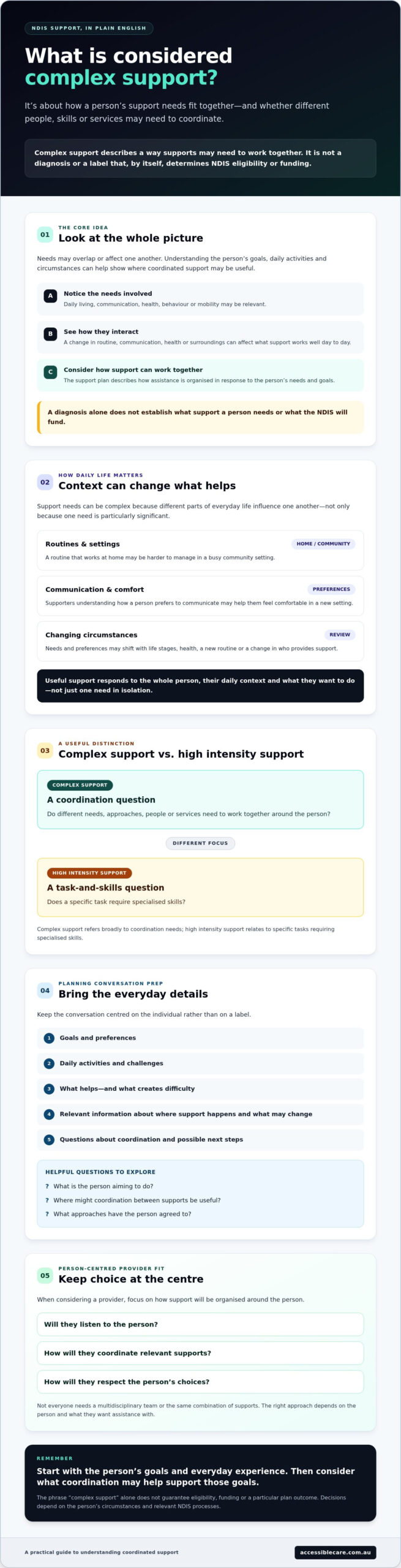
- To understand what is considered complex support, look at how a person’s needs interact and what coordination may help them pursue their goals.
- Notice how changes in routines, communication, health needs or surroundings affect the support that works well day to day.
- Distinguish broad coordination needs from specific high intensity tasks that may require specialised skills.
- Prepare for planning conversations by noting goals, daily challenges, relevant information and questions about possible next steps.
- When considering a provider, ask how they’ll listen to the person, coordinate relevant supports and respect their choices.
What Is Considered Complex Support in the NDIS?
The phrase “complex support” can be confusing because support needs differ from person to person. If you’re asking what is considered complex support, start by looking at how a person’s needs fit together and what assistance may help them pursue their goals. The phrase is often used to describe coordination around overlapping or specialised needs, rather than a specific diagnosis.
In plain English, complex support is coordinated support for a person whose significant, overlapping or specialised needs may require different skills, services or approaches to work together. A person’s needs and the supports arranged around them are related, but they aren’t the same thing. The person may have intersecting support needs; the support plan describes how assistance is organised in response.
Is complex support a formal NDIS category?
“Complex support” may come up in conversations with providers, families or workers, but service language and formal NDIS terminology aren’t always the same. The National Disability Insurance Scheme provides a broad overview of the scheme; for current terms and planning information, check official NDIA guidance. Don’t assume the phrase itself is a formal funding category, or that using it guarantees eligibility, funding or a particular plan outcome. Decisions depend on the person’s circumstances and the relevant NDIS processes.
What can make someone’s support needs complex?
Complexity can arise when several needs interact, even if no single need tells the whole story. For example, a person might need help with daily routines, communication support and assistance to manage health related needs. Another person may benefit from consistent approaches across support workers and settings because changes in routine or environment affect how they communicate or feel safe.
Needs may involve daily living, communication, health, behaviour or mobility. These examples don’t determine whether a person requires complex support. A diagnosis alone doesn’t establish what support they need or what the NDIS will fund. To understand someone’s situation, consider their goals and preferences, how daily activities are affected, where support happens and whether their circumstances change over time.
When describing support needs, focus on what happens in everyday life. What is the person aiming to do? What helps, what creates difficulty, and where might coordination between supports be useful? This keeps the conversation centred on the individual rather than on a label.
How Do Complex Support Needs Affect Everyday Life?
Support needs can be complex because different parts of daily life influence one another, not only because one need is particularly significant. A routine that works well at home may be harder to manage in a busy community setting. A change in communication, energy or health can also affect what assistance feels helpful on a given day.
Useful support responds to the whole person, their daily context and what they want to do, not just one need in isolation. This can mean paying attention to routines, communication preferences, health considerations and the environments where support takes place. The aim is not to make every part of life follow a rigid plan, but to provide consistency while respecting the person’s choices.
When several kinds of support need to work together
Practical assistance may sit alongside communication or therapy supports. For instance, hypothetical example: someone may want to take part in a local activity and find it easier when their supporters understand how they prefer to communicate and what helps them feel comfortable in a new setting. A useful response could involve sharing agreed information with the person’s chosen supporters, rather than automatically adding more services.
Clear communication helps everyone understand what the person wants, which approaches they’ve agreed to and what may have changed. Depending on the individual, relevant practitioners could include a speech therapist, occupational therapist, community nurse or positive behaviour support practitioner. Not everyone needs a multidisciplinary team or the same combination of supports. The right approach depends on the person and what they want assistance with.
How changing needs can affect support
Needs and preferences can vary between home, work, study or community settings. They may also shift with life stages, changes in health, a new routine or a change in who is providing support. Reviewing what is working can help the person and their chosen supporters decide whether an approach still fits or whether a small adjustment could better support comfort, choice and independence.
Hypothetical example: a person who has developed a new interest may want to spend more time in the community. Talking through transport routines, communication preferences and the support they want can keep the focus on their goal, rather than assuming existing arrangements must stay unchanged.
Useful questions include: What feels easier now? Is anything getting in the way? Would a different approach give the person more control? Include the individual in these conversations as much as they wish and can participate. If you’re exploring options, you can read about Accessible Care’s NDIS support services as one starting point for an individual discussion.
Complex Support vs High Intensity Support: What Is the Difference?
The terms can sound similar, but they describe different aspects of support. “Complex support” is commonly used to describe broad or overlapping needs and the coordination that may help address them. “High intensity support” refers to particular tasks that require specific skills and safeguards. A person may need one, both or neither. The terms aren’t interchangeable, and neither label alone determines NDIS funding.
| Aspect | Complex support | High intensity support |
|---|---|---|
| Everyday use | Describes support needs that may overlap or require coordination. | Describes specific daily support tasks that call for specialised skills. |
| Focus | How different needs, settings and supports fit together around the person. | How a particular task can be carried out safely and appropriately. |
| Possible examples | Coordinating practical assistance with communication or health related support. | Tasks may include complex bowel care or enteral feeding, subject to current NDIS guidance. |
| What needs individual assessment | The person’s goals, circumstances and what coordination may be helpful. | The specific task, the person’s needs and applicable provider and NDIS requirements. |
Does complex support always mean high intensity support?
No. The terms describe different things, so a person may have overlapping support needs without needing a high intensity task. Conversely, a particular high intensity task doesn’t by itself explain every part of someone’s support arrangement. What’s appropriate depends on the person’s assessed needs and applicable NDIS requirements. For task specific detail, read this guide to high intensity supports under the NDIS, and check current NDIS guidance when discussing a particular task.
Can complex support involve health or behaviour-related needs?
It can. Health related support or positive behaviour support may form part of an individual arrangement alongside other supports. Behaviour should be understood in context, including the person’s communication, environment, wellbeing and circumstances, rather than treated as a character flaw. The support approach should respect the person’s preferences and dignity.
For example, a person may need communication between their chosen supporters and relevant practitioners, as well as assistance with a specific health related task. That doesn’t mean everyone with overlapping needs requires the same team or service mix. Check current provider and NDIS guidance for requirements relating to the particular task, and discuss how supports can work together around the person’s goals.
How Can You Prepare to Discuss Complex Support Needs?
Before talking with a planner or provider, make a few notes about what matters to the person, what they want to work towards and where they would like more choice or independence. You don’t need to have every answer or use specialist language. Specific examples from daily life can help explain what is working and where support may be needed.
A simple sequence can make the conversation easier to organise:
- Identify goals: What would the person like to do, learn or change?
- Note daily challenges: Where does support help, and what gets in the way?
- Gather relevant information: Bring records that help explain the person’s circumstances, if appropriate.
- Prepare questions: Write down anything you want clarified, including unfamiliar terms.
Records can help explain support needs, but they don’t guarantee a particular plan or funding decision. For an overview before an individual conversation, you can learn about the NDIS.
What information may help explain support needs?
Keep notes focused on everyday life and the person’s own perspective. You might record routines, goals, existing supports, barriers and changes over time. For example, note what helps with a regular activity, what makes it harder and whether a change in setting or routine affects the support needed.
Professional reports may be relevant, but which ones matter depends on the person’s circumstances and the conversation. Ask which information would be useful rather than assuming every report is needed. Share personal information only with appropriate, trusted people, and involve the person in decisions about what is shared wherever possible.
What questions can you ask a provider or planner?
Clear questions can help you decide whether a proposed support fits the person’s goals and preferences. Consider asking:
- How does this support connect with the person’s stated goals?
- How will their preferences and choices guide the way support is provided?
- Who will communicate with the person and any relevant supporters or practitioners?
- How can the person raise a concern or discuss a change in circumstances?
- Could you explain that term or process in plain language?
You can also ask what information is needed for the next step and who will follow up. If you’re exploring what is considered complex support, keeping the conversation grounded in the person’s daily life can make their needs easier to describe. For a discussion about relevant support services, contact Accessible Care to ask about your circumstances.
Finding Person-Centred Support for Complex Needs
Choosing support is about more than finding a service that matches a list of needs. A person centred provider listens to the individual, respects their choices and considers what matters in everyday life. Include the person in decisions about their support to the extent they wish and are able to participate.
If you’re exploring what is considered complex support, look for a provider willing to understand how the person’s needs, goals and preferences fit together. Ask how they communicate with the person and their chosen supporters, respond to feedback and check whether the support remains a good fit. Clear answers can help you decide whether to continue the conversation.
What to look for in a support provider
Before making a decision, you could ask:
- How will the person’s goals and preferences shape the support?
- Who will communicate with the person, and how is continuity handled?
- How can the person or their chosen supporters raise feedback or concerns?
- Does the provider offer the specific service needed in the person’s location?
- What relevant experience do staff have, and how will their approach be explained?
A provider’s service list is a starting point, not proof that a particular service is suitable or available for every person or location. The individual should have a meaningful say in decisions, including what information is shared and who is involved in discussions.
How different services may contribute to support
Depending on the person’s goals and circumstances, support work may assist with practical activities, while community nursing may be relevant to certain health related support needs. Speech therapy, occupational therapy and positive behaviour support may also be considered where appropriate. These are examples, not a standard package. A person may need one service, several or a different combination altogether.
When different supports are involved, ask how communication will work and how relevant professional recommendations will inform the approach. The person’s priorities should guide any coordination. No single provider or service mix is right for everyone, and discussing options doesn’t guarantee a particular NDIS decision or outcome.
Accessible Care is a registered NDIS provider with services that include support work, community nursing, therapy and positive behaviour support. Availability and suitability depend on individual circumstances, so you can ask Accessible Care about support options in Melbourne or Adelaide.
Take the Next Step at Your Own Pace
Understanding what is considered complex support starts with looking at the person’s needs as a whole, rather than relying on a label. Complex support may involve coordinating overlapping needs, while high intensity support relates to specific tasks that require particular skills. Neither term alone guarantees NDIS funding or a particular plan outcome.
For a planning or provider conversation, focus on the person’s goals, what’s working in daily life and where they’d like more choice. Relevant notes and reports can help explain their circumstances, and asking for plain language answers can make next steps clearer.
Accessible Care is a registered NDIS provider, with services including support work, community nursing, therapy and positive behaviour support. The right options depend on the person’s circumstances, preferences and location. If you’d like to explore what may be relevant, talk with Accessible Care about support options.
You don’t need to have every answer before starting a conversation. A thoughtful next step can begin with listening to what matters most to the person.
Frequently Asked Questions
What is considered complex support under the NDIS?
Complex support generally describes support arrangements that may need to respond to several overlapping, significant or specialised needs. These could involve daily activities, communication, health related support or behaviour, with coordination shaped around the person’s goals and circumstances. The phrase “complex support” doesn’t describe a person’s identity or diagnosis. It’s a way people may talk about the support required, rather than a guaranteed NDIS funding outcome.
Is complex support an official NDIS category?
“Complex support” is often used descriptively in conversations, but don’t assume it’s a formal NDIS category or a specific funding decision. NDIS terminology and processes can change, so check current NDIA guidance for formal terms and planning information. If a planner or provider uses the phrase, ask what they mean in that context and which specific support needs or requirements they’re referring to.
Can someone receive complex support without a particular diagnosis?
Support needs shouldn’t be inferred from a diagnosis alone, and the phrase “complex support” doesn’t require a particular diagnosis as a label. Conversations about support can focus on how daily activities are affected, what assistance is helpful, and the person’s goals and preferences. NDIS access and funding decisions follow applicable requirements and individual processes. A diagnosis by itself doesn’t guarantee eligibility or funding for specific supports.
What examples of needs might involve complex support?
Examples may include a person who needs practical daily assistance alongside communication support, or someone whose health related support needs require clear coordination with their chosen supporters. Another person may benefit from consistent approaches across different settings. These are examples, not eligibility tests. Whether supports are appropriate depends on the individual’s circumstances, goals and assessed needs, rather than any single diagnosis or example.
How can I explain complex support needs to an NDIS planner?
Describe the person’s goals and everyday experience in clear, specific terms. Explain which activities are difficult, what support is already helping, what barriers remain, and whether needs change across routines or settings. Relevant records or professional reports may help explain the situation, but they don’t guarantee a plan or funding decision. Ask the planner to clarify unfamiliar terms and what information may be useful for the discussion.
Who can help with complex support needs in Melbourne or Adelaide?
Accessible Care is a registered NDIS provider serving Melbourne and Adelaide. Its services include support work, community nursing, speech therapy, occupational therapy and positive behaviour support. These are examples of service areas, not a determination of suitability, funding or availability for an individual. Contact the provider to ask whether the specific service you’re exploring is available in your location and discuss the person’s goals and circumstances.

