


What if social communication support didn’t mean learning one “right” way to talk, but finding options that feel useful and authentic to you? Speech therapy for pragmatic language disorder can support everyday communication, from taking turns in a conversation to interpreting implied meaning or joining a group discussion. These situations can be challenging, but there’s no single way they look for every person.
If you’re unsure what therapy involves, or worry it might focus on changing someone to meet other people’s expectations, those concerns matter. Support should start by listening to the individual and understanding what they want to communicate, where they’d like more confidence, and what feels comfortable.
This guide explains pragmatic language and its impact without relying on stereotypes. You’ll learn about person-led goals and approaches to discuss with a speech pathologist, plus questions that can help you compare providers and explore local support. In Melbourne and Adelaide, Accessible Care’s speech therapy team may be a point of contact to discuss communication needs and service fit; a dedicated pragmatic-language program isn’t confirmed, so ask what support is available.
Key Takeaways
- Pragmatic language is about communicating in context, not simply speech sounds or grammar, and differences alone don’t establish a disorder.
- Speech therapy for pragmatic language disorder should begin with the person’s priorities, with goals shaped around communication that matters in daily life.
- Individual sessions, group practice and communication-partner involvement each have different considerations; ask how an approach might fit your needs.
- Before therapy, note situations you’d like support with and discuss access needs, then agree on goals and ways to track meaningful progress.
- When contacting a provider, ask whether they can support your communication goals and confirm service suitability, delivery options and funding arrangements.
What does pragmatic language mean, and when might speech therapy help?
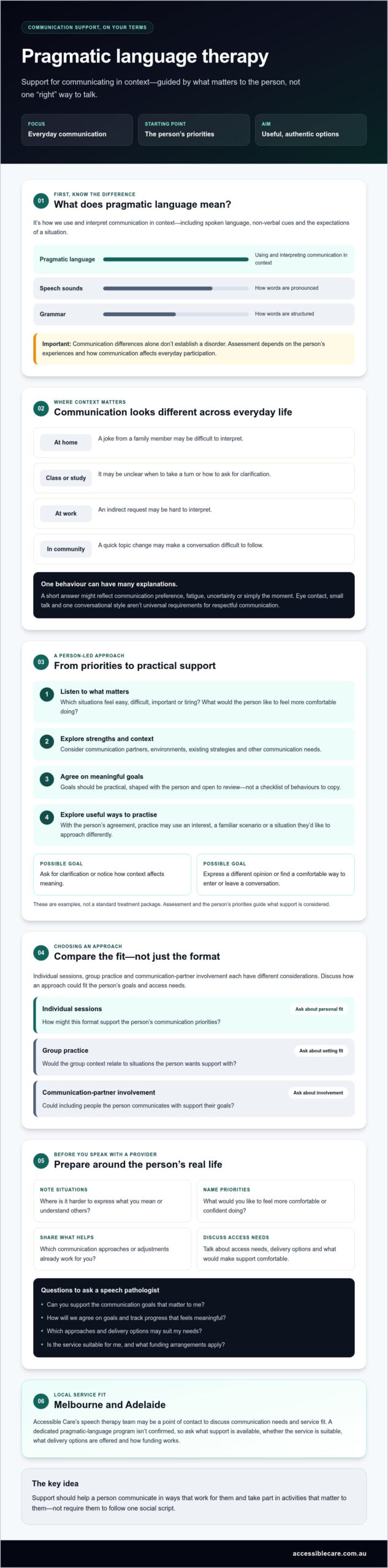
Communication is more than the words we say. Pragmatic language is how we use and interpret communication in context, including spoken language, non-verbal cues and the expectations of a particular situation. It differs from speech sounds, which concern how words are pronounced, and grammar, which concerns how words are structured.
People have different communication preferences. Someone may prefer direct language, need more time to respond, or find certain social settings tiring. Those differences don’t automatically mean a person has a disorder or a personal deficit. Social (pragmatic) communication disorder is a clinical diagnosis; whether assessment is appropriate depends on the person’s experiences and the impact on their everyday participation.
How pragmatic language differences can appear in everyday life
Context can make communication easier or harder. At home, someone might find it difficult to tell when a family member is joking. In a classroom or study group, they may be unsure when to take a turn or how to ask for clarification. At work, an indirect request may be hard to interpret; in the community, a quick topic change might make a conversation difficult to follow.
The same behaviour can mean different things for different people. A short answer might reflect a preference for concise communication, fatigue, uncertainty or simply the moment. Eye contact, small talk and one particular conversational style aren’t universal requirements for respectful communication. What matters is whether the person can communicate in ways that work for them and take part in activities that matter to them.
When is a speech pathologist worth speaking with?
Consider seeking advice when communication barriers affect activities or relationships that are important to the person, such as sharing ideas in class, understanding workplace conversations or feeling comfortable with friends. A speech pathologist can assess communication in context, discuss strengths and barriers, and explore whether support may be useful. An assessment should consider where communication happens, who is involved and what the person wants to change, rather than judging them against one social script.
Before a conversation with a speech pathologist, it may help to think about questions such as:
- Are there situations where I find it harder to express what I mean or understand others?
- What would I like to feel more comfortable or confident doing?
- Are there communication approaches or adjustments that already help?
These priorities can guide a discussion about speech therapy for pragmatic language disorder. The goal is to explore useful options with the person, not to assume that every difference needs therapy or that there’s only one acceptable way to communicate.
How speech therapy can support pragmatic language goals
Support should be shaped around what the person wants to communicate, not a checklist of behaviours to copy. After discussing communication priorities and assessing strengths and needs, a speech pathologist can work with the person to set goals that are practical, meaningful and open to review.
Depending on the assessment, goals might involve asking for clarification, noticing how context affects meaning, expressing a different opinion, or finding a comfortable way to enter or leave a conversation. These are examples, not a standard treatment package. The pragmatic profile of spoken language disorders offers a clinical overview, but a person’s assessment and priorities should guide which supports are considered.
What might a person-led assessment explore?
A speech pathologist may ask which communication situations feel easy, difficult, important or tiring. They can explore who the person communicates with, what different environments are like, and which strengths or existing strategies help. The assessment may also consider other communication needs. Findings inform a shared plan; they don’t automatically point to one therapy method or goal for everyone.
Examples of therapy activities and communication supports
With the person’s agreement, practice might use a conversation linked to an interest, a familiar scenario, or a situation they’d like to approach differently. They could try asking someone to explain an unclear message, or consider how the same words might be understood in different contexts. Role-play or visual supports may be options to discuss if they suit the person and the goal.
Communication partners might also explore ways to make exchanges clearer, such as allowing extra processing time or checking whether a message was understood. These are possibilities for a clinician and the person to assess together, not promised components of therapy. Ask the speech pathologist to explain why they recommend an activity, how it connects to the person’s goals, and how progress will be reviewed.
Therapy can support communication choices without requiring one socially typical style. In practice, that means working towards communication that feels more accessible or effective for the individual, rather than treating eye contact, small talk or a particular conversational manner as the measure of success.
If you’re exploring speech therapy for pragmatic language disorder in Melbourne or Adelaide, Accessible Care is a registered NDIS provider offering speech therapy. You can ask Accessible Care about speech therapy and whether its service may fit your communication goals. A dedicated pragmatic-language program isn’t confirmed, so check service suitability directly.
Comparing pragmatic language therapy approaches and settings
There isn’t one format that suits everyone. Individual sessions, group practice and involving a communication partner each offer different ways to work on a goal. A speech pathologist can discuss which options fit the person’s priorities and needs, and what the provider can actually offer. The aim is to make practice relevant, not to rank one approach as best for all.
Individual sessions, group practice, and communication partners
Individual sessions can provide space to focus on goals chosen by the person. Group practice may offer opportunities to try communication strategies with other people, if the person is comfortable and a suitable group is available. A trusted partner, such as a family member or support person, might join part of a session or practise agreed strategies in everyday conversations. Their involvement should respect the person’s consent and boundaries.
| Option | Possible goal or benefit | Considerations | Questions to ask |
|---|---|---|---|
| Individual sessions | Focus on a personally selected situation or communication goal. | Practice may need to be considered in relation to the person’s everyday settings. | How will goals reflect the person’s priorities, and how could strategies be used outside sessions? |
| Group practice | Try communication approaches with more than one interaction partner. | Group suitability, availability, comfort and access needs vary. | Who would take part, what would the group focus on, and can the person observe or opt out? |
| Communication-partner involvement | Explore ways to make everyday conversations more supportive and clear. | Agree on the partner’s role and protect the person’s privacy and choice. | Can a trusted partner be involved, and what would the person want them to know or practise? |
Choosing a setting and delivery format
Think about where communication goals matter most, then ask which formats are available. A clinic, home, community location or remote session may suit different preferences, but don’t assume a provider offers each option. Travel, sensory comfort, physical access, privacy, technology and scheduling can all affect what feels workable. The person should have a chance to share what helps them participate and what they’d rather avoid.
For speech therapy for pragmatic language disorder, ask how the proposed format connects to the person’s goals, whether adjustments are possible, and how progress will be reviewed. Accessible Care is an NDIS provider serving Melbourne and Adelaide, but available settings and service fit should be confirmed directly. For broader context about speech pathology, read this speech pathology guide.
How to prepare for pragmatic language therapy and track progress
A little preparation can help make an initial conversation more useful. You don’t need to arrive with perfect wording or a complete history. Start with what the person wants support with, and invite them to shape the discussion and decisions wherever possible.
- Identify priorities. Think about communication activities the person wants to feel more comfortable with, and why they matter.
- Note examples. Jot down a few situations that felt easy or challenging, including what was happening and what helped.
- Discuss access needs. Share preferences or adjustments that could make assessment and sessions more comfortable, such as communication style, sensory needs or the involvement of a trusted person.
- Agree on goals. Work with the speech pathologist to choose goals that reflect the person’s priorities and decide together how to review them.
Questions to ask before choosing a speech pathologist
Ask how the clinician involves the person in assessment, goal-setting and decisions about strategies. You might also ask about their experience with communication needs relevant to the person, and whether they can work in the settings the person prefers. Confirm fees, availability, service locations and funding arrangements directly with the provider, as these details can vary.
Agreeing on goals and recognising meaningful progress
Useful goals describe an activity or outcome the person values, rather than a need to appear more socially typical. For example, a goal might focus on sharing an idea in a chosen setting or feeling more at ease asking for clarification. With the clinician, agree on ways to notice change, such as reflecting on selected situations, recording the person’s experience or reviewing participation in an activity they care about.
Progress isn’t only about whether a particular behaviour occurs. The person might feel more understood, have more choices in how they communicate, or find an important interaction less tiring. Goals can also change as environments, needs or preferences shift. Review them together and adjust the plan if it no longer feels relevant.
If you’re considering speech therapy for pragmatic language disorder, ask how the provider can discuss service fit and funding. NDIS funding and plan coverage aren’t guaranteed; confirm the relevant plan details and current rules with your planner or provider. For general plan-navigation information, see this NDIS guide.
Accessible Care is an NDIS provider serving Melbourne and Adelaide. You can contact Accessible Care to discuss speech therapy and ask whether its service is suitable for your goals. A dedicated pragmatic-language service isn’t confirmed, so check availability, locations and funding arrangements directly.
Finding pragmatic language speech therapy in Melbourne or Adelaide
Finding a suitable service starts with a conversation, not a commitment. Describe the communication goals that matter to the person, such as feeling more comfortable in a particular setting or expressing their needs more clearly. Then ask whether the provider can assess those goals and whether its service is suitable for the person’s circumstances.
Accessible Care is an NDIS provider serving Melbourne and Adelaide. Its speech therapy service uses experienced Speech Language Pathologists and includes holistic assessments and communication support. The listed service focuses on communication, cognitive and language skills for people with acquired neurological disorders. A dedicated pragmatic-language program isn’t confirmed, so ask directly whether the team can support the person’s goals and whether the service is appropriate for their age and needs.
What to confirm with a prospective provider
Before deciding, clarify what support may involve and whether the practical arrangements work for you. A short list of questions can help:
- Can you support the communication goals and circumstances I’ve described?
- Which clinician may be involved, and what could an assessment or first appointment include?
- Which service locations and delivery formats are available, and can accessibility needs be accommodated?
- What are the fees, and what funding arrangements may apply? How should I confirm these for my circumstances?
Confirm costs and funding directly with the provider, and check any NDIS plan details with the relevant planner or provider. Funding eligibility and plan coverage aren’t guaranteed. It’s also reasonable to ask about availability before sharing more information or making a decision.
A supportive first step with Accessible Care
If you’re exploring speech therapy for pragmatic language disorder in Melbourne or Adelaide, you can contact Accessible Care to explain the person’s communication priorities and ask whether the service may be a fit. The team can clarify current service suitability, age range, locations, delivery options and availability. Asking these questions doesn’t mean you need to proceed; it simply helps you understand the options.
Contact Accessible Care to discuss your support needs and explore whether its speech therapy service may align with the communication goals that matter to you.
Choose communication support that starts with you
Pragmatic language describes how we use and interpret communication in context, and people naturally communicate in different ways. If communication barriers affect activities or relationships that matter to you, a speech pathologist can help explore your priorities and possible supports.
The right approach should be individual and collaborative. Goals might focus on meaningful participation, confidence or communication choices, with progress measured by what feels useful to the person, not by how closely they follow one social style. Session format and strategies can also be discussed and adjusted to fit personal preferences and access needs.
Accessible Care is a registered NDIS provider serving Melbourne and Adelaide. Its speech therapy service includes experienced Speech Language Pathologists, holistic assessments and communication support. A dedicated pragmatic-language service isn’t confirmed, so ask whether the team can support your goals and what arrangements may be suitable.
Contact Accessible Care to discuss your support needs and explore whether its speech therapy may be a fit. You can take the next step at your own pace, with your communication priorities at the centre.
Frequently Asked Questions
Is pragmatic language disorder the same as a speech or language disorder?
Not necessarily. Pragmatic language is about using and understanding communication in context, while speech and language can also involve speech sounds, vocabulary, grammar or comprehension. A person may have support needs in one area or several. A communication difference doesn’t automatically mean treatment is needed. If concerns affect activities that matter to the person, an appropriately qualified clinician, such as a speech pathologist, can assess their individual communication profile.
Can speech therapy help with pragmatic language difficulties?
Speech therapy may help someone explore communication goals and strategies that matter in daily life. The approach should be guided by an individual assessment, the person’s strengths, preferences and support needs. It shouldn’t assume that everyone must communicate in the same way. If you’re considering speech therapy for pragmatic language disorder, ask how the speech pathologist involves the person in choosing goals and how you’ll review whether the support is useful.
What happens during a pragmatic language assessment?
A speech pathologist may ask about communication across everyday settings, including what feels comfortable, what feels challenging and what the person wants to work towards. With the person’s permission, the clinician may also gather information from relevant supporters. The assessment should help guide individual goals, not label every difference as a problem. Ask what the assessment involves, how consent is handled, and how the clinician will explain their findings.
What are examples of pragmatic language therapy activities?
Activities depend on the person’s goals. A speech pathologist might explore ways to ask for clarification, respond to a change in conversation, or communicate a preference in a particular setting. These are possibilities, not a fixed checklist or a test of social conformity. Ask why an activity has been suggested, how it relates to the person’s priorities, and whether another strategy could feel more comfortable or relevant.
Can pragmatic language therapy be provided through the NDIS?
NDIS funding depends on the person’s circumstances, plan details and current rules, so don’t assume a particular therapy or provider will be funded. Check the plan and confirm eligibility, funding arrangements and costs with the relevant NDIS contact or provider. Accessible Care is a registered NDIS provider in Melbourne and Adelaide. Contact the team to ask whether its available speech therapy matches the person’s communication goals and circumstances.
How do I choose a speech pathologist for pragmatic language support?
Look for a clinician who listens to the person, explains assessment clearly and collaborates on goals that matter to them. Ask about experience relevant to the person’s communication profile, available settings, communication supports and how progress is reviewed. Confirm location, availability, fees and funding arrangements directly before deciding. A good fit should respect the person’s communication preferences and autonomy, rather than treating one social style as the only acceptable outcome.
Does Accessible Care offer speech therapy for pragmatic language disorder?
Accessible Care provides speech therapy with experienced Speech Language Pathologists and holistic assessments. Its listed service focuses on communication, cognitive and language skills for people with acquired neurological disorders. The available information doesn’t confirm a dedicated pragmatic-language-disorder service. If you’re in Melbourne or Adelaide, contact Accessible Care to discuss the person’s goals, age group and circumstances, and ask whether the available service is a suitable fit.

