


What if the document that looks like a formality is actually your best chance to make support clear and right for you? If you’re searching for “ndis service agreement explained,” you may want practical answers: what support will be provided, when it will happen, what charges may apply, and what happens if plans change.
It’s understandable to want clear answers before support begins. Your NDIS plan sets out your funding, while a service agreement records the supports you and a provider have agreed on. A written agreement is recommended for clarity, although it’s mandatory for Specialist Disability Accommodation supports. You can ask questions and discuss terms before deciding whether to sign.
This guide explains what an agreement does and what to check, including services, schedules, charges, cancellations, changes, and ending the arrangement. It also explains how an agreement differs from your plan and where to find current, independent guidance if something is unclear. With the details in plain view, you can make an informed choice and keep your preferences at the centre of the conversation.
Key Takeaways
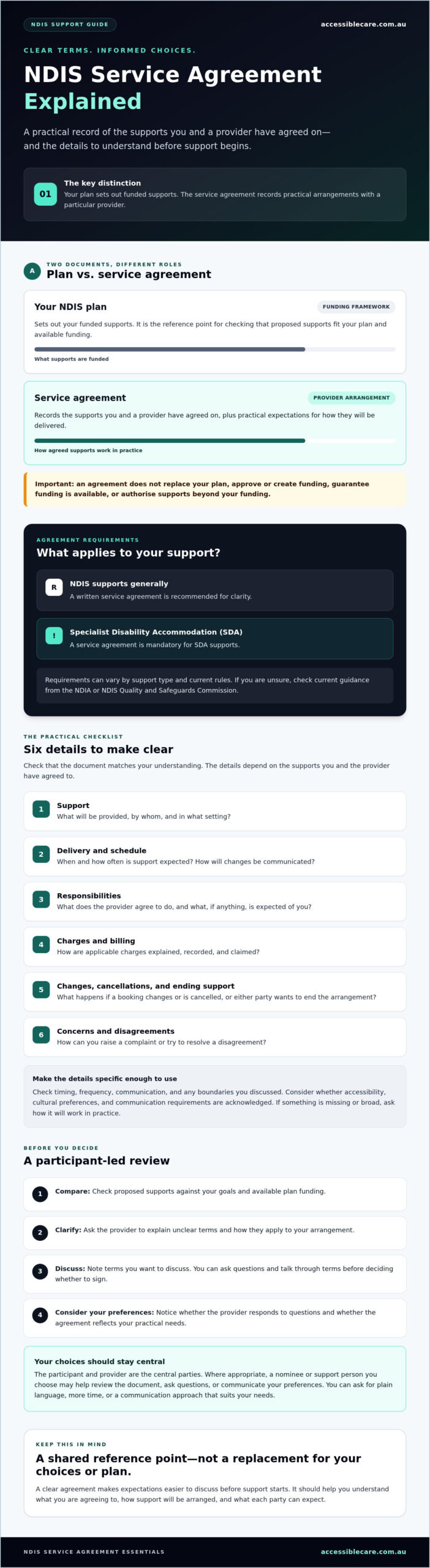
- A service agreement records the supports and practical terms you and a provider have agreed on. It does not replace your NDIS plan or approve funding.
- Check that the support description, delivery arrangements, communication expectations, and responsibilities are clear to you.
- Confirm whether specific requirements apply to your support type, and check current official NDIS guidance if you’re unsure.
- Before signing, compare the proposed supports with your goals and available plan funding. Note any terms you want to discuss.
- Pay attention to how the provider responds to questions and whether the agreement reflects your preferences and practical needs.
What Is an NDIS Service Agreement, and What Does It Actually Do?
It’s reasonable to ask for an NDIS service agreement in plain language. You should be able to understand what support you’re agreeing to, how it will be arranged, and what each party can expect. If a term is unclear, ask the provider to explain it before you decide.
A service agreement records the supports you and a provider have agreed on, along with practical arrangements and expectations for delivering them. Depending on the support, it may describe what will be provided, when and how it will happen, and how you and the provider will communicate. Treat it as a shared reference point, not a document that should leave you guessing.
One distinction is especially important when having an ndis service agreement explained: the agreement is not your NDIS plan, and it doesn’t approve or create funding. Requirements can vary by support type and current rules. Written agreements are recommended for NDIS supports generally, while Specialist Disability Accommodation (SDA) supports require one. Check current guidance from the NDIA or NDIS Quality and Safeguards Commission if you’re unsure what applies to your situation.
How is a service agreement different from an NDIS plan?
Your NDIS plan sets out your funded supports. A service agreement records the arrangements between you and a particular provider for supports you’ve agreed to receive. It can clarify how those supports are intended to work in practice, but it doesn’t change your plan, guarantee that funding is available, or authorise supports beyond your funding.
If you’re still getting familiar with the scheme, read this NDIS guide for a straightforward introduction. The National Disability Insurance Scheme (NDIS) provides the broader framework. Your agreement concerns the specific relationship with a provider.
Who is involved in agreeing to supports?
The participant and provider are the central parties in the discussion. Your goals, preferences, and understanding should guide it. Where appropriate, a nominee or support person you choose may help review the document, ask questions, or communicate your preferences.
Support should be explained in a way that works for you. You might ask for plain language, more time to consider the terms, or a communication approach that suits your needs. Being involved doesn’t mean you need to manage every detail alone. It means your views are heard and taken into account as decisions are made.
A clear agreement can make expectations easier to discuss before support starts. It’s a starting point for communication, not a substitute for your choices or your plan.
NDIS Service Agreement Explained: What Should It Cover Clearly?
A useful agreement makes the practical details easy to find, rather than leaving you to guess what a support involves. The details depend on the supports you and the provider have agreed to, but this checklist can help you review the main points. Start by checking whether the document reflects your understanding of the arrangement.
- Support: What will be provided, by whom, and in what setting?
- Delivery: When and how often is support expected to happen? How will changes be communicated?
- Responsibilities: What does the provider agree to do, and what, if anything, is expected of you?
- Charges and billing: How are charges explained, recorded, and claimed?
- Changes and ending support: What happens if a booking changes or is cancelled, or if either party wants to end the arrangement?
- Concerns: How can you raise a complaint or try to resolve a disagreement?
Are supports, schedules, and responsibilities specific enough?
Check that the description matches the support you discussed. For example, if you’ve agreed to support work, does the agreement explain what the support is intended to cover and where it will take place? Look for clear details about timing, frequency, communication, and any boundaries you’ve discussed. Consider whether accessibility, cultural preferences, and your communication requirements are acknowledged. If a detail is missing or broad, ask the provider how it will work in practice.
Are charges, cancellations, and changes explained?
Look for a clear explanation of applicable fees, how claims or invoices are handled, and whether cancellation terms apply to your arrangement. Don’t assume a term works one way or another based on a template. Ask the provider how it applies to the support you’ve agreed to. Check how much notice is expected for changes and what steps either party can take if plans need to shift.
Pricing rules can change, so check the current NDIS Pricing Arrangements and Price Limits for the relevant support. For NDIA-managed and plan-managed participants, providers can’t charge above applicable maximum price limits. The NDIA’s What is a service agreement guidance is a useful reference for understanding agreements and what they may cover.
Before signing, make sure you can find the process for raising concerns, handling disagreements, and ending the arrangement. If you’re considering support work, speech therapy, occupational therapy, positive behaviour support, or community nursing, you can discuss your support needs with Accessible Care and ask what details to clarify for the support you’re considering.
Is an NDIS Service Agreement Mandatory, and Can You Ask for Changes?
Not every NDIS support requires a written service agreement. Current NDIS guidance recommends agreements for supports generally, while a written agreement is mandatory for Specialist Disability Accommodation (SDA). Requirements can depend on the support and current rules, so check the NDIA’s latest guidance for your circumstances rather than relying on a provider template or older advice.
This distinction matters when having an ndis service agreement explained accurately: an agreement can be useful even when it isn’t required for every support. If you’re unsure whether a specific support type has a different rule, ask the provider and verify the answer with the NDIA or the NDIS Quality and Safeguards Commission.
Can you negotiate or request changes to an agreement?
Yes. You can raise terms that are unclear, don’t reflect what you discussed, or may not work for you. For example, ask for clearer wording about how to give notice of a booking change or how the provider will communicate with you. Participants can discuss and negotiate terms, but that doesn’t mean the provider must accept every requested change or that every service arrangement will remain unchanged. Ask what options are available and take time to consider the response.
If you and the provider agree to a revision, ask for the updated terms in writing and keep a copy in a format you can access. This helps everyone refer to the same understanding later. A respectful discussion is a useful starting point, though it can’t guarantee a particular outcome.
What if you do not understand or agree with a term?
Pause and ask for a plain-language explanation before agreeing. You might ask, “Can you explain what this means if I need to change a booking?” or ask the provider to show how a clause would apply to your support. You don’t have to sign a document you don’t understand or agree with. If you’re not ready to decide, ask whether you can take more time and clarify how that may affect the proposed arrangement or start of support.
You can involve a trusted person, your support coordinator, or an independent advocate if that would help you review the terms or express your preferences. NDIS providers and workers must follow the NDIS Code of Conduct, which sets expectations for safe, respectful, and competent conduct. If you have a concern you can’t resolve with the provider, check the NDIS Quality and Safeguards Commission’s current complaint guidance to understand possible next steps.
How to Review an NDIS Service Agreement Before Support Starts
You don’t need to review an agreement all at once. Take it at your pace, compare it with what you discussed, and note anything you want clarified before support begins. This checklist can help you decide whether the written terms reflect your goals and arrangements.
A practical agreement review checklist
- 1. Check the basic details. Make sure your name and the provider’s details are correct, and that the document covers the supports you discussed.
- 2. Compare the proposed support with your goals and plan. Ask whether the type and amount of support fit your goals, the relevant funding in your plan, and the funding available. An agreement doesn’t approve funding, so don’t treat it as confirmation that a support is funded.
- 3. Review delivery arrangements. Check who will provide support, where it will happen, and any agreed timing or frequency. Confirm that responsibilities and communication arrangements are understandable.
- 4. Check fees and practical terms. Read how charges, billing, cancellations, and changes are described. If you’re unsure whether a term matches current NDIS pricing rules, ask for clarification and check current official guidance.
- 5. Mark anything unclear or different. Note missing details, unfamiliar wording, or terms that don’t match your conversation. Check how the provider will communicate interruptions or changes, and how to raise a concern.
- 6. Ask for a version you can use. Request a plain-language explanation or an accessible format if that would help you understand the agreement. Ask for any agreed revisions in writing, and keep an accessible copy of the final document.
How to prepare for a provider conversation
Before speaking with the provider, write down the outcomes you’re working towards, your support preferences, and the questions you want answered. You could ask who your main contact will be, how to give feedback or make a complaint, and what happens if your needs or schedule change. If you’d like, bring a trusted person or support person to help you discuss the details.
Comparing providers as well as agreements? This NDIS provider selection guide may help you think through what matters to you. A useful review comes down to checking whether the written terms match your understanding, goals, and available funding, then asking about anything that doesn’t.
If you’re considering support work, speech therapy, occupational therapy, positive behaviour support, or community nursing, you can talk with Accessible Care about your support needs and the questions you’d like to clarify before support starts.
Choosing NDIS Supports With an Agreement That Respects Your Goals
A clear agreement can support a more trusting relationship because you and the provider have a shared understanding of how support is intended to work. It can make communication and practical expectations easier to revisit, but it can’t guarantee particular outcomes or ensure that every arrangement will suit you over time. Your preferences still matter, and it’s reasonable to consider whether the provider and proposed support feel like a good fit.
What makes a provider agreement feel clear and respectful?
Look beyond whether the document is complete. Consider whether the language is understandable, the support details reflect what you discussed, and the expectations seem realistic for your needs. Notice how the provider responds when you ask for clarification. Do they listen and explain without rushing you? A respectful discussion leaves room for your questions and gives you the chance to consider the terms.
Think about the relationship you’ll have in practice, too. Is there a clear way to contact the provider? Do the communication and review arrangements suit your preferences? If your communication needs, routines, or support priorities change, can you see how you would raise that and discuss next steps? These details can help you assess whether the arrangement feels workable, not just whether the wording looks formal.
How can Accessible Care help you explore support options?
Accessible Care is a registered NDIS provider serving Melbourne and Adelaide. Its supports include support work, occupational therapy, speech therapy, positive behaviour support, community nursing, and high-intensity support. Which options may be suitable depends on your individual needs and circumstances. You can ask questions about the support you’re considering, explain your goals and preferences, and discuss what arrangements may need to be clarified in an agreement.
If you’ve been searching for “ndis service agreement explained,” focus on terms that support an informed, person-led conversation. An agreement is one part of choosing support. The provider’s willingness to listen, communicate clearly, and discuss practical expectations can also help you decide whether the relationship feels right for you. Take the time you need to consider your options.
If you’d like to discuss your support needs or questions about an agreement with the team, talk with Accessible Care about your support needs.
Take Your Time and Choose Support With Confidence
A clear agreement can help you and your provider share an understanding of the supports and practical arrangements you’ve discussed. Remember, it’s separate from your NDIS plan and doesn’t approve funding. Before you agree, check that the details make sense for your goals, clarify anything uncertain, and confirm current guidance for your support type.
Having ndis service agreement explained in plain language can make it easier to ask questions and make informed choices. Take time to review the terms and talk through what matters to you. A useful conversation should leave room for your preferences, not pressure you to decide before you’re ready.
Accessible Care is a registered NDIS provider serving Melbourne and Adelaide, with support work, speech therapy, occupational therapy, positive behaviour support, and community nursing. If you’d like to explore whether its supports may suit your needs or discuss agreement questions, talk with Accessible Care about your support needs.
Your voice belongs at the centre of these decisions. Take the next step when you feel ready.
Frequently Asked Questions
What is an NDIS service agreement?
An NDIS service agreement records the supports you and a provider have agreed on, along with practical arrangements such as how support will be delivered and how you’ll communicate. It’s different from your NDIS plan, which sets out funded supports, and it doesn’t approve or create funding. The agreement clarifies your relationship with a provider, not your plan’s funding decision.
Is an NDIS service agreement compulsory?
A written service agreement isn’t compulsory for every NDIS support. The NDIA recommends agreements generally, while a written agreement is mandatory for Specialist Disability Accommodation (SDA). Requirements can depend on the support type and current rules, so check current official guidance if you’re unsure. A provider may still ask you to discuss and agree on practical terms before support begins, so clarify what applies to the support you’re considering.
Can I change or cancel an NDIS service agreement?
You can raise a request to change or end an agreement with the provider. Check the document for its notice, cancellation, and ending arrangements, and ask how they apply to your circumstances. The provider may not agree to every requested change. Clarify any applicable charges or effects on planned support rather than making assumptions. If you agree on revisions, ask for them in writing and keep an accessible copy.
What should an NDIS service agreement include?
It should clearly describe the agreed supports and practical arrangements. Check who will provide support, where and when it will happen, how you’ll communicate, and what each party is responsible for. The agreement should also explain applicable fees and billing, and cover how changes, cancellations, complaints, disagreements, or ending the arrangement are handled. The exact details depend on the supports involved. Ask the provider to explain anything unclear before you agree.
Does a service agreement use funding from my NDIS plan?
The agreement itself doesn’t provide or approve funding. It records the supports you’ve agreed to receive from a provider, which may be paid for using eligible funding in your NDIS plan, depending on your plan and funding arrangements. Check that the proposed supports fit your plan and available funding, and ask how billing or claims will be handled. Signing an agreement doesn’t guarantee that funding is available or change your plan.
What can I do if I do not understand an agreement?
Pause and ask the provider to explain the wording in plain language before you agree. You can request an accessible format or more time to review it. If you’d like support, consider asking a trusted person, nominee, support coordinator, or independent advocate to go through it with you. If you have a concern you can’t resolve with the provider, check the NDIS Quality and Safeguards Commission’s current complaint guidance for possible next steps.
Do I have to sign an NDIS service agreement before support begins?
There isn’t a general NDIS requirement for every participant to sign a written service agreement before receiving all types of support. A written agreement is mandatory for SDA, and the NDIA recommends agreements for supports generally. A provider may ask you to agree to practical terms before starting, so ask what applies to your support. Don’t sign a document you don’t understand. Request an explanation and check current official guidance if needed.
Can someone help me review an NDIS service agreement?
Yes. Where appropriate, you can ask a trusted person, nominee, support coordinator, or plan manager to help you understand or discuss the terms. An independent advocate may also be able to support you to express your preferences. You can ask the provider questions directly, too. Your goals and choices should remain central, even when someone helps with the review. Keep a copy of the final agreement in a format you can access.

