


What should happen when support feels unsafe, disrespectful or out of step with a person’s choices? The ndis support worker code of conduct guides everyday decisions, not just policies. It sets expectations for how NDIS workers and providers treat people, deliver support and respond to concerns.
Participants and families may be unsure what respectful support looks like, while workers may need clarity about what to do when something doesn’t seem right. The Code’s central purpose is to protect people’s rights, support their choices and promote safe, accountable support.
This practical guide explains the main expectations in plain English, with examples of how they can apply during support. It also covers steps participants, families and workers can take when they have a question or concern, and where to raise a complaint if needed. Use it to prepare for a conversation with a provider or to think through what respectful, safe support should look like.
Key Takeaways
- Understand who the NDIS Code of Conduct applies to and the role of the NDIS Quality and Safeguards Commission.
- See how the ndis support worker code of conduct translates into everyday expectations around rights, privacy, safety and honest support.
- Use practical examples to consider consent, professional boundaries, reliability and supporting a person’s choices.
- Learn how to respond to a concern, including what details to record and how to consider the right next step.
- Recognise how listening and clear communication can build trust while respecting each person’s independence.
What is the NDIS Support Worker Code of Conduct?
The NDIS Code of Conduct sets the minimum behaviour expected of providers and workers delivering supports under the National Disability Insurance Scheme. In practical terms, it sets a shared standard for treating people safely and respectfully, protecting their rights and responding responsibly to concerns. The National Disability Insurance Scheme (NDIS) provides the wider context for the supports the Code covers.
The Code is the NDIS-wide conduct standard for providers and workers, overseen by the NDIS Quality and Safeguards Commission. It applies to registered and unregistered providers. It is separate from workplace policies and agreements between participants and providers, although those documents may set out additional responsibilities and arrangements.
Who must follow the NDIS Code of Conduct?
The Commission uses “NDIS provider” for an organisation or person that provides NDIS supports or services. An “NDIS worker” is someone employed or otherwise engaged by a provider to deliver those supports or services. Providers and workers must follow the Code when providing NDIS support. Registration status does not remove that expectation.
Participants and families can use the Code as a reference when considering what conduct to expect. They are not required to comply with it as providers or workers, but its expectations can help them describe a concern or ask a provider questions.
Which body oversees the Code in Australia?
The NDIS Quality and Safeguards Commission is the independent regulator responsible for promoting and enforcing the Code. It has a safeguarding and regulatory role, including responding to concerns about the quality and safety of NDIS supports. The NDIA has a separate role in administering the NDIS, including participant plans and funding. It does not regulate conduct under the Code.
The Code also sits alongside other documents, each with a different purpose:
- Employment policies set workplace processes and expectations. They may give workers practical instructions, but they do not replace the Code.
- Service agreements record arrangements between a participant and provider, such as the supports to be delivered. They do not cancel a provider’s or worker’s conduct obligations.
- NDIS Practice Standards set quality and safety requirements for registered providers. They complement the Code rather than replacing its conduct expectations.
This guide offers general information, not legal advice. For an individual situation or the latest official wording, check current NDIS Quality and Safeguards Commission guidance. The Code is a useful starting point, but it does not decide every dispute or replace advice about a specific matter.
What does the NDIS Code of Conduct require from support workers?
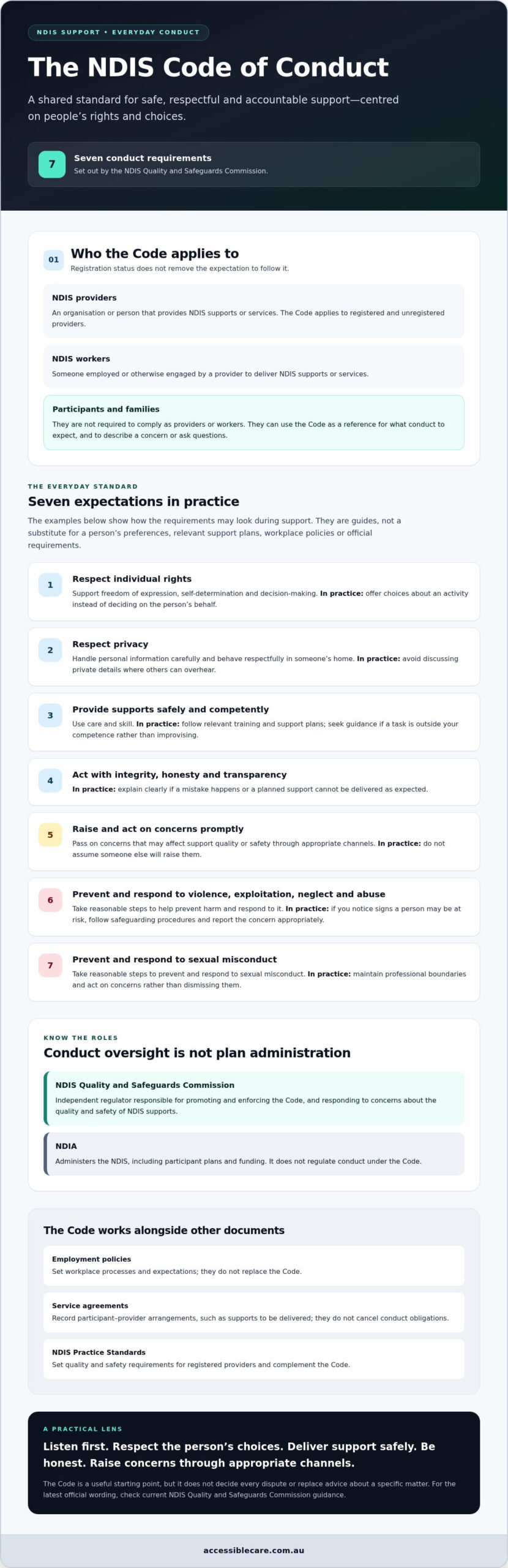
The ndis support worker code of conduct turns broad principles into expectations for how support is delivered. The NDIS Quality and Safeguards Commission sets out seven requirements in its NDIS Code of Conduct. The examples below show how they may apply in everyday situations. They are guides, not a substitute for a person’s preferences, relevant support plans, workplace policies or official requirements.
- Respect individual rights. Support freedom of expression, self-determination and decision-making. Offer choices about an activity rather than deciding on the person’s behalf.
- Respect privacy. Handle personal information carefully and behave respectfully in someone’s home. Avoid discussing private details where others can overhear.
- Provide supports safely and competently, with care and skill. Follow relevant training and support plans. If a task is outside your competence, seek guidance rather than improvising.
- Act with integrity, honesty and transparency. Explain clearly if a mistake happens or a planned support cannot be delivered as expected.
- Raise and act on concerns promptly. Pass on concerns that may affect support quality or safety through appropriate channels. Do not assume someone else will raise them.
- Take reasonable steps to prevent and respond to violence, exploitation, neglect and abuse. If you notice signs that a person may be at risk, follow safeguarding procedures and report the concern appropriately.
- Take reasonable steps to prevent and respond to sexual misconduct. Maintain professional boundaries and act on concerns about sexual misconduct rather than dismissing them.
How should workers respect choice, privacy and dignity?
Respect starts with listening. Before providing personal support or entering a private space, explain what you intend to do and seek the person’s consent. Check how they prefer to communicate, allow time for a response and respect a request to pause. If consent or communication needs are unclear, do not assume. Follow the relevant plan and seek appropriate guidance.
Privacy also means limiting access to personal information to people who need it for their role, and being discreet in the person’s home. A worker can explain options and offer practical help without taking control of decisions. The person’s preferences remain central, within relevant support arrangements and safety requirements.
What do safe and accountable supports look like?
Safe support depends on competence, honesty and accountability. Workers should understand the tasks they are undertaking, follow applicable training and plans, and speak up if something is unclear or outside their skills. If a concern arises, record and share the facts promptly through the provider’s appropriate process. Follow current Commission guidance where relevant.
People exploring support options can ask providers how their support work is planned around individual preferences and communication needs. Accessible Care provides support work in Melbourne and Adelaide. You can learn more about its support work services and ask how the service may fit your needs.
What does the Code look like in everyday support work?
The ndis support worker code of conduct is reflected in small, everyday choices: asking before acting, keeping private information private and following through on agreed support. These examples are prompts for discussion, not automatic findings of misconduct. Context, the participant’s preferences, applicable plans and workplace policies all matter. For the formal expectations, check the Commission’s NDIS Code of Conduct.
How do boundaries and privacy apply during a shift?
Warmth and trust can be part of good support, but a friendly relationship does not replace professional boundaries or responsibilities. For example, a worker should not assume they can post a photo from a shift just because the participant is comfortable with them personally. Workplace rules, consent and privacy requirements still matter. If a boundary feels unclear, pause and ask a supervisor or follow the provider’s guidance rather than relying on assumptions.
How can workers support choice while keeping support safe?
Start by asking what matters to the participant, listening to their reasons and explaining any specific risk clearly. Then explore options together, without treating a safety concern as a reason to dismiss the person’s preferences. If restrictive practices may be involved, do not improvise or assume a general safety concern authorises one. Restrictive practices have separate requirements, so workers should follow current official guidance and their provider’s procedures.
What should you do if an NDIS support worker concern arises?
A concern can feel difficult to raise, especially when support is ongoing. Start by considering immediate safety, then clarify what happened and who can help. A service concern, a complaint and a reportable incident are related, but they are not interchangeable terms.
- Service concern: A question or issue about how support was delivered, such as a missed visit or unclear communication. It may be resolved through a conversation with the provider.
- Complaint: An expression of dissatisfaction that a participant or another person wants addressed. A provider should have a process for receiving and responding to complaints.
- Potentially reportable incident: An event that may fit the NDIS Commission’s formal incident-reporting categories. Registered providers have specific reporting obligations. Whether an event meets the definition depends on the facts and current Commission guidance.
These categories can overlap. A concern about a worker’s conduct may also need to be handled through a complaints process or assessed as an incident. A worker’s duty to raise a risk internally is not necessarily the same as a provider’s formal notification obligation.
How can a participant or family raise a concern?
If it feels safe and appropriate, contact the provider and ask how to use its complaints process. You can also contact the NDIS Quality and Safeguards Commission if you are unsure, the provider’s response does not resolve the issue, or you do not feel comfortable raising it with the provider. Check the Commission’s current official guidance for complaint options and contact details.
Keep a factual record if you can. Note dates, what happened, who was present, what was said or done, and any response. Separate what you observed from what you suspect. Store notes securely and share personal information only with people or organisations who need it to respond. You do not need to be certain that a Code breach occurred before asking for guidance.
What should a support worker do after noticing a risk?
If someone is in immediate danger, act to protect their safety and contact emergency services on 000 where needed. Then follow workplace escalation procedures promptly. Write down objective observations, such as “the participant said they felt unsafe,” rather than adding assumptions or diagnoses. A worker should alert the appropriate person within the provider. The provider is responsible for assessing whether formal incident notification is required.
Reporting requirements and timeframes depend on the incident type and current rules. Do not rely on memory or guess. Check the provider’s procedures and the Commission’s latest guidance, and seek advice from an appropriate supervisor if the next step is unclear. The ndis support worker code of conduct supports speaking up about concerns, but it does not guarantee a particular outcome or confidentiality.
If you are considering support work with a provider, you can learn about Accessible Care’s support work and ask how its supports are planned around each person’s needs and choices.
How can respectful NDIS support build trust and independence?
Respectful support should be evident in the way a person is treated: their views are heard, their privacy and dignity matter, and they are involved in decisions about their support. Trust can grow when workers communicate clearly, follow agreed boundaries and do what they say they will do. These practices can support confidence and independence, although no approach can guarantee a particular outcome.
The ndis support worker code of conduct offers a useful standard for thinking about how support is provided. It works best alongside open conversations about what matters to the participant, how they prefer to communicate, which decisions they want to make for themselves and what support helps them work towards their goals.
What should participants look for in respectful support?
A respectful worker listens without rushing, explains plans in a way the person can understand and checks their preferences rather than making assumptions. For example, they might ask how the participant wants to approach an activity, then offer assistance while leaving choices and tasks with the person wherever possible.
Participants can share preferences when support is discussed or reviewed. It may help to explain what works well, what feels uncomfortable and how they would like workers to communicate or involve them in decisions. Families and supporters can help share this information if the participant wants them involved. Building a clearer picture of understanding the NDIS can also help participants prepare questions about their supports and choices.
Where can someone learn about related NDIS support?
Support options should reflect the person’s goals, circumstances and needs. If someone has complex support requirements, including needs associated with NDIS high intensity supports, they can ask providers what support they deliver and what qualifications, training or arrangements apply. Do not assume a provider offers a particular support just because it appears in a plan. Confirm the details directly and check current NDIS guidance where needed.
Accessible Care is a registered NDIS provider offering support work in Melbourne and Adelaide. When exploring a provider, ask how it listens to each person, communicates about support and respects autonomy. Those conversations can help you decide whether the approach feels right, without treating a provider as a substitute for the NDIS Commission or official guidance.
If you would like to discuss support options in Melbourne or Adelaide, you can contact Accessible Care about support options. You do not need to have every question worked out in advance. Start with what matters to you.
Choose support that respects your voice
The ndis support worker code of conduct sets a practical standard: support should respect each person’s rights, privacy and choices, while being safe and accountable. Listening, clear communication and professional boundaries can help participants feel heard and involved in everyday interactions.
If something concerns you, prioritise immediate safety, keep a factual record and consider the right pathway. A service concern, a complaint and a potentially reportable incident are not always the same, so check current NDIS Quality and Safeguards Commission guidance when you are unsure.
Choosing a provider is also a chance to talk about what respectful support means to you and the goals you want to work towards. Accessible Care is a registered NDIS provider offering support work in Melbourne and Adelaide. If you would like to explore whether its support options may suit your needs, talk with Accessible Care about support options.
Your preferences matter. Asking questions and sharing what helps you feel safe is a positive step towards support that reflects your choices.
Frequently Asked Questions
Does the NDIS Code of Conduct apply to all support workers?
The Code applies to NDIS providers and workers, including those working with registered and unregistered providers. How related obligations or processes apply can depend on the worker’s role and arrangement. The Code is separate from an employer’s workplace policy, so workers may need to follow both. If you are unsure what applies to your situation, check current NDIS Quality and Safeguards Commission guidance and ask the provider or employer for clarification.
What are the main responsibilities under the NDIS Code of Conduct?
The Code expects providers and workers to respect individual rights, privacy and self-determination; provide supports safely and competently; and act with integrity, honesty and transparency. It also covers raising concerns and taking reasonable steps to prevent and respond to violence, abuse, neglect, exploitation and sexual misconduct. For example, a worker should listen to a participant’s choices and speak up about a safety concern. This is a plain-English summary, not a substitute for current official wording.
What should I do if an NDIS support worker does not follow the Code?
If someone is in immediate danger, prioritise safety and contact emergency services if needed. Otherwise, write down what happened, including dates, people involved and any response, keeping to facts you observed. If it feels safe and appropriate, raise the concern with the provider through its complaints process. The NDIS Quality and Safeguards Commission may also be an option. Check its current guidance to identify the right pathway for your concern.
Can a participant make a complaint about an NDIS support worker?
Yes. A participant can raise a concern with the provider, usually through its complaints process, and may also contact the NDIS Quality and Safeguards Commission. The appropriate pathway depends on the issue and circumstances. A participant may ask a trusted person to help communicate or keep track of what happens. Before submitting a complaint, check current Commission guidance for the available options and what information may help explain the concern.
Is the NDIS Code of Conduct the same as the NDIS Practice Standards?
No. The Code sets conduct expectations for NDIS providers and workers. The NDIS Practice Standards are a separate framework related to quality and safeguards requirements for registered providers. Both support safe, respectful services, but they are not interchangeable. A concern about a worker’s behaviour may relate to the Code, while provider systems may also be considered under other requirements. Check current NDIS Commission information to understand what applies to a particular provider or situation.
What is the difference between a complaint and a reportable incident?
A complaint is an expression of dissatisfaction about a service, conduct or experience. A reportable incident is a defined category that can trigger formal obligations for a registered provider. Not every complaint is a reportable incident, and a single event may need to be considered through more than one process. A worker’s internal responsibility to raise a concern can differ from the provider’s notification duties. Check current Commission definitions rather than assuming the pathways are the same.
How can an NDIS support worker respect choice while maintaining safety?
A worker can listen to the participant, explain a specific risk clearly and involve them in discussing options. Support should follow relevant plans, training and workplace procedures while still respecting the person’s preferences and decisions. If there is an immediate safety risk, respond promptly and follow escalation procedures. When unsure, seek guidance rather than making assumptions. Record objective facts according to the provider’s process, and check current official requirements if the situation may involve additional safeguards.

