

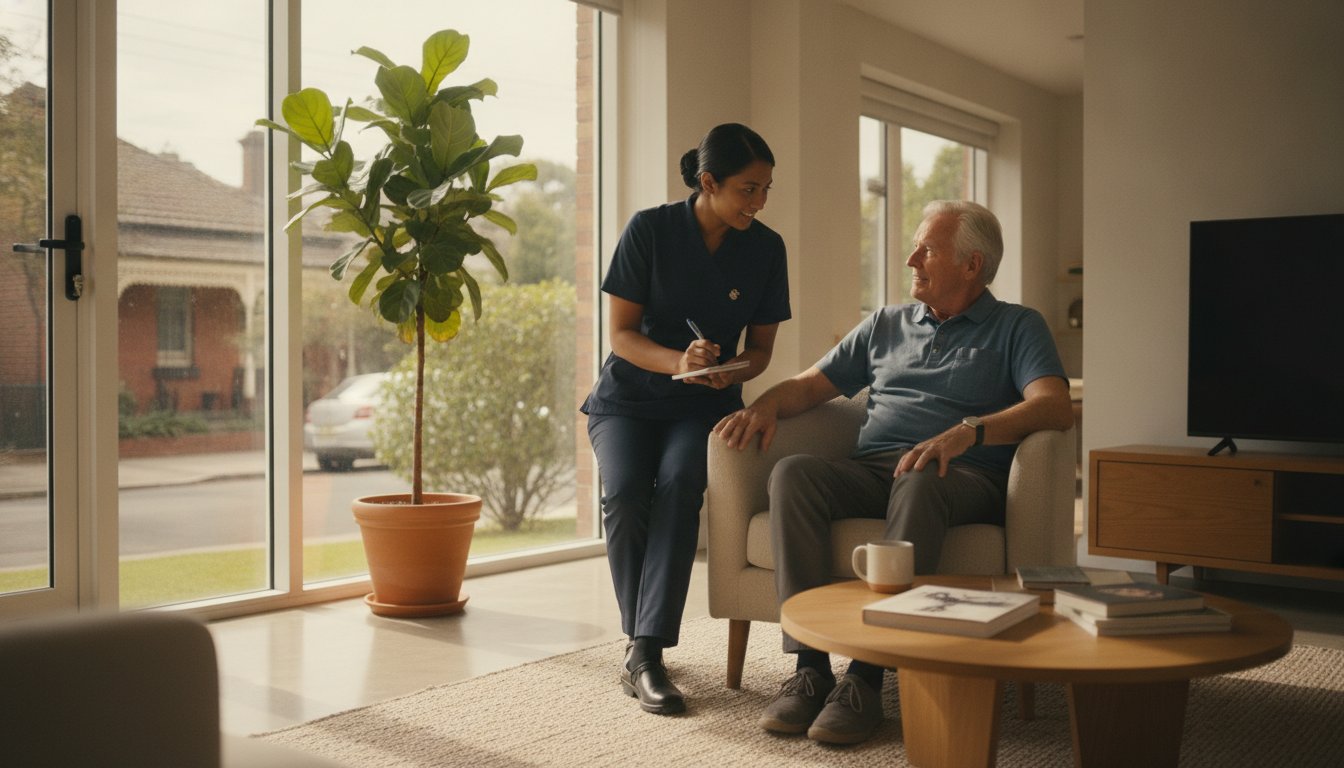
What if your home didn’t have to feel like a hospital ward just because you need clinical support? Choosing an ndis complex health care provider is one of the most significant decisions you’ll make for your family. It’s natural to feel a knot of anxiety about inviting clinical routines into your private sanctuary. You might worry that “High Intensity” labels mean losing the quiet dignity of your daily life or that your loved one’s autonomy will be overshadowed by medical checklists.
We understand that you’re looking for more than just technical skill; you’re looking for a team that truly listens. This guide will show you how to find a partner who balances rigorous clinical standards with a deep respect for your personal choices and self-direction. We’ll break down the 2026 NDIS requirements for complex care, provide a clear framework for interviewing potential teams, and help you build a care environment where clinical excellence and human connection go hand in hand. You deserve a partnership that prioritises your safety without ever compromising your dignity.
Key Takeaways
- Learn why “High Intensity” support requires specialized clinical knowledge and how to identify the specific expertise needed for your safety.
- Understand the essential role of Registered Nurses in supervising care plans to ensure medical safety while honouring your personal space.
- Use our practical framework to interview a potential ndis complex health care provider to ensure they value your autonomy and unique goals.
- Discover a gentle, step-by-step roadmap for transitioning clinical support into your home without disrupting your cherished daily routines.
- Explore how a multidisciplinary team creates a supportive bridge from hospital care toward true community independence and self-direction.
Understanding NDIS Complex Health Care: More Than Just Support
Stepping into the world of complex care is often a significant life transition for both participants and their families. It isn’t just about adding more hours to a support schedule; it’s about inviting a higher level of clinical expertise into your private life. We recognise that this shift can feel heavy. Whether you’re transitioning from a hospital stay or your health needs have evolved, the goal remains the same: ensuring you feel safe, heard, and respected in your own home. At its heart, complex care is specialized support that requires specific clinical knowledge to manage health risks effectively.
Within the National Disability Insurance Scheme (NDIS), this level of assistance is often categorized under High Intensity Daily Personal Activities. This terminology simply means that the support you need carries a higher level of risk and requires a more technical approach than standard daily help. However, even with these clinical requirements, you remain the expert on your own life. A quality ndis complex health care provider understands that while they bring the medical expertise, you bring the lived experience that guides every decision.
Standard Support vs. Complex Care: What is the Difference?
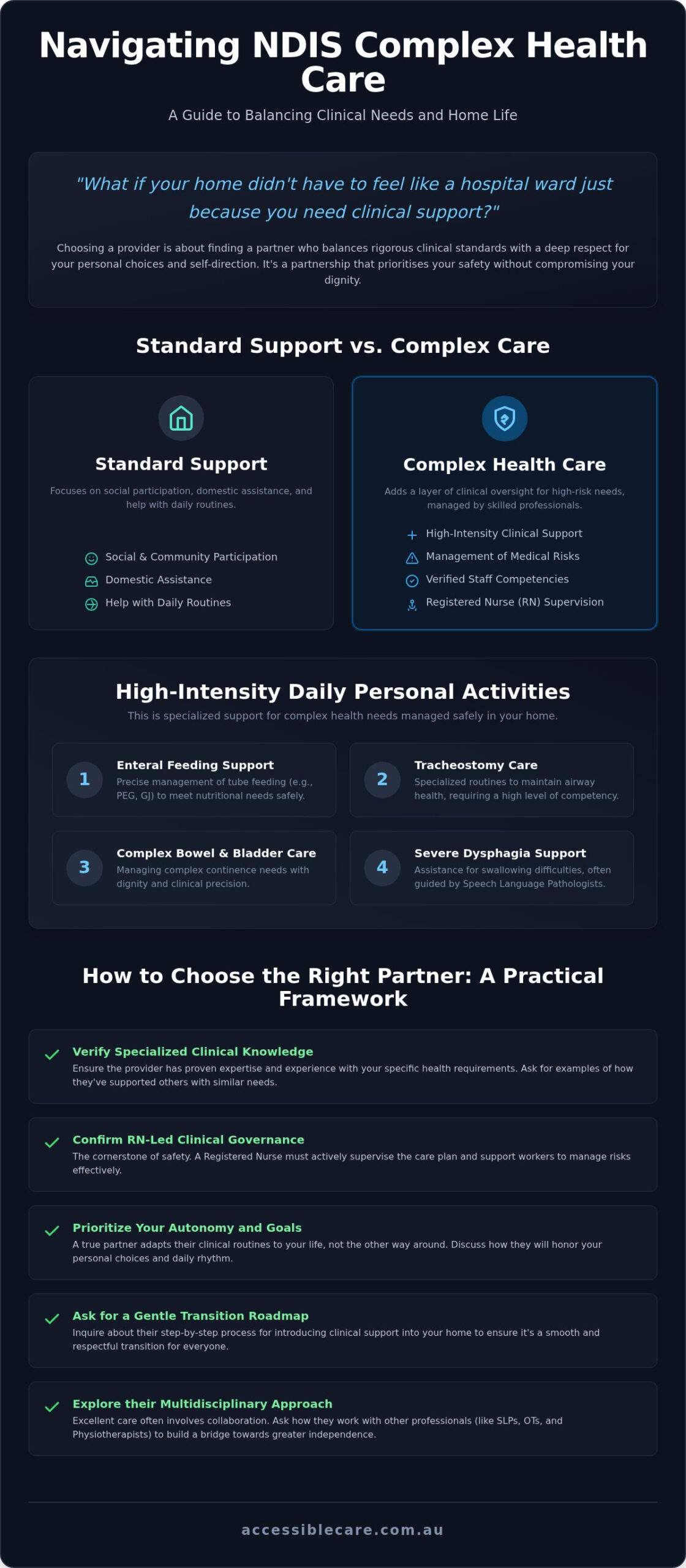
General disability support usually focuses on social participation, domestic assistance, and help with daily routines. Complex care adds a layer of clinical oversight to these activities. The NDIS Practice Standards for high-risk, high-intensity supports require providers to meet rigorous benchmarks for safety and quality. High Intensity Support is defined as care involving specific medical risks that require support workers to have verified competencies in clinical tasks. This might include help with complex bowel care, tracheostomy management, or enteral feeding. The difference lies in the level of training and the constant supervision of clinical professionals to ensure every procedure is performed safely.
The Emotional Journey of Families and Participants
It’s completely natural to feel a sense of anxiety about bringing clinical care into your sanctuary. You might worry that your home will begin to feel like a hospital ward or that your family’s natural rhythm will be lost to rigid medical routines. We want to reassure you that professional care should enhance your life, not diminish it. A compassionate ndis complex health care provider acts as a supportive partner rather than a detached contractor. By handling the complexities of clinical management, they give you the space to focus on your relationships and personal goals. When care is delivered with empathy, it protects your autonomy and allows your home to remain exactly what it should be: a place of comfort and connection.
High Intensity Daily Personal Activities: The Clinical Core
High intensity supports aren’t just a list of tasks. They’re the clinical backbone of a safe, fulfilling life at home. When you’re managing complex health needs, the medical side of things can feel like it’s taking over your living space. A dedicated ndis complex health care provider works to ensure that hospital-grade safety fits seamlessly into your daily rhythm. This isn’t about turning your home into a facility; it’s about providing the expert care you need to stay exactly where you belong.
The presence of a Registered Nurse (RN) is essential for maintaining clinical governance. They don’t just oversee a care plan; they actively protect your health by supervising the support workers who assist you every day. This layer of professional oversight ensures that risks are managed before they become emergencies. As highlighted by Inclusion Australia NDIS Advocacy, making the scheme work effectively for everyone requires a focus on both safety and the person’s right to live their life their way. Your clinical care must be adapted to your unique routine, ensuring that medical procedures never overshadow your personal autonomy.
Common Complex Health Needs Managed at Home
Enteral feeding, often referred to as tube feeding (such as PEG or GJ tubes), requires precise management to ensure nutritional needs are met safely. Similarly, tracheostomy care and complex bowel or bladder management involve specialized routines that demand high levels of competency from your support team. Severe dysphagia, or difficulty swallowing, is another area where clinical expertise is vital. In these cases, Speech Language Pathologists (SLPs) play a crucial role in assessing risks and creating safe mealtime plans. Each of these needs requires a high degree of technical skill, which is why a trusted ndis complex health care provider prioritises ongoing staff training and competency verification.
The Vital Role of Community Nursing
Community nursing brings professional medical care directly into the comfort of your home. These nurses act as the bridge between hospital settings and home-based independence. They coordinate closely with support workers, providing the training and guidance needed to maintain a consistently high standard of care. This collaborative approach means that even the most technical health requirements are handled with a gentle, person-centric touch. You can learn more about how this works through our Community Nursing pillar. If you’re feeling overwhelmed by these requirements, our team is here to help you find the right path forward with confidence and peace of mind.
Evaluating an NDIS Complex Care Provider: Key Benchmarks
Finding the right ndis complex health care provider requires looking beyond a simple list of services. You need to know that the team entering your home is both technically competent and deeply respectful of your personal space. Assessing a provider’s clinical benchmarks gives you the confidence that your care is in safe, capable hands. This evaluation process isn’t just about medical qualifications; it’s about finding a partner who values your autonomy as much as your safety.
Clinical Governance and Staff Training
A reliable provider must have a clear framework for clinical governance. When you’re interviewing potential teams, ask how they ensure support workers are trained for your specific complex tasks. It isn’t enough to have general experience. You should look for evidence of Registered Nurse oversight in every aspect of high-intensity support delivery. A nurse should be responsible for assessing staff competency and regularly reviewing your clinical care plan. We also suggest looking for providers who prioritise “attentive listening” during your initial assessment. This signature promise ensures that the clinical routines developed are tailored to your life, rather than forcing your life to fit a clinical routine.
The Value of a Multidisciplinary Approach
Complex care rarely exists in a vacuum. A multidisciplinary team provides a holistic safety net that single-service providers often can’t match. For instance, Speech Pathology is vital for participants with severe dysphagia, providing essential swallowing support and communication strategies. Occupational Therapy plays a critical role in adapting your home environment for complex medical equipment, ensuring safety doesn’t come at the cost of comfort. When these specialists work alongside Community Nursing and Positive Behaviour Support, the result is a unified care model. This collaboration ensures that your physical health, emotional well-being, and environmental needs are all addressed with equal importance.
Transparent communication is the final benchmark of a quality partnership. You should expect regular care plan reviews and an open line of communication with your clinical lead. Your health needs may change over time, and your provider must be agile enough to adapt. A provider who welcomes your feedback and involves you in every decision is one that truly respects your self-direction. By choosing a team that meets these high standards, you ensure that your home remains a place of both expert care and personal dignity.
Navigating the Transition to Complex Care at Home
Moving from a clinical setting back to your own home is a moment of both relief and adjustment. It marks a shift from being a patient to being a person in charge of their own environment again. Choosing the right ndis complex health care provider is the first step in making this transition smooth and safe. This process begins with a Functional Capacity Assessment. This assessment isn’t just a formality; it’s a comprehensive look at how clinical supports can best serve your daily life. It ensures your funding matches your actual needs, allowing you to focus on regaining your independence rather than just managing a condition. The ultimate goal of complex care is to empower you to live fully, ensuring that medical requirements support your life rather than defining it.
Preparing Your Home Environment
Setting up your home for high-intensity support requires thoughtful planning. You’ll need to identify dedicated spaces for medical supplies and potentially bulky equipment. This is where professional guidance becomes invaluable. An Occupational Therapist (OT) can assess your home and recommend specific assistive technology or modifications to keep you safe. Their expertise ensures that your living space remains functional and comfortable, even with the addition of clinical tools. For a deeper look at how this process works, you can read our guide on What is Occupational Therapy? to see how we help you reclaim your space.
Creating a Person-Centered Care Plan
A truly effective care plan looks beyond medical checklists. It should be a living document that prioritises your personal goals and aspirations. Whether you want to attend more community events or simply enjoy a quiet meal with family, these objectives drive the clinical routine. We follow a philosophy built on a three-part promise of personal agency: honor, autonomy, and self-determination. We encourage you to lead the conversation during the goal-setting phase. By being the primary voice in your care planning, you ensure that every support worker and nurse understands what matters most to you. When the participant leads, the care becomes a bridge to a better quality of life.
Transitioning to home-based care can feel like a daunting task, but you don’t have to navigate it alone. If you’re ready to start planning your move, contact our team for transition support today. We’re here to listen, guide, and help you build a care model that truly honours your life and your future.
Empowering Your Independence with Accessible Care
Accessible Care isn’t just another service agency; we’re a team dedicated to the belief that every participant deserves high-quality clinical support that feels human. As a registered ndis complex health care provider, we specialise in bridging the gap between hospital-level safety and the comfort of home. Our focus is on providing solutions that offer peace of mind, especially for those navigating the challenges of an Acquired Brain Injury or requiring complex nursing. We don’t just see a medical diagnosis. We see a person with goals, dreams, and a right to a fulfilling life. Our commitment is to provide the clinical excellence you need while protecting the quiet dignity of your daily routine.
Our Presence in Melbourne and Adelaide
We’ve rooted our services deeply in the communities of Melbourne and Adelaide. Being a local provider means our therapists and nurses aren’t just names on a screen; they’re professionals who live and work near you. This regional coverage allows us to be far more responsive when your needs change. Whether it’s a routine check-in or more urgent support, our local presence ensures help is never far away. We offer in-home assessments throughout Victoria and South Australia, meeting you where you’re most comfortable to begin our partnership. This local touch ensures that your care team understands the specific community resources available to you, making your journey toward independence feel truly supported and connected.
Our Commitment to Your Autonomy
At Accessible Care, we pride ourselves on being a trustworthy, nurturing, and reliable caregiver. We understand that clinical expertise is only half of the equation. The other half is genuine human connection. Our team is trained to practice attentive listening, ensuring your perspective is always the priority in every care decision. We believe in the foundational values of honor, autonomy, and self-determination. By choosing us, you aren’t just getting medical assistance; you’re gaining a partner who respects your expertise on your own life. We’re here to facilitate your objectives, not to direct them. We believe that when care is delivered with respect, it empowers you to reach your full potential.
Every journey starts with a single conversation. We invite you to reach out for a low-pressure discussion about your unique needs and how we can support your goals. Our coordinators are here to listen without judgment and provide clear pathways forward. Speak with a compassionate care coordinator at Accessible Care today to discover how we can help you thrive in the comfort of your own home.
Building Your Future with Confidence and Care
Choosing an ndis complex health care provider is a deeply personal decision that shapes the rhythm of your daily life. It’s about more than just checking clinical boxes; it’s about finding a team that honors your autonomy while providing the technical expertise needed for high-intensity support. We’ve explored how a multidisciplinary approach, including nursing, occupational therapy, and speech pathology, protects your safety at home while ensuring your dignity remains the priority. Clinical routines should never overshadow the warmth of your home or the strength of your family connections.
As a Registered NDIS Provider with a specialised multidisciplinary clinical team, Accessible Care is proud to serve the Melbourne and Adelaide communities. We bridge the gap between technical medical requirements and genuine human connection. You deserve a partner who prioritises your voice and your goals above all else. Partner with a provider who listens. Contact Accessible Care for a compassionate consultation.
Your journey toward independence is a path we’re honored to walk beside you. You don’t have to navigate these technical complexities alone. With the right support, your home can remain a place of comfort, connection, and true self-direction. We’re here to help you thrive.
Frequently Asked Questions
How do I know if I am eligible for NDIS complex health care funding?
Eligibility is determined by the NDIS based on whether you require specialised, health-related assistance to live safely. This usually falls under High Intensity Daily Personal Activities. You’ll need documentation from your doctor or therapists to prove that your supports require clinical oversight. As a registered ndis complex health care provider, we can guide you through the assessment process to ensure your plan accurately reflects your specific medical and personal requirements.
Do I need a Registered Nurse for my high-intensity supports at home?
A Registered Nurse (RN) plays a vital role in clinical governance for high-intensity supports. While support workers assist with daily routines, an RN must supervise the care plan and verify staff competency in technical tasks. This oversight protects your safety and ensures that procedures like tracheostomy care or enteral feeding are performed correctly. Our nursing team provides this essential bridge between hospital-grade safety and the comfort of your own home environment.
Can an NDIS complex care provider help with hospital-to-home transitions?
Transitioning from hospital to home in Melbourne or Adelaide is a core specialty of our team. As an ndis complex health care provider, we coordinate with discharge planners to ensure your home is prepared with the necessary protocols and trained staff. This process includes setting up care schedules and conducting initial assessments before you arrive. Our goal is to make the move gentle, allowing you to regain your independence in a familiar space.
What happens if my care needs change over time?
We understand that health is not static, so your care plan is designed to be flexible. If your needs change, we conduct new assessments and work with the NDIS to adjust your funding and support levels. This might involve increasing nursing hours or introducing new therapeutic supports like occupational therapy. We maintain an open, honest dialogue with you and your family to ensure your support always matches your current reality and goals.
How does Accessible Care ensure the quality of its support workers?
We ensure quality in our local teams through a strict competency-based framework overseen by our experienced clinical nurses. Every support worker undergoes specific training tailored to the participant’s unique health requirements. Beyond technical skills, we prioritise “attentive listening” and empathy during our recruitment process. This ensures that the people entering your sanctuary are not just competent professionals, but nurturing caregivers who respect your autonomy and your family’s personal space.
Is Positive Behaviour Support included in complex health care plans?
Positive Behaviour Support is frequently integrated into complex care plans to provide a truly holistic approach. It focuses on understanding the reasons behind challenging behaviours and developing strategies that improve your quality of life. By combining clinical nursing with PBS, we address both your physical health and your emotional well-being. This collaborative model helps reduce stress for both participants and their families, creating a more stable and supportive home environment.
What is the role of a Speech Pathologist in complex care?
Speech Pathologists are essential for managing risks related to swallowing (dysphagia) and communication. In a complex care setting, they conduct mealtime assessments and develop safe eating plans to prevent complications like aspiration. They also work with individuals to rebuild language skills after a neurological event or brain injury. Their expertise ensures that you can communicate your needs effectively and enjoy daily activities like eating with safety and confidence.
Can I choose my own support workers for high-intensity daily activities?
Your right to choose your own support team is a fundamental part of self-direction. We encourage you to be involved in the selection process to ensure a good personality match. Once you’ve chosen someone you feel comfortable with, we provide them with the specific clinical training required for your high-intensity activities. This balance of personal choice and professional training ensures that your care is both safe and respectful of your preferences.

