


What if your primary support worker or essential therapist was suddenly unavailable tomorrow morning? For many families in Melbourne and Adelaide, this question isn’t just a hypothetical; it’s a source of deep anxiety that can make the future feel uncertain. You’ve worked hard to build a life of independence, and the thought of that being disrupted by an unexpected emergency is understandably frightening. It’s natural to feel overwhelmed by complex terminology or worry that your specific needs might be overlooked during a disaster.
The good news is that developing a crisis management plan ndis doesn’t have to be a clinical or cold exercise. It’s actually a powerful act of self-determination. By creating a clear roadmap for the unexpected, you’re making a promise to yourself that your care remains uninterrupted and your voice remains heard. This guide provides a compassionate, step-by-step approach to building a robust emergency plan for 2026. We will explore how to coordinate with your community nursing team, document your specific preferences, and ensure your peace of mind is protected through every challenge life may bring.
Key Takeaways
- Learn why a modern crisis plan is a proactive strategy for your safety, moving beyond a simple list of phone numbers to ensure true continuity of care.
- Discover how developing a crisis management plan ndis using the P-CEP framework allows you to tailor emergency responses to your specific needs and personal strengths.
- Find out how to map your essential supports, ensuring vital services like community nursing and therapy remain uninterrupted during life’s unexpected challenges.
- Gain a clear, step-by-step process for gathering your support team and drafting a document that’s easy to follow, even in high-stress situations.
- Explore the benefits of co-designing your plan with experienced partners who specialize in high-intensity clinical oversight and positive behaviour support.
Understanding the Importance of an NDIS Crisis Management Plan
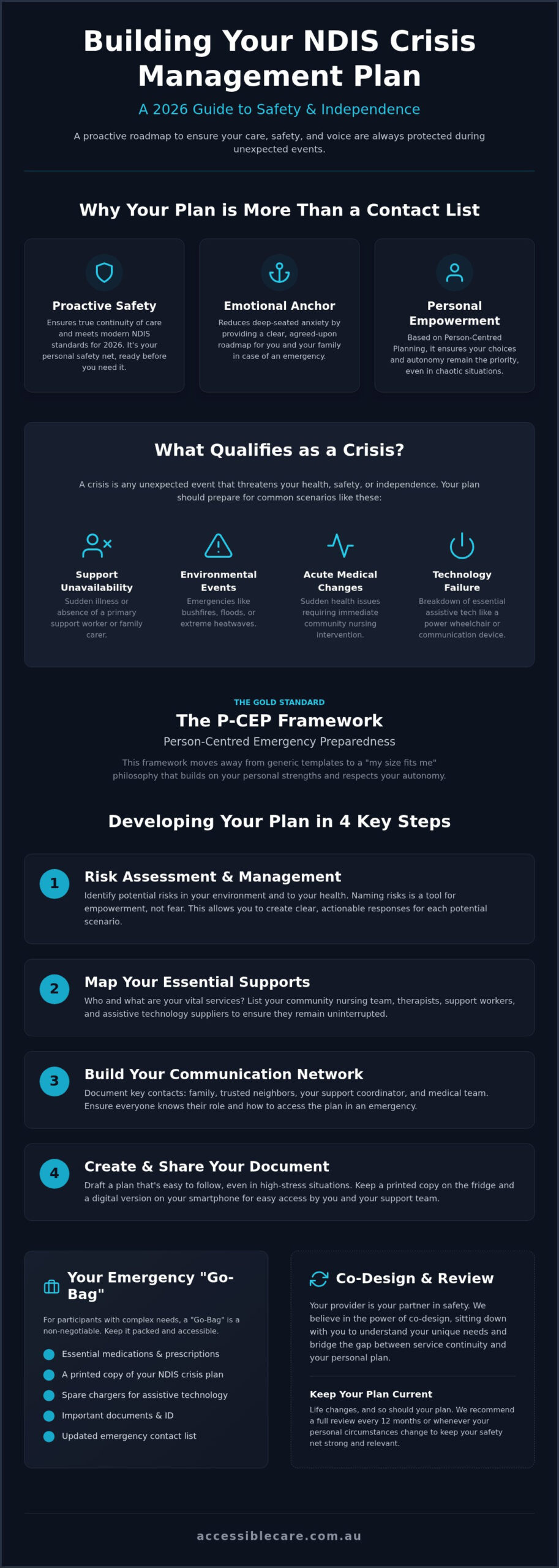
An NDIS crisis management plan is far more than a document tucked away in a drawer. It’s a proactive strategy designed to protect your safety and ensure your essential supports never skip a beat. In 2026, the NDIS Quality and Safeguards Commission has raised the bar. A simple list of emergency contacts is no longer enough to meet modern standards. Instead, we focus on a comprehensive approach that looks at your whole life, from your daily routines to your long-term goals.
Developing a crisis management plan ndis provides a profound emotional anchor. When you and your family know exactly what happens if a support worker is unwell or a storm hits, that deep-seated anxiety begins to lift. This process is rooted in Person-Centred Planning, which ensures that even in the middle of a chaotic event, your choices and autonomy remain the priority. You aren’t just a passive recipient of care; you’re the architect of your own safety net.
What Qualifies as a Crisis in the NDIS Context?
A crisis is any unexpected event that threatens your health, safety, or independence. In our experience supporting families across Melbourne and Adelaide, we see several common scenarios that require a clear response. These include:
- The sudden illness or absence of a primary family carer or support worker.
- Environmental emergencies, such as bushfires in South Australia or flash flooding in Victoria.
- Acute medical changes that require immediate community nursing intervention.
- The failure of essential assistive technology, like a power wheelchair or communication device.
The Role of Your Provider in Crisis Planning
At Accessible Care, we believe in the power of co-design. We don’t just hand you a template; we sit down with you to understand your unique needs. There’s a vital distinction between a provider’s service continuity plan, which covers how we keep our business running, and your personal crisis plan, which covers how your specific life is supported. We help bridge that gap by acting as a steady partner.
Whether you’re managing complex needs through high intensity supports NDIS or maintaining progress in speech therapy, we ensure those services are protected. We recommend reviewing these plans every twelve months or whenever your circumstances change. This keeps your safety net strong and relevant to your current life in Melbourne or Adelaide.
Core Components of a Person-Centred Emergency Preparedness (P-CEP) Plan
The P-CEP framework is the gold standard for developing a crisis management plan ndis because it moves away from generic templates. It embraces a “my size fits me” philosophy. This approach recognizes that every participant has unique strengths and specific requirements. Instead of focusing solely on what you can’t do, we start with your personal capabilities. Can you navigate your home independently? Do you have a way to alert neighbors? Identifying these strengths allows us to build a plan that respects your autonomy while filling the gaps where you need support most.
Practicality is just as vital as the framework itself. Your plan must be visible. We suggest keeping a printed copy on your fridge and a digital version easily accessible on your smartphone. For participants with complex needs, a “Go-Bag” is a non-negotiable component. This bag should contain essential medication, spare chargers for assistive technology, and a copy of your plan. Ensuring continuity of care during a crisis starts with a plan that is visible and understood by those around you. Our team at Accessible Care can help you document these strengths today.
Step 1: Risk Assessment and Management
Effective planning requires an honest look at your environment. In Melbourne, this might mean preparing for flash flooding or extreme heatwaves. For our friends in Adelaide, bushfire readiness is often a top priority. We also look at health risks, such as what happens if a respiratory condition flares up and requires immediate nursing intervention. Risk assessment is a tool for empowerment, not fear. By naming these risks, we take away their power to surprise us, allowing us to create clear, actionable responses for each scenario.
Step 2: Communication and Support Networks
No one should face a crisis alone. Building a “Circle of Support” involves mapping out everyone from family and friends to your GP and NDIS Coordinator. If you usually rely on high-tech AAC devices or specific speech tools, your plan must include alternative communication methods, like printed picture boards or basic hand signals. Reaching out to your disability support services Melbourne team ensures everyone is on the same page. Clear communication ensures that even if you can’t speak for yourself in a moment of panic, your needs and preferences are clearly understood by emergency responders.
Mapping Your Essential Supports: Continuity of Care During a Crisis
When you’re developing a crisis management plan ndis, it’s helpful to view your supports through the lens of necessity. Not every service needs to happen during a storm or a sudden carer absence. Critical supports are the non-negotiables: the nursing care, essential personal hygiene, and medication management that keep you safe. Non-essential supports are those that can wait a few days until the situation stabilizes. Distinguishing between the two helps you and your family stay focused during high-pressure moments.
Your progress in speech pathology or the independence you’ve gained through occupational therapy shouldn’t be lost during a disruption. In 2026, NDIS funding rules offer specific flexibilities for emergency support items. This might include short-term equipment hire or additional support hours to help you adapt to a temporary living environment. By identifying these needs early, you ensure your therapeutic goals remain a priority, even when life feels unpredictable.
Maintaining Therapeutic Momentum
Telehealth is a fantastic tool for keeping your therapy goals on track when physical visits aren’t possible. It ensures that your speech and OT progress continues without a break. We also ensure that every member of your support team is trained in your Positive Behaviour Support plan. This consistency helps reduce the emotional toll of a crisis by using familiar de-escalation strategies. A multidisciplinary team approach ensures that every professional involved in your care is aligned, providing a seamless safety net when you need it most.
High Intensity and Nursing Continuity
If you require high-intensity clinical support, community nursing must remain a constant. Your plan should outline how complex medication schedules or clinical tasks will be managed if you’re displaced from your home in Melbourne or Adelaide. Always keep a current Functional Capacity Assessment in your crisis folder. This document is a vital piece of the puzzle when developing a crisis management plan ndis, as it provides emergency services with a clear picture of your clinical and functional requirements, ensuring your dignity and health are protected.
Step-by-Step: Developing Your NDIS Emergency Management Plan in 2026
The process of developing a crisis management plan ndis is most effective when it’s treated as a collaborative conversation rather than a paperwork task. Start by gathering your trusted team. This might include family members, your primary support workers, and clinical professionals like your community nurse or occupational therapist. By sitting at the table together, you ensure that every perspective is considered. This collective wisdom helps identify blind spots and ensures the plan is grounded in the reality of your daily life and personal goals.
When you begin drafting, use simple, direct language. In a moment of high stress, complex instructions can become difficult to follow. Focus on “panic-proof” phrasing. Use bullet points and clear headings that anyone can understand quickly. Once the draft is ready, rehearsal is the next vital step. A plan is only truly a plan if you know it works under pressure. Practicing your response to a power outage or a sudden carer absence builds confidence for everyone involved. Remember that your life is dynamic. Review and update your plan every twelve months or after any significant change in your health or living situation.
Local Resources for Melbourne and Adelaide Residents
Living in Melbourne or Adelaide means preparing for specific environmental challenges. We recommend all participants register with the VicEmergency app or the South Australian State Emergency Service (SES) to receive real-time alerts. It’s also wise to contact your local council to inquire about “Vulnerable Persons Registers.” These registers help emergency services prioritize those who may need extra assistance during an evacuation. Connecting with local NDIS community hubs can also provide regional-specific advice tailored to your suburb, ensuring you’re linked into the local safety network.
The Crisis Communication Checklist
Communication is the bridge to safety during an emergency. We suggest following the “15-minute rule.” Within fifteen minutes of a crisis occurring, your primary circle of support should be notified according to a pre-set list. Your plan is your voice when you are under stress. It should clearly state your communication preferences and any high-intensity needs to first responders who may not know you. Having this information ready prevents misunderstandings and ensures you are treated with the respect and autonomy you deserve. If you’re ready to begin this journey, contact our team at Accessible Care to co-design a safety net that truly reflects your needs.
How Accessible Care Supports Your Safety and Independence
Choosing a partner for developing a crisis management plan ndis is a significant decision for your family. At Accessible Care, we don’t believe in one-size-fits-all solutions or clinical templates that ignore your personal story. We take a compassionate, co-design approach to every safety strategy we build. This means we sit with you, listen to your concerns, and honor your goals as the foundation of your plan. By combining your personal insights with our professional expertise, we create a roadmap that ensures your supports remain stable, no matter what 2026 brings.
Our team is uniquely equipped to handle the complexities of high intensity supports NDIS. We provide the clinical oversight required for complex nursing care and high-needs support work. Additionally, our specialized focus on acquired brain injury allows us to support participants through cognitive or behavioral crises with grace and skill. We understand that a crisis isn’t just a physical event; it’s an emotional one too. Our specialists are trained to provide de-escalation and support that prioritizes dignity and calm.
The Accessible Care Difference: Listening First
Listening is the first step in developing a crisis management plan ndis that actually works for you. We believe that your autonomy is the most important part of any safety strategy. We don’t take control; we facilitate your independence. This commitment to self-determination is why we prioritize your voice in every meeting and every document. We provide consistent, high-quality ndis high intensity supports throughout Melbourne and Adelaide. Our intake team is ready to hear your story and help you secure your future. You can reach us directly through our website to schedule a time that suits your family.
A Partner in Every Situation
Our relationship with you doesn’t end when the plan is written. We are your partner in every situation, from your daily morning routine to an unexpected emergency response. We build long-term trust by showing up, listening well, and providing professional care that feels personal. Our multidisciplinary team of nurses, therapists, and support workers is dedicated to your quality of life. We are here to ensure you never have to face the unknown alone. Contact us today to begin developing your compassionate crisis plan and take the first step toward true peace of mind.
Securing Your Future with Confidence and Care
A crisis plan is more than a safety net; it’s a promise to yourself that your independence will always be protected. By mapping out your essential supports and identifying your personal strengths, you’ve taken a vital step toward a more secure future. Remember that developing a crisis management plan ndis is an ongoing journey that evolves as your life does. Whether you’re in Melbourne or Adelaide, having a clear, actionable document ensures that your voice remains heard, even during life’s most unpredictable moments.
As a registered NDIS provider in VIC and SA, our expert multidisciplinary team is here to walk alongside you. We specialize in high-intensity care and clinical oversight, always placing your autonomy and self-direction at the heart of our work. You don’t have to navigate these complexities alone. Start your journey toward peace of mind with Accessible Care and let’s co-design a plan that honors your unique goals. You deserve the comfort of knowing that your care is as resilient as you are.
Frequently Asked Questions
Is an NDIS crisis management plan mandatory for all participants?
No, it isn’t legally mandatory for participants to have one, but it’s a vital tool for your safety and continuity of care. The NDIS Quality and Safeguards Commission requires registered providers to have emergency management plans in place. Having your own personalized plan ensures that your specific choices and autonomy are respected during a disruption. It’s a proactive way to protect your independence and peace of mind in 2026.
Can I use my NDIS funding to pay someone to help me develop a crisis plan?
Yes, you can use your NDIS funding to get professional help with developing a crisis management plan ndis. Support Coordinators often assist with this as part of their service. Additionally, your Occupational Therapist or Speech Pathologist can use their clinical hours to help co-design a plan that addresses your specific functional needs. This ensures your safety net is built by experts who understand your unique situation and clinical requirements.
What should I do if my primary NDIS support worker doesn’t show up?
Your first step should be to follow the “Who to Call First” section of your crisis plan. Contact your provider’s office immediately to report the absence and request a replacement worker. If they cannot provide someone quickly, reach out to your “Circle of Support,” such as family or friends listed in your plan. Having a pre-arranged backup strategy prevents panic and ensures your essential daily routines remain supported without significant interruption.
How often should I review my emergency management plan?
We recommend reviewing your emergency management plan at least once every twelve months. However, you should also update it whenever a significant life change occurs. This includes moving to a new home in Melbourne or Adelaide, a change in your health status, or if you start using new assistive technology. Regular reviews ensure that your contact lists, medical information, and support strategies remain accurate and ready for use at any moment.
What is the difference between a disaster plan and a crisis management plan?
A disaster plan focuses on external events like bushfires or floods that affect the wider community. In contrast, a crisis management plan is more personal; it addresses individual disruptions such as the sudden loss of a carer, equipment failure, or a medical emergency. While a disaster plan helps you evacuate safely, a crisis plan ensures your specific NDIS supports continue smoothly even if your personal circumstances change unexpectedly. Both are essential for holistic safety.
Does the NDIS provide extra funding during a declared state of emergency?
During a declared state of emergency, the NDIA often introduces temporary flexibilities rather than automatic extra funding. This might include allowing you to use your core budget more flexibly to purchase emergency supplies or extra support hours. It’s important to stay in touch with your Support Coordinator or provider during these times. They can help you understand the current 2026 guidelines and ensure you’re utilizing your plan effectively to stay safe.
How do I ensure emergency services know about my specific disability needs?
You can ensure emergency services are informed by registering with “Vulnerable Persons Registers” through your local council in Melbourne or Adelaide. Additionally, keep a printed copy of your crisis plan in a visible spot, like your fridge. Your plan should include a clear summary of your communication needs, medical requirements, and mobility challenges. This allows first responders to provide respectful, person-centred assistance that honors your dignity even in high-pressure situations.
Can my Speech Pathologist or OT help with my crisis plan?
Absolutely, your multidisciplinary team is essential for developing a crisis management plan ndis. Your Speech Pathologist can help create alternative communication strategies if your usual tools fail. Your Occupational Therapist can assess how to modify your environment for temporary crisis living or identify essential assistive technology backups. Their clinical expertise ensures that your plan isn’t just a list of names, but a robust strategy that addresses your functional and therapeutic needs.

