


What if the goal of therapy wasn’t to change who you are, but to give you the tools to express your truest self? For many families and individuals, the search for a speech pathologist for autism adelaide is often clouded by fears of rigid, “compliance-based” methods that don’t respect neurodivergent identities. You want more than just a clinical provider; you’re looking for a partner who understands that communication is about connection, not just following rules.
We know how overwhelming it feels to juggle NDIS budgets while sitting on endless waitlists. You deserve a clear path forward that feels supportive rather than stressful. In this article, you’ll discover how to identify neuro-affirming practitioners who prioritize autonomy and self-determination across every life stage. We’ll look at navigating NDIS funding for speech therapy, integrating support with other services like Occupational Therapy, and finding a team that truly listens to your unique needs.
Key Takeaways
- Understand why modern communication support focuses on building meaningful social connections and functional skills rather than just verbal speech.
- Learn how to identify a qualified speech pathologist for autism adelaide by prioritizing “Certified Practicing Speech Pathologist” (CPSP) status and a neuro-affirming philosophy.
- Discover how therapy needs evolve across life stages, from play-based support for children to autonomy-focused strategies for Autistic adults.
- Gain confidence in navigating the NDIS by understanding which budget categories cover therapy and how a Functional Capacity Assessment helps secure your funding.
- Explore the benefits of a multidisciplinary approach where speech therapy, OT, and positive behaviour support work together to honour your personal goals.
The Role of a Speech Pathologist for Autism: Beyond Just Speaking
Many people think speech therapy is only about teaching a child to say their first words or correcting a lisp. While verbal speech is one way we communicate, it’s certainly not the only way. A compassionate The Role of a Speech Pathologist for Autism involves looking at the whole person and their unique way of interacting with the world. For an Autistic individual, communication is the bridge to autonomy, self-expression, and meaningful connection.
A common misconception is that speech therapy is only for “late talkers.” In reality, finding a speech pathologist for autism adelaide who understands neurodiversity means choosing a professional who values how you communicate, whether through words, signs, gestures, or assistive technology. This approach moves away from “fixing” a person and instead focuses on building a supportive environment where their voice is heard and respected.
Understanding Functional Communication
Functional communication is the ability to express needs and thoughts effectively in daily life. It’s the foundation of independence. Many Autistic individuals face “hidden” communication challenges, such as interpreting subtle social cues or managing the sensory load of a busy conversation. A neuro-affirming approach doesn’t try to “mask” these traits; instead, it provides practical strategies to bridge the gap between the individual and their environment. When a person can express their feelings and requirements clearly, frustration and anxiety often decrease, leading to a much higher quality of life.
The Impact of Speech Pathology on Daily Life
The skills built in therapy sessions aren’t meant to stay within the four walls of a clinic. They’re designed to flourish in schools, workplaces, and local community spaces. Working with a speech pathologist for autism adelaide who uses a person-centric lens helps individuals develop strong self-advocacy skills. This might involve learning how to ask for sensory accommodations at work or explaining a preferred communication style to a new group of friends.
Self-advocacy is a vital part of long-term success and wellbeing. For a deeper look at how these clinical supports integrate into a holistic care plan, you can explore our Speech Pathology Pillar. By focusing on autonomy and mutual regard, therapy becomes a powerful tool for empowerment rather than just a series of tasks to be completed. It’s about ensuring every individual has the agency to direct their own life and share their perspective with the world.
Choosing the Best Speech Pathologist in Adelaide for Your Needs
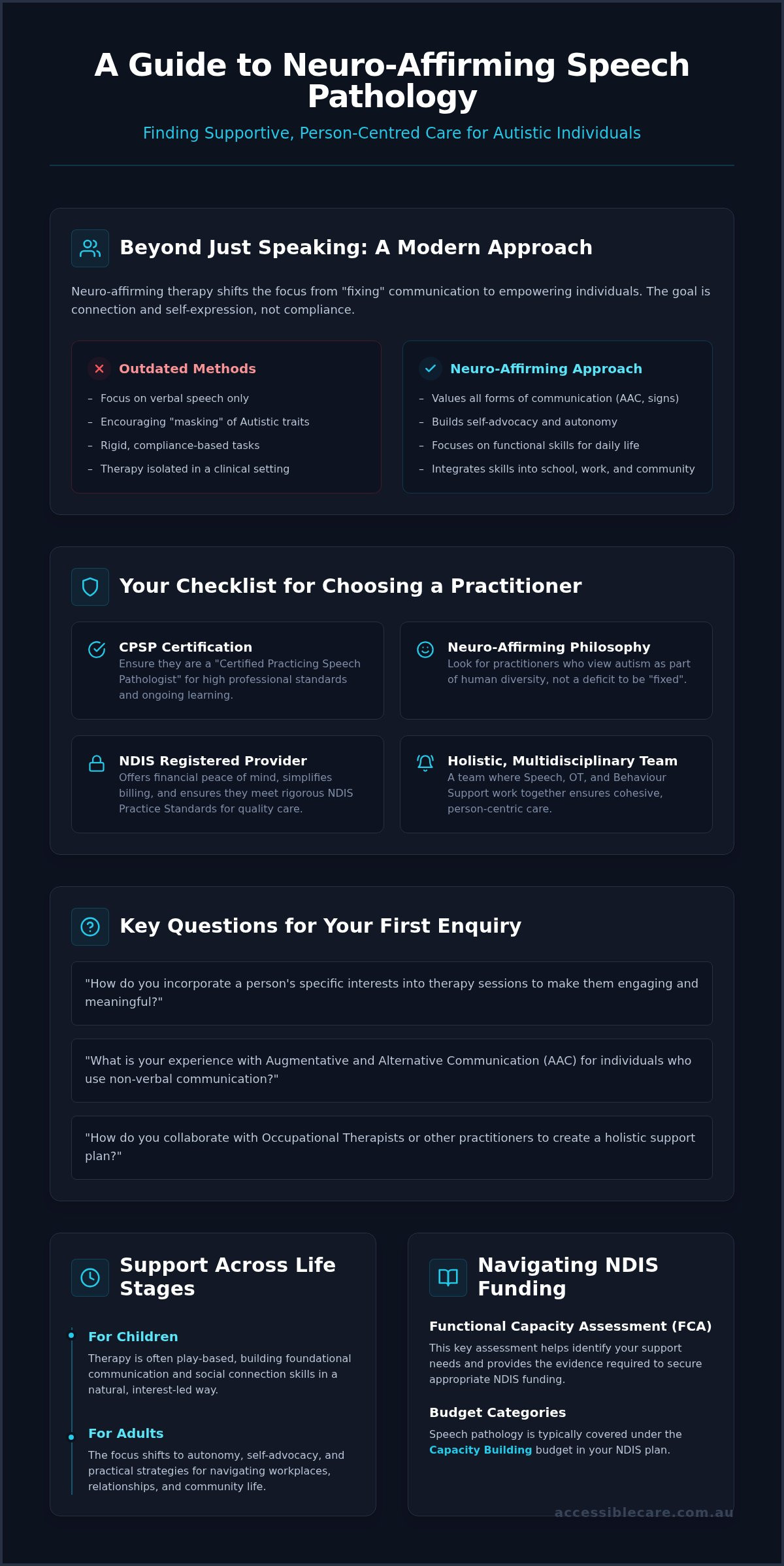
Finding the right fit for your therapy journey is a deeply personal process. You aren’t just looking for a clinician; you’re looking for a supportive partner who respects your family’s values and unique perspective. A non-negotiable first step is ensuring your therapist holds “Certified Practicing Speech Pathologist” (CPSP) status. This credential ensures they meet high professional standards and engage in ongoing learning. When Choosing the Best Speech Pathologist in Adelaide, look for a provider that identifies as neuro-affirming. This means they view autism as a natural part of human diversity rather than something to “fix” through compliance-based training.
Choosing an NDIS registered provider offers significant financial peace of mind and safety. These providers undergo rigorous audits to ensure they meet the NDIS Practice Standards, giving you confidence in the quality of care. It also simplifies the billing process and ensures your funding is used effectively. Finding a speech pathologist for autism adelaide who is part of a multidisciplinary team can make your journey much smoother. When therapists work together, your care feels cohesive rather than fragmented.
Questions to Ask During Your First Enquiry
Your first conversation with a potential provider is the perfect time to see if your values align. Don’t be afraid to ask direct questions. A compassionate team will welcome your curiosity and take the time to listen to your concerns. Consider asking:
- “How do you incorporate my child’s specific interests, like trains or space, into our sessions?”
- “What is your experience with AAC or other alternative communication methods for those who don’t use verbal speech?”
- “Do you offer multidisciplinary support with Occupational Therapists or behaviour practitioners to ensure a holistic approach?”
Location and Accessibility in Adelaide
Adelaide offers a mix of clinic-based and community-based therapy. Think about what works best for your daily rhythm. Clinic sessions provide a dedicated, quiet space with specialized tools. Community-based therapy happens where life actually occurs, such as at home, school, or the local park. This helps skills transfer naturally to real-world situations. It’s also helpful to find a provider who understands the local Adelaide NDIS landscape and can offer clear timelines regarding waitlists.
Waitlists can be a source of stress, but a reliable provider will be transparent about their capacity. If you’re feeling overwhelmed by the options, reaching out for a gentle conversation can help clarify the next steps for your family. We’re here to help you find a path that feels right for you.
Neuro-Affirming Therapy: Support for Children and Adults
Every stage of life brings new opportunities for growth and connection. A “one size fits all” approach never works for autism because every person’s brain is wired differently. Finding a speech pathologist for autism adelaide who recognizes this means you receive care that evolves alongside you. Whether it’s a child discovering the joy of play or an adult navigating the complexities of the workplace, therapy should always honor the individual’s pace and personal preferences.
Communication isn’t a static skill learned once in childhood. It’s a dynamic process that changes as our environments do. By moving away from rigid, clinical milestones, we focus on what actually matters to the person. This ensures that therapy feels like a supportive partnership rather than a series of chores. It’s about giving you or your loved one the agency to direct their own life and express their unique perspective with confidence.
Paediatric Support: Helping Children Shine
For our youngest clients, therapy is often disguised as play. Early intervention isn’t about making a child “act more typical.” Instead, it focuses on building essential pre-linguistic skills like joint attention, turn-taking, and shared engagement. These are the building blocks of all future communication. We often find that kids thrive most when their supports are integrated. For example, our team works closely across disciplines, ensuring that Occupational Therapy and speech pathology complement each other to support a child’s sensory and communication needs simultaneously.
Adult Speech Pathology: Honoring Autonomy
Many providers stop their support once a person finishes school, but communication needs don’t vanish at eighteen. Adult speech pathology focuses on the individual’s own goals rather than external milestones. This might involve refining executive functioning skills to manage a busy work schedule or building confidence in social environments. We prioritize social autonomy, helping adults build meaningful relationships on their own terms. By focusing on self-determination, a speech pathologist for autism adelaide helps adults navigate a world that isn’t always designed for neurodiversity.
Augmentative and Alternative Communication (AAC)
For those who don’t use verbal speech, Augmentative and Alternative Communication (AAC) provides a vital voice. AAC includes everything from high-tech tablets with specialized software to low-tech boards and gesture systems. It’s never a “last resort.” Instead, it’s a powerful tool that reduces frustration and fosters deep connection. Our goal is to ensure the Adelaide community is accessible to everyone, regardless of how they choose to share their thoughts. By embracing diverse communication tools, we help individuals participate fully in the life of our city.
Navigating NDIS Funding for Speech Pathology in Adelaide
The NDIS system can feel like a complex maze, especially when you’re already managing the daily demands of life. It’s completely normal to feel a bit overwhelmed by the technical language and the various budget categories. Understanding how to use your funding effectively is the first step toward securing the consistent support you deserve. Most speech therapy services for Autistic individuals are funded through the “Capacity Building – Improved Daily Living” category. This specific budget is designed to help you build the functional skills that lead to greater independence and social connection. If you’re looking for a registered NDIS provider in Adelaide, we can help you navigate these initial steps with ease.
A critical part of this journey is the Functional Capacity Assessment (FCA). Think of the FCA not as a test, but as a detailed map of your unique communication needs. It provides the NDIS with the clinical evidence required to understand why certain supports are essential for your well-being. When you work with a speech pathologist for autism adelaide, they’ll use this assessment to advocate for the funding you need. Your local Adelaide NDIS coordinator or Plan Manager can also be a wonderful ally in this process, helping you find a therapist who aligns with your specific goals and budget.
The NDIS Process Step-by-Step
- Step 1: Check your current NDIS plan. Ensure it includes funding under the “Improved Daily Living” category. This is where most allied health services sit.
- Step 2: Find a registered provider. Choosing a registered provider like Accessible Care ensures that your therapist meets rigorous safety and quality standards, offering you an extra layer of protection.
- Step 3: Book an initial assessment. This is a gentle conversation where you and your therapist establish what you want to achieve. It’s about your vision for the future.
- Step 4: Begin your regular therapy sessions. Your therapist will provide progress reporting that is vital for your next plan review, ensuring your support continues smoothly.
Advocating for Your Communication Needs
Plan reviews are an opportunity to ensure your support still fits your life. To prepare, it’s helpful to gather evidence of how therapy has made a difference. This might include stories of improved social connection or better expression at school or work. Clinical reports are the most important piece of this puzzle. They must clearly highlight that the support is “reasonable and necessary” for your specific situation. This means the therapy directly helps you overcome barriers related to your disability and aligns with your personal objectives. For a broader understanding of how to manage your plan, explore our NDIS Guide. We believe that with the right information and a supportive team, you can feel confident in directing your own care and making choices that honor your autonomy.
Why Accessible Care is Your Trusted Adelaide Partner
Choosing a speech pathologist for autism adelaide is a significant decision for any family or individual. At Accessible Care, we don’t take that trust lightly. We see ourselves as a nurturing extension of your own support network. Our approach is rooted in the deep belief that every person deserves to be heard, understood, and respected. We prioritize your autonomy at every turn, ensuring that every therapy plan is directed by your personal goals and your unique vision for the future. We aren’t here to direct your life; we’re here to facilitate the objectives you’ve set for yourself.
Our commitment to the Adelaide community is at the heart of everything we do. We understand the local NDIS landscape and the specific challenges that participants face across South Australia. By offering a multidisciplinary team, we provide a “one-team” approach that saves you time and emotional energy. When your speech pathologist, OT, and behaviour practitioner are all part of the same supportive environment, they can align their strategies perfectly. This means your communication goals are supported by sensory strategies from your OT and emotional regulation tools from your behaviour practitioner. It’s a seamless, professional way to build independence and confidence.
A Holistic Model of Care
Our speech pathologists frequently collaborate with our Occupational Therapists to create a sensory-informed environment for communication. We know that if a person is feeling sensory overload or physical discomfort, they can’t focus on social connection or expression. By addressing these needs together, we create a safe, calm space where communication can flourish naturally. For individuals who require more specialized medical attention, we also offer High Intensity Supports. This ensures that even the most complex needs are managed with the highest standards of professional care and genuine compassion.
Getting Started with Accessible Care
We’ve made joining our community as simple and low-pressure as possible because we know how stressful navigating therapy can be. We don’t start with clinical forms and checklists; we start by listening. We want to understand your unique story, your strengths, and the things that bring you joy. This helps us tailor our support to fit your daily rhythm, rather than asking you to change for us. This act of attentive listening is our signature promise to every person we support. We invite you to reach out for a gentle conversation about your needs and how we can walk alongside you on this journey toward improved connection and autonomy.
Empowering Your Communication Journey in Adelaide
Finding the right support is about more than just checking boxes; it’s about finding a team that honors your unique voice. A neuro-affirming speech pathologist for autism adelaide focuses on functional connection and self-determination at every stage of life. We’ve discussed how a multidisciplinary approach, combining speech therapy with Occupational Therapy and Positive Behaviour Support, creates a safe and sensory-informed environment for growth. You deserve a partner who views your neurodivergence as a strength and works tirelessly to help you navigate the NDIS landscape with confidence.
If you’re ready to take the next step toward meaningful social connection and independence, our team is here to walk beside you. Find your voice with Accessible Care’s compassionate Adelaide speech pathologists. As a Registered NDIS Provider, we’re dedicated to providing care that is both professional and deeply personal. You don’t have to navigate this path alone. We look forward to hearing your story and helping you achieve the goals that matter most to you. Your journey toward autonomy and connection starts with a single, gentle conversation.
Frequently Asked Questions
Does a speech pathologist only help with talking?
No, speech pathology covers a much broader range of support than just verbal communication. Our therapists help with understanding language, social interaction, and even safe swallowing. For Autistic individuals, this might include using technology to communicate or learning how to interpret social cues in a way that feels natural. It’s about giving you the tools to connect with the world effectively, regardless of whether you use spoken words or alternative methods.
Can I use NDIS funding for speech pathology in Adelaide?
Yes, you can certainly use your NDIS funding for these services. Most participants access this support through the “Capacity Building – Improved Daily Living” budget category. As a registered NDIS provider, we help you navigate the system to ensure your funding is used to its full potential. Working with a speech pathologist for autism adelaide ensures your therapy aligns with your NDIS goals while prioritizing your autonomy and long-term independence.
Do I need a referral to see an autism speech pathologist?
You don’t strictly need a referral from a doctor to begin therapy with us. Many families choose to self-refer to get started as quickly as possible. However, if you’re looking to access Medicare rebates, a Chronic Disease Management Plan from your GP is required. For NDIS participants, having speech therapy listed as a “reasonable and necessary” support in your plan is the most common way to fund your ongoing sessions.
How long does a speech pathology assessment take?
Initial assessments usually take between 60 and 90 minutes. This isn’t just about clinical testing; it’s a gentle conversation where we listen to your story and understand your specific goals. After the face-to-face session, your therapist spends time reviewing the results and writing a comprehensive report. This document acts as a roadmap for your therapy, ensuring every session is purposeful and tailored to your unique communication style and needs.
What is the difference between speech therapy and occupational therapy for autism?
While both therapies often overlap, they focus on different areas of daily life. Speech therapy prioritizes communication, language, and social connection. Occupational therapy focuses on daily living skills, sensory processing, and fine motor tasks. At Accessible Care, we use a multidisciplinary approach where our therapists collaborate closely. This ensures that your communication goals are supported by sensory strategies, creating a more holistic and effective path toward independence for both children and adults.
Can speech pathology help Autistic adults with social anxiety?
Yes, speech therapy can be a powerful tool for managing social anxiety by building communication confidence. We focus on self-advocacy and helping you navigate social environments on your own terms. Instead of teaching you to “mask” or hide your traits, we work on strategies that respect your neurodivergent identity. This might involve practicing workplace communication or building meaningful relationships, allowing you to feel more comfortable and empowered in various community settings.
What happens if my child is non-speaking?
If your child is non-speaking, we focus on finding the communication method that works best for them. This often involves Augmentative and Alternative Communication (AAC), such as tablets with specialized apps, picture boards, or signing. Being non-speaking doesn’t mean having nothing to say. A dedicated speech pathologist for autism adelaide will prioritize your child’s voice and autonomy, ensuring they have the tools to express their thoughts, feelings, and needs clearly.
How often should we attend speech pathology sessions?
The frequency of your sessions depends entirely on your personal goals and NDIS funding. Most individuals find that weekly or fortnightly sessions provide the best balance for consistent progress. We work with you to create a schedule that fits your daily rhythm without feeling overwhelming. Our focus is always on quality over quantity, ensuring that every session provides practical tools you can use at home, school, or work.

