


Your screening check is nationally recognised, but you apply through a state or territory Worker Screening Unit. The NDIS support worker screening process involves an assessment of whether you pose a risk to people with disability. A clearance is valid for up to 5 years, according to the NDIS Quality and Safeguards Commission.
It’s understandable to want clear answers before applying, especially if you’re unsure whether you can start work while waiting or what happens to your details. You don’t need to upload your check for a future employer. Give them your worker screening number so they can confirm its current status.
This guide explains what the check assesses, how to apply through your state or territory, and what to expect while your application is processed. It also covers working while you wait, renewing a clearance, and how worker screening information is accessed and shared.
Key Takeaways
- Start your application with the Worker Screening Unit in one state or territory, and prepare identity documents before you begin.
- Whether you can start a risk-assessed role while your application is pending depends on the rules that apply where you’ll work and the required supervision.
- Keep track of your clearance expiry and follow your state or territory’s renewal process to maintain current screening status.
- You can share your worker screening number with a future employer so they can confirm your check’s status without you uploading the check.
- Once you understand the screening steps, explore how NDIS support services can help you work towards your goals and independence.
What is an NDIS worker screening check?
An NDIS Worker Screening Check assesses whether a person who works, or seeks to work, with people with disability poses a risk to them. Accessible Care notes that volunteer fees vary by jurisdiction, and applicants should check local requirements across Victoria and South Australia.
- Understand what the check assesses. The Worker Screening Unit in the state or territory where you apply conducts the national check and decides whether you’re cleared or excluded. It considers criminal history and other relevant information, with ongoing monitoring while a clearance is valid. The check supports safer work with people with disability. It isn’t simply a document to show an employer.
- Note the clearance period and national recognition. An Australian NDIS Worker Screening Check is valid for up to 5 years, according to the NDIS Quality and Safeguards Commission. It’s nationally recognised, so you generally don’t need a new application when moving between states or territories like Victoria and South Australia. If your check remains current, its status can be verified across Australia.
- Keep your details current and respond to requests. Use the state or territory Worker Screening Unit to update your information, rather than trying to change details directly in the national database. In Victoria and South Australia, applicants must respond to a request for more information within the specified timeframe. Missing the stated deadline means the application will be withdrawn.
- Plan for expiry and renewal. You can apply to renew a check up to 90 days before its expiry. In Victoria, clearance holders must update changed personal details within 21 days, while South Australian applicants must adhere to local screening unit guidelines. Keep track of your expiry date and follow the correct renewal process used by your state screening unit.
- Know what an unsuccessful decision means. A decision to exclude you means you haven’t been cleared to work in a role requiring the check. An excluded person cannot make another application for 5 years without exceptional circumstances. In Victoria, if an internal review upholds an NDIS Exclusion, the person may apply to VCAT for review within 28 days of that internal review.
What about working while my application is being processed?
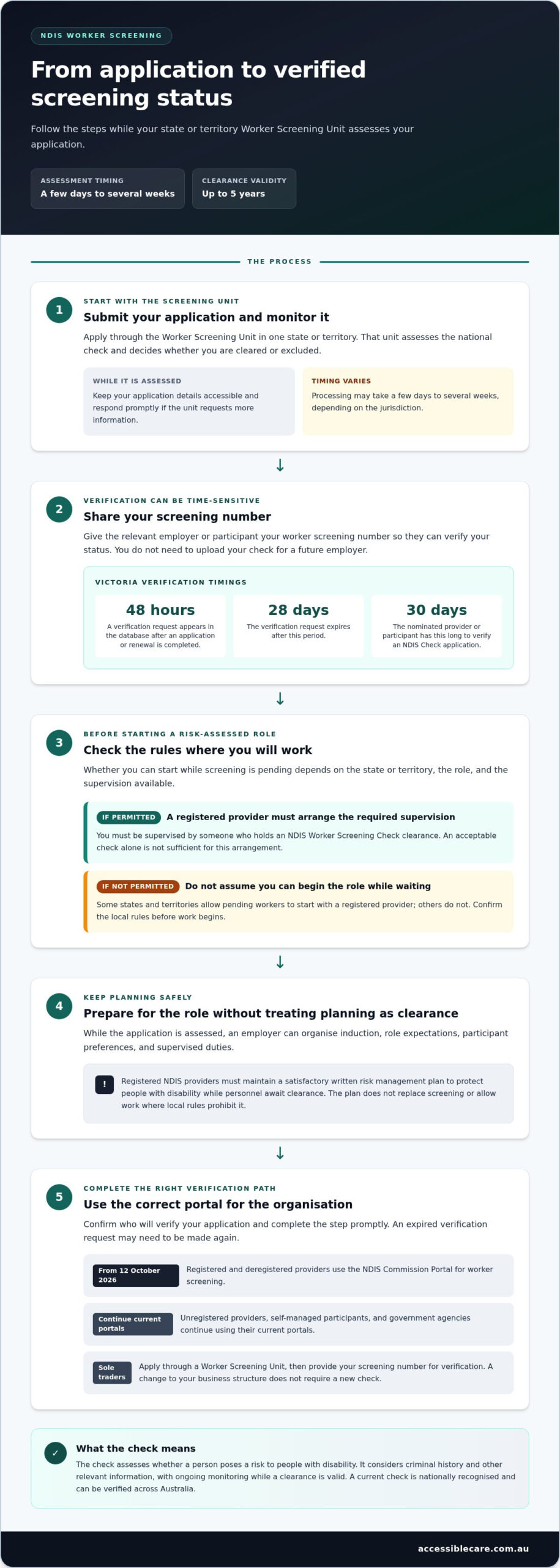
Whether you can start work before your clearance arrives depends on the state or territory, the role, and the supervision available. Use these steps to understand how your application moves from submission to verification and what arrangements may apply in the meantime.
- Submit your application and follow its status. The state or territory Worker Screening Unit assesses your application and decides whether you’re cleared or excluded. Processing times vary by jurisdiction and may range from a few days to several weeks. Keep your application details accessible and respond promptly if the screening unit requests more information.
- Arrange employer or participant verification. In Victoria, the nominated provider or participant has 30 days to verify an NDIS Check application, according to the NDIS Quality and Safeguards Commission. A verification request appears in the database within 48 hours after you finish an application or renewal, and expires after 28 days. Share your worker screening number so the relevant organisation can verify your status.
- Confirm the rules before starting a risk-assessed role. Some Australian states and territories allow a worker to start with a registered provider while screening is pending; others don’t. Where starting is allowed, the registered provider must ensure you’re supervised by someone with an NDIS Worker Screening Check clearance. Supervision by someone with only an acceptable check isn’t sufficient for this arrangement.
- Keep service planning moving without assuming clearance. While the screening unit assesses your application, an employer can organise induction, role expectations, participant preferences, and supervised duties. Registered NDIS providers must maintain a satisfactory written risk management plan to protect people with disability while personnel await clearance. The plan supports safe arrangements, but it doesn’t replace screening or authorise work where local rules prohibit starting.
- Follow the appropriate verification path if you’re a sole trader. Apply through the Worker Screening Unit in the state or territory where you choose to apply, then give the relevant employer or participant your screening number for verification. A change to your business structure doesn’t require a new check. If you support self-managed participants or work with an unregistered provider, they may still ask to see a clearance or acceptable check, or ask you to apply for one.
- Use the correct portal for your organisation. From 12 October 2026, registered and deregistered providers use the NDIS Commission Portal for worker screening. Unregistered providers, self-managed participants, and government agencies continue using their current portals. Confirm who will verify your application and complete that step promptly, because an expired request may need to be made again.
Applying through the state or territory Worker Screening Unit
The NDIS support worker screening process starts with an application to a Worker Screening Unit in one Australian state or territory. The check is national, but application steps differ by jurisdiction. These differences may include identity documents, eligibility, in-person verification, and how you access your outcome after assessment.
To apply, choose one state or territory unit, follow its instructions, and provide the required identity information. The unit assesses your application and records the outcome in its screening system.
- Choose the right screening unit. Workers apply through a Worker Screening Unit in one state or territory, not separately in every state where they might work. The unit conducts the check and decides whether the applicant is cleared or excluded. Because the result is nationally recognised, moving interstate doesn’t by itself require another application.
- Prepare your identity documents. Applicants are advised to prepare at least four identity documents. In Victoria, applicants need at least three different identity documents. Follow the chosen unit’s instructions to ensure your documents meet its requirements, and enter your personal details consistently throughout the application.
- Complete jurisdiction-specific steps. In New South Wales, applicants must visit a Service NSW Centre within 28 days of starting their online application. An applicant under 18 needs consent from a parent or legal guardian. In NSW, you can’t apply unless you’re employed or about to be employed by an NDIS provider.
- Attend any required verification appointment. For an application in New South Wales, a visit to a Service NSW Centre is part of the process, so keep your application details handy. In other jurisdictions, follow the identity and verification steps set by the relevant unit. Completing each requested step helps the unit progress its assessment using the information you provide.
- Track the outcome with the unit you chose. Application and processing times vary by state or territory and may range from a few days to several weeks. Use the same unit’s application system to follow your status. In NSW, clearance is recorded digitally in MyServiceNSW Account. No certificate or card is issued.
- Share your screening number after clearance. Give the number to the registered provider or other organisation that needs to verify your status. Workers access and update their information through the state or territory unit, not directly in the national database. For the NDIS support worker screening process, keep your application reference and unit correspondence accessible until the outcome is recorded.
Clearance validity and renewal
Use these steps to understand which roles need clearance, interpret an outcome, and keep your screening status current.
-
Review Clearance and Bar Outcomes
Read the decision from your state or territory screening unit and identify the recorded outcome: cleared, excluded, or interim bar. An interim bar is a distinct status, so don’t describe yourself as cleared unless your record shows clearance. If the decision is an exclusion, note the review information and deadlines in the notice.
An excluded person cannot make another NDIS Worker Screening Check application for 5 years without exceptional circumstances. If an internal review upholds an NDIS Exclusion, the person may apply to VCAT for review within 28 days of that internal review. Keep the decision notice and any review correspondence together for reference.
-
Maintain Clearance Validity
Record your expiry date and plan renewal through the relevant screening unit. An Australian NDIS Worker Screening Check is valid for up to 5 years. A worker can apply for a new check when the current check will expire within 3 months. In Victoria, clearance holders receive an email reminder 120 days before expiry.
New South Wales uses a different process: holders receive expiry reminders 3 months, 2 months, and 1 month before expiry. A holder can reapply from 3 months before expiry, but an NDIS Worker Check cannot be renewed. You don’t need to reapply while a current NSW check remains valid, including when changing employers or roles, or moving interstate.
-
Confirm Whether Your Role Requires Clearance
Ask the registered NDIS provider whether your position is a risk-assessed role. Registered providers must assess all roles under the NDIS Practice Standards and identify those requiring screening. Roles involving specified supports or services, as well as key personnel roles, require an NDIS Worker Check. Work involving more than incidental contact with people with disability may also be risk-assessed.
Give the provider a clear description of your duties, including how you interact with participants. Incidental contact alone doesn’t require an NDIS Worker Screening Check. The role’s actual responsibilities matter, not just its title or whether you’re employed directly by a provider.
-
Keep Your Clearance Details Current
After clearance, retain your screening number and monitor messages from your state or territory unit. Cleared workers remain subject to ongoing monitoring of criminal history and other relevant information during the check’s validity. In Victoria, clearance holders must notify the department within 7 days of specified changes in circumstances.
Changing employer, role, or state doesn’t automatically mean you need a new check while your clearance remains current. Reapply if your check expires or is cancelled, following the relevant unit’s process. For example, a worker moving from Victoria to another state can rely on national recognition while their clearance remains valid.
NDIS Worker Screening Database access and privacy
Your screening status is checked through secure verification, not by sharing your background information with every employer. These steps explain what to share, who verifies it, and how to keep your details current.
- Share your worker screening number, not an uploaded check. You don’t need to upload your NDIS Worker Screening Check for a future employer. Give the employer your worker screening number so they can confirm your current status. This allows a registered provider to verify whether your clearance is current without asking you to circulate a separate certificate.
- Use your state or territory unit to access or update your information. Workers access and update their screening information through the relevant Worker Screening Unit, not directly in the national worker screening database. If your personal details change, use the unit’s process to update them. This keeps your record with the screening authority responsible for your check.
- Understand the verification request’s time limit. A verification request appears in the database within 48 hours after you finish an application or renewal. It expires after 28 days. Share your screening number promptly with the employer or participant who needs to verify your status, and complete any requested verification within that window.
- Know who may need to verify your status. A registered NDIS provider checks screening status when engaging workers in risk-assessed roles. Self-managed participants and unregistered providers may also ask workers to show a clearance or acceptable check, or to apply for one. Share your number with the person responsible for verifying your screening, rather than sending it broadly.
- Keep clearance and expiry details together. A national check can remain valid for up to 5 years, but the database verification confirms its current status. Keep your worker screening number, screening-unit correspondence, and expiry details accessible. If an employer changes or you move interstate, provide the number to the new organisation so it can verify the existing check.
- Use the right portal for the organisation. From 12 October 2026, registered and deregistered providers use the NDIS Commission Portal for worker screening. Unregistered providers, self-managed participants, and government agencies continue using their current portals. If you’re seeking disability support alongside your work, you can explore support options suited to your goals.
Accessible Care: NDIS Support Services
Accessible Care can help you explore services aligned with your goals and preferences. A worker screening check assesses suitability for risk-assessed roles. It’s separate from the support a participant may seek for daily life, communication, or independence.
Depending on your needs, options include NDIS Support Services, Speech Therapy, Occupational Therapy, and Positive Behaviour Support. Speech Therapy may suit someone working on communication, while Occupational Therapy can support everyday activities and independence. Positive Behaviour Support may be relevant when a person needs support focused on behaviour and wellbeing.
When you’re ready to discuss support that reflects your priorities, contact Accessible Care or visit the website.
Take your next step with confidence
The NDIS support worker screening process is one part of building safe, respectful support. Next, consider what could help you or someone you care for pursue their goals, whether that’s practical assistance, communication support, or greater independence in daily activities.
Accessible Care offers NDIS Support Services, Speech Therapy, and Occupational Therapy. If you’re looking for support that reflects your priorities, start a conversation about options that may suit your needs. Your goals and preferences can guide the discussion.
Contact Accessible Care for help exploring support options. Take the next step at your own pace.
Frequently Asked Questions
How is it different from other background checks?
An NDIS Worker Screening Check assesses whether a person poses a risk to people with disability, rather than simply providing a result for a single employer. It considers criminal history and other relevant information, with ongoing monitoring while the clearance is valid. For example, a cleared worker changing employers can share their screening number so the new organisation can verify their current status.
What about sole traders or self-employed workers?
Sole traders apply through a state or territory Worker Screening Unit, like other applicants. A change in business structure doesn’t mean you need to apply again if your check remains current. Workers supporting self-managed participants or unregistered providers aren’t required to hold a clearance under transitional arrangements, though those participants or providers may still ask to see one or request that you apply.
What documents do I need?
Prepare at least four identity documents before beginning your application, as applicants are advised to do so. Victorian applicants need at least three different identity documents. Follow the chosen state or territory unit’s instructions and use consistent personal details across your documents. In New South Wales, you’ll also need to visit a Service NSW Centre within 28 days of starting your online application.
What happens after I’m cleared?
After clearance, keep your worker screening number available and give it to an organisation that needs to verify your status. You don’t need to upload a copy of the check for a future employer. Your clearance remains subject to ongoing monitoring, so keep your contact details current with the relevant screening unit and pay attention to messages about your screening record.
Who needs to have an NDIS clearance?
Workers in risk-assessed roles for registered NDIS providers need an NDIS Worker Screening Check clearance. This can include roles involving specified supports or services, key personnel, or work likely to involve more than incidental contact with people with disability. Registered providers assess their roles to identify which are risk-assessed. Incidental contact alone doesn’t require a check.
What is the NDIS Worker Screening Check and who needs one?
It’s a national assessment of whether someone working, or seeking to work, with people with disability poses a risk to them. It’s required for risk-assessed roles with registered NDIS providers, including relevant key personnel positions. Workers supporting self-managed participants or unregistered providers aren’t required to hold a clearance under transitional arrangements, though those participants or providers may still ask for one.
What documents and identity checks are required for an NDIS worker screening application?
Have at least four identity documents ready, following the document guidance from the state or territory where you apply. Victoria requires at least three different identity documents. Application steps differ: in New South Wales, applicants must attend a Service NSW Centre within 28 days after beginning the online process. Applicants under 18 in New South Wales need consent from a parent or legal guardian.
How long does NDIS worker screening take and how can applicants track it?
Processing can take up to 4 weeks, while application times vary by state or territory and may range from a few days to several weeks. Track progress through the Worker Screening Unit where you applied, and respond to any requests it sends. In New South Wales, a clearance is recorded digitally in the applicant’s MyServiceNSW Account, rather than issued as a card or certificate.

