

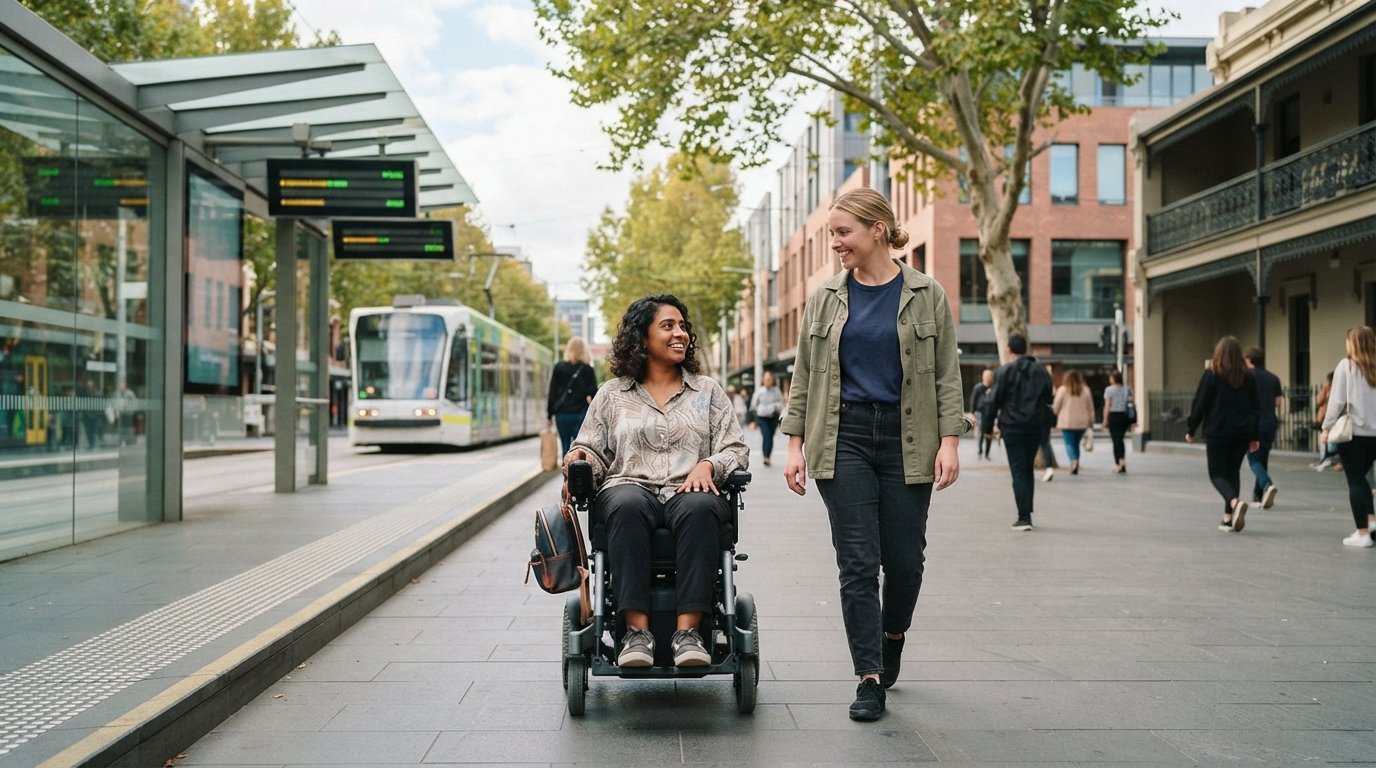
Taking part in everyday life can require more than standard assistance. In the NDIS, what high-intensity community participation means is support that helps a person with complex needs engage in family, work and community life, alongside high-intensity daily personal activities delivered by trained workers under clinical direction. These supports address complex disability-related needs; they are not medical or nursing procedures.
It is understandable to wonder where the line falls between everyday assistance and high-intensity support. The distinction depends on the person’s needs and the tasks involved, not simply on whether an activity takes place at home or in the community.
This article explains what high-intensity support can involve, who may need it, and how it can fit into daily life. It also covers how individual support plans, worker training and safeguards help keep support aligned with a person’s needs and choices.
Key Takeaways
- High-intensity support can help a person take part in family, work and community life when their disability-related needs call for specialised assistance.
- Learn how it differs from standard community support by looking at the tasks involved, the person’s needs and the level of worker training required.
- NDIS funding is considered in light of individual support needs, with relevant evidence helping explain the assistance required.
- Individualised plans, trained workers, clear communication and risk management all contribute to safer support.
- The National Disability Insurance Scheme (Provider Registration and Practice Standards) Rules 2018 are the cited rules for high intensity daily personal activities, according to Australian Government, Federal Register of Legislation.
Participation in family, work and community life
High-intensity support can help a person with complex disability-related health needs take part in meaningful routines, such as a family meal, a work shift or a visit to a local community group. Support is shaped around the person’s goals and the assistance needed for daily personal activities. This can make participation more manageable without turning the person’s day into a clinical routine.
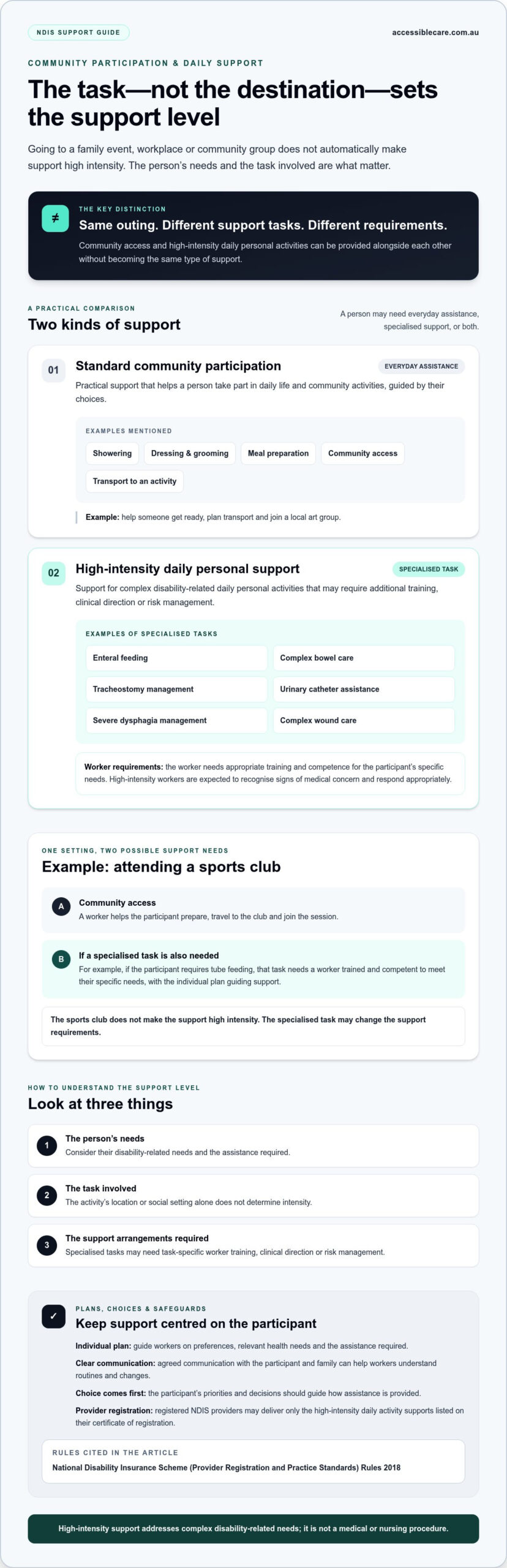
Community participation support and high-intensity daily personal support are related, but they describe different things. A worker might assist with getting ready, travelling to a class or attending a family event. If a participant also needs a specialised task, such as enteral feeding or severe dysphagia management, that task requires appropriate training and individual support arrangements. The activity itself does not determine the intensity; the person’s needs and the tasks involved do.
For example, someone attending a family celebration may need assistance with daily activities before leaving home. Their support plan can guide workers on the person’s preferences, relevant health needs and the assistance required during the outing. That planning helps the participant focus on seeing family and making choices, rather than having the event organised around other people’s assumptions.
Participation can also mean contributing at work or joining a regular community activity. A person’s NDIS plan may describe support work that helps them prepare for a shift or get to an activity, while separate daily personal support addresses complex care needs. The participant’s priorities should guide how assistance is provided. Workers can help a person communicate preferences, take part in decisions and maintain familiar routines.
Families may benefit when roles and communication are clear. A participant can explain what matters to them, while workers and family members share relevant observations through agreed support arrangements. For instance, a family member might explain which routines help someone feel comfortable before an outing. The participant’s choices remain central, and workers should follow the individual plan rather than impose their own preferences.
The National Disability Insurance Scheme (Provider Registration and Practice Standards) Rules 2018 are the NDIS Provider Registration Rules cited for high intensity daily personal activities, according to Australian Government, Federal Register of Legislation. In Australia, registered NDIS providers may deliver only the high intensity daily activity supports listed on their certificate of registration. Registration and worker skills therefore matter when a person’s plan includes a specialised task alongside community access.
Assessment connects a person’s goals with the support they need in daily life. It can consider the activity they want to join, the personal assistance involved and any disability-related health needs. High-intensity support workers are expected to recognise signs of medical concern and respond appropriately. Clear communication with the participant and family helps workers understand changes, follow the person’s arrangements and keep participation centred on the participant.
High-intensity support is not needed for every outing or social activity. Standard disability support workers also provide a broad range of daily living and community participation support. A participant may need everyday assistance with community access, specialised support for a particular daily personal task, or both within their NDIS plan. Matching support to the task helps preserve choice while addressing complex care needs appropriately.
How does high intensity community participation differ from standard community participation support?
The difference lies in the support tasks and the person’s needs, not the destination. Attending a sports club does not automatically make support high intensity. A worker might help someone enter the venue, communicate with staff or follow the activity. These are examples of standard community participation support. If the person also needs a specialised daily personal activity, that task may require high-intensity support arrangements.
Standard NDIS support can assist with everyday activities such as showering, dressing, grooming, meal preparation and community access. For example, a worker may help someone get ready, plan transport and take part in a local art group. The worker’s role is to support the participant’s choices and practical access. The activity can be meaningful without involving high-intensity care.
High-intensity support relates to complex daily personal activities that require additional training, clinical direction or risk management. Examples include enteral feeding, complex bowel care, tracheostomy management, urinary catheter assistance, severe dysphagia management and complex wound care. A participant may need one of these supports before leaving home or during a community activity. It is the specialised task, not the social setting, that changes the support requirements.
Consider a participant who wants to attend a local sports club. Standard support might help them prepare, travel and join the session. If they also require tube feeding, the task needs to be carried out by a worker trained and competent to meet the participant’s specific needs. The individual plan should guide how support is delivered. Community access and high-intensity daily personal activities can sit alongside each other without becoming the same type of support.
Support plans also differ in the level of task-specific guidance they require. For standard assistance, a plan may describe preferred routines, communication methods and the help needed to take part. For high-intensity activities, instructions need to address the specialised task, relevant risks and actions to take if concerns arise. For example, a dysphagia support plan should reflect the person’s needs and preferences around food, fluids, preparation techniques and feeding equipment.
Worker preparation is another distinction. A worker supporting a participant at a community group still needs to understand their role and follow the participant’s support arrangements. A worker carrying out a high-intensity task must also be trained and competent in that specific activity. The NDIS Quality and Safeguards Commission’s High Intensity Daily Personal Activities supplementary module sets requirements for providers delivering these supports.
Some participants need both types of assistance, while others need standard community support alone. The NDIS plan and the tasks involved help clarify the appropriate arrangement. A useful way to describe the need is to separate the goal from the support: “I want to attend the club” explains the goal; “I need trained assistance with a particular daily personal task” explains the specialised support. For tailored community participation support, keep those needs and goals clear in the discussion.
High-intensity daily personal activities may require additional competency, supervision or clinical collaboration compared with standard personal care. In Australia, NDIS high-intensity support workers should be appropriately trained and competent, follow participant-specific care plans, and work with clinical supervision to support quality and safety. They should seek clarification from supervising clinicians when needed, communicate observations clearly and promptly, and know when to seek help.
NDIS high-intensity support plans identify how risks, incidents and emergencies will be managed, including actions and escalation to support participant wellbeing. NDIS high-intensity support workers are expected to maintain accurate records and communicate clearly with participants and their broader care team. Their role has defined limits: they should not diagnose participants, alter treatment plans, administer unauthorised medication or perform clinical procedures for which they are not trained or certified. These safeguards help distinguish specialised support from standard personal care while keeping the participant’s wellbeing central.
How can someone arrange high intensity community participation through an NDIS plan?
Start with the activities the participant wants to pursue and the support each one requires. For example, attending a work placement may involve community access and a specialised daily personal activity. Understanding what high-intensity community participation involves helps separate the participation goal from the disability-related assistance needed to achieve it. The NDIS plan should describe both clearly.
High-intensity daily activity support is typically funded through the NDIS Core Supports budget under Assistance with Daily Life. Funding is assessed against the participant’s individual needs and set out in their plan. NDIA delegates make funding decisions based on each participant’s circumstances, including the type and degree of support required.
Access to this funding is typically identified during a planning meeting or plan review. The participant is involved in assessing and developing their support arrangements. They can explain their preferred activities, personal goals, daily routines and practical barriers. Family members may contribute relevant information, while the participant’s preferences remain central.
Before a planning meeting or review, organise information that connects the requested support with daily life. Useful evidence may include a treating medical professional’s letter, risk assessments, clinical notes, and a care or health support plan. These documents can explain the participant’s health needs, the tasks requiring assistance and what may happen without appropriate support.
For instance, someone seeking support to attend a community course could describe the course goal, the daily personal activity they need help with and how that assistance affects attendance. A health support plan can set out relevant care instructions and risks. Specific examples make it easier to understand how participation, daily support and the requested funding connect.
During planning, describe the support in practical terms. Explain:
- The activity or routine the participant wants to take part in.
- The daily personal task requiring high-intensity assistance.
- The worker skills and support arrangements the task requires.
- The risks, expected support and relevant emergency response information.
- How the assistance will help the participant pursue their stated goal.
The NDIS plan may combine standard and high-intensity supports, depending on the participant’s circumstances. For example, a plan could include everyday help to travel to a community activity alongside specialised assistance for a daily personal task. Separating these needs clarifies which support relates to access and which addresses complex health needs.
Check the approved plan to see how funded supports are described and allocated. High-intensity daily activity supports must match the participant’s assessed needs and plan. A provider’s registration also matters: registered NDIS providers may deliver only the high-intensity daily activity supports listed on their certificate of registration. The participant’s requested task and the provider’s registration must align.
If the plan does not include the requested high-intensity support, participants can submit supporting medical documents and assessments to the NDIA to request funding. Keep the evidence connected to the person’s daily support needs, identified risks and participation goals. A clear account of the activity, the task and the assistance required gives the NDIA relevant information to consider the request.
What risks and safeguards apply to high intensity community participation
High-intensity support can involve health-related risks during everyday activities outside the home. A participant at a community event may need support with tube feeding, seizure-related needs or a pressure injury. Risks depend on the person and the task. A clear plan helps workers understand what to do, what to observe and when to seek further assistance.
Before a high-intensity activity, workers should review the participant’s care plan and consider risks relevant to the task. For example, a worker supporting someone with dysphagia needs to follow individual instructions about food, fluids, preparation and feeding equipment. The participant’s preferences matter alongside safety needs. Workers should not diagnose, change treatment plans, administer unauthorised medication or perform tasks they are not trained to complete.
Training must match the specific high-intensity activity and the participant’s needs. A worker supporting a person with complex bowel care requires task-specific competence. Severe dysphagia management training must be delivered by an appropriately qualified health practitioner. Workers should also know the participant’s emergency response plan and how to contact relevant members of the health team.
Risk arrangements need to work in real settings, not just at home. A community outing may involve transport, unfamiliar facilities, changes to a routine or limited access to the participant’s usual supports. The individual plan should explain how identified risks, incidents and emergencies will be managed. For example, it can specify who to notify if a worker observes a change in the participant’s condition.
Safe support also depends on timely communication and accurate records. Workers are expected to monitor changes, report concerns, record daily activities, and use suitable infection-control and manual-handling techniques. If an incident occurs, documentation should capture what happened, when it happened, what actions were taken, who was informed and any follow-up required. These details help the participant and care team review support arrangements.
During an emergency, workers should follow the participant’s response plan, seek medical assistance when needed and provide first aid within their training. They should inform the health team leader and document the incident. For instance, if a participant shows signs of medical concern during a community activity, workers should follow the agreed escalation steps rather than make a diagnosis or change treatment.
The NDIS Quality and Safeguards Commission sets standards for providers delivering high-intensity support, including staff training and provider compliance. Providers delivering High Intensity Daily Personal Activities must be registered with the NDIS Commission and audited against the relevant supplementary module of the NDIS Practice Standards. The Commission’s High Intensity Daily Personal Activities supplementary module sets out requirements for these supports.
Support levels should reflect the person’s needs and the activity’s risks. Some participants may require a 2:1 support ratio or higher for safe service delivery. This depends on the individual support arrangements, not a universal ratio for every outing. Discuss high-intensity support needs when planning participation that involves complex health support, so the person’s goals and safety arrangements can be considered together.
Accessible Care: NDIS Support Services
Accessible Care helps participants and families connect daily support needs with personal goals. Its NDIS Support Services and support work assist people to take part in everyday routines and community life. Speech Therapy, Occupational Therapy and Positive Behaviour Support can also address communication, everyday activities and behaviour support goals.
Consider these services when clarifying what matters to the participant, which activities they want to pursue and what support may help. Sharing those priorities is a useful starting point for discussing suitable supports and how they relate to the person’s NDIS plan.
For a respectful discussion about support options, contact Accessible Care.
Take the Next Step Towards Participation That Fits
Understanding what high-intensity community participation means can help you describe support needs in a way that reflects the person’s priorities. Start with what they want more room to do, whether that means building a routine, strengthening communication or taking part in an activity that matters to them. Their goals can guide the next conversation.
Accessible Care offers NDIS Support Services, Speech Therapy and Occupational Therapy. These services can be relevant when a person’s support needs connect with everyday activities, communication or participation goals. A conversation can help you explore how those needs relate to the person’s circumstances and what they hope to work towards.
There’s no need to have every detail worked out before beginning. Share what matters to the participant and the questions you’re considering. Contact Accessible Care to discuss support and explore a thoughtful next step. With the person’s voice at the centre, progress can begin with one clear goal.
Frequently Asked Questions
What does high intensity community participation mean in Australia?
It means taking part in everyday community life with support that accommodates complex disability-related needs. Understanding high-intensity community participation means considering both the person’s chosen activity and any specialised daily support they need. For example, someone may want to attend a family gathering while requiring assistance related to tube feeding. The goal is participation, with the required support organised around the person’s individual needs and choices.
What high intensity community participation supports are included under the NDIS?
NDIS high-intensity daily personal activities can include support with complex bowel care, enteral feeding, severe dysphagia, tracheostomy management, urinary catheter management, ventilator management, subcutaneous injections and complex wound management. These are specialised daily support tasks, not social activities. A person’s plan may also include standard assistance with community access, depending on their needs. The tasks supported must relate to the participant’s individual circumstances and plan.
What are examples of high intensity community participation activities?
Examples include attending a community class, joining a family celebration or taking part in a local group while receiving the specialised daily support the person needs. A participant with complex dysphagia might attend a library activity with support arrangements that reflect their individual needs around food and fluids. Another person may take part in a community event while receiving support related to catheter management. The activity remains personal; the support responds to the task and the participant’s needs.

