

Social skills support should build on what your autistic child wants to do and practise, not ask them to hide who they are. To understand how to help my autistic child with social skills, start with the situations they find difficult or want to enjoy, then practise useful skills through play and everyday interactions. Support can include clear guidance, patient practice and changes that make social situations more comfortable.
It can be hard to know whether your child needs help starting a conversation, reading gestures or joining a game. Social skills look different from child to child, and the goal isn’t to make every child social in the same way. Your child’s interests, communication style and preferences matter.
This article explains what social skills can involve and how to find interest-led ways to practise them, from shared games to familiar real-life situations. It also explores when tailored professional support and NDIS services may help your child work towards their own social goals.
Key Takeaways
- Focus practice on the social situations your child wants or needs to navigate, while respecting their communication style and preferences.
- Use play and role-play to make conversations and turn-taking easier to practise in a supportive setting.
- Build on your child’s interests to create low-pressure opportunities for connection with peers.
- Professional and NDIS support may help tailor strategies to your child’s goals and everyday social experiences.
1. What Are Social Skills Deficits in Autistic Children?
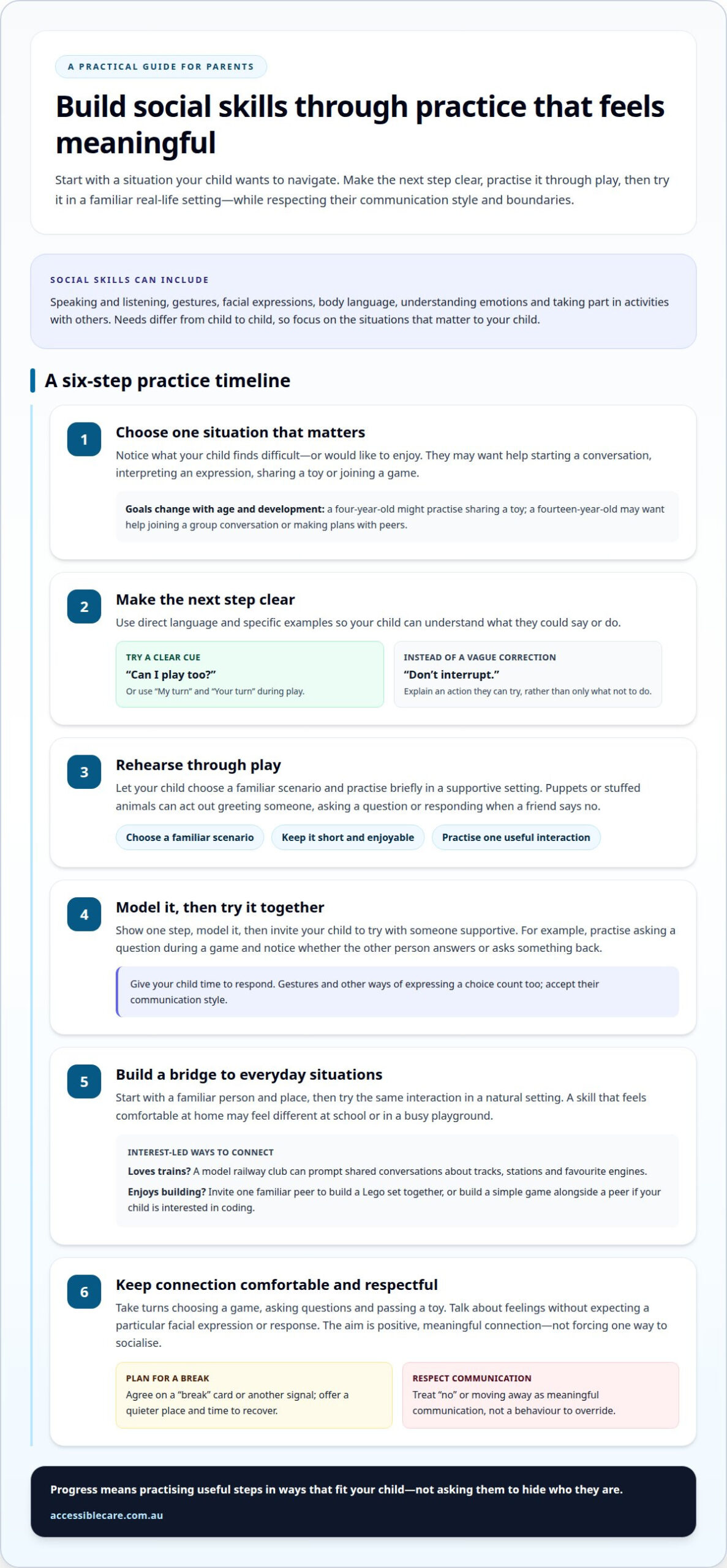
Social skills include speaking and listening, gestures, facial expressions, body language, understanding emotions and taking part in activities with others. An autistic child may find some situations challenging, such as starting a conversation or interpreting another person’s expression. Needs vary, so focus practice on the situations your child wants to manage.
Social skills needs vary with age and development. A four-year-old might practise sharing a toy, while a fourteen-year-old may want help joining a group conversation or making plans with peers. Use your child’s goals and everyday experiences to decide what to practise.
Explain interactions with clear language and specific examples. For instance, say, “You can ask, ‘Can I play too?’” rather than “Don’t interrupt.” Simple cues such as “My turn” and “Your turn” can make the next step easier to understand during play.
Role-play gives your child a chance to practise before a real interaction. Use puppets or stuffed animals to act out greeting someone, asking a question or responding when a friend says no. Keep practice short and enjoyable, and let your child choose a familiar scenario.
Pair direct teaching with real-life practice. Show one step, model it, then invite your child to try with someone supportive. For example, practise asking a question during a game, then notice whether the other person answers or asks something back. Talk about feelings without expecting a particular facial expression or response.
Practise in different environments, because a skill used at home may feel different at school or in a busy playground. Start with a familiar person and place, then try the same interaction in a natural setting, such as asking to join a playground game.
Practise conversation and sharing together: take turns choosing a game, asking questions and passing a toy. Give your child time to respond and accept their communication style, including gestures or other ways of expressing a choice. The aim is positive, meaningful connection, not forcing one way to socialise.
2. Professional and NDIS support for social interactions
A speech pathologist or occupational therapist can help turn your child’s social goals into practical steps. Sessions might practise responding to greetings, understanding conversational turns or asking for help. Let your child’s interests, communication preferences and everyday challenges shape the teaching.
Choose a group or therapy program that supports your child’s goals, respects their communication style and offers practice relevant to real interactions. Ask how sessions accommodate sensory needs, body language and opportunities to build relationships, rather than expecting children to copy one social style.
Neurodiversity-affirming support helps autistic children understand interactions and pursue meaningful connections, rather than making them mask. Support friendships by valuing shared interests, accepting different ways of communicating and helping peers respond respectfully.
Visual supports make steps easier to see and revisit. A cue card could show “greet,” “wait” and “respond”; a social story could explain how to join a game, including asking to play and accepting either answer. Practise the story through role-play, then use it to prepare for a familiar situation.
Respect boundaries and sensory needs by agreeing on a “break” card or another signal before a social activity. Offer a quieter place, allow time to recover and treat “no” or moving away as meaningful communication. These adjustments can make participation more comfortable without requiring your child to tolerate distress.
Medicare and NDIS are separate funding pathways. Eligibility and funding depend on the service, applicable arrangements and your child’s circumstances. Costs depend on the service, format and individual needs, with the price provided after a quote request.
For autism-informed speech pathologists or occupational therapists, look for clinicians who listen to the child’s goals, explain strategies clearly and include the family’s everyday context. Speech therapy and occupational therapy can help translate social goals into individual strategies and supported practice.
Ask the provider for a quote, as fees vary with the service, format and individual needs. Medicare and NDIS are distinct funding pathways, and eligibility and available funding depend on the service and your child’s circumstances.
3. Finding activities that match a child’s interests
Start with something your child enjoys, then choose an activity that naturally involves another person. If they love trains, a model railway club can prompt shared conversations about tracks, stations and favourite engines. A child interested in coding might enjoy building a simple game alongside a peer. Shared interests give children something meaningful to talk about, without making every interaction feel like a lesson.
Choose an activity that suits your child’s age, abilities and comfort. Lego, chess, music lessons, sport or coding can offer natural chances to cooperate and take turns. For a first playdate, invite one familiar peer and plan an activity your child enjoys, such as building a Lego set together. Keep the plan flexible, so your child can pause or change activities.
School can support friendships by creating opportunities around shared interests, such as a lunchtime chess game or a group art project. Educators can help peers recognise and respond to one another’s attempts to connect, then encourage participation in different situations. Parents and school staff can share which activities help your child feel included and which interactions are difficult.
Notice and describe a positive interaction specifically. “You asked Sam what they wanted to build, and you listened to their answer” tells your child what worked without judging their personality or communication style. A brief, genuine comment after an enjoyable activity can help them recognise a moment they may want to repeat.
Review whether an activity is working by noticing your child’s comfort, interest and chances to connect. If a noisy sports session makes conversation harder, try a quieter activity or a smaller setting. If a coding group feels engaging but offers little peer interaction, plan a collaborative project. Adjust activities as your child’s interests, goals and abilities change. Success means a useful, respectful connection, not simply joining more groups.
4. What social skills are and how children use them
Social skills are the ways people communicate, respond and connect in a situation. They include spoken language, listening, gestures, facial expressions, body language, recognising emotions and understanding social expectations. For example, joining a conversation may involve noticing a pause, sharing an idea and listening to someone else’s reply.
For an autistic child, these parts of social communication may work differently or take more effort. A child might enjoy talking about a favourite subject but find it challenging to tell whether someone wants to change topics. Another may communicate comfortably using gestures, written words or an augmentative communication method. These differences don’t mean a child lacks interest in relationships.
Social skills also include choice and self-advocacy. Saying “I need a break,” asking someone to explain a joke or declining a hug are useful communication skills. Treat these responses as meaningful and show others how to listen. This supports mutual understanding instead of placing all responsibility on the autistic child.
Social expectations can change between settings. At school, a child might need to signal that they want to join a group task. At home, they may ask a family member to wait while they finish speaking. These examples show why strategies should reflect real situations, not one fixed idea of “good” social behaviour.
Skills develop as children grow, and the interactions that matter depend on each child’s age, priorities and communication. A younger child may want to share an activity; an older child may prefer to connect through messages or a shared interest. Ask what feels important to your child, then focus support on that goal.
The clearest takeaway is that social connection is reciprocal. A child can learn ways to express needs, while parents, peers and educators learn how to understand and respond to that child. If health needs make everyday participation challenging, explore community nursing support.
Accessible Care
Accessible Care helps families connect social goals with practical support suited to their child’s communication, interests and everyday routines. Speech Therapy and Occupational Therapy can support communication and participation, while Positive Behaviour Support helps families understand behaviours and plan supportive responses. NDIS Support Services can also help families access assistance aligned with their child’s goals.
Consider professional support if social situations cause ongoing stress, your child wants help with particular interactions, or strategies are difficult to use across home, school and community settings. A collaborative approach keeps your child’s preferences central and helps your family focus on meaningful, self-directed outcomes.
To discuss support for your child’s social goals, contact Accessible Care.
Take the next step at your child’s pace
There’s no single measure of progress that suits every child. A meaningful next step might be feeling comfortable asking for help, enjoying time with a peer or communicating a boundary. Let your child’s priorities guide your focus, and adjust support as their needs and interests change.
If you’re considering how to help your autistic child with social skills, a conversation with a support team can help you explore options that fit your family’s goals. Accessible Care offers NDIS Support Services, Speech Therapy and Occupational Therapy to support communication and participation.
Contact Accessible Care to discuss support for your child and the goals that matter to them. A thoughtful next step can begin with listening to your child and deciding together what feels right.
Frequently Asked Questions
What Are Social Skills Deficits in Autistic Children?
They describe differences or difficulties with aspects of social communication, not a lack of interest in people. If you’re wondering how to help my autistic child with social skills, start by noticing which interactions your child wants to manage differently. For example, they may find it hard to tell whether a classmate’s brief reply means the conversation has ended. Let their goals guide support.
Where can I learn more?
Discussing your child’s communication and social goals with a professional who understands their needs can help you identify practical strategies. Accessible Care offers Speech Therapy and Occupational Therapy to support communication and participation. Bring a real example, such as a difficult group activity or an interaction your child would like to manage differently, to focus the discussion.
What social skills support is recommended for autistic children in Australia?
Support should reflect your child’s goals, communication preferences and daily life. A speech pathologist or occupational therapist may help identify practical strategies, while NDIS Support Services may suit families seeking disability support. For example, a goal could be communicating a need during a school activity. The approach should respect your child’s autonomy and boundaries.
How can parents practise social skills with an autistic child at home?
If you’re wondering how to help my autistic child with social skills at home, start by practising within a familiar routine. During cooking, your child could ask for an ingredient, wait for your response or say they need help. Keep the exchange natural, allow time to respond, and accept speech, gestures or another communication method.

