

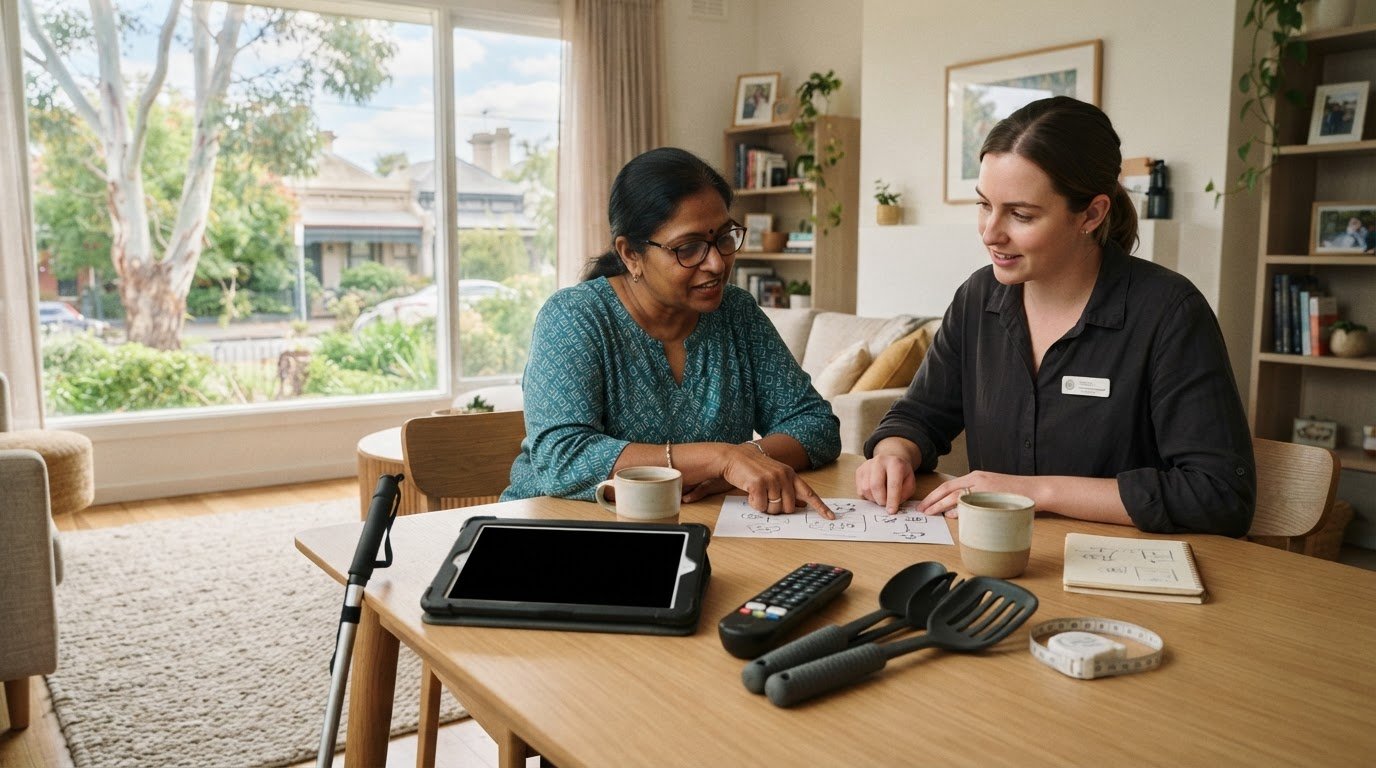
What if the clearest NDIS assistive technology request starts not with a device, but with a picture of your everyday life? Preparing for an NDIS assistive technology assessment can feel uncertain, especially if you’re unsure who will be involved or how your needs will be documented. The assessment should connect practical challenges with your goals, routines and the support that may help you do more independently.
You may be wondering what to bring, whether equipment will be trialled, and how a recommendation, evidence and quotes fit into an NDIS funding request. Your experiences matter. Examples of tasks that are difficult, barriers at home or in the community, and changes you’d like to make can help show how a recommended option relates to your daily life.
This step-by-step guide explains what to expect before, during and after an assessment, and how to prepare useful examples of your needs and goals. You’ll also learn how recommendations and supporting evidence can inform an NDIS request. Person-centred occupational therapy can help explore practical needs and independence goals, with your priorities at the centre.
Key Takeaways
- An NDIS assistive technology assessment links your everyday needs and goals to technology recommendations, but doesn’t guarantee NDIS funding.
- Know the steps to expect, from discussing your goals and routines to considering options and documenting recommendations.
- Compare options in light of your goals, the task, your environment, safety and the support you may need.
- Prepare examples of daily challenges, current equipment and supports, and questions you’d like to discuss.
- Know what to look for in the written recommendation and how to keep evidence organised for your next steps.
What is an NDIS Assistive Technology Assessment?
An NDIS assistive technology assessment explores what you need help with, which equipment or technology may suit those needs, and how a recommended option could support your goals. The discussion starts with you, not a product catalogue. It considers your daily activities, the places you spend time, your preferences and any barriers affecting your independence or participation.
In brief: an assessment is a person-centred process for understanding support needs and recommending suitable technology, not a decision to buy equipment. An occupational therapist or another relevant assessor may ask you to describe difficult tasks, what you already use, and what you’d like to do more safely or independently. Depending on your circumstances, the process may also consider your home or other environments and how an option would fit into your routines.
The outcome may include a recommendation and supporting evidence explaining why an option could be appropriate. This information can help the NDIA consider a funding request, but it doesn’t guarantee funding. The decision depends on the request and applicable NDIS requirements. A clear recommendation connects the proposed technology to your circumstances rather than relying on a general claim that an item could be helpful.
What counts as assistive technology in an NDIS context?
Assistive technology broadly refers to equipment or technology that helps a person carry out activities, support function or participate in everyday life. Examples can include mobility equipment, communication aids or devices that help with tasks at home. The Assistive Technology overview explains the wider range of applications. Whether an item is relevant to an NDIS request depends on the person’s needs and circumstances. Not every potentially useful item is necessarily eligible for funding.
How is an assistive technology assessment different from an FCA?
An assistive technology assessment focuses on a particular need and whether a technology solution may help address it. A functional capacity assessment (FCA) takes a broader look at how a person manages daily activities and what support they may need across different areas of life. FCA findings may help describe the wider context, while an assistive technology assessment explores a potential equipment-related response. For more background, see the functional capacity assessment guide.
For example, an FCA might describe the support a person needs to manage daily routines. An assistive technology assessment would look more closely at a specific task, the barriers involved and whether a technology option could help. Both approaches consider the person’s needs, but they answer different questions. The right starting point depends on what you’re trying to understand or support.
What happens during an NDIS assistive technology assessment?
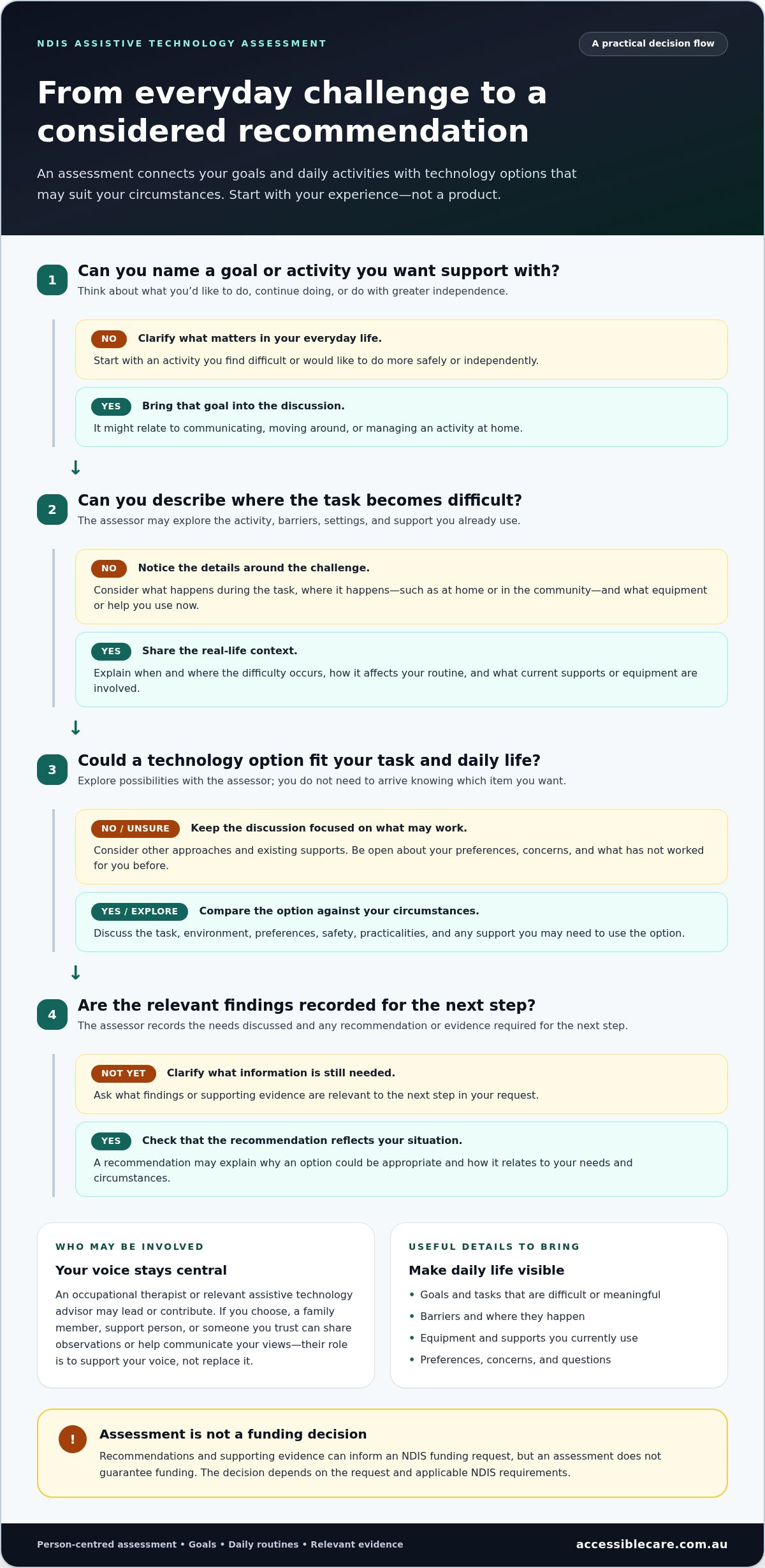
An NDIS assistive technology assessment is a conversation about what matters to you and what could make everyday activities more manageable. The assessor gathers information about your goals, routines, environments and current supports, then considers whether technology may help address a specific need. You don’t need to arrive knowing which item you want. Your lived experience is a valuable starting point.
The discussion often follows a practical sequence, although the exact steps depend on the technology, your circumstances and current NDIS requirements:
- Talk about your goals. Describe what you’d like to do, continue doing or do with greater independence. Your goal might relate to communicating, moving around or managing an activity at home.
- Explore the activity and barriers. Explain what happens during the task, where it becomes difficult and what support or equipment you use now. The assessor may ask about different settings, such as home or the community.
- Consider possible options. Discuss approaches that may address the need, including technology and existing supports. The focus is on what may fit your circumstances, not on choosing an item before your needs are understood.
- Document relevant findings. The assessor records the needs discussed and any recommendation or evidence required for the next step. The NDIS Assistive Technology Assessments guidance explains the assessment process from the NDIA’s perspective.
Who may be involved in the assessment?
You’re central to the assessment and should have a say in how your priorities and preferences are represented. An occupational therapist or relevant assistive technology advisor may lead or contribute, depending on the request. If you choose, a family member, support person or someone else you trust can share observations or help you communicate your views. Their role is to support your voice, not replace it.
What questions might the assessor explore?
Questions are likely to focus on tasks that are difficult, important or meaningful to you. You might be asked what you want to achieve, when a challenge occurs and how it affects your routine. The assessor may also explore where an option would be used, who might help you use it, and what could make it difficult to use consistently.
Be open about your preferences and concerns, including comfort, safety, practicalities and the support available. A solution that seems useful in one setting may not suit another part of your routine. Explain what you’d feel comfortable using and what hasn’t worked for you before. If it helps, bring someone who knows your everyday routines and can add examples, while keeping your choices at the centre.
An assessment is a collaborative conversation, not a test. If you’re exploring practical needs and independence goals with an occupational therapist, person-centred occupational therapy support can help keep your priorities in focus.
How does assessment evidence help compare assistive technology options?
Evidence helps explain how a proposed option relates to your daily life, so the recommendation is more than a product name or list of features. In an NDIS assistive technology assessment, the assessor may compare options against your goal, the task you want to do, where you’ll use the technology, safety considerations and the support available to use it.
Good evidence connects a proposed option to a person’s functional needs and shows how it may support an activity that matters to them. It can describe the barrier, why an option may help and what alternatives were considered. This gives the NDIA information to consider, but doesn’t guarantee funding. The NDIS explains its broader assistive technology funding context in Understanding Assistive Technology in the NDIS.
- Goal: What would you like to do more easily, safely or independently?
- Task: Which part of the activity is difficult, and what needs to happen for you to complete it?
- Environment: Where will you use the option, and what features of that setting matter?
- Safety and support: What risks may need consideration, and what help would you need to use it?
- Alternatives: Could an existing support, a change to the task or a less complex option address the need?
How do goals and daily tasks shape recommendations?
A recommendation should link each relevant feature to an activity you want or need to do. For example, evidence might explain how a communication aid could support you to express choices, or how mobility equipment may help you move around a particular environment. Personal care and household tasks may involve different needs. A diagnosis alone doesn’t determine the right option. People with the same diagnosis can have different goals, routines, preferences and environments.
Specific examples make the connection clearer. Describe what happens during the task, what you can do now, where you need assistance and what change you hope to achieve. The assessor can then consider whether an option addresses that particular barrier, rather than assuming one device will suit every situation.
How are safety, suitability, and value considered?
Suitability depends on the person, the intended activity and the environment where the technology will be used. An assessor may consider foreseeable risks, how the option would be used, and whether support or training may be needed. Cost-effectiveness and evidence requirements can depend on the request, so use current NDIS guidance rather than assuming the same process applies to every option.
Alternatives are part of a thoughtful comparison, not a reason to dismiss your goal. An existing support or lower-complexity option may meet the need, or the assessment may explain why it wouldn’t suit your circumstances. If you’re exploring practical needs and independence goals with an occupational therapist, person-centred occupational therapy support can help keep your everyday priorities central.
How can you prepare for an NDIS assistive technology assessment?
A little preparation can make it easier to explain what matters to you, but you don’t need a perfect file or a complete solution before the appointment. For an NDIS assistive technology assessment, focus on clear examples of your everyday needs, the support you already use and the change you hope to achieve.
What information should you gather beforehand?
Write down a few activities that are difficult or important to you. Include when the difficulty happens, where it occurs, what you do now and what successful participation would look like. Your notes can be brief. A concrete example is often more helpful than a general statement such as “I need more independence.”
- Your goals: What would you like to do, and what difference would it make in your daily life?
- Task examples: Which steps are challenging? Note when they happen and whether the difficulty changes across the day or setting.
- Current equipment and supports: Record what you already use, who helps, and what works or doesn’t work for you.
- Relevant environments: Think about home, work, study or community settings where the activity takes place.
- Your questions and preferences: Note what matters to you, any concerns you have and anything you’d like the assessor to explain.
If you have relevant information about existing equipment or supports, bring it along. You can also keep a short diary for a few days, noting the activity, what made it difficult and what assistance you needed. This can help you recall patterns during the conversation without relying on memory alone.
How can you make the assessment feel more accessible?
Taking part should work for you. Before the assessment, think about what would help you communicate and stay comfortable. You can request adjustments to communication, access or pacing, and bring a trusted support person if you want their involvement. Let the assessor know if you need breaks, extra time to consider a question or information presented in a particular way.
You can pause, ask for clarification or revisit an option. If speaking on the spot is difficult, written notes or examples may help you share your perspective. A support person can add observations, but your own preferences and choices should remain central.
Before submitting a funding request, review the current NDIS guidance, templates and evidence requirements that apply to your circumstances. Requirements can vary with the request, so avoid relying on old forms or assumptions. Keep copies of your notes and any documents you provide. Preparation helps you explain your needs without having to manage every step alone.
Explore occupational therapy support to discuss practical needs and independence goals with a person-centred team.
What happens after the assessment, and how can support help?
After an NDIS assistive technology assessment, the written recommendation can help you understand what was considered and what information may support a funding request. Read it before moving to the next step. The report should reflect your goals and everyday needs, explain the options considered and include relevant supporting evidence. A recommendation is not a promise of funding. The NDIA considers requests against applicable requirements and your individual circumstances.
How should you use the assessment report?
Check that the report describes your priorities accurately, including the activity you want to do, the barriers you experience and how the recommended option relates to those needs. If something important is missing or unclear, raise it with the assessor so you understand the report and any next steps.
Before submitting a request, follow the current NDIS guidance for your circumstances. Requirements for supporting evidence or quotes can differ, so use current information rather than relying on an old template or advice that may no longer apply. Keep the report and related documents together. They can help you refer back to the reasoning behind the recommendation in future planning conversations.
- Review the details: Check that your goals, daily challenges, preferences and relevant environments are represented.
- Understand the recommendation: Make sure you know what option is being recommended and what evidence supports it.
- Organise your records: Keep the report, any relevant quotes and supporting documents in one place.
- Follow current guidance: Use the NDIS instructions that apply to your request before sending information.
These steps can make it easier to keep track of what has been assessed and submitted. They don’t determine the funding outcome, which depends on NDIS requirements and your circumstances.
How can occupational therapy support your next steps?
Occupational therapy considers how you manage everyday activities, what matters in your routines and what may support greater independence. It can connect practical needs with personal goals while keeping your preferences at the centre of the conversation. This support may be useful as you make sense of an assessment or explore what you want to work towards next.
Accessible Care provides occupational therapy for adults and children in Melbourne and Adelaide, with holistic assessments focused on supporting independence. The person-centred approach starts with your priorities and how daily life works for you, helping shape meaningful support. This doesn’t guarantee an NDIS funding decision, but it can help keep your goals and functional needs in view.
If you’d like to explore support for your everyday independence goals, you’re welcome to explore Accessible Care support at your own pace.
Take Your Next Step Towards Greater Independence
Your goals can guide what comes next. Consider which everyday activity you’d most like to make easier, or what you want more choice and confidence to do. Keeping that priority in view can help make your next planning conversation more personal and purposeful.
An NDIS assistive technology assessment is one part of exploring support that may fit your life. You don’t need to have every answer before seeking guidance. Take things one question at a time, share what matters to you and ask for support to understand your options.
Accessible Care’s occupational therapy can help you explore practical needs and independence goals in a way that respects your routines and preferences. If you’re ready to consider what support could look like for you or your child, explore occupational therapy support with Accessible Care.
Your priorities are a meaningful place to begin, and you can move forward at a pace that feels right for you.
Frequently Asked Questions
Who can complete an NDIS assistive technology assessment?
The right person to contribute depends on the technology, the participant’s needs and the evidence required for the request. An occupational therapist or another relevant assistive technology advisor may be involved. The assessment should draw on appropriate expertise and the participant’s own experience, rather than relying on a diagnosis alone. Review current NDIS guidance to understand what type of advisor and evidence may apply to the specific request.
Does an NDIS assistive technology assessment guarantee funding?
No. An assessment can explain why a particular option may suit a person’s needs, but the NDIA makes funding decisions based on applicable requirements and the participant’s circumstances. A recommendation is supporting evidence, not an approval notice. Before paying for equipment or committing to a purchase, check whether the specific request requires further evidence, a quote or approval. This can help you understand the process before making a financial commitment.
How long does an NDIS assistive technology assessment take?
There isn’t one set timeframe for every assessment. The time needed can depend on the person’s needs, the complexity of the technology and whether the assessor needs to consider different options, environments or safety factors. A focused discussion may be more straightforward than an assessment requiring several sources of information. Allow enough time to explain your circumstances and ask questions. The assessor can discuss the likely steps for your individual assessment.
What should I bring to an NDIS assistive technology assessment?
Bring notes or examples that help explain the activity you want to manage differently. A recent situation can be useful: what you were trying to do, what got in the way and what happened next. If you have manuals or other information about equipment you already use, these may help clarify your current setup. You can also write down questions beforehand or ask someone you trust to join you.
Can an occupational therapist help with an NDIS assistive technology assessment?
Yes, an occupational therapist may help explore how a person’s abilities, routines, environment and goals relate to everyday activities and possible technology options. The therapist’s role depends on the assessment and the evidence needed. Accessible Care offers occupational therapy for adults and children, with a focus on daily living skills and independence. This support can help clarify practical needs and goals, but it doesn’t determine whether the NDIS will fund a request.
Do I need a quote before an NDIS assistive technology assessment?
Not necessarily. Whether a quote is needed depends on the request and current NDIS guidance. The assessment may help clarify which option is being considered and what supporting information could be relevant, but don’t assume the same quote or approval steps apply to every request. Check the latest NDIS instructions before arranging a purchase or submitting documents. If approval may be required first, avoid committing to a purchase until you understand the applicable process.

