


What if the published NDIS price limit isn’t the amount you’ll actually pay? It’s easy to mistake a maximum price for a fixed charge, especially when support items and claiming rules add more detail. The ndis pricing arrangements 2026 also refer to a pricing year, not necessarily the January-to-December calendar year.
That uncertainty is understandable. For 2026-27, the NDIS Pricing Schedule took effect on 1 July 2026, and pricing information is now spread across three publications: the Annual Pricing Review, the NDIS Pricing Schedule and the NDIS Support Catalogue.
This guide explains how to identify the documents and dates that apply, understand what a price limit does and doesn’t tell you, and distinguish it from an agreed charge or your plan budget. You’ll also learn what to review in a support item and its claiming conditions before discussing an arrangement, so you can make informed choices about support that fits your needs.
Key Takeaways
- Use the ndis pricing arrangements 2026 documents to match a support to its item, applicable price limit and claiming conditions, rather than relying on a headline rate.
- Start with the date the support is delivered, then find the pricing document and support item that apply to that date.
- Compare the agreed charge with the service details and relevant price limit. A published maximum isn’t automatically the amount charged.
- Consider whether the plan is self-managed, plan-managed or NDIA-managed, as pricing rules and claiming processes can differ.
- Bring support goals, service details and pricing guidance together for a clearer, more person-centred conversation about an arrangement.
NDIS pricing arrangements 2026: what the documents cover
Looking up a support cost can be confusing when different documents use terms such as “support item”, “price limit” and “claiming rule”. The key is to read them together. The ndis pricing arrangements 2026 are the documents and rules that explain which support can be claimed, the conditions that apply and, where relevant, the maximum price that can be charged.
Quick definition: A price limit is the maximum amount permitted under the applicable pricing rules for a support. An agreed price is the amount the participant and provider agree to charge for a specific service, subject to the rules that apply to the participant’s plan and claiming arrangements. The limit isn’t automatically the agreed charge.
What does an NDIS pricing arrangement include?
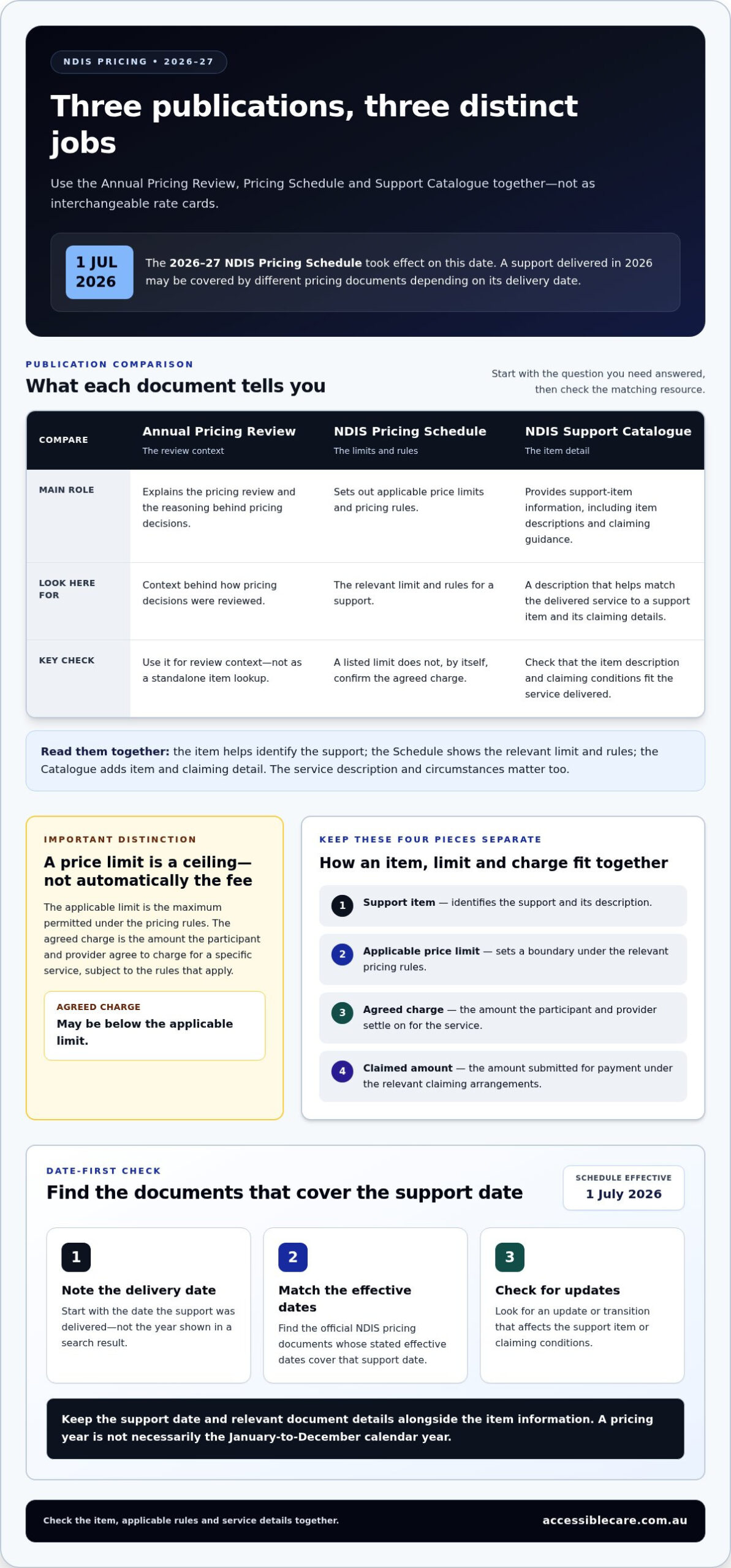
For 2026-27, pricing information is published across three resources rather than in one all-purpose rate card. The Annual Pricing Review explains the review and the reasoning behind pricing decisions. The NDIS Pricing Schedule sets out applicable price limits and pricing rules. The NDIS Support Catalogue provides support-item information, including item descriptions and claiming guidance.
Each resource answers a different question. The item helps identify the support being delivered; the Schedule shows the relevant limit and rules; the Catalogue gives further detail on how an item may be claimed. A listed amount on its own doesn’t confirm that an item fits a particular service or that every claiming condition is met. The service description and circumstances matter too.
This distinction can make pricing easier to discuss. For example, two services that sound similar in everyday language may relate to different support items or have different claiming conditions. The right comparison isn’t simply one number against another. It’s the item, its rules and the service being provided. For wider background on the scheme’s history and structure, see the National Disability Insurance Scheme (NDIS) Wikipedia overview. For pricing decisions, use the current official NDIS publications.
Which 2026 pricing year or document applies?
“2026” may mean the calendar year, from January to December, or shorthand for the NDIS pricing year named in a document. The 2026-27 NDIS Pricing Schedule took effect on 1 July 2026. That means a support delivered in 2026 may fall under different pricing documents depending on its date. Don’t rely on a search result’s year alone.
Use this simple check before comparing a charge:
- Note the date the support was delivered.
- Find the official NDIS pricing documents whose stated effective dates cover that date.
- Check whether the documents describe an update or transition that affects the support item or claiming conditions.
This date-first approach helps prevent an older rate or rule from being applied to a later service, or a newer document from being assumed to cover an earlier one. If you’re reviewing an arrangement, keep the support date and relevant document details alongside the item information. That gives you a clearer basis for understanding the pricing guidance before discussing what was agreed.
How NDIS price limits, support items, and charges fit together
A price check makes more sense when you separate four pieces: the support item, its applicable price limit, the agreed charge and the amount claimed. They’re connected, but they don’t mean the same thing. The item identifies the support and its description. The limit sets a boundary under the applicable pricing rules. The agreed charge is what the participant and provider settle on for the service. The claimed amount is what is submitted for payment under the relevant claiming arrangements.
What is the difference between a price limit and an agreed charge?
A maximum price is a ceiling under the applicable rules, not a mandatory fee that every participant must pay. A provider and participant discuss the support and its charge before it is delivered, taking account of the service details and the rules that apply to the participant’s plan and management type. The agreed charge may be below an applicable limit. The limit alone doesn’t tell you what was agreed or what can be claimed in a particular situation.
For the ndis pricing arrangements 2026, avoid treating a headline limit as a universal rate. Claiming conditions can differ depending on the support item and circumstances, so don’t read a figure in isolation. The official NDIS Pricing Arrangements and Price Limits 2026-27 materials bring together current pricing information and related guidance to help you check the rules behind a figure.
Why does the support item matter?
The NDIS Support Catalogue helps connect a service to a support item and its description, including information relevant to claiming. This matters because everyday language isn’t always precise enough to identify the item. Two services might sound alike in conversation but have different catalogue descriptions or conditions. Matching the item to what was actually delivered is a more reliable starting point than choosing a rate based on a general label such as “therapy” or “support”.
Hypothetical example: A participant arranges a scheduled support session with a provider. Before the session, they identify the catalogue item that best describes the support and discuss the charge and service details. After delivery, the amount claimed is considered against the agreed arrangement and the applicable item rules. If the item or circumstances don’t match, the listed limit alone can’t resolve whether the claim is appropriate. No specific 2026 rate is assumed in this example.
- Support item: Does its description fit the service delivered?
- Price limit: What boundary and pricing conditions apply to that item?
- Agreed charge: What amount was discussed for the service?
- Claimed amount: Does the claim reflect the service and relevant rules?
Keeping these details clear supports a more informed conversation about costs and expectations. Accessible Care provides NDIS support services, including support work and therapy in Melbourne and Adelaide. Explore Accessible Care’s NDIS support services to start a conversation centred on your needs and support arrangement.
How pricing can differ across plan management and support arrangements
Your plan management type affects how funding and payments are administered. It doesn’t automatically determine the charge for a support. To understand a particular arrangement, consider both sides: who handles the payment process and which pricing rules apply to the support, the plan and the date it’s delivered.
For the 2026-27 pricing year, price limits became legally binding for NDIA-managed and plan-managed participants on 24 September 2026. Self-managed participants aren’t bound by those limits. Because rules can change, check the official NDIS pricing publications for the support date and your management arrangement before relying on a comparison.
What should participants compare between management types?
The administrative steps vary. A self-managed participant generally manages payment and claim administration themselves. With plan management, a plan manager handles payment administration. Under NDIA management, payment administration is handled through the NDIA process. These distinctions describe who manages the process, not whether a particular service is funded or what charge has been agreed.
| Management type | Who generally handles payment administration? | Pricing point to verify |
|---|---|---|
| Self-managed | The participant | Confirm the current claiming requirements and how the agreed charge relates to the plan and support. |
| Plan-managed | The plan manager | Check the applicable price rules for the support date and the information needed to process the invoice. |
| NDIA-managed | The NDIA process | Verify the current pricing and claiming conditions that apply to the item and arrangement. |
This is a practical overview, not a substitute for checking current requirements. A management type shouldn’t be treated as a shortcut for working out the right charge. Compare the support item, agreed charge, service details and any conditions that apply to the claim. Check rule-dependent details against the current official NDIS documents.
How do service details affect a pricing discussion?
Clear service information helps everyone understand what an agreed charge covers. Before support begins, discuss the type of support, when it will be delivered and any relevant service conditions. The written arrangement should make those details understandable, so the participant can compare what was agreed with what was provided and what appears on an invoice.
An invoice with a clear service description is easier to review than one that relies on a vague label. If anything is difficult to interpret, compare the description with the relevant support item and claiming guidance. This doesn’t guarantee a particular charge or funding outcome, but it gives you a more useful basis for reviewing the arrangement.
The ndis pricing arrangements 2026 are best read alongside your plan-management context. Keep the support date, item description, agreed service details and applicable conditions together. That simple habit can help you ask focused questions and make informed decisions without assuming every participant follows the same payment or claiming process.
A practical checklist for checking an NDIS price in 2026
A simple, date-first check can help you make sense of a pricing entry before agreeing to support or reviewing an invoice. The goal isn’t to interpret one number in isolation. It’s to connect the right document and support item with the service details, agreed charge and claiming conditions.
A five-step check before agreeing to a support
Work through these steps in order. Keep a note of what you checked, particularly if a pricing update or transition may apply.
- Identify the support date. Note when the service is expected to be delivered, or the date it was delivered. Find a document whose effective period covers that date, rather than relying on a search result labelled only “2026”.
- Find the current official document. Use the relevant NDIS pricing publications and check their dates and any update notices. If the support falls near a changeover, look for guidance explaining which version applies.
- Locate the support item. Read the item description in full and compare it with the support being arranged. Don’t choose an item based only on a familiar-sounding service name.
- Review the limit and conditions. Check the applicable price limit alongside the claiming rules. Then compare these with the proposed charge and the details of the support, including when and how it will be delivered.
- Keep a record. Save or note the document name, version or effective date, item details, agreed service information and any clarification you receive. This makes later invoice reviews easier to follow.
Quick check: Match the support date to the current document, then compare the item, limit, claiming conditions, agreed service and invoice.
What to do when an invoice or price is unclear
Start by placing the invoice beside the service agreement or another record of what was arranged. Does the description make sense in plain language? Does it appear to refer to the support delivered, and can you relate it to the relevant catalogue item? A difference or unclear label is a reason to seek an explanation, not proof on its own that a rule has been broken.
Ask the person responsible for the invoice or arrangement to explain the charge or claiming detail in terms you can understand. Point to the specific line, date or description that raises a question. If the answer doesn’t resolve a question about the rules, consult the current official NDIS guidance for the relevant support and claiming circumstances. Keep the response with your records.
This checklist can help you prepare for a clearer conversation about support arrangements. Accessible Care provides support work and therapy in Melbourne and Adelaide. Explore NDIS support options with Accessible Care.
Putting NDIS pricing guidance into a person-centred support plan
Pricing guidance is one part of planning support. Your goals, preferences and day-to-day needs should remain central, while the service details and applicable NDIS rules help make the arrangement clear. A useful discussion connects what you want support to achieve with what will be delivered, how the charge is agreed and which pricing guidance applies.
How to discuss pricing alongside your support needs
Start by describing what matters to you. You might explain a goal you’re working towards, the kind of support that would help and what you’d like the service to look like. This gives the conversation a person-centred starting point rather than allowing a price limit or catalogue label to define the support on its own.
Then work through the practical details together. Ask for the proposed service and charge to be explained in clear, accessible language. Discuss what the support includes, when it will be provided and any relevant conditions that may affect how it is claimed. You should have the opportunity to understand the arrangement and consider whether it reflects your preferences before moving forward.
It can help to keep a short written summary of the agreed details. For example, if you’re discussing support work, therapy or community nursing, record the support being arranged and the information needed to understand its pricing and claiming context. The relevant item and rules depend on the support and circumstances, so don’t assume similar services share the same pricing conditions. Consider your plan’s available funding alongside the applicable guidance.
Clarity supports choice. If a term or charge is confusing, pause and ask for a plain-language explanation. A respectful discussion should leave you better able to understand what has been agreed, raise questions and make decisions about your supports.
Where Accessible Care fits into the conversation
Accessible Care is a registered NDIS provider serving Melbourne and Adelaide. Participants exploring support work or therapy can bring their goals and preferences into a conversation about the service they’re seeking. Support arrangements can be discussed in relation to the person’s needs, the service details and relevant pricing guidance, without treating a published maximum as a promised or automatic charge.
For example, someone considering therapy may want to discuss the support they’re seeking and how it relates to their goals. A person exploring support work may want to understand the service details and agreed arrangement. In either case, the discussion should help the participant understand what is proposed and retain a meaningful role in decisions about their support.
If you’re considering support work or therapy in Melbourne or Adelaide, talk with Accessible Care about your support needs. A clear conversation can bring your goals, service details and pricing questions together, while keeping your choices at the centre.
Take your next support discussion one step at a time
Your next step doesn’t need to be a perfect grasp of every pricing document. Start with what matters to you: the goals you want to work towards and the kind of support that could help. Bring your questions about service details and charges into the discussion, and take the time you need to understand the arrangement before making decisions.
The ndis pricing arrangements 2026 are a reference point for informed conversations, not a substitute for support shaped around your circumstances. Clear communication can help you connect your priorities with the service being discussed and feel more confident about the choices ahead.
Accessible Care provides support work and therapy in Melbourne and Adelaide. Talk with Accessible Care about support that fits your goals. Your voice belongs at the centre of the conversation, and each clear question is a positive step towards support that feels right for you.
Frequently Asked Questions
What are the NDIS pricing arrangements for 2026?
For the 2026-27 pricing year, NDIS pricing information is published in three documents: the Annual Pricing Review, the NDIS Pricing Schedule and the NDIS Support Catalogue. Together, they explain pricing decisions, applicable limits, support items and claiming guidance. “NDIS pricing arrangements 2026” may be a calendar-year search phrase, but it doesn’t identify the applicable document by itself. Match the document’s effective dates to the date the support is delivered, and check current official updates.
When do the 2026-27 NDIS pricing arrangements take effect?
The NDIS Pricing Schedule for 2026-27 took effect on 1 July 2026. Check the current official publications and update notices for the date of the particular support, especially if it was delivered around a change to pricing rules. For NDIA-managed and plan-managed participants, price limits became legally binding on 24 September 2026 under the 2026 pricing determination. Self-managed participants aren’t bound by those limits.
Is the NDIS price limit the amount every participant must pay?
No. A price limit is a maximum under the applicable pricing rules, not a standard fee every participant must pay. The charge is agreed for the service and needs to be considered alongside its details, the participant’s management arrangement and the rules that apply. For example, if a proposed charge is below the applicable limit, the limit doesn’t require it to be raised. Check the written arrangement and invoice to understand what was agreed.
Can a provider charge more than the NDIS price limit?
It depends on the participant’s management type and the rules applying to that support. From 24 September 2026, price limits are legally binding for NDIA-managed and plan-managed participants; self-managed participants aren’t bound by those limits. This doesn’t mean any charge is automatically claimable or appropriate. Check the current NDIS Pricing Schedule and item conditions for the support date, including any stated exceptions or different treatment.
How do I find the right NDIS support item for a service?
Use the NDIS Support Catalogue to search for an item whose description matches the support delivered, then read its claiming guidance. Don’t rely on a broad label such as “therapy” or on an invoice description alone. Compare the item’s wording with the service’s purpose and details, and check the related pricing rules in the applicable NDIS Pricing Schedule. Use the catalogue version that applies to the support date.
Do NDIS pricing arrangements differ for self-managed and plan-managed participants?
Yes, both payment administration and applicable price rules can differ. A self-managed participant handles their own payment administration, while a plan manager processes invoices for a plan-managed participant. Since 24 September 2026, price limits are legally binding for plan-managed participants, but not self-managed participants. These differences don’t replace support-specific requirements. Check the current guidance for your management type, support item and service date before relying on a price comparison.
What should I do if an NDIS invoice does not match the agreed support?
Compare the invoice with your service agreement and your own record of the support delivered. Look at the date, service description and other details that explain what the charge covers. If something still doesn’t match or is unclear, ask the person responsible for the invoice to explain it in plain language. Keep the invoice and any response, then use current official NDIS guidance if you still have a question about claiming rules.

