


If support feels unsafe or unsuitable, would you know whether to contact the NDIS Quality and Safeguards Commission or the NDIA? It’s understandable to be unsure: both are part of the NDIS, but they have different responsibilities. Understanding the ndis quality and safeguards commission role can help you identify the right pathway when you have a concern.
The Commission regulates NDIS provider conduct and focuses on the quality and safety of supports. The NDIA manages participant access, plans and funding. Knowing the difference helps you direct a concern to the organisation responsible for that issue.
This guide explains what the Commission oversees, what falls outside its role, and how its responsibilities relate to provider standards and participant safety. You’ll also find practical steps for raising concerns about support quality or safety, and for identifying questions better directed to the NDIA. Throughout, the participant’s rights, choices and voice should remain central.
Key Takeaways
- Understand the ndis quality and safeguards commission role and how provider oversight differs from participant planning and funding.
- Learn how provider standards, worker safeguards and incident processes support safer NDIS services.
- Use a practical approach to describe a concern, consider immediate safety and choose an appropriate contact pathway.
- See how regulation supports quality without replacing a participant’s preferences, choices or voice.
- Recognise what respectful, person-centred support can look like in everyday interactions.
What is the NDIS Quality and Safeguards Commission’s role?
NDIS responsibilities can be confusing when a support concern arises. The NDIS Quality and Safeguards Commission, often called the NDIS Commission, is the national regulator for NDIS providers and supports. In plain language, the ndis quality and safeguards commission role is to oversee provider conduct and promote safe, quality supports that respect participants’ rights.
In brief: the Commission regulates the safety and quality of NDIS services; providers deliver those services, and the NDIA manages participant plans and funding. The Commission does not provide support directly or manage an individual’s plan. This distinction helps clarify whether an issue concerns how support is delivered or a decision about a plan.
The Commission sets and oversees regulatory expectations, provides information and guidance, and responds to concerns within its remit. Its purpose is not simply to enforce rules. Safeguards help protect participants from harm, while quality expectations support services that respect each person’s dignity, choices and goals. For general background on the organisation’s purpose and establishment, see the NDIS Quality and Safeguards Commission Wikipedia page.
What does ‘quality and safeguards’ mean in the NDIS?
Quality means delivering supports in line with applicable requirements and with attention to the participant’s goals and preferences. In everyday terms, a worker might listen when a participant explains how they want a task done. Safeguards are protections designed to reduce the risk of harm and help address concerns. A missed appointment or disagreement may need to be discussed, but it does not automatically mean a provider has breached an obligation.
Context matters. A support arrangement may not suit a participant, and the provider may need to understand what happened and respond respectfully. If someone’s immediate safety is at risk, address that promptly. The Commission provides a regulatory pathway for concerns about provider conduct and support safety; it does not replace communication and decision-making between the participant and provider.
Who does the Commission work with?
The Commission works across the NDIS community, including participants, providers, workers, families and the broader community. It provides education and guidance to help people understand expectations and responsibilities, alongside its regulatory activities. Safe support depends on everyday interactions as well as formal rules: people should be treated with dignity, listened to, and supported to exercise choice, control and self-direction.
Understanding the ndis quality and safeguards commission role makes it easier to identify the kind of help you need. A concern about service conduct or safety is different from a question about plan funding. In either case, the participant’s perspective should guide how the issue is understood and what happens next.
NDIS Commission vs NDIA: who handles regulation, plans, and funding?
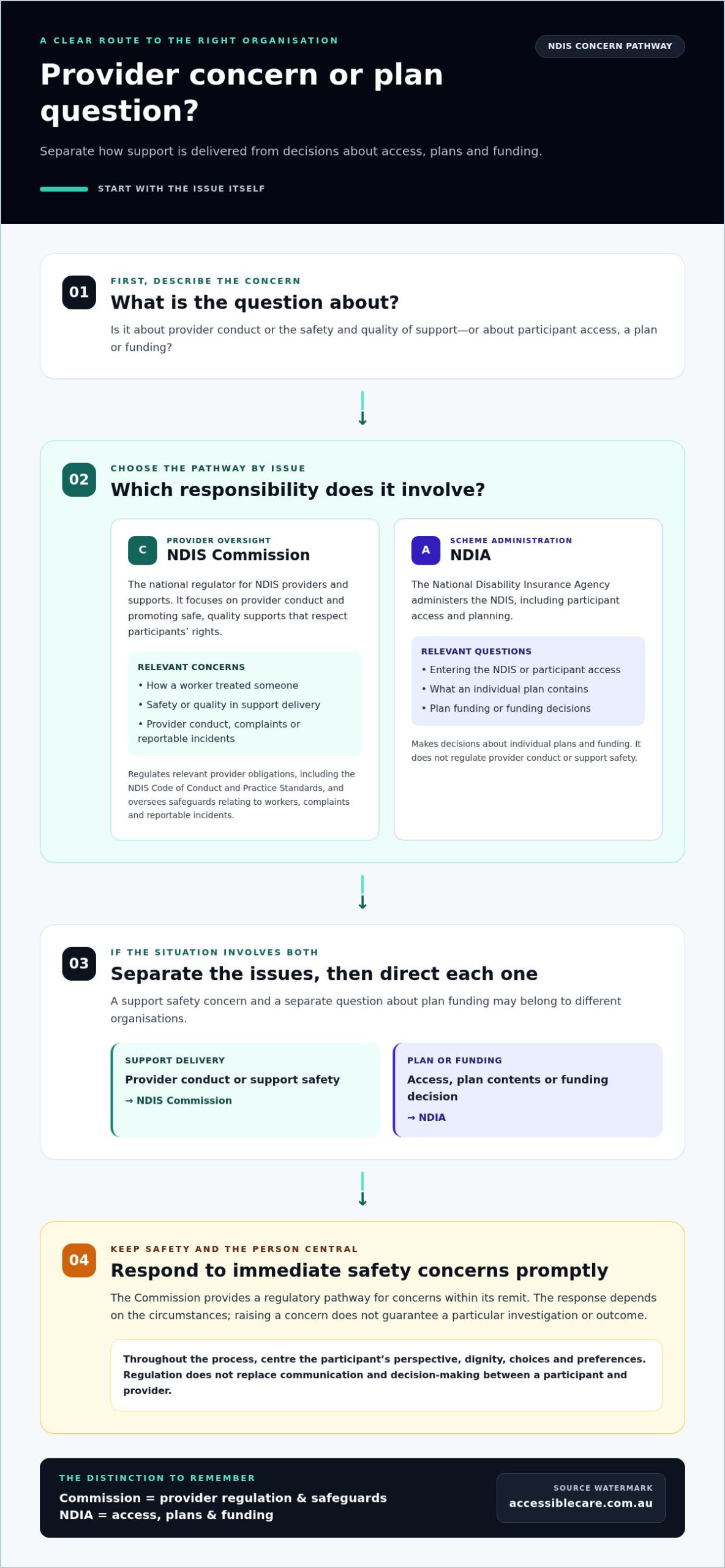
When a question involves both a provider and an NDIS plan, separate the issues: is the concern about how a support is being delivered, or about access, funding or a plan decision? The NDIS is the scheme. The NDIS Quality and Safeguards Commission and the National Disability Insurance Agency (NDIA) are separate organisations with different responsibilities.
The Commission regulates provider conduct and safeguards; the NDIA administers the scheme and participant plans. This distinction is central to the ndis quality and safeguards commission role. The comparison below can help you work out which organisation is relevant to your question.
NDIS Quality and Safeguards Commission
- Regulates NDIS providers and monitors relevant obligations, including the NDIS Code of Conduct and Practice Standards.
- Oversees safeguards relating to workers, complaints and reportable incidents.
- Addresses concerns about provider conduct or the quality and safety of NDIS supports.
National Disability Insurance Agency (NDIA)
- Administers the NDIS, including participant access and planning.
- Makes decisions about individual plans and funding.
- Handles questions about plan contents, access or funding decisions.
What does the NDIS Quality and Safeguards Commission handle?
The Commission focuses on provider regulation and participant safeguards. If you’re concerned about how a worker treated someone or about a safety issue in the delivery of support, the concern may fall within the Commission’s remit. It also deals with complaints and reportable incidents under applicable requirements. The response depends on the circumstances, so raising a concern does not guarantee a particular investigation or outcome. The official NDIS Quality and Safeguards Commission website explains its regulatory work and pathways for concerns.
What does the NDIA handle instead?
The NDIA handles questions about entering the scheme, planning, funding or a decision about an individual plan. For example, a concern about disrespectful provider conduct is different from disagreeing with the funding in a plan. For broader context on the scheme, see this NDIS guide.
Some situations involve both organisations. A participant might have a concern about the safety of a support and a separate question about whether their plan funds a different arrangement. Consider each issue separately and direct it to the organisation responsible for that area. If you’re exploring respectful, person-centred NDIS support services, clear communication about goals and preferences can help keep the participant’s voice central.
How does the NDIS Commission protect participants and regulate providers?
The Commission’s safeguards work across several connected areas: provider requirements, worker-related protections, complaints, reportable incidents and behaviour support. Together, these measures set expectations for safer services and give the regulator ways to respond when concerns arise. The ndis quality and safeguards commission role is not to guarantee that every interaction will go smoothly, but to oversee relevant obligations and address risks within its remit.
Regulation sets expectations and monitors provider compliance; education helps providers and workers understand how to meet those expectations in practice. Both can contribute to safer, more respectful supports, while participants’ views remain central to the services they receive.
Provider standards and worker safeguards
Registered providers must meet the NDIS Practice Standards that apply to their services. These standards describe expectations for safe, quality support and provider systems. The NDIS Code of Conduct sets conduct expectations for all NDIS providers and workers, whether a provider is registered or unregistered. These requirements create a framework, but registration alone cannot guarantee that every support will suit a participant or that every experience will be positive.
Worker safeguards matter too. People in risk-assessed roles working with NDIS participants must have a valid NDIS Worker Screening Check. Screening is one protective measure, not a substitute for respectful conduct, appropriate support or speaking up if something feels wrong. For example, a participant can give feedback if a worker repeatedly ignores their communication preferences, even when there is no immediate danger.
Complaints and reportable incidents
A complaint and a reportable incident relate to safety and service quality, but they are not the same. A participant, family member or other person may make a complaint about a support experience or provider conduct. Separately, providers have obligations to notify the Commission about certain reportable incidents. A provider’s reporting duty does not depend on a participant making a complaint, and a complaint does not automatically mean an incident meets reporting criteria.
Routine feedback still deserves a thoughtful response. A concern about unclear communication or an unsuitable support arrangement may be raised with the provider. A serious safety concern may require urgent attention and contact with the Commission. The appropriate pathway depends on what happened, the level of risk and the applicable requirements. If anyone is in immediate danger, seek urgent help first.
Behaviour support and restrictive practices
Behaviour support oversight aims to promote supports that respect a person’s rights and reduce reliance on restrictive practices. Where restrictive practices are involved, specific safeguards and reporting requirements may apply. The rules can depend on the circumstances and relevant state or territory requirements, so the process may differ between situations. Participants and families can ask how a support plan protects the person’s dignity, preferences and safety.
These protections work best when concerns are heard early and handled with care. Participants can share what feels safe, what does not, and what they want to change. A concern does not need to be proven as a breach before someone can seek information or raise it through an appropriate channel.
When can participants or families raise a concern with the Commission?
Speaking up about support can feel difficult, especially if you’re worried about what might happen next. The participant’s safety, wishes and control should guide the response. A concern may relate to how support is delivered, a person’s treatment or a safety risk. You do not need to decide whether a provider has broken a rule before seeking information or raising what is troubling you.
Use these steps to identify a practical next move:
- Identify the issue. Is it about provider conduct, support quality, safety, or an NDIS plan decision?
- Consider immediate safety. If someone is in immediate danger in Australia, call emergency services on 000. The NDIS Commission is a regulator, not an emergency response service.
- Choose a contact pathway. If it feels safe and appropriate, raise the issue with the provider. You can also contact the Commission about concerns involving NDIS support quality or safety. Plan and funding questions generally belong with the NDIA.
- Keep relevant details. Brief notes can help you describe what happened and what you hope will change.
The right pathway depends on the concern. For example, a participant who feels a worker has ignored their communication needs may speak with the provider or raise a conduct concern with the Commission. If they’re unhappy with the funding allocated in their plan, that is a plan-related issue for the NDIA. The ndis quality and safeguards commission role is to address regulatory matters, not make individual plan decisions.
What information may help when raising a concern?
If useful, note when the issue happened, what took place, who was involved and any steps already taken. Include what outcome the participant hopes for, such as clearer communication or a change to how support is delivered. They can communicate in the way that works for them and involve a trusted supporter if they choose. Share only information relevant to the concern, and review the Commission’s current guidance on how information is handled. Do not assume confidentiality or a particular outcome.
You can raise a concern even if the details are not perfectly organised. Start with what the participant wants the Commission or provider to understand. Their preferences matter throughout, including whether they want a family member or another trusted person involved.
What if the issue is about a plan rather than a provider?
If the question is why a plan includes a particular amount of funding, or whether a support is funded, contact the NDIA about the plan decision. The Commission does not decide an individual’s plan or funding. For background on how the scheme works, the NDIS guide explains the basics.
If you’re looking for respectful, person-centred support that keeps individual goals and preferences in view, explore NDIS support services.
What the Commission’s role means when choosing and receiving NDIS supports
Regulation provides a framework for safe, quality NDIS services, but it does not make decisions for participants or replace their voice. A registered provider’s status is not a guarantee that every interaction will be the right fit. The practical value of the ndis quality and safeguards commission role is that provider obligations create expectations for safe conduct, while participants remain central to decisions about their everyday supports.
Quality also shows up in ordinary moments: being asked how you prefer a task to be done, having information explained in a way you understand, and being treated with dignity. If a support does not feel suitable, feedback can help clarify what needs to change. The participant should be supported to express their view, not spoken over or left out of the conversation.
How can participants stay involved in their supports?
Participants can share what matters to them, including their goals, routines, communication preferences and boundaries. They might explain that they prefer extra time to consider choices, or want instructions given verbally and in writing. These preferences can guide support planning and day-to-day interactions.
- Share goals and preferences in the way that feels comfortable.
- Give feedback if an approach is helpful or needs adjusting.
- Choose whether to involve family members or other trusted people.
Feedback does not have to wait until there is a serious problem. A participant may simply want a worker to check before changing a routine or explain what will happen before support begins. Listening and responding respectfully can keep the support relationship collaborative and centred on the person.
How can a provider support safe, person-centred services?
Providers can put their responsibilities into practice through respectful staff conduct, clear communication and attention to each participant’s dignity and choices. For example, a worker can explain a planned activity, listen to the person’s response and adapt where appropriate. These everyday actions complement formal standards and safeguards; they do not replace them.
Accessible Care is a registered NDIS provider serving Melbourne and Adelaide. Its supports include support work, speech therapy, occupational therapy for children and adults, positive behaviour support and community nursing. Its registration describes its provider status; it should not be read as a Commission recommendation or endorsement. For participants, the important question remains whether support is communicated clearly, delivered respectfully and shaped around their goals and preferences.
As you consider or receive supports, it is reasonable to ask questions and share what helps you feel heard and involved. Accessible Care provides support work, therapy, positive behaviour support and community nursing in Melbourne and Adelaide. Explore its NDIS support services to find out how these supports may fit your goals.
Take your next step with confidence
Knowing the ndis quality and safeguards commission role can help you feel more prepared to speak up, ask questions and take part in decisions about support. You do not need to have everything figured out before starting a conversation. A clear description of what matters to you can be a useful first step towards support that reflects your goals and preferences.
Keep your priorities at the centre. The right support relationship should make room for your voice, your communication style and the choices that shape your day. If you’re exploring options, take the time you need to understand how different supports may fit into your life.
Explore Accessible Care’s NDIS support services and consider what kind of support could help you move towards your goals. Contact Accessible Care to discuss support work, therapy, positive behaviour support or community nursing in Melbourne or Adelaide.
Frequently Asked Questions
Can I make a complaint to the NDIS Quality and Safeguards Commission on someone else’s behalf?
A family member or supporter may be able to raise a concern, but the participant’s wishes, privacy and consent should guide their involvement. For example, you could help someone describe what happened without taking over their choices. Being a supporter does not automatically give you authority to make decisions for them. Check the Commission’s current complaint guidance for its process and any limits on making a complaint for another person.
Can I make an anonymous complaint to the NDIS Commission?
Check the Commission’s current complaint guidance to find out whether and how anonymous reports can be made. Consider what information you’re comfortable sharing: contact details may help the Commission seek clarification or provide updates, while relevant details can help explain the concern. Do not assume a report will remain anonymous or confidential, lead to an investigation, or result in a particular outcome. Keep the participant’s safety and preferences central.
Does the NDIS Commission investigate every complaint?
No. Making a complaint does not mean it will lead to a formal investigation or receive the same response in every case. The Commission considers whether a concern falls within its regulatory role, along with the information available and its current processes. If you’ve raised an issue, consult official Commission guidance about possible next steps. Do not rely on a particular finding, resolution or timeframe, as none can be assumed in advance.
Can the NDIS Commission change my NDIS plan?
No, the Commission does not make individual NDIS plan or funding decisions. It regulates providers and safeguards, while the NDIA handles plan administration. If a provider’s conduct concerns you, that is different from disagreeing with the funding or supports included in your plan. Identify which issue you’re raising, then use current official guidance to find the right pathway. This distinction is central to understanding the ndis quality and safeguards commission role.
What should I do if an NDIS support concern involves immediate danger?
If someone is in immediate danger in Australia, call emergency services on 000. Do not wait for a regulator’s complaint process to respond to an emergency. Once immediate safety is addressed, consider whether to raise a support or provider concern through an appropriate pathway. If there is no immediate danger, take time to identify what happened and whether it relates to provider conduct, support delivery or a plan issue.
Does being a registered NDIS provider mean the Commission endorses a provider?
No. Registration is a regulatory status, not a Commission endorsement or a guarantee of a particular service experience. It does not remove a participant’s right to express preferences or raise a concern if support does not feel suitable. For instance, you can discuss communication needs or a change to a support approach with a provider. Use the Commission’s current guidance to understand what registration means and which concerns it can address.
What is the NDIS Worker Screening Check for?
The NDIS Worker Screening Check is one safeguard intended to help manage risks associated with workers in relevant roles. It is part of a broader safety framework, not a guarantee that every interaction will be safe or suitable. Requirements can depend on current rules and the work involved. For details about who needs a check and how screening works, consult official Commission guidance and keep participant choice and safety in view.

