


What if your child’s meltdowns aren’t a sign of “naughty” behavior, but a physical response to a world that feels overwhelming? When you’re looking into occupational therapy for anxiety in children, you’re often searching for more than just a clinical solution. You’re looking for a way to help your child feel safe again. It’s incredibly difficult to watch your little one struggle with panic while feeling the silent judgment of other parents or teachers. You want your child to feel regulated, yet the path to support often feels buried under confusing NDIS terminology and funding rules.
We understand the weight you’re carrying, and we’re here to help you find clarity. This guide explores how sensory-based strategies can empower your child to manage big feelings and regain their confidence. We’ll share practical tools you can use at home to create a sense of security and discuss ways to help your child feel safe at school. We also provide clear steps on how to access NDIS funding, ensuring you have a smooth pathway to the professional care your family deserves. Together, we can help your child move from a state of fear to a place of calm and connection.
Key Takeaways
- Learn how anxiety affects your child’s daily participation and how their nervous system manages the fight or flight response.
- Discover how occupational therapy for anxiety in children uses a discovery phase to identify unique sensory triggers and emotional needs.
- Explore the three core pillars of support, including sensory regulation and environmental changes tailored to your child’s sensory fingerprint.
- Understand how to use NDIS Capacity Building funding to access professional support for anxiety that impacts your child’s daily life.
- See how a gentle and person-centric approach to therapy helps your child feel safe and regulated during their very first session.
What is Occupational Therapy for Anxiety in Children?
Anxiety often feels like a heavy cloud that follows a child around. While many people focus on the thoughts inside that cloud, What is Occupational Therapy? In our practice, it’s about the “doing.” Occupational therapy for anxiety in children looks at how those big feelings stop your child from joining in on daily life. It’s not just about the emotion; it’s about the missed birthday parties, the school mornings spent in tears, and the difficulty of simply getting through a routine.
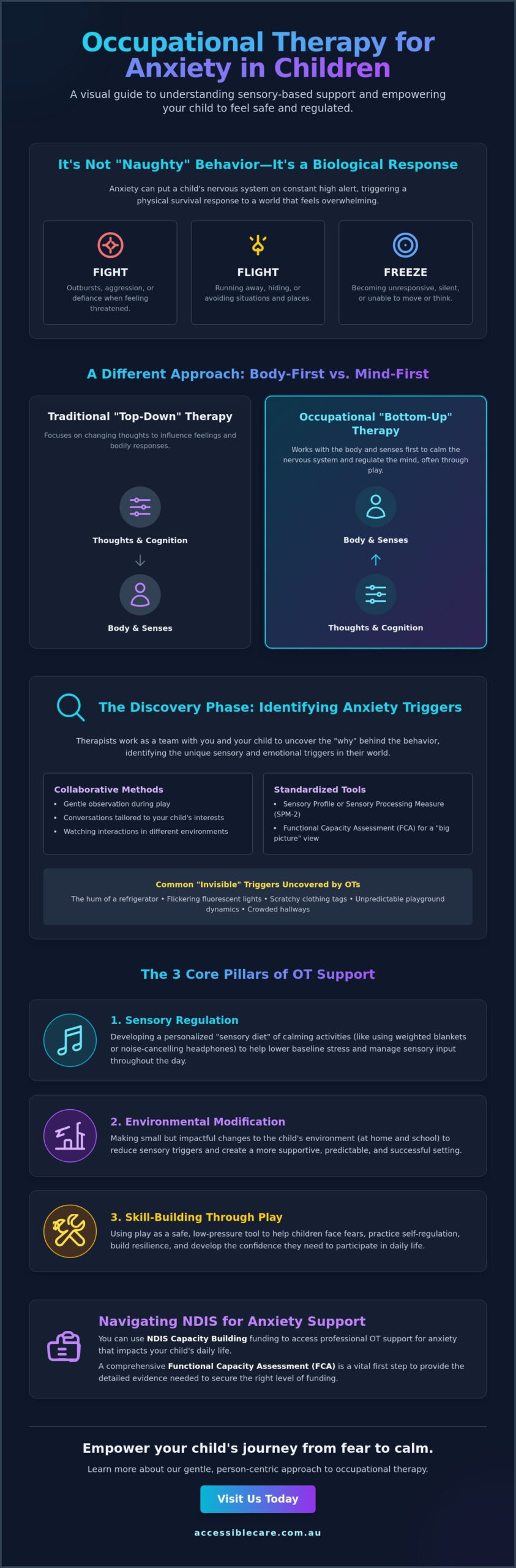
When a child’s nervous system is constantly on high alert, it triggers a “fight, flight, or freeze” response. This is a biological reaction that can make the world feel unpredictable and scary. We treat anxiety by addressing specific sensory triggers and building the self-regulation skills your child needs to feel in control. This improves what we call “occupational performance,” helping your child feel confident in their most important roles: playing, learning, and growing. We want to see your child move from a state of survival to a state of thriving.
The Sensory-Anxiety Connection
Many children with anxiety are also highly sensitive to the sounds and textures of their environment. A loud classroom or a scratchy jumper can feel like a direct threat to their safety. To help, we often create a “sensory diet” of specific, calming activities that help lower their baseline stress levels throughout the day. Sensory modulation is the brain’s volume control for the world. By fine-tuning this control, we help your child feel more grounded and less overwhelmed by the world around them.
Why OT is Different from Traditional Talk Therapy
Traditional talk therapy is often a “top-down” approach that focuses on changing thoughts to influence the body. OT is different because it’s often “bottom-up.” We work with the body and the senses first to calm the mind. Play is our primary language because it offers a safe, low-pressure way to face fears and build resilience. We also don’t believe the child is the only thing that needs to change. We work with you to modify the environment at home or school, making it a supportive place where your child can succeed.
How Occupational Therapists Identify Your Child’s Anxiety Triggers
Identifying what sparks a child’s anxiety can feel like solving a complex puzzle. We approach this as a “discovery phase” where you, your child, and the therapist work as a team. Instead of a clinical interrogation, we use gentle observation and conversation to understand your child’s inner world. We look at their “occupations,” which for a child means play, school, and self-care. By watching how they interact with their toys or move through a room, we can spot the subtle signs of stress that others might miss.
Standardized tools are part of this journey too. We often use the Sensory Profile or the Sensory Processing Measure (SPM-2). These aren’t tests your child can fail. They are simply ways to gather data on how your child’s brain processes information. This helps us see if a child’s anxiety is linked to a specific sensory sensitivity. Understanding how OT helps children manage these sensory inputs is often the first step toward a calmer home life. It’s about finding the “why” behind the behavior.
Sometimes triggers are hidden in plain sight. It might be the hum of a refrigerator, the flickering of a fluorescent light at school, or the unpredictable nature of the playground. When we use occupational therapy for anxiety in children, our goal is to uncover these “invisible” stressors. Once we know what they are, we can build a plan to manage them together. We want to empower your child to navigate their world with a sense of safety and predictability.
The Functional Capacity Assessment (FCA)
An FCA is a foundational part of the process, especially if you are seeking support through the NDIS. It provides a “big picture” view of your child’s independence across all areas of life. It doesn’t just focus on the anxiety itself. It looks at how that anxiety impacts their ability to get dressed, eat, or socialize with peers. This detailed report is vital for securing NDIS funding and ensuring your child receives the right level of care. You can learn more about this process in our guide on What is a Functional Capacity Assessment?
Setting Collaborative Therapy Goals
We believe that therapy is most effective when the goals matter to your family. We don’t set generic clinical targets. Instead, we ask what would make your life easier. Perhaps it’s your child attending a birthday party without a meltdown, or being able to sit through a school assembly. These real-world wins are what we strive for. At Accessible Care, our approach is professional yet deeply gentle. We know that small successes build a child’s “self-efficacy,” which is the belief that they can handle difficult situations. As your child achieves these milestones, their baseline anxiety begins to drop. If you’re feeling overwhelmed by where to begin, our team at Accessible Care is here to walk alongside you.
3 Core OT Strategies for Managing Childhood Anxiety
Every child experiences the world through a unique “sensory fingerprint.” What feels like a gentle breeze to one child might feel like a sharp gust to another. Because of this, occupational therapy for anxiety in children doesn’t use a cookie-cutter approach. Instead, we lean on three core pillars: Sensory Regulation, Emotional Coaching, and Environmental Modification. Our primary goal is regulation, not perfection. We aren’t trying to “fix” your child; we’re helping them find their own rhythm and sense of safety. These core OT strategies are often delivered through specialized paediatric occupational therapy, where play becomes the medium for growth.
Sensory Regulation and ‘Sensory Diets’
When the nervous system is overwhelmed, “heavy work” or proprioception acts as a natural anchor. These are activities that involve pushing, pulling, or carrying, which send calming signals to the brain. We might suggest a “sensory diet” that includes specific tools like weighted blankets for sleep, fidgets for focus, or a dedicated quiet corner at home. Implementing a five-minute sensory break before high-anxiety transitions, like leaving for school, can significantly lower a child’s baseline stress. It gives their body the input it needs to stay grounded during a difficult moment.
Developing Emotional Regulation Skills
Helping a child understand their feelings is a vital step in reducing panic. We often use frameworks like the “Zones of Regulation” to help children name their emotional state using simple colors. We also teach interoception, which is the ability to notice what’s happening inside the body. Does their heart race? Do their palms get sweaty? Do they feel “butterflies” in their tummy? Recognizing these physical signs of anxiety allows a child to use a calming strategy before a meltdown occurs. Naming a feeling is the first step to taming it.
Executive Functioning and Predictability
Anxiety thrives on the unknown. We use visual schedules to turn a chaotic morning into a predictable sequence, providing a sense of safety through structure. We also use a technique called “scaffolding,” where we break down scary tasks into tiny, manageable steps. If a child is struggling with school refusal, we don’t start by demanding they stay for the whole day. We might start by simply driving past the school, then walking to the gate, and gradually building up. This builds their confidence slowly and respectfully. These practical adjustments to daily routines help your child feel empowered to face their day with a little less fear and a lot more support.
Navigating the NDIS for Anxiety Support in Melbourne and Adelaide
Understanding the NDIS can feel like learning a second language while you’re already exhausted. If your child’s anxiety significantly impacts their ability to participate in daily life, they may be eligible for support. Anxiety is often recognized as a primary or secondary disability when it creates a functional impairment. This means if the anxiety stops them from attending school, socializing, or caring for themselves, occupational therapy for anxiety in children can often be funded. We provide this specialized support across both Melbourne and Adelaide, helping families find a path forward through the system.
Most therapy supports fall under the “Capacity Building” budget category in an NDIS plan. This specific funding is designed to help your child develop the skills they need to become more independent over time. It’s different from “Core Supports,” which usually cover everyday consumables or support workers. For peace of mind and professional guidance, it’s often best to partner with a registered NDIS provider in Melbourne who understands the intricacies of the scheme.
How to Access OT Funding for Anxiety
To access funding, you’ll generally need a formal diagnosis or clear evidence of how the anxiety impacts your child’s function. The NDIS requires an “Evidence of Disability” form completed by a health professional. This document tells the story of your child’s challenges and why therapy is “reasonable and necessary.” If you’re feeling overwhelmed by the paperwork, a support coordinator can be an invaluable ally. They help you maximize your therapy budget and connect you with the right specialists for your child’s unique needs.
Choosing the Right Provider in Victoria and South Australia
A multidisciplinary team is often the gold standard for complex anxiety. Having access to an OT, Speech Pathologist, and Positive Behaviour Support (PBS) specialist under one roof ensures your child’s care is consistent. We know that getting to a clinic can sometimes be a trigger in itself. That’s why Accessible Care offers mobile services throughout Melbourne and Adelaide. We meet your child where they feel safest. For families dealing with complex or severe anxiety, choosing a provider experienced in “High Intensity Supports” ensures that the therapy is both safe and effective. If you are ready to start this journey, you can contact our NDIS support team to discuss your child’s plan.
How Accessible Care Supports Your Child’s Journey
At Accessible Care, we believe that every child deserves to feel safe and understood. Our philosophy isn’t about clinical checklists; it’s about building a supportive partnership with your family. When you begin occupational therapy for anxiety in children with us, our first priority is always your child’s comfort. We know that a new environment can be a trigger for many, so our initial sessions are designed to be exceptionally gentle. We follow your child’s lead, using play and attentive listening to create a space where they feel empowered to be themselves. This respectful approach helps build the trust necessary for meaningful progress.
One of the unique benefits of working with our team is the continuity of care we provide. We offer both specialized paediatric therapy and adult services. This means we can walk alongside your child as they grow, providing consistent support through every developmental milestone. You won’t have to start from scratch with a new provider just because your child has reached a certain age. We are here for the long term, ensuring your child always has a familiar face and a trusted advocate in their corner. This stability is often a key factor in reducing anxiety for both the child and the parent.
A Holistic, Multidisciplinary Approach
Anxiety rarely exists in a vacuum. It often intersects with communication challenges or behavioral needs that require a broader perspective. That’s why our OTs work closely with our Speech Pathology and Positive Behaviour Support teams. This holistic approach ensures that every aspect of your child’s well-being is considered. We also prioritize the “attentive listening” promise. We hear your concerns as a parent just as clearly as we observe your child’s needs. In our practice, you aren’t just a bystander; you are an active partner in the therapy process. Your insights into your child’s daily life are the most valuable tools we have.
Take the First Step Toward Calm
Seeking support is a powerful act of advocacy for your child. It shows that you are listening to their needs and looking for ways to help them thrive in a world that can sometimes feel overwhelming. If you’re ready to explore how occupational therapy for anxiety in children can help your family, we invite you to reach out for a low-pressure consultation. Our teams in Melbourne and Adelaide are ready to listen and help you navigate the next steps with clarity and compassion. You don’t have to manage this journey alone. Contact Accessible Care today to find a compassionate OT for your child and start the move toward a calmer, more confident future.
Empower Your Child to Move Forward with Confidence
Helping your child manage anxiety is a journey of discovery and small, meaningful wins. By focusing on sensory regulation and creating predictable environments, you can help your child feel safe in their body and their world. We’ve explored how occupational therapy for anxiety in children provides the practical tools needed to turn daily struggles into moments of connection and growth. Whether it’s through a tailored sensory diet or navigating the complexities of NDIS funding, professional support is available to help your family find its calm again.
At Accessible Care, we’re proud to be a Registered NDIS Provider with an experienced paediatric multidisciplinary team. We offer mobile services across Melbourne and Adelaide, meeting you and your child in the comfort of your own home. Our goal is to provide professional, empathetic care that respects your family’s unique needs. If you’re ready to take the next step, we’re here to listen and help. Book a Compassionate Consultation with an Accessible Care OT today. You don’t have to navigate this path alone; we’re ready to walk beside you.
Frequently Asked Questions
Can an occupational therapist diagnose anxiety in my child?
An occupational therapist does not provide a clinical diagnosis of anxiety; this is typically the role of a GP, paediatrician, or psychologist. However, an OT is essential in assessing how anxiety symptoms impact your child’s ability to participate in daily life. We focus on functional challenges, such as sensory sensitivities or difficulty with school routines, and provide detailed evidence that can support a formal diagnosis from other medical specialists.
How many OT sessions will my child need to see an improvement in their anxiety?
The number of sessions required varies for every child because there’s no “one size fits all” approach to therapy. Some families notice small improvements in regulation after just a few weeks, while others benefit from longer-term support to reach complex goals. We work with you to set clear milestones and regularly review progress to ensure the therapy remains effective and meaningful for your child’s specific needs.
Is occupational therapy for anxiety covered by the NDIS?
Yes, occupational therapy for anxiety in children is often covered by the NDIS if the anxiety significantly affects their daily functioning. Funding is usually accessed through the “Capacity Building” budget category. Our team can help you understand how to use your child’s plan to access these essential supports, ensuring they have a smooth pathway to feeling safer and more regulated in their everyday environments.
What is the difference between a psychologist and an OT for anxiety?
My child refuses to leave the house; can an OT come to our home in Melbourne?
Yes, our team provides mobile services across Melbourne and Adelaide to support children who find it difficult to leave their safe space. We understand that school refusal or homebound anxiety requires a gentle, flexible approach. By meeting your child in their natural environment, we can better identify hidden triggers and implement calming strategies where they feel most secure and comfortable.
What age can a child start occupational therapy for emotional regulation?
Children can start occupational therapy for emotional regulation as early as the toddler years through early intervention programs. If you notice your little one has frequent, intense meltdowns or seems easily overwhelmed by sensory input, it’s never too early to seek guidance. Early support helps build a strong foundation for resilience before they transition into the more structured environment of primary school.
Will the OT work with my child’s school and teachers?
Collaboration with schools and teachers is a core part of our approach to ensure your child has consistent support. We can provide sensory profiles to teachers, suggest classroom modifications, and help develop “calm down” plans for the school day. This partnership ensures that the strategies your child learns in therapy are reinforced in the classroom, helping them feel safe and successful while they learn.
What should I bring to my child’s first OT assessment?
For the first assessment, it’s helpful to bring any previous reports from paediatricians or psychologists and a copy of your child’s NDIS plan. You might also find it useful to jot down a few notes about your child’s specific triggers, their strengths, and the goals you hope to achieve together. This information helps us jumpstart the discovery phase and create a personalized plan that truly reflects your family’s unique needs.

