


What if changing your NDIS provider wasn’t a sign of something going wrong, but a brave step toward getting the support you actually deserve? It’s completely natural to feel a heavy weight of anxiety when considering the changing ndis providers process. You might worry about losing the continuity of your speech or occupational therapy; perhaps you even feel a sense of dread about the confrontation of leaving. We understand that these feelings come from a place of deep care for your autonomy and your future.
You deserve a support system that truly listens and aligns with your personal goals. We promise to help you navigate this transition with confidence, ensuring you maintain your essential services without any stressful gaps. This guide covers everything from managing notice periods and service agreements to aligning your supports with the new 2026 NDIS tiered registration system and updated planning requirements. Together, we can ensure your journey remains focused on your growth and peace of mind.
Key Takeaways
- Understand how to exercise your right to choice and control to ensure your supports align with your personal goals for 2026.
- Follow a gentle, five-step roadmap for the changing ndis providers process to maintain your continuity of care without any gaps.
- Learn the practical details of navigating service agreements and notice periods to make your transition as smooth as possible.
- Discover the essential qualities to look for in a new partner, from their communication style to their registration and safety standards.
- See how a supportive provider can handle the administrative heavy lifting, allowing you to focus on your wellbeing and peace of mind.
Understanding Your Right to Choice and Control in 2026
The National Disability Insurance Scheme (NDIS) was built on a single, powerful idea: you are the expert in your own life. This is often referred to as “Choice and Control.” It isn’t just a policy term; it’s a foundational promise. Choice and Control is the legal right of every NDIS participant to direct their own life. This means you have the power to decide who supports you, how those supports are delivered, and when it’s time for a change.
By the time we reach 2026, many participants find their needs have evolved. The plan you started years ago might not fit the person you are today. Perhaps you’ve recently moved to Melbourne or Adelaide and need local expertise. Maybe your communication with your current team has drifted, or your goals have shifted from early intervention to community participation. Whatever the reason, the changing ndis providers process is a tool designed to keep your care aligned with your reality. You don’t need a “valid” excuse or a documented failure to seek a new partner. Your comfort and peace of mind are reason enough to explore better options.
When is the right time to change providers?
Identifying the right moment for a transition often starts with a feeling. You might notice high staff turnover, which makes it hard to build a trusting relationship. Perhaps your progress has felt stagnant for months. If you are entering a new life stage, such as starting school or seeking employment, you may require a different set of skills than your current provider offers. A provider that offers a multidisciplinary team can be vital here, as they bring together various experts to support complex, changing goals. If your current team no longer feels like a bridge to your future, it’s likely time to begin the changing ndis providers process.
Overcoming the anxiety of transitioning
It’s completely normal to feel a sense of guilt when leaving a long-term provider. You’ve shared your story and your home with these people. However, choosing a new path isn’t a betrayal. It’s a proactive step toward your own growth. Try to frame the conversation as a business decision focused on your evolving objectives. When you prioritize your own needs, you aren’t being difficult; you’re simply exercising your rights. Every participant deserves a support team that listens, adapts, and honors their autonomy without hesitation.
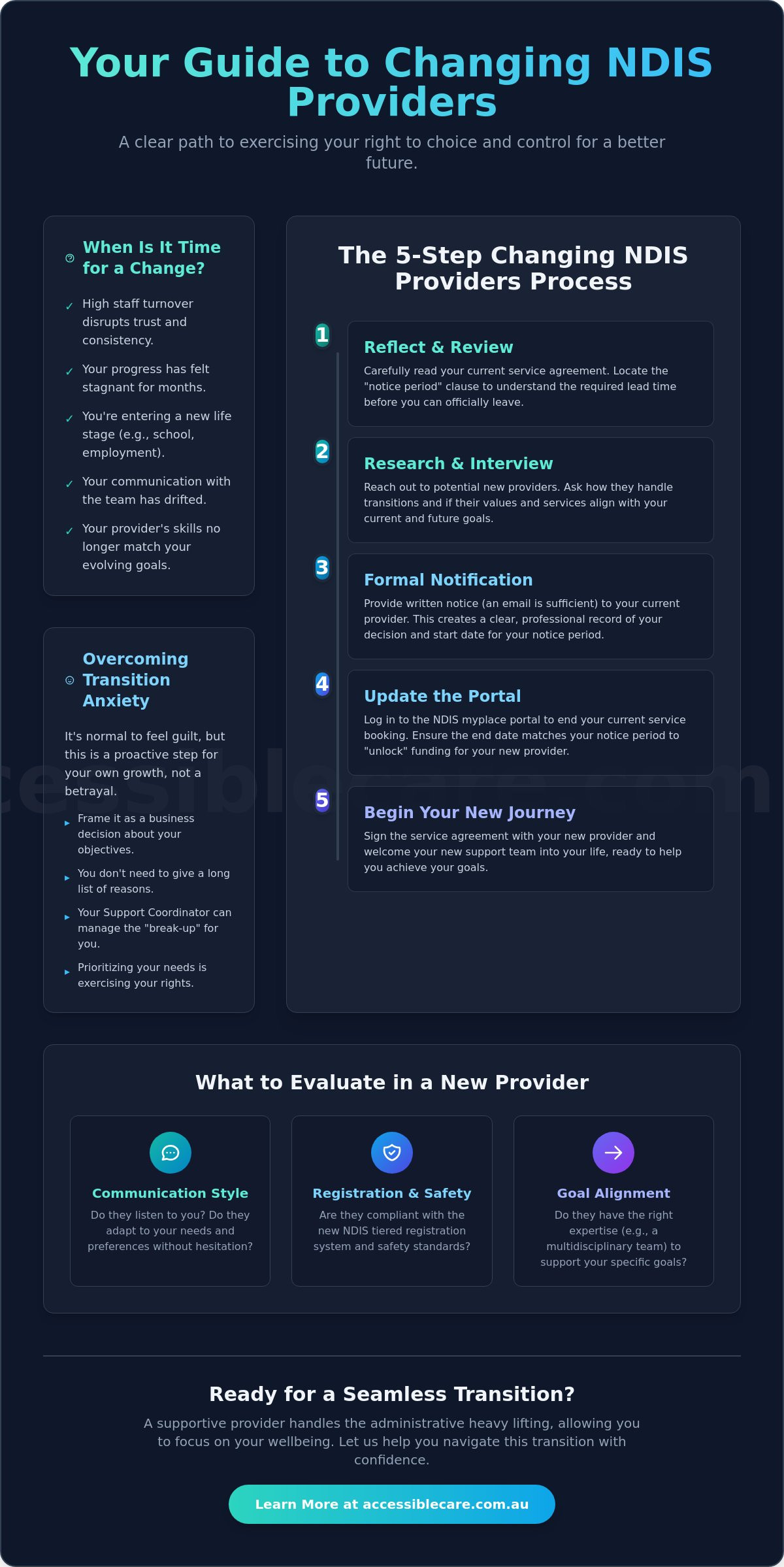
The 5-Step Changing NDIS Providers Process
Transitioning to a new support team doesn’t have to be overwhelming. When you follow the official NDIS 5-step process, you gain a clear roadmap that protects your continuity of care. This structured approach ensures you remain in the driver’s seat of your own life while minimizing administrative stress. The changing ndis providers process is designed to be a bridge to better support, not a barrier.
- Step 1: Reflect and Review. Carefully read your current service agreement. Look for the “notice period” clause, which tells you how much lead time you must give before leaving.
- Step 2: Research and Interview. Reach out to potential new providers in Melbourne or Adelaide. Ask them how they handle transitions and if their values align with your 2026 goals.
- Step 3: Formal Notification. Provide written notice to your current provider. This creates a clear, professional record of your decision.
- Step 4: Update the Portal. Log into the NDIS myplace portal to end your current service booking, ensuring the end date matches your notice period.
- Step 5: Begin Your New Journey. Sign your new service agreement and welcome your new team into your life.
Notifying your current provider
Writing a notice of termination can feel intimidating, but it’s a standard part of any professional relationship. You don’t need to provide an exhaustive list of reasons. A simple email stating your intended end date is often enough. If you feel unsafe or deeply uncomfortable speaking with them directly, you don’t have to do it alone. Your Support Coordinator can facilitate this “break-up” for you. They act as your advocate, ensuring the conversation remains focused on your rights and your future. If you’re feeling stuck, a compassionate partner like Accessible Care can offer guidance on how to manage these delicate conversations with dignity.
Managing the NDIS Portal updates
It’s vital to understand the difference between ending a service booking and ending a relationship. The portal update is the technical step that “unlocks” your funding for your new provider. You’ll need to coordinate this closely with your Plan Manager to avoid any payment overlaps or budget errors. Before you log in, have your current provider’s NDIS number and your agreed-upon final service date ready. Keeping everyone in the loop ensures your speech or occupational therapy continues without a single day of interruption. By following the changing ndis providers process carefully, you protect the funding meant for your growth.
Navigating Service Agreements and Notice Periods
A service agreement is more than just a contract; it’s a document that protects your rights and outlines what you can expect from your support team. One of the most important parts of the changing ndis providers process is understanding your notice period. This is the amount of time you agree to give your provider before your services stop. These periods exist to allow for safe and organised provider transitions, giving the team time to finalize their documentation and ensure you aren’t left without support during the move.
The NDIS Commission and your protections
The NDIS Quality and Safeguards Commission ensures you are treated with respect throughout the changing ndis providers process. You have the legal right to be free from coercion or “sharp practices.” This means a provider cannot pressure you to stay, withhold your information, or make it difficult for you to move on. If a provider refuses to release your funding or acts unprofessionally, you can lodge a formal complaint with the Commission. A respectful exit also includes the professional transfer of your clinical records. Ensuring your speech pathology or occupational therapy notes are shared with your new team is essential for maintaining your progress.
Transitioning complex or high-intensity care
Moving between providers requires extra care when you rely on high intensity supports NDIS. These services often involve community nursing or positive behaviour support, which require a detailed clinical handover to keep you safe. You’ll want to ensure your new team fully understands your specific medical or behavioural requirements well before the first day of service. Safety and continuity are the primary goals during a complex care handover. By focusing on a clear exchange of information, you can transition to a new partner without risking your health or your peace of mind.
Finding a New Partner: What to Evaluate
Choosing a new partner is the most empowering part of the changing ndis providers process. It’s your opportunity to find a team that doesn’t just provide services, but truly honors your vision for your life. When you first reach out, pay close attention to the “vibe” and communication style of the team. Do they listen more than they talk? Do they show genuine empathy for your situation? A provider that prioritizes your autonomy from the very first phone call is likely to respect your self-direction throughout your entire journey.
Safety and quality are also non-negotiable. Ensure your potential new partner is registered and adheres to the latest NDIS Quality and Safeguards standards. By December 2026, all providers must re-register under the new tiered registration system, which is designed to increase accountability. Choosing a provider with local offices in Melbourne or Adelaide offers a distinct advantage. Local teams understand the specific community resources available to you and can often provide more responsive, face-to-face support when it matters most. Don’t hesitate to ask about their specific experience with your disability, whether you are living with MND or a complex neurological condition.
Questions to ask a potential new provider
Before you commit to a new service agreement, it’s helpful to have a direct conversation about how the provider manages day-to-day care. Consider asking these specific questions:
- “How do you handle staff absences to ensure my essential care isn’t interrupted?”
- “Can I meet my therapists, such as my Speech Pathologist or OT, before I sign the agreement?”
- “How do you involve me and my family in the goal-setting and review process?”
A trustworthy provider will welcome these questions and offer clear, direct answers that put your mind at ease.
The value of a holistic, multidisciplinary approach
There is immense value in choosing a provider that offers a holistic, multidisciplinary team. Having your Occupational Therapy, Speech Therapy, and Community Nursing under one roof simplifies your life and reduces administrative heavy lifting. Integrated teams communicate with each other constantly, ensuring that your progress in one area supports your goals in another. This level of coordination is especially vital for those living with an acquired brain injury or other complex needs. When your therapists work together, your care feels like a seamless partnership rather than a series of disconnected appointments.
If you want a partner who listens first and acts with heart, reach out to Accessible Care to discuss your transition today.
How Accessible Care Supports Your Seamless Transition
At Accessible Care, we believe that the changing ndis providers process should be a period of renewal rather than a source of stress. We’ve built our entire intake approach around a “Listen First” philosophy. This means we don’t start by looking at your funding or your files; we start by looking at you. We want to hear about your dreams, your daily challenges, and what you hope to achieve in 2026. By putting your voice at the center of the conversation, we ensure that every support we provide is a true reflection of your autonomy and self-direction.
We understand that the administrative heavy lifting of a transition can feel overwhelming. That’s why our team takes an active role in helping you navigate the technicalities we’ve discussed, from coordinating with your Plan Manager to ensuring your new service agreement is clear and fair. Our intake process is designed to be reassuring and thorough. We take the time to get every detail right, so your transition feels like a gentle step forward rather than a leap into the unknown. We are here to walk beside you, ensuring your voice is heard at every stage of the changing ndis providers process.
Our presence in Melbourne and Adelaide
Our deep roots in Melbourne and Adelaide allow us to offer more than just therapy; we offer community connection. We maintain strong relationships with local health networks across Victoria and South Australia, which helps us coordinate your care more effectively. Whether you need experienced Speech Language Pathologists to help with communication or OTs to modify your home environment, our regional teams are ready to help. For those with complex medical needs, our community nursing team provides expert, compassionate support right in the comfort of your own home, ensuring safety and professional care are always within reach.
Taking the first step toward a better partnership
Choosing a new provider is a significant decision, and we want you to feel completely confident in your choice. We invite you to book a no-obligation consultation to discuss your goals and see if our “Listen First” approach feels right for you. Our promise is simple: we are here to support your journey, not just manage your plan. We view ourselves as facilitators of your independence, dedicated to helping you live the life you choose with dignity and joy. Your peace of mind is our highest priority, and we are ready to prove it through our actions and our care.
Contact Accessible Care today for a compassionate transition to better support.
Embracing Your Journey Toward Better Support
Your future is shaped by the choices you make today. We’ve explored how the changing ndis providers process is a powerful expression of your right to choice and control. By understanding your notice periods and following a clear, five-step plan, you can transition to a team that truly honors your autonomy. Remember that your comfort and progress are the only justifications you need for seeking a better partnership. You deserve a team that doesn’t just manage a plan, but actively listens to your unique story and values.
At Accessible Care, we’re proud to be a Registered NDIS Provider specializing in Speech and Occupational Therapy. Our local experts in Melbourne and Adelaide are ready to provide the specialized support you need with a gentle, professional touch. We handle the administrative complexities of your move so you can focus on your wellbeing and growth. It’s our mission to ensure your transition is smooth, respectful, and entirely focused on your self-direction.
Experience a more compassionate way of care; switch to Accessible Care today
You don’t have to navigate this change alone. We’re here to guide you toward a partnership built on trust, empathy, and mutual regard. Your next chapter begins with a single, courageous step toward the support you deserve.
Frequently Asked Questions
Can I change NDIS providers at any time?
Yes, you have the legal right to change your providers whenever you feel your current supports no longer align with your goals. This is a fundamental part of your right to choice and control within the scheme. You don’t need to wait for a plan review to make a move; you simply need to follow the notice period outlined in your current service agreement.
Do I have to tell my current provider why I am leaving?
No, you aren’t required to provide a specific reason or justification for your decision to leave. While some participants choose to offer feedback to help a provider improve, your privacy and comfort are paramount. A simple, professional written notice stating that you’re ending the service is all that’s necessary to begin your transition to a new partner.
How long does the process of changing NDIS providers take?
The duration of the transition usually depends on the notice period in your current contract, which is typically 14 to 28 days. Once this period is honored, the technical changing ndis providers process in the myplace portal can be completed almost immediately. We recommend starting your research for a new provider early to ensure there’s no gap in your essential therapies.
Will I lose my NDIS funding if I change providers mid-plan?
No, your NDIS funding belongs to you and stays with your plan regardless of which provider you choose. When you end a service booking with one organization, those funds are released and become available for your new provider to claim. This ensures you can move between services without losing the financial support you’ve been allocated for your care and development.
What is a reasonable notice period for an NDIS service agreement?
In the disability support industry, a notice period of 14 to 28 days is generally considered fair and standard. This timeframe allows your current team to finalize their documentation and conduct a safe handover of your care. It also gives your new provider enough time to prepare their team and set up your initial appointments for a seamless start.
Can my current provider charge me an “exit fee”?
Generally, providers are not permitted to charge “exit fees” or financial penalties simply for choosing to leave their service. Under the NDIS Pricing Arrangements, you are only responsible for paying for the supports actually delivered during your agreed notice period. If a provider attempts to charge an arbitrary fee for leaving, you can seek guidance from the NDIS Commission.
How do I transfer my therapy progress notes to a new provider?
You can formally request a copy of your progress notes or a summary report from your current therapists at any time. These records are vital for the changing ndis providers process because they help your new Speech or Occupational Therapy team understand your history. Having these notes ensures your progress continues steadily without having to repeat assessments or start from the beginning.
What if I am unhappy with my Support Coordinator or Plan Manager?
You have the same right to change your Support Coordinator or Plan Manager as you do any other service provider. If you feel your current coordinator isn’t listening or your plan manager is difficult to reach, you can look for a new partner who offers better communication. Finding the right administrative support is key to feeling empowered and at peace with your plan.

