


Early assessment can help families understand what a child is experiencing. Stuttering can involve repeating or prolonging sounds, words or phrases, or moments when speech stops altogether. Speech therapy for stuttering in children in Adelaide can begin with an assessment of whether a child is stuttering, how often it happens and the types of stutters they experience.
It’s understandable to wonder whether changes in your child’s speech are part of typical development or a sign they could benefit from support. Some children aged two to five experience non-fluency that fades over time. An individual assessment can help clarify what’s happening and whether support may help.
Here, you’ll learn what stuttering can look and sound like, what a speech pathologist considers during an assessment, and how therapy can be tailored to a child’s needs. You’ll also find practical ways to support communication at home and in everyday settings around Adelaide.
Key Takeaways
- Seeking advice from a speech pathologist early can help you understand your child’s communication and discuss suitable support.
- Notice whether speaking feels harder for your child in particular situations, and share those observations during an assessment.
- Stuttering isn’t caused by parenting or a child’s intelligence, and telling a child to try harder isn’t a solution.
- With your child’s needs in mind, coordinate supportive approaches at home and, when helpful, with their childcare centre, kindergarten or school.
Speech pathologist assessment and personalised treatment
A speech pathology assessment can clarify whether a child is stuttering and what support may suit them. In Adelaide, assessment and treatment can take account of the child’s speech, everyday communication and family priorities.
Early Stuttering Assessment
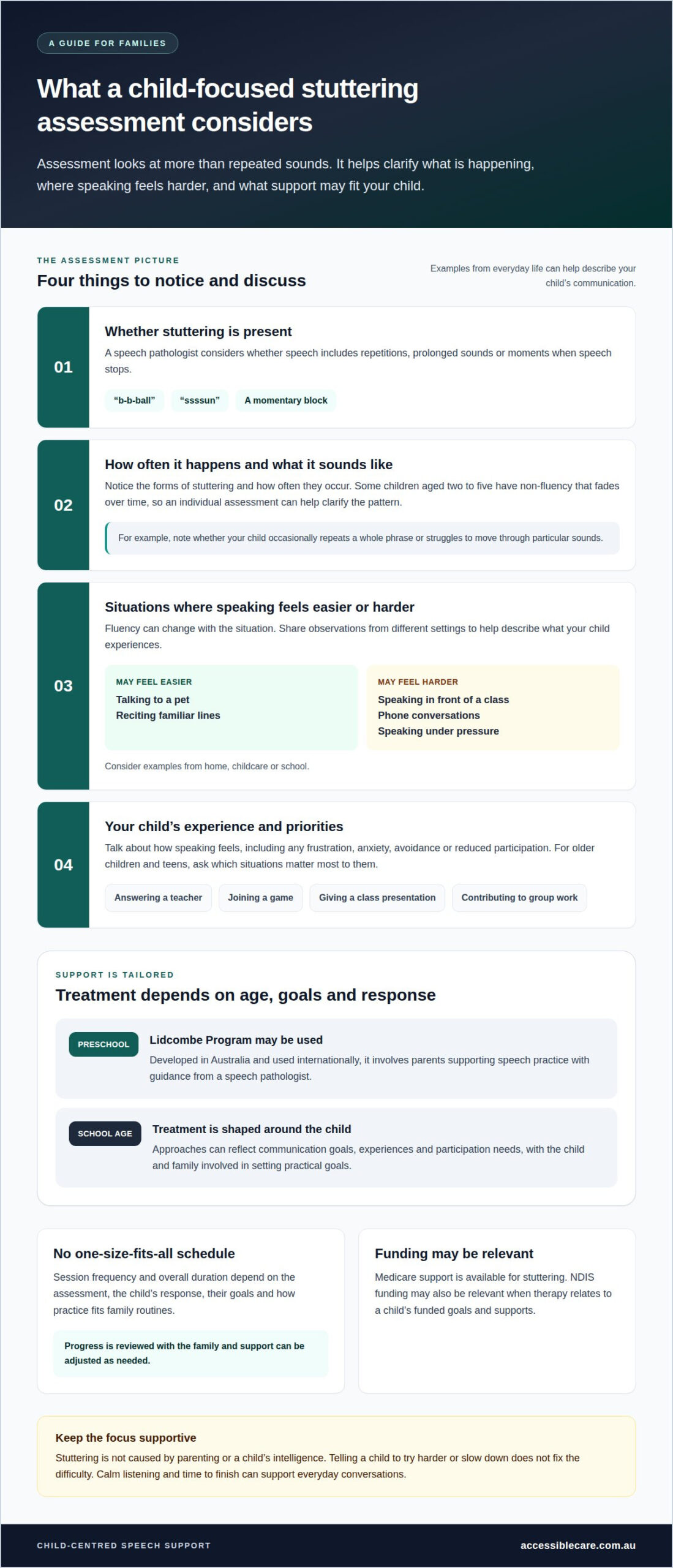
A speech pathologist can assess whether stuttering is present, how often it occurs and which types of stutters the child experiences. Parents can seek advice as soon as they suspect stuttering rather than waiting to see if it passes. Children who stutter can benefit from early intervention, including during the preschool years.
Parents can contact an Adelaide speech pathology service to discuss an assessment. Referral requirements depend on the funding pathway. Share examples of when speech feels easier or harder, along with any concerns about talking at home, childcare or school.
Personalised Treatment Approaches
For preschool children, speech pathologists may use the Lidcombe Program, developed in Australia and used internationally. Parents support their child’s speech practice with guidance from a speech pathologist. For school-age children, treatment is tailored to their communication goals, experiences and participation needs. The clinician can explain the approach and involve the child and family in setting practical goals.
Session Frequency and Treatment Duration
There is no single schedule that suits every child. Session frequency and overall duration depend on the assessment, the child’s response to treatment, their goals and how practice fits family routines. A speech pathologist reviews progress with the family and adjusts support as needed. Ask how progress will be discussed and how activities at home or school connect with each goal.
Speech pathologists are trained professionals who assess communication and plan support. Adelaide families can access speech pathology locally, with an assessment focused on the child rather than a standard clinic template. Medicare support is available for stuttering. NDIS funding may also be relevant when speech therapy relates to a child’s funded goals and supports.
Signs and characteristics of stuttering
Stuttering affects speech fluency, but it can sound different from one child to another. The pattern may also change between a relaxed conversation and a pressured speaking situation.
Common Fluency Difficulties
Some children aged two to five have non-fluency that fades over time. They might repeat a word or phrase while organising their thoughts, then continue speaking without getting stuck. Notice the form and context. For example, does a child occasionally repeat a whole phrase, or do they struggle to move through particular sounds in everyday conversation?
Fluency can vary by situation. A child may speak more easily to a pet or while reciting familiar lines, but find speaking in front of a class, on the phone or under pressure harder. These differences can help describe the pattern. Note examples from different settings, such as playing at home and sharing news at school.
Recognising Stuttering Signs
Stuttering can involve repeating or prolonging sounds, words or phrases. A child might say “b-b-ball”, stretch the first sound in “ssssun”, or repeat “I want, I want, I want”. Another sign is a block, when the child seems ready to speak but no sound comes out for a moment. These behaviours relate to the control and coordination of speech.
Look beyond the repeated sounds. A child might avoid a particular word, show frustration, or become anxious or self-conscious about speaking. They may participate less in class or social situations. Stuttering isn’t a measure of intelligence or personality, and parents don’t cause it through how they interact with their child. Telling a child to try harder or slow down doesn’t fix the difficulty. Calm listening and patient responses can support everyday conversations. For practical ideas, explore ways to support communication at home.
Supporting families of children who stutter
Families can support communication by giving a child time to finish talking without interruption. During dinner, for example, pause and listen instead of completing a sentence or asking the child to slow down. These small changes keep attention on the child’s message, not just the sounds they make. Parents don’t cause stuttering, and a child can’t fix it simply by trying harder.
Notice how your child feels about speaking, as well as what you hear. A child who avoids ordering food, answering a teacher or joining a game may be feeling anxious or frustrated. Respond without pressure: acknowledge their message, keep the conversation going and let them choose whether to discuss stuttering. A speech pathologist can offer families information and practical activities for home or school practice.
Older children and teens can take an active role in deciding what support looks like. Ask which situations matter most to them, such as giving a class presentation, calling a friend or contributing to group work. Goals based on their own priorities can help them practise communication in meaningful settings. Avoid turning participation into a test of fluency. Listening to their preferences supports confidence and choice.
Medicare support is available for stuttering. Families can raise Medicare with the speech pathologist when discussing assessment and therapy arrangements. The child’s support plan should also account for where communication challenges arise, whether at home, school or social activities. This connects therapy goals with the conversations and situations the child wants to manage.
With the child’s agreement, share useful information with their childcare centre, kindergarten or school teacher. For example, explain that the child may need time to finish an answer and should not be rushed or spoken for. Consistent responses at home and school can make everyday conversations more supportive. Keep the child involved in deciding what is shared, with whom and how.
Speech therapy clinic location in Adelaide
For Adelaide families, a clinic’s location can affect how easily appointments fit into everyday life. Consider the child’s usual travel route, school timetable and the adult who will attend. For example, a clinic near a regular commute may make ongoing visits easier to organise than a cross-city trip. A practical location helps speech pathology fit around family routines.
Before an appointment, review the clinic address and travel arrangements in the booking information. Think through the journey from home, childcare or school, including transport and the time needed after the visit. If your child is more comfortable with familiar routines, plan an appointment that leaves time to settle in and talk with the speech pathologist. These details help families arrive ready to focus on the child’s communication goals.
Location is one part of choosing speech therapy in Adelaide. The intervention should also address the child’s needs and ability to take part. Start by identifying where communication feels most difficult, such as answering questions in class or joining conversations during play. Share that example during the assessment. It gives the speech pathologist a clear starting point for discussing goals and support.
Families can also consider whether travel demands are manageable throughout treatment. A convenient clinic may be especially helpful when appointments form part of a longer support plan. Keep the child’s school day, energy and family commitments in view when planning attendance. The right location is one that makes consistent participation practical without adding avoidable strain.
For Adelaide families ready to discuss their child’s communication needs, explore Adelaide speech therapy support.
Accessible Care: Speech Therapy
Accessible Care provides speech therapy for children who stutter, helping families explore support that reflects their child’s communication needs. If stuttering affects talking at home, participation at school or social confidence, therapy offers space to understand the child’s priorities and work towards practical goals.
Support can include discussing what the child finds difficult and how communication affects everyday activities. Families can share the situations that matter most, such as answering in class or joining conversations with friends. Where relevant, NDIS Support Services can help families consider support in relation to a child’s funded goals.
Every child’s experience is personal. Accessible Care works with families to consider a suitable next step for their child. To discuss speech therapy for your child, contact Accessible Care.
Take the next step at your child’s pace
Choosing support can start with one simple question: what would help your child feel more comfortable communicating? Their priorities can guide the goals, whether that means contributing in class, talking with friends or feeling heard at home. Keep your child involved and let their experiences shape decisions as support develops.
For families considering speech therapy for stuttering in children in Adelaide, Accessible Care offers speech therapy and NDIS Support Services. Occupational therapy is also available when a child has related everyday participation goals. The right supports depend on what matters to your child and family.
Whenever you’re ready to discuss a possible next step, contact Accessible Care. A thoughtful conversation can help your family move forward with greater clarity and confidence.
Frequently Asked Questions
What is stuttering?
Stuttering is a disruption in the flow of speech that can make speaking feel difficult for a child. For instance, a child might know what they want to say but struggle to start the first sound. The experience can differ between children and across conversations. A speech pathologist can help families understand how these disruptions affect the child’s everyday communication.
Do you have a waitlist?
Contact Accessible Care to discuss current waitlist arrangements for speech therapy. When you get in touch, share your child’s communication needs and any practical appointment considerations, such as school hours or travel. This helps make the conversation relevant to your family’s situation and the support you’re seeking.
What might difficulties with fluency look like?
Fluency difficulties may appear as uneven, effortful or interrupted talking. For example, a child might pause repeatedly while telling a story, restart a sentence several times or find it hard to speak during show-and-tell. Notice whether these moments affect sharing ideas, joining play or answering questions. A specific example can help explain your concern to a speech pathologist.
What is fluency?
Fluency describes how smoothly speech flows as someone shares a message. It includes the rhythm and continuity of talking, not the importance or quality of the ideas. A child can communicate a thoughtful answer even if speaking takes extra effort. For example, listen to how the child tells a familiar story compared with explaining a new game to classmates.
Why does my child need speech therapy?
Speech therapy can help clarify what makes communication difficult and support goals that matter to your child. A child might want to feel more comfortable contributing to class discussions or ordering a snack independently. Therapy can give families practical ways to support those goals. The reason to seek support is the child’s communication experience, not pressure to speak perfectly.
Which speech pathologists in Adelaide specialise in childhood stuttering?
Accessible Care provides speech therapy delivered by experienced Speech Language Pathologists (SLPs). Families seeking speech therapy for stuttering in children in Adelaide can discuss their child’s fluency concerns and communication priorities with the team. Share where your child finds speaking challenging, such as at school or during social activities, so the conversation can focus on relevant assessment and support.

