


Cleft-related speech differences don’t all have the same cause. Speech therapy for cleft palate can help a child learn clearer speech sounds and change patterns developed to work around differences in the palate, but it can’t correct speech errors caused directly by structural differences. Understanding what’s behind a child’s speech is an important first step.
If you’re concerned about how your child speaks, it’s natural to wonder what support may help. A specialist assessment looks at speech sounds, resonance, airflow and communication to identify whether therapy may be useful or whether structural factors also need attention.
This article explains how cleft palate can affect speech, what specialist assessment involves, and how speech-language pathologists support children before and after palate repair. You’ll also learn how targeted therapy and everyday practice can help build clearer, age-appropriate communication, with support shaped around your child’s needs.
Key Takeaways
- Early speech and language support can begin in infancy and adapt as a child’s communication develops.
- A specialist assessment looks at speech sounds, resonance and airflow to help distinguish learned speech patterns from structural factors.
- Targeted therapy can help children change compensatory speech patterns, while errors caused directly by palate structure may need physical management.
- Caregiver encouragement and everyday practice help children use emerging speech skills beyond therapy sessions.
- Ongoing monitoring helps identify changes in speech and communication needs as a child grows.
What Is Speech-Language Therapy?
Speech-language therapy supports a child’s communication development, including speech sounds and language. For children with cleft palate, early support can help build skills while clinicians monitor speech development.
Early Speech and Language Intervention
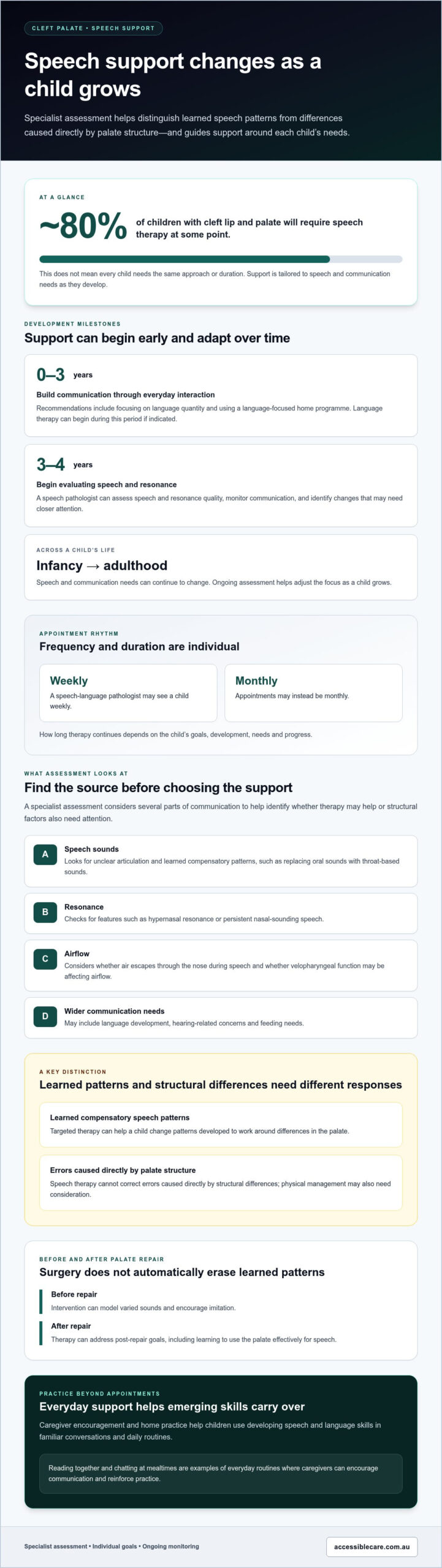
Early speech and language intervention supports communication development through activities suited to a child’s age and needs. For children aged 0-3 years, recommendations include focusing on language quantity and using a home programme with a language emphasis. Language therapy can also begin during this period if indicated. These early steps help families support communication in everyday interactions, rather than waiting for speech concerns to become more noticeable.
Therapy Timing and Duration
Speech therapy should begin as soon as possible when a child with cleft palate needs support. A speech-language pathologist may work with a child weekly or monthly; the duration depends on the child’s goals and development. Support may extend from infancy to adulthood, with intervention tailored to the individual. A specialist can assess changing needs over time and adjust the focus accordingly.
How often and for how long do children with cleft palate need speech therapy? A speech-language pathologist may see a child weekly or monthly, while the overall duration varies with individual needs and progress. Families can also support practice during daily routines. Home activities help a child use emerging skills beyond appointments, carrying new sounds and language into familiar conversations.
Early surgery may make speech problems less likely to develop, but it doesn’t automatically remove learned speech patterns. Before palate repair, intervention can model varied sounds and encourage imitation. After repair, therapy can address goals specific to the post-repair period. A child may need help learning to use the palate effectively for speech, because earlier habits don’t disappear automatically after surgery.
What are the risks of delaying speech therapy for a child with cleft palate? Delayed specialist support can allow speech difficulties to persist as communication develops, while early referral can help prevent later speech problems. Some isolated or milder clefts are identified later, after speech differences appear. Late diagnosis can also affect feeding, growth, speech and language development, and increase parental anxiety.
Progress depends on matching intervention to the source of a speech difficulty. A child may need language-focused support, help practising speech sounds, or ongoing review as communication changes. Cleft-related speech needs can continue from infancy into adulthood, so early assessment is a starting point, not a fixed endpoint. Consistent caregiver encouragement and home practice help carry therapy goals into everyday communication.
How do speech pathologists support children with clefts?
A speech pathologist tracks how a child communicates and identifies the support that may help. For children with cleft palate, this can include speech sounds, resonance, language development, hearing-related concerns and feeding needs. The goal is age- and developmentally appropriate communication, with support shaped around each child’s profile.
Speech differences can include unclear articulation, hypernasal resonance or air escaping through the nose during speech. Velopharyngeal dysfunction can affect how the palate and throat manage airflow. Hearing problems may also affect how clearly a child hears speech and communicates. Feeding can be another concern, particularly for babies with clefts who have difficulty creating suction.
Support changes as children grow. For children aged 3-4 years, the intervention timetable recommends beginning to evaluate speech and resonance quality. A speech pathologist can monitor communication over time and help identify changes that need closer attention. Hospital and community speech-language pathologists can also work together when ongoing support is needed.
Finding a Cleft-Trained Speech-Language Pathologist
Experience with cleft palate matters because the source of a speech difference shapes assessment and support. Families can ask whether a speech-language pathologist has worked with the child’s specific speech sound errors and treated children with cleft palate. These questions clarify relevant experience, such as helping a child who replaces oral sounds with throat-based sounds.
Specialist assessment is important if a child has persistent nasal-sounding speech or speech clarity that falls behind peers. Highly specialised assessment of cleft-related speech and velopharyngeal dysfunction is available through regional cleft centres. The cleft team can help coordinate care when the child’s needs call for specialist investigation.
Qualifications and Team-Based Support
A speech-language pathologist contributes to decisions about cleft management, including speech therapy, surgery and prosthetics. This input connects communication goals with the child’s broader care. Families can ask how the clinician works with the cleft team and which speech or resonance features they will monitor.
Speech support may involve more than one setting. Hospital and community pathologists can coordinate when a child needs continuing care. Caregivers also play a daily role by encouraging communication and reinforcing practice during familiar routines, such as reading together or chatting at mealtimes.
Roughly 80% of children with cleft lip and palate will require speech therapy at some point. That doesn’t mean every child needs the same approach or duration. A pathologist assesses the child’s speech and communication needs, then tailors support as development progresses. Some children need targeted help with speech sounds; others also need language support or monitoring of resonance.
For families looking for ongoing communication support, speech therapy support can be a relevant next step. The focus is the child’s individual goals and the skills they need in everyday interactions.
Articulation and compensatory speech errors
Cleft-related articulation differences can arise from palate structure or learned ways of producing sounds. Identifying the source matters because therapy targets learned patterns, while structural causes may need physical management.
Articulation Disorders and Errors
Articulation disorders affect how a child forms speech sounds, while compensatory errors are learned alternatives used to work around a palate gap. For example, a child may produce a sound in the throat instead of using the lips or tongue. Targeted speech therapy can help change these patterns and establish correct placement.
A speech-language pathologist identifies which sounds are affected and how the child produces them. This distinction matters: therapy can address mislearned placement, but speech therapy alone cannot resolve errors caused directly by structural differences. Pervasive nasal air emission or weak oral pressure may require surgery or other physical management.
Articulation and Oral Pressure Goals
Therapy aims to establish correct articulatory placement, build oral pressure for pressure consonants and support oral-pharyngeal function. For a plosive sound such as “p,” the child needs to bring the lips together and direct air through the mouth. A pathologist may use tactile cues to help the child feel lip closure and oral pressure.
Visual cues can make airflow easier to notice. A therapist may use a feather to show whether air moves through the mouth or escapes through the nose. These cues connect what the child sees or feels with the intended sound, helping practice focus on the specific movement rather than simply repeating a word.
Speech practice should target sounds the child can produce with the required structure and airflow. For example, therapy may focus on one pressure consonant, then practise it in syllables and words as the child gains control. An example schedule describes practising the “P” sound for 30 minutes per week during therapy. Home activities can reinforce the same target in everyday speech.
Practice also needs to carry over beyond therapy sessions. A child might practise a target sound in a short home activity, then use it during a familiar conversation or shared reading. Caregivers can encourage attempts without reinforcing compensatory productions, such as laryngeal growls or nasal fricatives. The pathologist can show families which sound patterns to model and which errors to avoid repeating.
Not every mouth-movement exercise helps speech. Nonspeech oral motor exercises, such as movements without speaking, aren’t effective for children with cleft palate. Therapy should focus on speech itself: the sound, placement, airflow and pressure needed for clear production. This keeps practice connected to the child’s communication goals and the speech function they’re learning.
The broader goal is normal speech and resonance, not merely speech that listeners can accept. A pathologist measures progress by whether the child can produce target sounds correctly and use them in communication. If nasal air emission or weak pressure continues despite targeted practice, the team considers whether a structural factor is limiting speech.
Specialist speech assessment
In Australia, a speech-language pathologist assesses a child’s speech sounds, resonance and airflow. When velopharyngeal dysfunction is identified, referral should be made to a specialist speech-language therapist at the nearest regional cleft centre. Assessment helps distinguish learned speech patterns from difficulties linked to palate structure.
A specialist assessment involves listening carefully to how a child produces sounds in connected speech and during focused tasks. The pathologist considers articulation, nasal resonance and whether air escapes through the nose on particular sounds. For example, a child might produce one sound clearly but show nasal air emission on another. This difference helps guide further assessment and support.
Perceptual assessment means the clinician listens to speech and evaluates its characteristics. For cleft palate and velopharyngeal dysfunction, this work requires highly specialist skills and investigations available within regional cleft centres. General screening can identify a concern, while specialist assessment examines what is driving it and whether further clinical investigation is needed.
For children aged 3-4 years, the intervention timetable recommends beginning to evaluate speech and resonance quality. This developmental review can identify patterns that need monitoring, such as persistent hypernasality or reduced clarity. A pathologist also considers the child’s communication in daily settings. Parents can share examples from home, while observations from school can show how speech works in group conversations.
A clinician can use simple tools alongside listening. For phoneme-specific nasal emission, a stethoscope placed against the side of the nose can help target the sound. The pathologist can compare sounds with and without nasal airflow, helping the child notice the difference. This is targeted assessment, not a substitute for specialist investigation when structural concerns arise.
Hearing is also relevant because hearing problems can affect speech intelligibility and acceptability. The assessment considers whether a child’s communication difficulties involve articulation, resonance or hearing-related factors. Parents can describe situations where the child is harder to understand, such as speaking in class or answering questions at home. These real examples connect clinical observations with everyday communication.
Assessment findings contribute to decisions about speech therapy, surgery or other physical management. If speech difficulties involve pervasive nasal air emission or weak pressure on oral consonants, physical management may be needed. Therapy alone cannot resolve speech errors caused directly by structural differences. Specialist assessment helps clarify the source so families and the cleft team can consider suitable next steps.
Cleft-related speech difficulties
Children with cleft palate can experience different speech difficulties, and the cause guides the response. Some differences relate to palate structure; others develop as a child learns to produce sounds around a gap. Language delay, articulation problems, hypernasality, nasal air emission and voice differences can occur. Speech therapy for cleft palate focuses on the child’s specific communication needs, not simply the diagnosis.
Structural differences can make it difficult to build the oral pressure needed for certain sounds. A child may have weak pressure on oral consonants or persistent nasal air emission. These are not simply habits to practise away. Speech therapy alone cannot resolve obligatory speech errors caused directly by structural anatomy, so assessment considers whether physical management is needed.
Learned compensatory errors have a different relationship with the palate. Children may change where or how they produce sounds to work around a gap. For example, a child might use a throat-based sound instead of the intended oral sound. In speech therapy for cleft palate, targeted work can help replace learned patterns with more appropriate placement and production.
Resonance describes how speech sounds, including whether the voice seems unusually nasal. Hypernasality and nasal air emission can reduce speech clarity, while voice differences may also affect communication. A specialist listens to connected speech and individual sounds to identify which features occur. The pattern helps show whether a child needs support with learned production or further consideration of structural factors.
Some cleft-related difficulties become clearer as a child grows. A submucous cleft palate, a milder form, may only be identified later in childhood when speech differences appear. Velopharyngeal dysfunction can also result from mislearning rather than a structural problem. This distinction matters because appropriate support depends on what affects speech, not just on the presence of nasal-sounding sounds.
Speech and language needs can overlap. A child may have difficulty producing sounds and also experience language delay, which can affect understanding or expressing ideas. Hearing problems can affect speech intelligibility, too. These factors may influence communication at home and school. Ongoing observation helps families describe what changes across settings and share useful examples with the child’s care team.
Notice patterns rather than judging a child’s communication by one sound alone. Persistent nasal-sounding speech, unclear words or a gap between a child’s clarity and peers’ speech are useful reasons to contact the cleft team. The team can consider sound patterns, resonance, airflow and possible structural factors together, then discuss appropriate next steps with the family.
For support with communication goals, explore speech therapy support focused on your child’s needs.
Accessible Care: NDIS Support Services
Accessible Care offers NDIS Support Services and Speech Therapy for people working towards communication goals. If a child’s cleft-related speech needs call for ongoing practice and personalised goals, speech therapy can support communication skills in everyday life. Occupational Therapy and Positive Behaviour Support are also available when they align with a person’s broader support needs.
Families can turn to Accessible Care to discuss support focused on the child’s needs, preferences and daily routines. A conversation can help clarify how speech therapy may fit alongside other supports and communication goals.
Contact Accessible Care to discuss support, or visit accessiblecare.com.au.
Choose a Supportive Next Step
Your child’s communication goals can evolve as they grow, so keep those goals part of everyday planning. Speech therapy for cleft palate can be one part of that support, alongside the child’s priorities and family routines. A clear conversation about what matters most can help shape a practical path forward.
Accessible Care offers Speech Therapy and NDIS Support Services, with Occupational Therapy also available for broader daily living goals. Families can discuss the support they’re seeking and how it relates to their child’s needs. The focus stays on listening, shared decision-making and supporting each person’s independence.
Contact Accessible Care to talk about support for your family. Every small step toward communication and participation matters, and your child’s goals can guide what comes next.
Frequently Asked Questions
What is cleft lip and palate?
A cleft is an opening that forms when parts of the lip or roof of the mouth don’t join completely during development. A cleft lip affects the upper lip; a cleft palate affects the roof of the mouth. A child may have either condition or both. Because a palate opening can be less visible, an isolated cleft palate may not be obvious without an examination after birth.
How Can Parents Help?
Parents can support communication by making room for unhurried conversation and responding to what their child is trying to say. For example, during a shared picture book, pause so the child can name an image, then respond naturally. If a clinician has given a specific practice activity, follow their guidance rather than asking the child to repeat every unclear word. Note situations where communication feels harder and share those examples with the child’s care team.
How are clefts managed?
Cleft management brings together care for a child’s changing needs, including feeding, speech and decisions about physical treatment. Speech-language therapists contribute to discussions about speech therapy, surgery and prosthetics. After palate repair, the team may still monitor speech and consider whether further support is needed. The plan depends on the specific anatomy, speech patterns and development, rather than applying the same pathway to every child.
How does cleft palate affect speech development and what speech problems are common?
A cleft palate can affect how a child forms sounds and controls airflow during speech. Common difficulties include unclear articulation, hypernasal resonance, nasal air emission and compensatory sound patterns. Some children also experience language delay or voice differences. The effects vary: one child may struggle with pressure consonants, while another may sound nasal across many words. A trained professional can assess the pattern and its effect on everyday communication.
What speech therapy techniques are used for cleft palate-related speech problems?
Therapy techniques depend on the speech pattern being addressed. A clinician may use a feather as a visual airflow cue or tactile prompts to help a child feel lip closure for a sound such as “p.” A tube can also amplify auditory feedback so the child and pathologist hear a sound together. Therapy targets speech production itself; nonspeech oral motor exercises haven’t been found effective for children with cleft palate.
How do speech therapy and cleft palate surgery work together?
Surgery can address structural differences, while speech therapy supports the child in using the repaired palate for speech. Learned speech habits may continue after surgery, so a pathologist can work on goals suited to the post-repair stage. If weak oral pressure or persistent nasal air emission is linked to structural factors, therapy alone cannot correct the cause. The cleft team considers speech findings alongside physical management when planning care.
How can parents support speech practice at home?
Use activities recommended by the child’s speech-language pathologist and fit them into a familiar routine, such as practising a target sound during a book or play activity. Keep the focus on the agreed sound rather than correcting every sentence. Encourage attempts and avoid repeating compensatory productions, such as nasal fricatives, as though they were correct. Share changes or difficulties with the pathologist so home activities stay aligned with therapy goals.
How can families access cleft palate speech therapy through Australian public health services?
Families can raise speech concerns with their child’s cleft team or hospital speech-language pathologist and ask about specialist assessment. When velopharyngeal dysfunction is identified, referral should be made to a specialist speech-language therapist at the nearest regional cleft centre. Hospital and community speech-language pathologists can work together when ongoing support is needed. Keep examples of speech concerns from home or school to help explain what the child finds difficult.

