

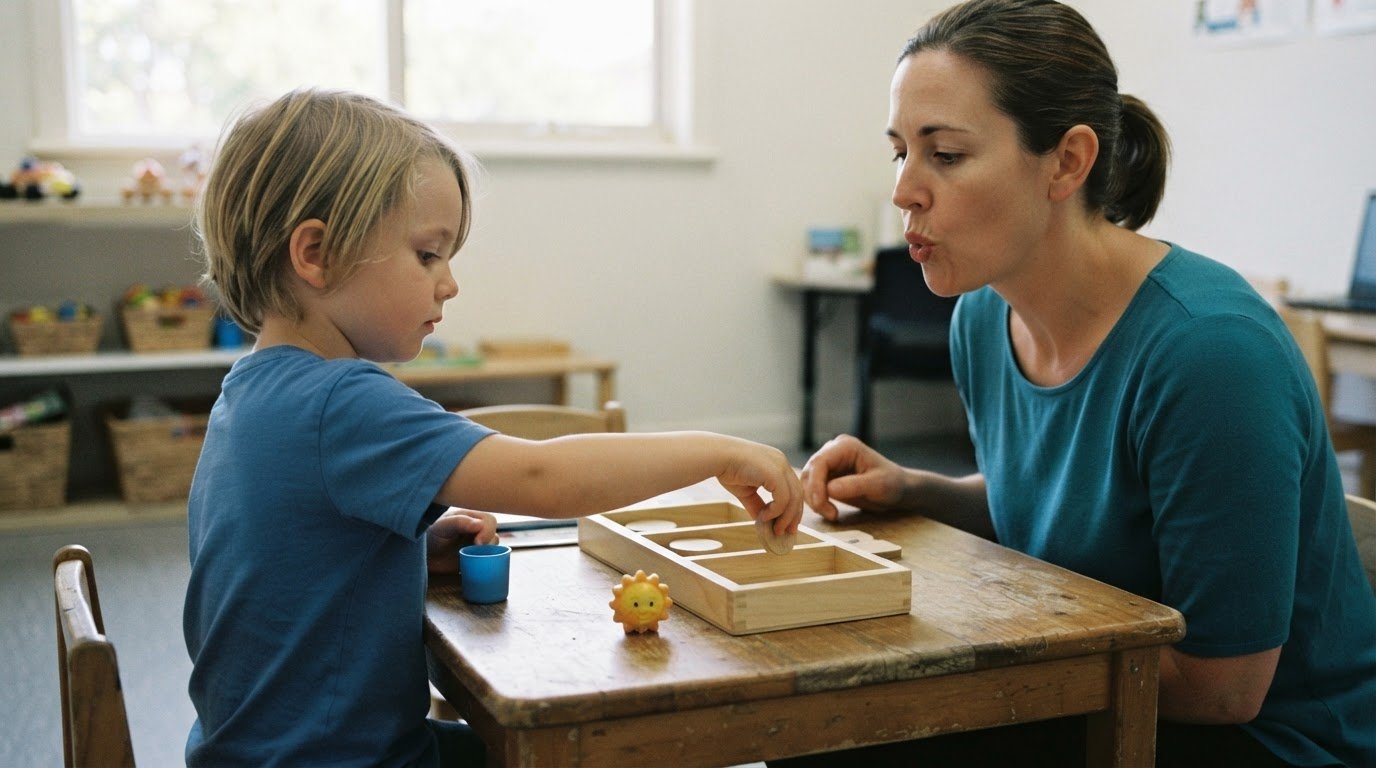
Reading struggles aren’t always a sign that a child isn’t trying. Speech therapy for children’s reading difficulties can support language skills that help with reading, spelling and writing, such as hearing sounds in words and linking them to letters. A speech pathologist looks at how these skills work together, not only at whether a child can read a particular word.
It’s understandable to wonder whether a child will catch up with time or needs extra support. Difficulty recognising rhymes or letters, blending sounds to read simple words, learning new vocabulary or understanding a story may be signs worth exploring. One sign alone doesn’t determine what a child needs, but ongoing difficulties can be a reason to seek an assessment.
This article explains what speech therapy involves, how phonological awareness supports early literacy, and which reading, spelling and language signs to notice. It also outlines how a speech pathologist can assess a child’s skills and shape support around their goals and circumstances, so you can better understand possible next steps.
Key Takeaways
- Phonological awareness helps children notice and work with the sounds in words, an important foundation for connecting sounds with letters.
- Speech pathologists can look beyond decoding to consider how vocabulary, language and comprehension may shape a child’s literacy.
- Early, tailored support can strengthen literacy skills and confidence; a child’s needs matter more than a one-size-fits-all approach.
- Difficulty with rhymes, letter sounds, blending words, spelling or understanding text may be signs to explore with a speech pathologist.
Phonological awareness
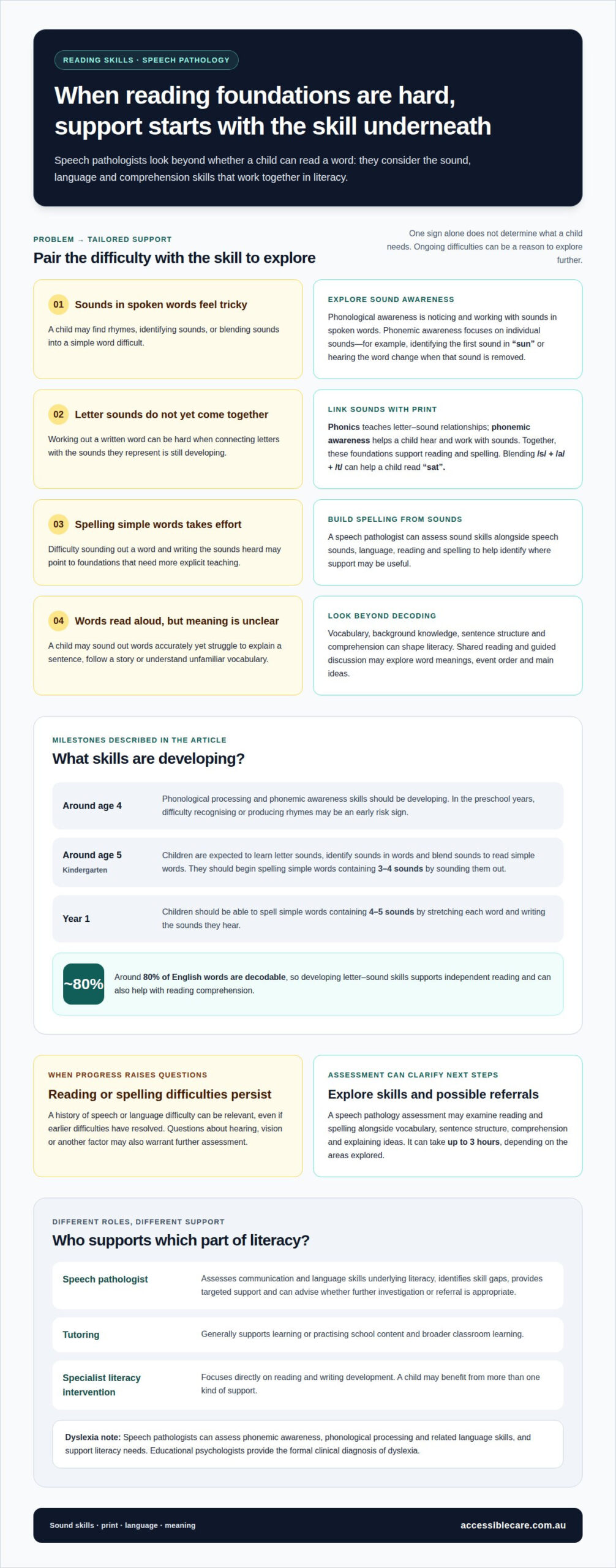
Phonological awareness means noticing and working with sounds in spoken words. Around age 4, children should be developing phonological processing and phonemic awareness skills.
Phonemic Awareness and Sound Processing
Phonemic awareness is the ability to hear and manipulate individual sounds in words, while phonological processing includes broader sound skills. A speech pathologist assesses these alongside speech sounds, receptive and expressive language, reading and spelling. For example, they may explore whether a child can identify the first sound in “sun” or hear how “sun” changes when its first sound is removed. These skills can help pinpoint where a child is having difficulty.
How Sound Awareness Supports Decoding
Decoding is using letter-sound knowledge to work out written words, and phonological awareness helps children connect spoken sounds with print. Around age 5, Kindergarten children are expected to learn letter sounds, identify sounds in words and blend sounds to read simple words. For example, blending /s/, /a/ and /t/ helps a child read “sat”. Around 80% of English words are decodable, so developing this skill supports independent reading and can also help with reading comprehension.
Phonemic Awareness and Phonics
Phonics teaches the relationship between letters and sounds; phonemic awareness helps a child hear and work with those sounds. Together, they support reading and spelling. In Kindergarten, children should begin spelling simple words containing 3-4 sounds by sounding them out. By Year 1, they should be able to spell simple words containing 4-5 sounds by stretching out each word and writing the sounds they hear. Difficulty with these tasks can show which foundations need more explicit teaching.
Support for Dyslexia and Decoding Difficulties
Speech pathologists support children with dyslexia or decoding difficulties by assessing phonemic awareness, phonological processing and related language skills. They can identify literacy skill gaps, provide targeted support and advise whether further investigation or referral is needed. Educational psychologists provide the formal clinical diagnosis of dyslexia; a speech pathology assessment explores the skills contributing to reading and spelling difficulties. If a child’s progress raises questions about hearing, vision or another factor, the speech pathologist can advise whether further assessment is appropriate.
Why Do Speech Pathologists Teach Literacy?
Reading draws on spoken language as well as print. Vocabulary and comprehension help children make sense of stories, instructions and classroom writing.
Vocabulary Development and Background Knowledge
Vocabulary is the words a child understands and uses. Background knowledge is what they already know about a topic. Both help readers connect new information with familiar ideas. For example, a child who knows the words “nest”, “feathers” and “hatch” may follow a story about birds more easily. Speech pathologists can assess vocabulary and language skills, then target gaps affecting comprehension. Families can share familiar topics that interest their child, such as pets or sport.
Vocabulary, Comprehension, and Fluency
Reading fluency is reading with increasing ease, while comprehension means understanding the text. A child may sound out each word accurately but struggle to explain a sentence’s meaning. Unfamiliar vocabulary can slow reading and interrupt the flow of a story. Speech pathologists may use shared reading and guided discussion to explore word meanings, sequence events and identify main ideas. These activities can help strengthen language skills as reading demands grow.
Speech Pathology Assessment for Reading Difficulties
A speech pathology assessment examines reading and spelling alongside language skills that can affect literacy. It may consider vocabulary, sentence structure, comprehension and the child’s ability to explain ideas. An assessment can take up to 3 hours, depending on the areas being explored. In Australia, parents can look for speech pathologists whose service information includes literacy assessment and intervention. The findings help clarify skill gaps and whether further investigation or referral may be appropriate.
Speech Pathology, Tutoring, and Literacy Intervention
Speech pathology focuses on communication and language skills underlying literacy, while tutoring generally supports learning or practising school content. Specialist literacy intervention focuses directly on reading and writing development. These supports can address different needs, and a child may benefit from more than one. For example, a speech pathologist may target vocabulary or comprehension, while tutoring supports broader classroom learning. If language skills are affecting reading or writing, explore speech therapy support as a possible part of the support plan.
How Will Working on Literacy Help My Child?
Early literacy support focuses on the language skills behind reading, spelling and understanding text, and can help identify useful next steps.
Early Speech and Language Difficulties
Early speech or language difficulties can be linked with later reading challenges, even if earlier difficulties have resolved. In the preschool years, around ages 3 to 4, difficulty recognising or producing rhymes may be an early risk sign. A history of language difficulty can also make reading harder to spot in the first school years. Sharing that history during an assessment helps the speech pathologist consider literacy needs.
Early Intervention for Literacy Difficulties
Early intervention provides structured support for literacy skills that a child finds difficult. A speech pathologist can identify specific needs, such as understanding spoken instructions, learning words or organising a sentence. Support can then target those skills rather than relying only on repeated reading. Early help may strengthen language and literacy skills before gaps in classroom learning grow, while recognising each child’s pace and strengths.
Supporting Reading and Language at Home
A speech pathologist can show parents ways to support language and reading through familiar routines. During shared reading, for example, pause to talk about a character’s actions or explain an unfamiliar word. Discussing a story can build vocabulary and help a child describe events in sequence. Activities can be shaped around the child’s communication needs, including use of a communication board or speech-generating device.
Recognising Progress in Reading
Progress may show in specific skills before reading feels easy overall. Families and the speech pathologist can notice whether a child recognises more letter sounds, blends sounds with less support, or spells simple words by listening for their sounds. Understanding a story may also improve, for example, by explaining what happened or answering questions about a character. Reviewing goals together helps show which literacy skills are strengthening and where support may still help.
Signs a child may benefit from speech therapy
Reading difficulties can involve sound awareness, word reading, spelling, language or comprehension. One sign alone doesn’t establish the cause, but persistent difficulties at school and home can make an assessment helpful.
- Sound and letter confusion: A child may struggle to recognise letters, match them with sounds, hear rhymes, or blend sounds into a word.
- Decoding difficulties: Sounding out unfamiliar words may remain slow or inaccurate after explicit teaching. A child might guess instead of using letter-sound connections.
- Spelling challenges: Persistent spelling errors, or difficulty hearing separate sounds in words, can point to literacy skill gaps.
- Speech and language differences: Unclear speech sounds, limited vocabulary, difficulty learning new words, or trouble understanding sentence structure and grammar may affect reading.
- Comprehension struggles: A child may read a passage aloud but find it hard to explain its meaning, retell events, or answer questions.
Look for a pattern rather than focusing on one difficult word. For example, trouble blending sounds, spelling unfamiliar words and explaining a short story may indicate that several skills need assessment. Slow or inaccurate reading and difficulty sounding out new words can also be associated with dyslexia, but they don’t confirm a diagnosis.
A family history of reading difficulties can provide useful context, as literacy challenges can run in families. Notice whether reading also affects your child’s confidence or motivation. These changes, alongside classroom difficulties, can help describe the support your child may need.
Speech therapy for children’s reading difficulties can begin with assessing reading, spelling and related language skills. If several signs persist despite explicit teaching, explore speech therapy support to discuss your child’s literacy needs. An assessment can help identify the skills to focus on, without assuming one cause fits every child.
Accessible Care: Speech Therapy
Accessible Care offers Speech Therapy for children whose communication skills may affect reading, spelling or understanding written text. If your child is struggling with sounds, vocabulary or comprehension, a speech pathologist can assess their language-related literacy needs and shape person-centred support around their goals and circumstances. This can clarify which skills need attention and what support may help alongside school learning. The focus is on understanding your family’s concerns and your child’s strengths as well as their challenges. When reading difficulties persist or affect your child’s confidence, contact Accessible Care to discuss Speech Therapy.
Choose a next step that fits your child
Your child’s reading journey is personal. A next step can be a conversation about what feels hardest, such as reading unfamiliar words, spelling or explaining a story. Sharing what you’ve noticed at home or school can help build a clearer picture of your child’s strengths and support needs. You don’t need to have every question answered before seeking guidance.
Accessible Care provides Speech Therapy, NDIS Support Services and Occupational Therapy. For families considering speech therapy for children’s reading difficulties, support can begin by understanding the child’s communication and literacy needs, then identifying person-centred support tailored to their goals and circumstances. Support should respect your child’s pace and help them participate in learning with growing confidence.
If you’d like to talk through what your child is experiencing, contact Accessible Care. A thoughtful conversation can help you consider a supportive way forward.
Frequently Asked Questions
What Is Speech Therapy?
Speech therapy supports communication skills, including understanding and using language. For literacy support, a speech pathologist may explore how a child understands instructions, explains ideas, uses words and follows a story. For example, a child might benefit from help organising a spoken retell before writing about a book. The focus depends on the child’s communication profile and learning goals.
Does my child have dyslexia?
Reading difficulties alone don’t establish that your child has dyslexia. Educational psychologists provide the formal clinical diagnosis, while a speech pathologist can assess reading, spelling and related language skills. They can identify areas that may need support and advise whether further investigation is appropriate. Share specific examples, such as difficulty spelling unfamiliar words or reading new text, to help clarify what is happening.
At what age should I be concerned about my child’s reading?
Consider seeking advice whenever reading difficulties persist or interfere with learning, rather than waiting for a particular age. Around age 4, children should be developing phonological processing and phonemic awareness; Kindergarten learning includes letters and sounds. A child’s progress, prior language history and response to explicit teaching all matter. Support can be useful at any school stage, including high school.
Shouldn’t the school be helping with this?
Schools play an important role in teaching literacy, and classroom observations can help explain where a child is finding reading difficult. A speech pathology assessment takes a closer look at communication and language skills connected with literacy. The two perspectives can complement each other. With your family’s agreement, sharing relevant assessment insights with the school can help align goals and classroom support.
Will they grow out of it?
Some children make progress as they learn, but persistent reading difficulties shouldn’t be assumed to disappear without support. Reading and spelling are learned skills that benefit from explicit teaching. If a child continues to struggle with unfamiliar words, spelling or understanding text, an assessment can clarify which skills need attention. Support can be adjusted as their learning needs and strengths develop.
Can speech therapy help children with reading difficulties?
Yes. Speech therapy can support language-related skills that contribute to reading, spelling and comprehension. A speech pathologist may assess a child’s needs and focus on areas such as vocabulary, language processing or understanding text. For a child who reads words but struggles to explain a story, support may focus on meaning and comprehension. The approach is shaped around the child’s specific skill gaps.

