


A communication strategy can miss the mark if it teaches a request that doesn’t meet the person’s needs. Understanding what functional communication training is starts with its purpose: to identify what a behaviour communicates and teach a practical way to express that need. The new skill might use speech, signs, pictures or a communication device.
It’s understandable to want a clear approach when communication becomes difficult, especially when someone is stressed. Functional communication training (FCT) focuses on teaching a useful alternative, not simply stopping a behaviour. That alternative needs to be easy for the person to use and clear to the people around them.
This article explains what functional communication training involves, how it differs from differential reinforcement of alternative behaviour (DRA), and how communication can be supported across settings. It also covers common mistakes, such as choosing a method that does not suit the person or expecting a new skill to work before it has been practised and supported. Understanding these differences can help families and support teams take a calm, consistent approach that respects the person’s autonomy.
Key Takeaways
- Look for what a behaviour may communicate before choosing a replacement skill.
- Understand how FCT and DRA differ in their focus and use of reinforcement.
- Explore ways to help communication skills carry over between people and settings.
- Recognise common teaching mistakes that can make a new communication skill harder to use.
How is FCT different from differential reinforcement of alternative behaviour (DRA)?
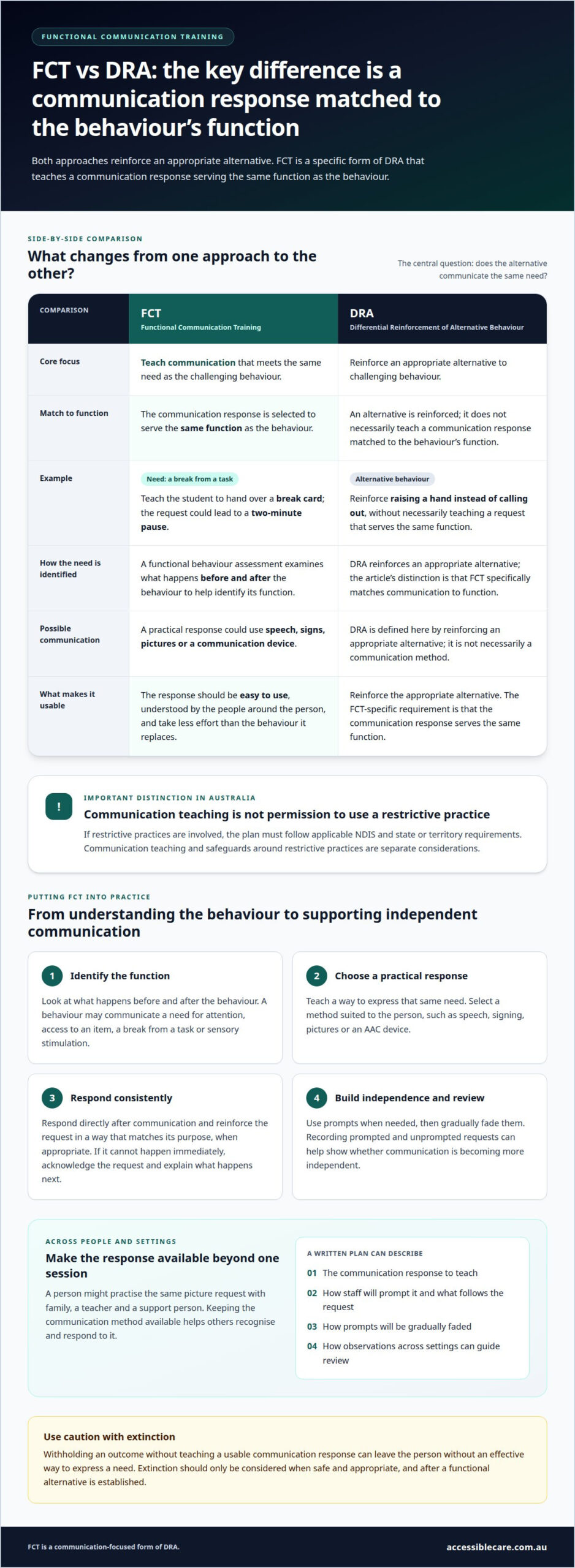
FCT and DRA are related approaches, but they differ in specificity. DRA reinforces an appropriate alternative to challenging behaviour. FCT is a specific form of DRA: it teaches a communication response that serves the same function as the behaviour. A functional behaviour assessment helps identify that function by examining what happens before and after the behaviour. A behaviour may communicate a need for attention, access to an item, a break from a task or sensory stimulation.
That function guides what is taught. If a student’s behaviour helps them leave a difficult task, an FCT plan might teach them to hand over a break card. The appropriate request could then lead to a two-minute pause. DRA might reinforce another alternative, such as raising a hand instead of calling out, without teaching a communication response matched to the behaviour’s function. In FCT, the replacement skill should be easy to use and understood by people in the student’s different settings.
In Australia, FCT is a teaching approach, not permission to use a restrictive practice. If restrictive practices are involved, the plan must follow applicable NDIS and state or territory requirements. Communication teaching and safeguards around restrictive practices are separate considerations.
Consistency matters. A written behaviour plan can describe the communication response to teach, how staff will prompt it and what happens after the student uses it. Adults should reinforce the new communication consistently. Challenging behaviour should stop accessing the same outcome only when it is safe and appropriate to do so, and after a functional alternative is established. The plan should also explain how prompts will be gradually faded so the student can communicate with increasing independence.
For example, staff might first point to the break card, then pause to let the student reach for it independently. Recording prompted and unprompted requests can show whether communication is becoming more independent. Reviewing observations across settings helps the team teach consistently and adjust the plan if the response does not meet the student’s needs.
What is Functional Communication Training (FCT)?
FCT teaches a communication response that helps meet the same need as a challenging behaviour. Its effectiveness depends on a response that’s practical, understood by others and reinforced consistently.
In Australia, costs depend on the practitioner and number of consultations; fees are provided after a quote request. Medicare may cover FCT depending on the therapist and consultations.
Immediate and Consistent Reinforcement
Immediate reinforcement means responding directly after a person communicates, so the connection between their response and its outcome is clear. Consistency helps parents and other supporters reinforce the same alternative in everyday situations. For example, if someone hands over a picture to request help, responding promptly makes that picture a useful way to communicate. The response should also take less effort than the behaviour it replaces.
As the skill becomes more familiar, a practitioner can adjust support and gradually fade prompts or reinforcement. This helps the person communicate more independently instead of relying on an adult to cue every response.
Reinforcing and Honouring Communication
Reinforcing functional communication means responding to a request in a way that matches its purpose. If someone asks for a break, honouring the request means providing a pause when appropriate. This shows that communication works, whether the person uses a picture, sign, speech-generating device or spoken words.
Parents and support people can make the approach clearer by recognising the person’s communication method and responding consistently. A request may not always be possible immediately, but adults can acknowledge it and explain what will happen next.
Extinction and Reinforcement
Extinction means no longer reinforcing behaviour with the outcome that previously maintained it. In FCT, this may be considered alongside reinforcement for the functional alternative, but only when it is safe and appropriate and that alternative has been established.
Withholding an outcome without teaching a usable communication response can leave the person without an effective way to express a need. A written plan can guide consistent responses and help supporters understand when the communication skill should be reinforced. For support aligning communication goals with behaviour strategies, explore Positive Behaviour Support.
Generalisation across settings and caregivers
A communication response needs to work with different people, not just during one therapy session. For example, a child who uses a picture to request help at home can practise the same response with a teacher, support person and family member. Keeping the communication method available across settings makes it easier for others to recognise and respond to it. Visual supports can also show routines and how to access communication tools throughout the day.
For autistic people, a reliable way to communicate can make requests, refusals and needs easier to understand. The response might use speech, signing, pictures or an augmentative and alternative communication (AAC) device. An assessment helps identify an option that suits the person’s current communication skills. Caregivers can then use the same approach in everyday routines, such as asking for a break during homework or requesting an item at mealtimes.
Evidence for FCT includes research across diverse populations, including autistic people and people with intellectual disabilities. A 2020 review of school-based FCT interventions using AAC supports identified 38 studies. A 2025 meta-analysis of FCT for young autistic children reported large effects in reducing challenging behaviour, with moderate-to-large effects in increasing replacement behaviour across the studies analysed. Results and the time needed to build skills vary between individuals.
Parents and caregivers help practise communication during ordinary activities, while therapists can guide assessment, select a suitable response and support consistent implementation. Research on parent-implemented FCT via telehealth reported average reductions in problem behaviour of 93 to 98 percent over 12-week intervention periods. That finding describes the reported studies, not a promised outcome for every family. A practical plan can identify who carries the communication tool, how each person recognises the response, and how supporters record prompted and independent use across settings.
Common mistakes in functional communication training
One limitation of FCT is that a replacement response may not help if the assessment misses the reason for the behaviour. For example, if a child’s behaviour is maintained by escape from a difficult task, teaching a request for attention will not meet that need. FCT also takes time, and a new communication skill may not yet be available when the person feels stressed. Careful assessment and ongoing review are therefore important.
One common mistake is teaching a new response only when a child is already upset. Practise while the child is calm and engaged, then support them to use it during familiar routines. A verbal request, picture or sign should suit the child’s current communication skills. If the response takes more effort than the behaviour it replaces, the child may continue using the familiar behaviour.
Another mistake is assuming every instance of challenging behaviour has the same purpose. An applied behaviour analysis approach considers what happens before and after a behaviour, then uses that information to guide teaching. A child might leave the table to escape a task, while a similar action elsewhere may have a different reason. Assuming a function without checking patterns can lead to an ineffective approach.
Inconsistent responses can also make learning confusing. If one caregiver honours a break request but another ignores it, the child receives mixed signals about whether communication works. A written plan can clarify how each supporter will respond, how prompts will be faded and what to record. Track whether requests are prompted or independent, and review the plan if the response is not working as intended.
FCT isn’t a quick fix or a substitute for understanding the person’s needs. It works best as an individualised approach, with appropriate support and practice across daily settings. If communication and behaviour goals feel difficult to coordinate, discuss support for communication goals.
Accessible Care
Accessible Care can help families consider how communication goals fit within a person’s wider support needs. When communication differences and behaviour concerns overlap, Speech Therapy and Positive Behaviour Support may be relevant parts of a coordinated approach. NDIS Support Services and Occupational Therapy can also contribute to support shaped around the person’s goals, daily routines and independence.
It may help to seek support when a communication approach is difficult to use consistently at home, school or in the community, or when the person’s needs change. A shared understanding of goals can help families and support teams respond more consistently in everyday settings while respecting the person’s choices and communication style.
Contact Accessible Care to discuss support shaped around your circumstances and the person’s goals.
Make the next step person-led
Understanding what functional communication training involves can help you notice where a person needs communication support in everyday life. A useful next step is to centre their preferences: which communication methods feel accessible, which people need to understand them, and what could help them express choices more independently?
These observations can guide conversations about support without expecting families to create a plan alone. Accessible Care offers NDIS Support Services, Speech Therapy and Occupational Therapy to help address communication and daily support needs in a connected way.
If you’d like to explore support that reflects the person’s goals and circumstances, contact Accessible Care to discuss support. Each small step towards being heard can help create more room for choice, connection and self-direction.
Frequently Asked Questions
Does the child need to be verbal for FCT to work?
No. A child can use FCT without spoken words. The communication response might be a sign, gesture, picture or speech-generating device. For example, a child could point to a “help” symbol during a game. The key is that familiar communication partners can recognise the response and understand what the child is asking for, including when routines change.
Can FCT be used at home by parents?
Yes. Parents can practise the agreed communication response during everyday home routines, such as getting dressed or preparing a snack. A therapist can help caregivers understand how to respond and keep the approach consistent with other settings. Starting with a familiar activity can make it easier to see whether the child can use the skill outside a formal session.
Does FCT require a functional behaviour assessment first?
FCT starts with a functional assessment to understand what the behaviour may be communicating. Without that information, adults could teach a response that does not meet the child’s need. For example, a request for a toy will not help if the behaviour is connected to avoiding a noisy environment. Assessment findings guide the communication goal and help the team decide what to observe next.
How do I use it?
Work with the child’s support team to identify a communication response that suits their abilities and everyday life. For instance, if a child needs help opening a lunch container, they could use a spoken word, sign or picture at school. Agree on how familiar adults will recognise the request, then observe whether it works during the routine.
How is FCT different from just punishing the problem behaviour?
FCT teaches a useful way to communicate a need; punishment focuses on consequences for behaviour and does not, by itself, teach that skill. If a child struggles during a noisy activity, for example, FCT could help them learn a clear way to ask for a quieter space. The aim is to make communication more effective, rather than relying on punishment to change behaviour.
Is FCT the right method for my child?
FCT may be appropriate when assessment suggests a behaviour serves a clear communication function and a practical alternative can meet that need. The child’s communication abilities, preferences and everyday environments matter when choosing an approach. If the reason for a behaviour is unclear, gathering information about what happens around it can help the team decide whether FCT aligns with the child’s goals.

