


A support worker’s sick day can change a planned shift, but paid leave rights still apply. To understand what happens if my support worker is sick, start with their employment type: employees who are unfit for work because of illness or injury can use personal/carer’s leave. According to the Fair Work Ombudsman, full-time employees receive 10 days of paid leave per year, while part-time employees receive a pro-rata entitlement. An employer may request evidence to support a leave claim.
When care is part of a daily routine, a sudden change can leave families unsure what happens next. It’s reasonable to want clear information while allowing the worker time to recover.
This guide explains how paid personal/carer’s leave applies to full-time and part-time support workers in Australia, how casual employment differs, and what notice or evidence may be required. It also covers the practical impact of a missed shift, so you can distinguish a worker’s leave entitlements from what the change means for your support arrangements.
Key Takeaways
- Learn how a sick day can affect a planned support shift and what paid leave may apply based on the worker’s employment type.
- Understand how replacement arrangements are handled and what information can help clarify the change to your support.
- Find out who to contact when a shift is cancelled and what details to share about your immediate support needs.
- See what notice and evidence may be required, and how NDIS Support Services can support your wider needs.
What happens to a support worker shift if the worker is sick in Australia?
If you’re asking what happens if my support worker is sick, the shift may be cancelled or covered by another worker. An employee who is unfit for work because of illness or injury can take personal/carer’s leave if eligible. The worker’s leave entitlement and arrangements for the shift are separate matters. Contact the roster contact about the support you need that day, such as help with an essential task.
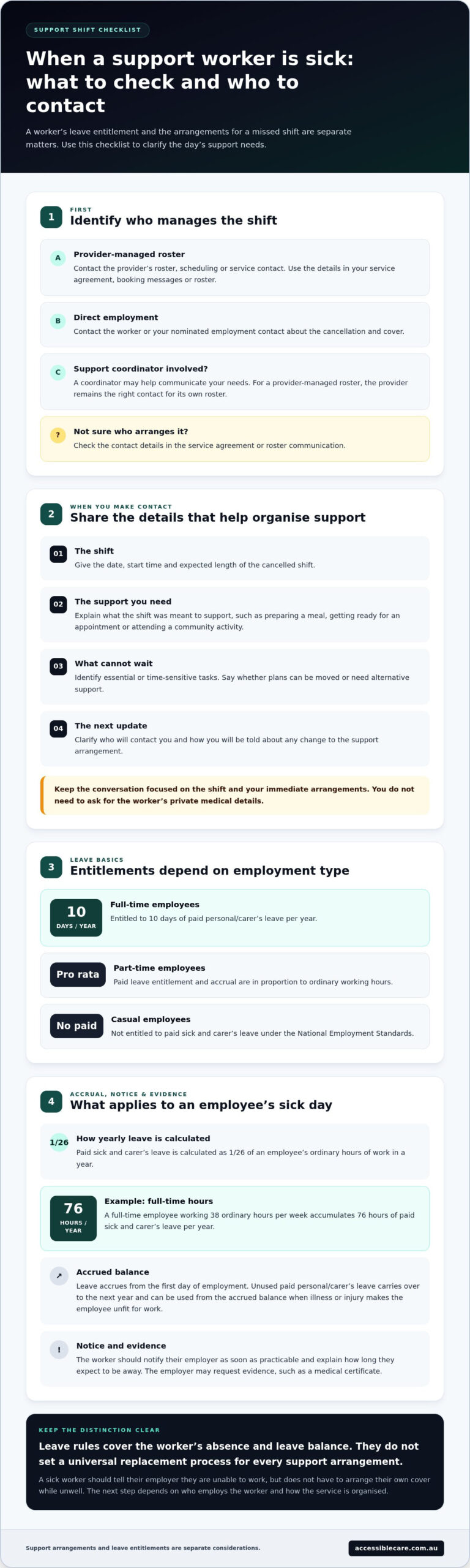
For employees, paid leave depends on employment type and accumulated balance. According to the Fair Work Ombudsman, full-time employees are entitled to 10 days of paid sick and carer’s leave per year, while part-time employees receive a pro-rata entitlement. Leave accrues from the first day of employment, and unused paid personal/carer’s leave carries over to the next year. Casual employees aren’t entitled to paid sick and carer’s leave under the National Employment Standards.
Understanding what happens if my support worker is sick also means knowing how leave is calculated. According to the Fair Work Ombudsman, yearly paid sick and carer’s leave is calculated as 1/26 of an employee’s ordinary hours of work in a year. A full-time employee working 38 ordinary hours per week accumulates 76 hours per year. Part-time employees accrue paid sick and carer’s leave in proportion to their ordinary working hours. Leave can be used from the worker’s accrued balance when illness or injury makes them unfit for work.
If your support worker is sick, notice and evidence are also relevant. The worker should notify their employer as soon as practicable and explain how long they expect to be away. The employer may request evidence, such as a medical certificate. The worker doesn’t need to share private medical details with you for the shift change to be communicated.
For example, if a worker reports being unwell before a planned community outing, tell the roster contact which support tasks are time-sensitive. This helps clarify the impact of the cancellation and which arrangements need discussion.
Does a support worker have to find a replacement when they are sick?
A sick support worker should tell their employer they’re unable to work, but they don’t have to arrange their own cover while unwell. For a provider-managed roster, the employer or rostering team can coordinate the shift and tell the person receiving support about any change.
Paid personal/carer’s leave rules cover an employee’s absence and leave balance. They don’t set a universal replacement process for every support arrangement. The next step depends on who employs the worker and how the service is organised. For example, a worker employed by an NDIS provider can notify that provider, while a directly employed worker contacts their employer or nominated coordinator.
In Western Australia, an employee should tell their employer about an illness-related absence as soon as practicable and explain how long they expect to be away. The employer may request evidence for paid leave. This helps the employer record the absence and consider cover. The worker doesn’t need to share private medical details with the person receiving support.
For families, contacting the roster contact is usually more useful than asking an unwell worker to find a substitute. Share the shift time, the support tasks that can’t be missed and any practical changes needed that day. For example, if the shift includes help getting to an appointment, tell the coordinator whether it can be rescheduled or needs alternative support.
- Provider-managed shift: Notify the provider’s roster contact and explain the immediate support need.
- Direct employment: Contact the employer or nominated coordinator about cover.
- Unclear arrangement: Use the contact details in the service agreement or roster communication.
Clear communication supports continuity without placing rostering duties on someone who is unfit to work. If you’re reviewing how support arrangements are organised, consider who handles cancellations and how urgent changes are communicated.
Who should I contact if my disability support worker cancels a shift?
Start with the person or organisation responsible for arranging the shift. If an NDIS provider manages the roster, contact its scheduling or service contact using the details in your service agreement, booking messages or roster. Give your name, the cancelled shift time and the support you need. This helps the right person understand what has changed.
If you employ the worker directly, contact the worker or your nominated employment contact about the cancellation. Keep the conversation focused on the shift and your immediate arrangements. You don’t need to ask for private medical information. The worker’s health details are separate from the practical question of whether another arrangement can be made.
For a provider-managed service, contact your support coordinator if they help organise your supports. They may help communicate your needs to the provider, but the provider is the right contact for its own roster. If you don’t have a support coordinator, use the provider’s listed contact.
When you get in touch, explain what the shift was meant to support. For example, say whether it involved getting ready for an appointment, preparing a meal or attending a community activity. Explain which tasks are time-sensitive and whether plans can change. This gives the person organising support useful details, rather than just a request for “cover”.
- Share the shift details: Give the date, start time and expected length.
- Describe the immediate need: Identify essential tasks and any plans that can move.
- Ask about the next update: Clarify who will contact you and how you’ll hear about a new arrangement.
If the first contact doesn’t respond, use the provider’s next listed contact or escalation channel. Keep a brief record of the cancellation and your messages, including dates and names. For example, note that you called the roster contact and explained that an appointment depended on that shift. A clear record makes follow-up easier if the change affects ongoing support.
Contact the person or organisation arranging the shift, explain what support you need and which tasks are time-sensitive, and ask who will update you about a replacement and when. If you don’t get a response, use the provider’s next listed contact or escalation channel. Keep a brief record of cancellations and messages, and contact your support coordinator if they help organise your supports.
What should an NDIS provider do when a support worker is sick
An NDIS provider should record the worker’s absence, review the affected roster and communicate changes clearly. The process begins when the worker notifies their employer. The provider can then identify participants with scheduled support and consider whether alternative arrangements are needed. The priority is understanding each person’s immediate support needs, not simply filling a vacant shift.
Next, the provider should consider the type of support planned and when it is needed. A cancelled community outing may be rescheduled, while help with an essential daily task may need another arrangement. For example, if a shift includes support to prepare for an appointment, the provider can explain whether it is cancelled and discuss practical options with the participant.
Leave administration is separate from arranging participant support. Under Australia’s Fair Work rules, an employer may request evidence for paid sick leave. Written evidence may include a medical certificate. The Fair Work Act 2009 also protects an employee from dismissal because of a temporary absence from work due to illness or injury. A provider should handle the worker’s leave appropriately while coordinating the roster.
Communication should be direct and respectful. The provider can tell the participant which shift is affected, what support tasks were planned and who will provide the next update. It should protect the worker’s private health information and share only what the participant needs to understand the service change. If a support coordinator helps organise the response, the provider can include them.
- Record the absence: Update the roster and note which bookings are affected.
- Review support needs: Identify time-sensitive tasks and discuss suitable arrangements.
- Keep the participant informed: Explain the change and provide a clear follow-up contact.
These steps help keep roster management centred on the participant’s needs while respecting the worker’s leave. Discuss your support needs if you’re considering how disability supports can fit your daily routines and goals.
Accessible Care: NDIS Support Services
Accessible Care provides NDIS Support Services for people seeking support that reflects their needs, preferences and goals. If a cancelled shift has prompted you to review your wider support arrangements, discussing your day-to-day priorities can help clarify what assistance may suit you.
Accessible Care also provides support work, Speech Therapy, Occupational Therapy and Positive Behaviour Support. These services address different needs, from assistance with everyday activities to communication, daily living skills and behaviour support. The right option depends on the goals and support needs you want to focus on.
You may be looking for support work that fits your routines or exploring therapy as part of your wider NDIS supports. Contact Accessible Care to discuss your needs, or visit accessiblecare.com.au.
Build a support plan that works for you
Knowing what happens if my support worker is sick can prompt a broader conversation about the support that matters most to you. Consider which routines you want to protect, how you prefer changes to be communicated and who should be involved in decisions about your supports. These preferences can keep future conversations centred on your autonomy and goals.
Accessible Care provides NDIS Support Services, Speech Therapy and Occupational Therapy. If you’re exploring support for daily living, communication or therapy goals, discuss what matters to you and consider which service aligns with those priorities.
Contact Accessible Care to discuss your support needs. Your goals can guide the next conversation, one step at a time.
Frequently Asked Questions
How much notice should a support worker give when calling in sick in Australia?
They should notify their employer as soon as practicable, rather than waiting until the shift begins. There’s no single advance-notice period for every illness, since symptoms can arise suddenly. For example, if a worker becomes unwell overnight, they should contact their employer when able and explain how long they expect to be away. The employer can then update the roster.
Can I request a replacement support worker under my NDIS service agreement?
Yes, you can ask the provider to arrange a replacement when a scheduled support worker is unavailable. Review your service agreement for how roster changes and cancellations are handled, then contact the provider through its listed channel. Explain which support tasks are essential and whether you need a worker with particular experience or familiarity. If suitable cover can’t be arranged, discuss rescheduling the support.
What steps should I take if my support worker is repeatedly unavailable or no replacement is provided?
Contact the provider’s next listed contact or escalation channel, or your support coordinator if they help organise your supports. Explain which essential tasks are affected, ask who will update you about arrangements and keep a brief record of cancellations and your messages.

